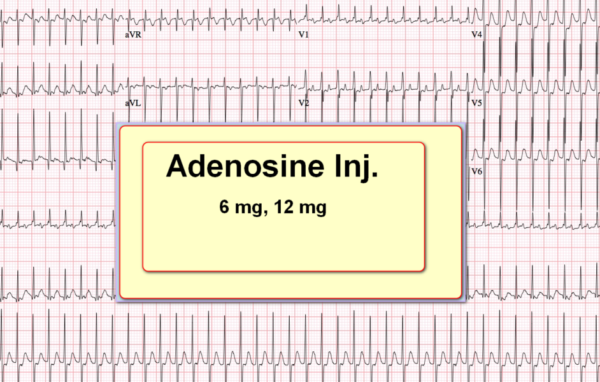
Adenosine is a purine nucleoside base. It has many homeostatic functions in the body but is primarily used in patients with cardiac arrhythmias.
Adenosine Uses:
It is used to treat paroxysmal supraventricular tachycardia (PSVT) including that associated with accessory bypass tracts (Wolff-Parkinson-White syndrome). In one study, compared to verapamil, adenosine was inferior in the emergency treatment of supraventricular tachycardia [Ref].
Unlabeled uses of adenosine iv include:
- Stable, narrow-complex regular tachycardias;
- Unstable narrow-complex regular tachycardias while preparations are made for synchronized direct-current cardioversion;
- Stable regular monomorphic, wide-complex tachycardia as a therapeutic (if SVT) and diagnostic maneuver.
- It is also used for vasodilator testing in pulmonary artery hypertension.
Adenosine receptors:
There are four major types of adenosine receptors, namely A1-AR, A2a-AR, A2b-AR, and A3-AR [Ref]. These receptors are G-protein coupled receptors that have multiple homeostatic functions in the body.
-
The A1-AR:
- These receptors are primarily present in the SA and AV nodes.
- The antiarrhythmic effects (treatment of supraventricular tachycardia) of adenosine and adenosine triphosphate are thought to be mediated by these receptors.
- These receptors also mediate pain (at peripheral, spinal, and supraspinal sites)
-
The A2a-AR:
- These receptors are present in the coronary arteries.
- The vasodilatory effects of adenosine for myocardial perfusion testing are mediated by these receptors when administered as an infusion.
- The A2a- AR antagonism may have a role in immune-mediated control of cancer progression
- These receptors might be the targets for the treatment of Alzheimer's and other neurodegenerative diseases like Parkinson's disease [Ref].
-
The A2b-AR:
- Drugs that act on these receptors have not been developed.
- Activation of these receptors might have a beneficial role in ischemia, vascular leakage, atherosclerotic diseases, diabetes, and acute lung injury.
-
The A3-AR:
- Activation of these receptors inhibits chemotaxis and neutrophil activation.
- Activation of A3-AR may have anti-inflammatory and anticancerous effects.
- The A3- AR activators are also being studied in patients with Rheumatoid arthritis and other inflammatory diseases like psoriasis.
Adenosine for hair growth:
The topical application of adenosine is used for healthy skin and hair growth. Adenosine 0.75% solution had similar efficacy to minoxidil in patients with androgenic alopecia. Adenosine 0.1% cream or 1% dissolvable film is used topically for cosmetic purposes. It smoothens the skin and removes wrinkles.
Adenosine sleep:
It reduces the neuronal activity in the brain and thus reduces oxygen consumption by the brain. In animal studies, the extracellular levels of adenosine were higher in the sleeping mode compared to the awake brain. When the levels fall during sleep, the brain initiates the waking cycle.
Adenosine caffeine:
Caffeine blocks adenosine receptors non-selectively. Its role in the treatment of depression is thought to be secondary to the inhibition of adenosine receptors [Ref]. For optimal cardiovascular effects, caffeine should not be co-administered with adenosine.
Adenosine Dose in Adults
Adenosine dose in Paroxysmal supraventricular tachycardia (PSVT):
- 6 mg as a rapid intravenous push over 1 - 2 seconds via a peripheral line.
- If it is not effective within 1-2 minutes, a second dose of12 mg may be given as a rapid intravenous push.
- The dose may be repeated again if needed to the maximum single dose of 12 mg.
- Each dose of the drug should be followed by an intravenous flush with a 20 ml normal saline.
NOTE:
The initial dose should be reduced to 3 mg if:
- The patient is receiving Carbamazepine (Tegral) or dipyridamole.
- The patient has a transplanted heart
- It is administered via a peripheral line.
Adenosine use in pharmacologic stress testing:
- 140 mcg/kg/minute as a continuous intravenous infusion via a peripheral intravenous line for 6 minutes using a syringe or volumetric infusion pump.
- The total dose is 0.84 mg/kg.
- Thallium-201 is injected at the midpoint (3 minutes) of infusion.
Adenosine use as an acute vasodilator testing in pulmonary artery hypertension:
- 50 mcg/kg/minute as an initial intravenous infusion.
- The dose is increased by 50 mcg/kg/minute every 2 minutes to a maximum dose of 500 mcg/kg/minute or to a maximum dose of 250 mcg/kg/minute.
- It acutely assesses the vasodilator response
Adenosine Dose in Childrens
Adenosine injection dose in Paroxysmal supraventricular tachycardia (PSVT):
-
Neonates:
- 0.05-0.1 mg/kg as a rapid intravenous initial dose is given.
- If it is not effective within 1-2 minutes, then increase the dose by 0.05-0.1 mg/kg increments every 1-2 minutes to a maximum single dose of 0.3 mg/kg or until termination of PSVT
-
Infants and Children:
- 0.1 mg/kg up to a maximum dose of 6 mg as a rapid intravenous or intraosseous injection.
- If it is not effective, give 0.2 mg/kg (maximum dose of 12 mg)
Adenosine dose as per the manufacturer's recommendations:
-
Infants, Children, and Adolescents <50 kg:
- 0.05-0.1 mg/kg as a rapid intravenous dose.
- If it is not effective within 1-2 minutes, then increase the dose by 0.05-0.1 mg/kg increments every 1-2 minutes to a maximum single dose of 0.3 mg/kg or until termination of PSVT.
-
Children and Adolescents ≥50 kg and Adults:
- 6 mg as an intravenous push.
- If not effective within 1-2 minutes, then 12 mg may be given
- The dose (12 mg) may be repeated if needed.
Adenosine Dosage in kidney disease:
- Any recommendations regarding dose adjustment has not been provided in the manufacturer's labeling.
- However, adenosine is not eliminated via the kidneys.
Adenosine Dosage in liver disease:
- Any recommendations regarding dose adjustment has not been provided in the manufacturer's labeling.
- However, since, adenosine is not hepatically eliminated.
How to administer?
Administer as an intravenous push over 1-2 seconds at a peripheral I.V. site as proximal as possible to trunk (not in the lower arm, hand, lower leg, or foot).
- The injection should be followed by a rapid normal saline flush (20 ml of adults, 5-10 ml for children).
- Use of 2 syringes (one with adenosine dose and the other with normal saline flush) connected to a T-connector or stopcock is recommended.
- If administered via central line in adults, reduce the initial dose.
It is compatible and Stable in D 5 LR, D 5 W, LR, and NS.
Adenosine Pregnancy Risk Factor C
- It has not yet been tested in pregnancy.
- ACLS guidelines recommend that it be used during pregnancy. Breast milk excretion is unknown
Adenosine Contraindications
- Hypersensitivity to the drug
- Second- and third-degree AV block
- Sick sinus syndrome or symptomatic bradycardia (except for patients with an artificial pacemaker);
- Use in patients with atrial fibrillation/flutter with underlying Wolff-Parkinson-White (WPW) syndrome.
- Asthma
Warnings and Precautions
- Wolff Parkinson White patients have had reports of atrial fibrillation, flutter and other symptoms.
- It has been associated with the reports of AV nodal conduction blockages, heart blocks, and prolonged fatal cases asystole.
- Patients with hypotension, autonomic dysfunction and carotid-stenosis should not use it.
- It can cause vasodilation that leads to hypotension. It is more effective when it is administered as a continuous infusion rather than as a single bolus.
- It can cause polymorphic ventricular rhythmic tachycardia and proarrhythmic effects. It is more common to cause ventricular and atrial ectopics.
- Patients with hypokalemia or hypomagnesemia, as well as heart transplant recipients, should not use it.
- Patients with concomitant heart disease and pulmonary vein occlusive disease should be cautious when using vasodilator tests in pulmonary hypertension.
Drug therapy issues that are concurrent:
- Avoid caffeine and theophylline at least 12 hours before pharmacologic stress testing. Caffeine can inhibit the effects of adenosine.
- Carbamazepine and dipyridamole potentiate the effects of adenosine.
- Before pharmacologic stress testing, dipyridamole-containing medications must be withheld for 24 hours
- It should be used with caution in patients using drugs that slow AV node conduction like digoxin and verapamil.
Adenosine side effects (common):
- Angina
- apprehension,
- arrhythmia (discontinue if asystole or severe bradycardia occur),
- AV block,
- dizziness,
- dyspnoea,
- flushing,
- headache,
- nausea,
- sinus pause
Adenosine side effects (uncommon):
- Blurred vision,
- hyperventilation,
- metallic taste,
- palpitation,
- sweating,
- weakness
Adenosine side effects (rare):
- Bronchospasm,
- injection-site reactions,
- transient worsening of intracranial hypertension,
- cardiac arrest,
- convulsions,
- hypotension
- respiratory failure
- syncope, and
- vomiting.
Monitoring Parameters:
- ECG
- Heart rate, and
- Blood pressure
Adenosine Mechanism of action as an Antiarrhythmic agent:
- It reduces conduction time through AV node and interrupts reentry pathways through AV node. This restores normal sinus rhythm.
- Myocardial perfusion scintigraphy uses adenosine
- It increases coronary blood flow and causes coronary vasodilation.
- There is little or no increase in the stenotic coronary vessels.
- The stenotic coronary vessels will have a lower level of thalium-201 uptake, indicating areas of inadequate blood flow.
It has a rapid onset of action and a very brief duration of action. It has a half-life elimination of fewer than 10 seconds.
It isMetabolizedIn the blood and tissues to inosine, then to adenosine monophosphates (AMP), and hypoxanthine.
Adenosine brand names in Pakistan
- Adenocor
Adenosine Brand Names International:
- Adenocard
- Adenocor
- Adenoject
- Adenoscan
- Adenosina Biol
- Adenozer
- Adrekar
- Cardimax
- Cardiovert
- Krenosin
- Krenosine
- Tricor
Adnenosine Brand Names in the U.S.
- Adenocard® IV;
- Adenoscan®
Adenosine Brand Names in Canada
- Adenocard®;
- Adenosine Injection, USP;
- PMS-Adenosine
.png)