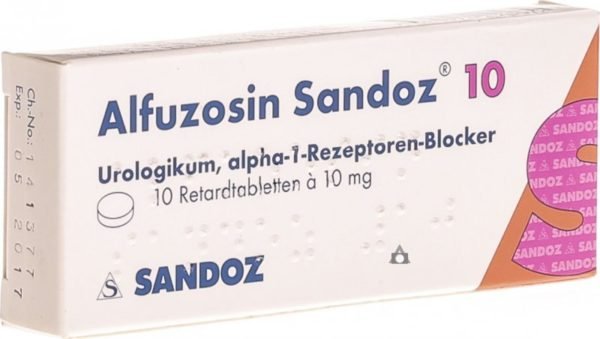
Alfuzosin is an alpha-receptor blocker. It inhibits the activation of alpha receptors present primarily in the smooth muscles of the lower urinary tract. Inhibition of alpha receptors relaxes the smooth muscles relieving symptoms of prostatic hyperplasia and improving urinary flow. It is also used to facilitate the expulsion of small ureteral stones.
Alfuzosin Dose in Adults
Alfuzosin dosage:
-
Benign prostatic hyperplasia (BPH):
- Oral tablets: 10 mg once daily
-
Off-label Use in Ureteral stones:
- Oral tablets: 10 mg once daily.
- The drug should be stopped after stone expulsion from the body.
Use in Children:
Not recommended in chidren
Pregnancy Risk Factor B
- The baby has not been adversely affected by Alfuzosin during pregnancy.
Use during breastfeeding:
- It is unknown whether breastmilk contains any drug excreted. Take care.
Alfuzosin dose in kidney disease:
- The manufacturer has not provided any dose adjustment in renal impairment.
- It should be used with caution in patients with severe renal impairment.
Alfuzosin Dose in Liver disease:
- In patients with mild hepatic impairment (Child-Pugh class A), the manufacturer has not provided any dose adjustment.
- Alfuzosin is contraindicated in patients with moderate or severe hepatic impairment (Child-Pugh class B or C).
Common side effects of alfuzosin (Uroxatral):
-
Central nervous system:
- Dizziness,
- fatigue,
- headache, and
- pain
-
Gastrointestinal:
- Abdominal pain,
- constipation,
- dyspepsia, and
- nausea
-
Genitourinary:
- Impotence
-
Respiratory:
- Upper respiratory tract infection,
- bronchitis,
- pharyngitis, and
- sinusitis
Rare side effects:
- Angina pectoris (pre-existing CAD),
- angioedema,
- chest pain,
- atrial fibrillation,
- diarrhea,
- edema,
- flushing,
- hepatic injury (including cholestatic),
- hypotension,
- intraoperative floppy iris syndrome (with cataract surgery),
- jaundice,
- priapism,
- pruritus,
- rhinitis,
- skin rash,
- systolic hypotension,
- tachycardia,
- thrombocytopenia,
- toxic epidermal necrolysis,
- urticaria, and
- vomiting
Contraindications to alfuzosin (Uroxatral):
- Severe allergic reactionsAfter alfuzosin or any other component of the formulation intake
- Moderate to severe liver disease(Child Class C and B)
- Concurrent useAlfuzosin and CYP3A4-inhibitorsItraconazole and ketoconazole are some examples.Ritonavir(
- Concurrent useOther alpha1-blockers
Warnings and Precautions
- Angina
- If the patient experiences symptoms of angina, or worsening of angina pre-existing, discontinue treatment.
- CNS depression
- Alfuzosin can cause CNS depression, which may lead to impaired mental or physical abilities.
- Patients who use heavy machinery need to be extra cautious
- Floppy iris syndrome:
- Intraoperative Floppy Iris Syndrome may occur in patients who have had cataract surgery.
- Alpha-blockers patients may need to be modified in their surgical procedure.
- Orthostatic hypotension and syncope:
- Alfuzosin can relax the vascular tone, and may cause orthostatic hypotension or syncope.
- You should increase the dose gradually and avoid simultaneous use of antihypertensive medications such as nitrates or phosphodiesterase inhibitors, like sildenafil.
- Priapism:
- A sustained painful erection or priapism may occur.
- If the condition persists for more than four hours, it is important to seek medical advice.
- Cardiovascular disease
- Patients with heart disease should be cautious as the drug may cause myocardial ischemia and tachyarrhythmias.
- Prostate cancer:
- Prostatic carcinoma should not be treated as it can cause similar symptoms.
- Extension of QT
- Patients at high risk of developing prolonged QT-intervals should not take Alfuzosin.
- Patients withGrave renal impairmentYou should take the drug with caution.
- Use restrictions:
- AlfuzosinShould not be used in conjunction with antihypertensive medication.
Alfuzosin: Drug Interaction
Note: Drug Interaction Categories:
- Risk Factor C: Monitor When Using Combination
- Risk Factor D: Consider Treatment Modification
- Risk Factor X: Avoid Concomitant Use
Risk Factor C (Monitor therapy). |
|
| Alpha-/Beta Agonists | Alpha1-Blockers could reduce the vasoconstricting effects of Alpha/BetaAgonists. Alpha-/Beta Agonists could also decrease Alpha1-Blocker vasodilation. |
| Alpha1-Agonists | Alpha1-Blockers could reduce the vasoconstricting effects of Alpha1-1-Agonists. Alpha1-Agonists could also reduce Alpha1-Blocker vasodilation. |
| Aprepitant | High risk of Inhibitors causing an increase in serum CYP3A4 Substrates concentrations |
| Beta-Blockers | Alpha1-Blockers may increase orthostatic hypotensive effects. Ophthalmic products are less likely to pose a risk than systemic drugs. Exceptions: Levobunolol; Metipranolol. |
| Blood Pressure Lowering Agents | The hypotensive effects of Blood Pressure Lowering Agents may be enhanced by Alfuzosin. |
| Bosentan | Could lower serum concentrations of CYP3A4 substrates (High Risk with Inducers). |
| Ceritinib | High risk of Inhibitors increasing serum concentrations of CYP3A4 substrates. Management: Ceritinib should not be used with a narrow therapeutic index CYP3A substrat (eg, alfentanil or cyclosporine, dihydroergotamines, ergotamines, fentanyls, pimozide, quinidines, sirolimus, tacrolimus). We will discuss exceptions separately. |
| Clofazimine | High risk of Inhibitors causing an increase in serum CYP3A4 Substrates concentrations |
| Moderate CYP3A4 Inducers | Could lower serum concentrations of CYP3A4 substrates (High Risk with Inducers). |
| Moderate CYP3A4 inhibitors | Might decrease metabolism of CYP3A4 substrates (High Risk with Inhibitors). |
| Dapoxetine | Alpha1-Blockers may increase the orthostatic hypotensive effects. |
| Deferasirox | Could lower serum concentrations of CYP3A4 substrates (High Risk with Inducers). |
| Duvelisib | High risk of Inhibitors causing an increase in serum CYP3A4 Substrates concentrations |
| Fosaprepitant | High risk of Inhibitors causing an increase in serum CYP3A4 Substrates concentrations |
| Fosnetupitant | High risk of Inhibitors causing an increase in serum CYP3A4 Substrates concentrations |
| Haloperidol | QT-prolonging agents (Indeterminate risk - Caution), may increase the QTcprolonging effects of Haloperidol. |
| Ivosidenib | Could lower serum concentrations of CYP3A4 substrates (High Risk with Inducers). |
| Larotrectinib | High risk of Inhibitors causing an increase in serum CYP3A4 Substrates concentrations |
| Netupitant | High risk of Inhibitors causing an increase in serum CYP3A4 Substrates concentrations |
| Nitroglycerin | The hypotensive effects of Nitroglycerin could be enhanced by Alfuzosin. |
| Palbociclib | High risk of Inhibitors causing an increase in serum CYP3A4 Substrates concentrations |
| Phosphodiesterase 5 Inhibitors | Alpha1-Blockers (Uroselective), may increase the hypotensive effects of Phosphodiesterase 5 inhibitors. |
| Agents that prolong QT (highest risk) | QT-prolonging agents (Indeterminate risk - Caution), may increase the QTc prolonging effect of QT Prolonging Agents. When using these agents together, be sure to monitor for QTc interval prolongation or ventricular arrhythmias. Patients at higher risk for QTc prolongation might have additional risk factors. |
| Rilmenidine | Rilmenidine may have a hypotensive effect that Alpha1-Blockers might enhance. |
| Sarilumab | Could lower serum concentrations of CYP3A4 substrates (High Risk with Inducers). |
| Siltuximab | Could lower serum concentrations of CYP3A4 substrates (High Risk with Inducers). |
| Simeprevir | High risk of Inhibitors causing an increase in serum CYP3A4 Substrates concentrations |
| Tocilizumab | Could lower serum concentrations of CYP3A4 substrates (High Risk with Inducers). |
Risk Factor D (Consider therapy modifications) |
|
| Strong CYP3A4 Inducers | May increase metabolism of CYP3A4 substrates (High Risk with Inducers). Management: You may consider a different drug to replace one of the interacting drugs. Some combinations might be contraindicated. Consult appropriate manufacturer labeling. |
| Dabrafenib | High risk of Inducers causing a decrease in serum CYP3A4 substrates. Management: If possible, seek alternatives to the CYP3A4 substrate. Concomitant therapy should be avoided if possible. Monitor the clinical effects of the substrate carefully (especially therapeutic effects). |
| Enzalutamide | High risk of Inducers causing a decrease in serum concentrations of CYP3A4 substrates. Management: Avoid concurrent use of enzalutamide and CYP3A4 substrates with a narrow therapeutic index. You should exercise caution when using enzalutamide or any other CYP3A4 sub-substance. |
| Lorlatinib | High risk of Inducers causing a decrease in serum concentrations of CYP3A4 substrates. Management: Do not use lorlatinib concurrently with any CYP3A4 Substrates. Even a slight decrease in serum concentrations could cause therapeutic failure or serious clinical consequences. |
| Mitotane | High risk of Inducers causing a decrease in serum concentrations of CYP3A4 substrates. Treatment: Patients receiving mitotane may require significant adjustments in the dosage of CYP3A4 Substrates. |
| Pitolisant | High risk of Inducers causing a decrease in serum concentrations of CYP3A4 substrates Management: Avoid combining pitolisant and a CYP3A4 substrat with a low therapeutic index. Pitolisant should not be combined with other CYP3A4 sub-substances. |
| St John's Wort | High risk of Inducers causing a decrease in serum CYP3A4 Substrates. Management: You may consider a different drug to replace one of the interacting drugs. Some combinations might be contraindicated. Consult appropriate manufacturer labeling. |
| Stiripentol | High risk of Inhibitors causing an increase in serum concentrations of CYP3A4 substrates. Management: Avoid stiripentol use with CYP3A4 Substrates that have a narrow therapeutic Index. This is to avoid adverse effects and toxicities. Monitoring of any CYP3A4 substrate that is used with stiripentol should be closely done. |
Risk Factor X (Avoid Combination) |
|
| Alpha1-Blockers | This may increase the antihypertensive effects of Alpha1-Blockers. |
| Conivaptan | High risk of Inhibitors causing an increase in serum CYP3A4 Substrates concentrations |
| Strong CYP3A4 inhibitors | May increase the serum concentration of Alfuzosin. |
| Fusidic Acid (Systemic). | High risk of Inhibitors causing an increase in serum CYP3A4 Substrates concentrations |
| Idelalisib | High risk of Inhibitors causing an increase in serum CYP3A4 Substrates concentrations |
| Protease inhibitors | May increase the serum concentration of Alfuzosin. |
Monitor:
- Urine flow,
- blood pressure, and
- PSA (Prostate specific antigen) levels periodically
How to take alfuzosin (Uroxatral)?
Take the tablet whole (do not chew or crush), after meals at the same time each day.
Alfuzosin mechanism of Action:
- Alfuzosin, an alpha-adrenergic antagonist receptor blocker, is one example.
- It works by blocking the alpha receptors, which are primarily found in the smooth muscle of the lower urinary track.
- This causes relaxation. This causes a decrease in urine flow symptoms such as hesitancy and urgency, poor stream, post-micturition dizziness, and poor stream.
- Patients with an enlarged prostate often experience all of these symptoms.
Absorption is reduced by 50% under fasting conditions It is 82% to 90% protein bound.
Metabolism is primarily via the liver.
Bioavailability is 49% after a meal.
Half-life elimination is about 10 hours
Time to peak plasma concentration is 8 hours following a meal
Excretion is via feces (69%) and urine (24% Old patients and patients with impaired hepatic function have a 3 - 4 fold increase in the plasma levels.
International Brand Names of alfuzosin:
- Alfasin XR
- Alfirum
- Alfron XL
- Alfsin XL
- Alfu
- Alfu-Kal XL
- Alfumax
- Alfurix XL
- Alfusin
- Alfutor ER
- Alfuzo XL
- Alfuzon XL
- Alsiful S.R.
- Azosin SR
- Benestan
- Benestan OD
- Benprostex
- Bundisarin
- Dalfaz
- Danafusin
- Flotral
- Fozal
- Fuzocim
- Lafunomyl
- Lafuzo
- Lura XL
- Mittoval
- Nuo Shu An
- Profuzosin
- Prosterol
- Ranfuzosin
- Tevax
- Unibenestan
- Urion
- Uritab XL
- Uriten
- Uroxatral
- Uroxatral OD
- Uroxatral uno
- WeiPing
- Xatger
- Xatosin XL
- Xatral
- Xatral LP
- Xatral OD
- Xatral Retard
- Xatral SR
- Xatral XL
- Xatral XL PR
- Xatral XR 10
- Zapros XL
- Apo-Alfuzosin
- Sandoz-Alfuzosin
- Teva-Alfuzosin PR
Alfuzosin brand names in Pakistan:
|
Alfuzosin 5 mg Tablets in Pakistan |
|
| EZIFLO SR | NABIQASIM INDUSTRIES (PVT) LTD. |
|
Alfuzosin 10 mg Tablets in Pakistan |
|
| EZIFLO XL | NABIQASIM INDUSTRIES (PVT) LTD. |
| KHLOCK XR | WILSONS PHARMACEUTICALS |
| XATRAL-LP | SANOFI AVENTIS (PAKISTAN) LTD. |
| ZATRAL XR | WERRICK PHARMACEUTICALS |
|
Alfuzosin 2.5 mg Tablets in Pakistan |
|
| KHLOCK | WILSONS PHARMACEUTICALS |
| ZATRAL | WERRICK PHARMACEUTICALS |
|
Alfuzosin SR 5 mg Tablets in Pakistan |
|
| ALFUPROZIN | NOVINS INTERNATIONAL |
| FUZIN | PULSE PHARMACEUTICALS |
| XATRAL | SANOFI AVENTIS (PAKISTAN) LTD. |
.png)


