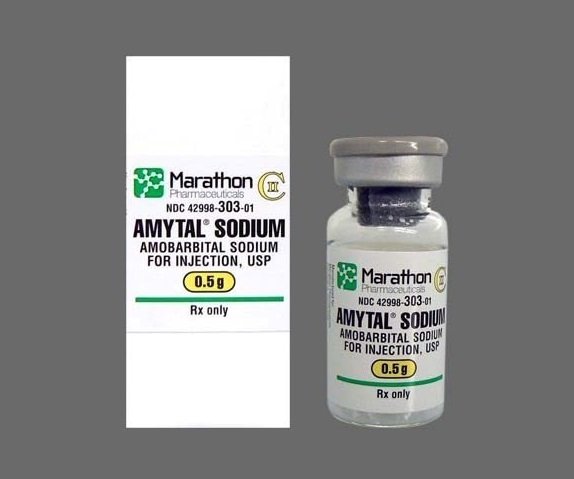
Amobarbital is an intermediate-acting barbiturate that depresses the sensory cortex, decreases motor activity, and alter cerebellar function producing sedation, drowsiness, and hypnosis.
It is used as a sedative, hypnotic, or as a pre-anesthetic.
It is also used as an off-label treatment for diagnostic and therapeutic purposes in amytal interviewing (Wada test) for psychiatric purposes.
Amobarbital Dose in Adults
Dose for use as a Hypnotic:
- 65 - 200 mg intramuscular or intravenous at bedtime to a maximum single dose of 1,000 mg)
Use as a Sedative:
- 30 - 50 mg intramuscular or intravenous 2 - 3 times a day to the maximum single dose of 1,000 mg.
Off label use in the “Amytal interview”:
- 50 - 100 mg/minute intravenous for a total dose of 200 - 1,000 mg or until the patient experiences drowsiness, develops slurred speech, nystagmus, or impaired attention.
Off Label use in the Wada test:
- 60 - 200 mg intracarotid (usual dose: 125 mg) over 2 - 5 seconds via a percutaneous transfemoral catheter (the usual dose is 125 mg)
- The dose may be repeated after 30 - 45 minutes of completion of the first injection.
Amobarbital Dose in Childrens
Hypnotic as in preoperative sedation:
- Children older than 6 years and Adolescents:
- 2 - 3 mg/kg/dose to a maximum dose of 500 mg/dose intramuscular (preferred) or intravenous.
Intracarotid amobarbital procedure (Wada test):
- Children older than 6 years and Adolescents:
- 75 - 125 mg/dose intraarterial administered through femoral arterial catheter.
Pregnancy Risk Factor D
- If administered in the first trimester, barbiturates can cross the placental barriers and cause teratogenic reactions.
- The third trimester administration may cause symptoms of withdrawal after delivery, lasting up to 14 days.
Amobarbital during breastfeeding:
- Breastfeeding is a good time to avoid it. Breast milk contains small amounts of barbiturates.
Amobarbital Dose in Renal Disease:
- Adjustment in the dose has not been recommended by the manufacturer.
- The dose may need adjustment in renal disease.
Amobarbital Dose in Liver Disease:
- Adjustment in the dose has not been recommended by the manufacturer.
- It should be avoided in severe hepatic impairment and the dose should be adjusted in mild to moderate hepatic impairment.
Amobarbital side effects:
- Cardiovascular:
- Bradycardia
- Hypotension
- Syncope
- Central Nervous System:
- Abnormality In Thinking
- Agitation
- Anxiety
- Ataxia
- Central Nervous System Depression
- Confusion
- Dizziness
- Drowsiness
- Hallucination
- Headache
- Insomnia
- Nervousness
- Nightmares
- Psychiatric Disturbance
- Gastrointestinal:
- Constipation
- Nausea
- Vomiting
- Hematologic & Oncologic:
- Megaloblastic Anemia with chronic use
- Hepatic:
- Hepatic Injury
- Hypersensitivity:
- Hypersensitivity Reaction
- Angioedema
- Skin Rash
- Exfoliative Dermatitis
- Hypersensitivity Reaction
- Local:
- Injection Site Reaction
- Neuromuscular & Skeletal:
- Hyperkinesia
- Respiratory:
- Apnea
- Atelectasis
- Hypoventilation
- Miscellaneous:
- Fever
Contraindication to Amobarbital Include:
- Allergy to barbiturates and any component of the formulation
- Patients with porphyria
- Advanced liver disease
- Patients suffering from a severe or moderately severe respiratory condition that is complicated by hypoxemia or hypercapnia.
Warnings and Precautions
- CNS depression:
- CNS depression can occur in patients who use heavy machinery or those who perform tasks that require mental abilities above average.
- Paradoxical responses:
- Patients with chronic/ acute pain may feel a paradoxical sense of excitement.
- Depression
- Patients suffering from depression or suicidal tendencies must be cautious when taking the drug.
- Use of drugs:
- Tolerance, psychological and physical dependence may develop from prolonged use.
- Patients who have a history or potential for drug abuse should be cautious about using the drug.
- Hepatic impairment
- It is contraindicated for patients with severe hepatic impairment or impending hepatic disease.
- Patients suffering from mild or moderate hepatic dysfunction might need to reduce their dose.
- Hypoadrenalism
- Hypoadrenal patients should not use it.
- The effects of glucocorticoids may be diminished by its use.
- Renal impairment
- Dose adjustment may be necessary for patients with impaired renal function.
- Patients with kidney disease should use it with caution.
- Respiratory disease
- It can cause respiratory depression so patients suffering from respiratory disease should not use it.
Amobarbital: Drug Interaction
Note: Drug Interaction Categories:
- Risk Factor C: Monitor When Using Combination
- Risk Factor D: Consider Treatment Modification
- Risk Factor X: Avoid Concomitant Use
| Risk Factor C (Monitor therapy). | |
| Alcohol (Ethyl) | CNS Depressants can increase the CNS depressant effects of Alcohol (Ethyl). |
| Alizapride | CNS Depressants may increase the CNS depressant effects. |
| Beta-Blockers | Beta-Blockers may be decreased by barbiturates. Exceptions: Atenolol; Levobunolol; Metipranolol; Nadolol. |
| Blood Pressure Lowering Agents | The hypotensive effects of Blood Pressure Lowering Agents may be enhanced by barbiturates. |
| Brexanolone | CNS Depressants can increase the CNS depressant effects of Brexanolone. |
| Brimonidine (Topical) | CNS Depressants may increase the CNS depressant effects. |
| Bromopride | CNS Depressants may increase the CNS depressant effects. |
| Calcium Channel Blockers | The metabolism of Calcium Channel Blockers may be increased by barbiturates. Management: Watch for decreased therapeutic effects from calcium channel blockers when using concomitant barbiturate treatment. Adjustments in calcium channel blocker dosage may be required. Nimodipine Canadian labeling prohibits concurrent use with Phenobarbital. Clevidipine is an exception. |
| Cannabidiol | CNS Depressants may increase the CNS depressant effects. |
| Cannabis | CNS Depressants may increase the CNS depressant effects. |
| Chlorphenesin Carbamate | CNS Depressants may have an adverse/toxic effect that can be exacerbated by them. |
| CNS Depressants | Can increase the toxic/adverse effects of CNS Depressants. |
| Dimethindene (Topical). | CNS Depressants may increase the CNS depressant effects. |
| Doxylamine | CNS Depressants may have a greater depressant effect on the brain. Management: The manufacturer of Diclegis (doxylamine/pyridoxine), intended for use in pregnancy, specifically states that use with other CNS depressants is not recommended. |
| Dronabinol | CNS Depressants may increase the CNS depressant effects. |
| Esketamine | CNS Depressants may increase the CNS depressant effects. |
| Felbamate | Could increase serum Barbiturates. Felbamate serum concentration may be decreased by barbiturates. Management: Monitor for elevated barbiturate concentrations/toxicity if felbamate is initiated/dose increased, or reduced concentrations/effects if felbamate is discontinued/dose decreased. For patients who are receiving phenobarbital, refer to the dosing guidelines. |
| Griseofulvin | Griseofulvin serum concentration may be decreased by barbiturates |
| Kava Kava | CNS Depressants may have an adverse/toxic effect that can be exacerbated by them. |
| Lofexidine | CNS Depressants may have a greater depressant effect on the brain. Management: Separate drug interaction monographs are available for drugs listed as an exception to this monograph. |
| Magnesium Sulfate | CNS Depressants may increase the CNS depressant effects. |
| MetyroSINE | MetyroSINE may have a sedative effect that can be enhanced by CNS depressants. |
| Minocycline | CNS Depressants may increase the CNS depressant effects. |
| Mirtazapine | CNS Depressants can increase the CNS depressant effects of Mirtazapine. |
| Multivitamins/Minerals (with ADEK, Folate, Iron) | Could lower the serum Barbiturates concentration. |
| Nabilone | CNS Depressants may increase the CNS depressant effects. |
| Piribedil | CNS Depressants could increase the CNS depressant effects of Piribedil. |
| Pramipexole | Pramipexole may have a greater sedative effect if it is combined with CNS depressants. |
| Primidone | Can increase the toxic/adverse effects of Barbiturates. Primidone can be converted to Phenobarbital and is therefore added to existing barbiturate therapies. |
| Propacetamol | Propacetamol metabolism may be increased by barbiturates. This could 1) reduce the desired effects of Propacetamol and 2) increase the chance of liver damage. |
| Pyridoxine | May increase metabolism of Barbiturates. High pyridoxine dosages (eg 200 mg/day) may make it more apparent. |
| Rifamycin Derivatives | May increase metabolism of Barbiturates. |
| ROPINIRole | CNS Depressants can increase the sedative effects of ROPINIRole. |
| Rotigotine | CNS Depressants can increase the sedative effects of Rotigotine. |
| Rufinamide | CNS Depressants may have an adverse/toxic effect that can be exacerbated by this. Particularly, dizziness and sleepiness may be increased. |
| Selective Serotonin Reuptake inhibitors | CNS Depressants can increase the toxic/adverse effects of Selective Serotonin Resuptake Inhibitors. Particularly, psychomotor impairment could be increased. |
| Tetrahydrocannabinol | CNS Depressants may increase the CNS depressant effects. |
| Tetrahydrocannabinol, and Cannabidiol | CNS Depressants may increase the CNS depressant effects. |
| Theophylline Derivatives | The serum concentrations of Theophylline Derivatives may be decreased by barbiturates. Dyphylline is an exception. |
| Thiazide and Thiazide -Like Diuretics | The orthostatic hypotensive effect Thiazide-Like Diuretics and Thiazide-Like Thiazide may be enhanced by barbiturates. |
| Trimeprazine | CNS Depressants may increase the CNS depressant effects. |
| Valproate Products | Could increase the serum level of Barbiturates. The serum concentration of Valproate Products may be decreased by Barbiturates. |
Risk Factor D (Consider therapy modifications) |
|
| Blonanserin | CNS Depressants can increase the CNS depressant effects of Blonanserin. |
| Buprenorphine | CNS Depressants can increase the CNS depressant effects of buprenorphine. Management: Consider reduced doses of other CNS depressants, and avoiding such drugs in patients at high risk of buprenorphine overuse/self-injection. Buprenorphine patches (Butrans) should be initiated at 5 mg/hr for adults when taken with other CNS depression drugs. |
| Chloramphenicol (Systemic) | Barbiturates may slow down metabolism. The metabolism of Chloramphenicol (Systemic) may be increased by Barbiturates |
| Chlormethiazole | CNS Depressants may increase the CNS depressant effects. Monitoring: Look out for signs of CNS depression. If a combination of chlormethiazole and other drugs is required, a reduced dose should be used. |
| CycloSPORINE Systemic | CycloSPORINE (Systemic) metabolism may be increased by barbiturates |
| Doxycycline | Doxycycline may be reduced by barbiturates. |
| Droperidol | CNS Depressants may increase the CNS depressant effects. Management: Droperidol and other CNS agents, such as opioids, may be reduced or used in combination with droperidol. Separate drug interaction monographs provide more detail on exceptions to this monograph. |
| Estrogen Derivatives (Contraceptive) | Barbiturates can decrease the therapeutic effects of Estrogen Derivatives (Contraceptive). It is possible to have contraceptive failure. Management: It is recommended to use a nonhormonal contraceptive. |
| Flunitrazepam | CNS Depressants can increase the CNS depressant effects of Flunitrazepam. |
| HYDROcodone | CNS Depressants can increase the CNS depressant effects of HYDROcodone. When possible, avoid concomitant use with hydrocodone and other CNS depressants. Combining these agents is not recommended unless there are other options. Limit the amount and duration of each drug when combined. |
| HydrOXYzine | Barbiturates may increase the CNS depressant effects. Management: If barbiturate is used in combination with hydroxyzine, you may consider a reduction of the dose. Patients should be closely monitored for an excessive response to concurrent use. |
| LamoTRIgine | The serum level of LamoTRIgine may be decreased by barbiturates. Management: Refer to lamotrigine prescribing for age-dependent guidelines for concurrent use with a barbiturate. Also, adjust lamotrigine dosage if the barbiturate is stopped. |
| Methotrimeprazine | Methotrimeprazine may have a higher CNS depressant activity than CNS Depressants. Methotrimeprazine can increase the CNS depressant effects of CNS Depressants. Management: Lower the adult dose of CNS Depressants by 50% and start concomitant methotrimeprazine treatment. After clinically proven efficacy of methotrimeprazine, further CNS depressant dose adjustments should only be made. |
| Opioid Agonists | CNS Depressants can increase the CNS depressant effects of Opioid Aggonists. Management: When possible, avoid concomitant use opioid agonists and other CNS depressants. Combining these agents is not recommended unless there are other options. Limit the amount and duration of each drug when combined. |
| OxyCODONE | CNS Depressants can increase OxyCODONE's CNS depressant effects. When possible, avoid the simultaneous use of oxycodone and other CNS depressants. Combining these agents is not recommended unless there are other options. Limit the amount and duration of each drug when combined. |
| Perampanel | CNS Depressants may have a greater CNS depressant effect. Perampanel and any other CNS depressant drug should be used in combination. Patients who take perampanel together with any other drug with CNS depressant activity should not engage in complex or high-risk activities until they have had experience with the combination. |
| Contraceptive Progestins | Progestins' therapeutic effects may be diminished by barbiturates (Contraceptive). It is possible to have contraceptive failure. Management: It is recommended to use nonhormonal contraceptives. |
| Sodium Oxybate | CNS Depressants may have a greater depressant effect if taken in combination. Management: Look for alternatives to the combination use. If you must combine use, reduce the dose of any one or more drugs. It is not recommended to combine sodium oxybate and alcohol, or any sedative hypnotics. |
| Suvorexant | CNS Depressants can increase the CNS depressant effects of Suvorexant. Management: Suvorexant or any other CNS depressionant can be reduced in doses. Suvorexant should not be taken with alcohol. It is also not recommended to take suvorexant along with any other drugs for insomnia. |
| Tapentadol | CNS Depressants may increase the CNS depressant effects. Tapentadol, benzodiazepines and other CNS depressants should be avoided when possible. Combining these agents is not recommended unless there are other options. Limit the amount and duration of each drug when combined. |
| Teniposide | Teniposide serum concentrations may be decreased by barbiturates. Management: There is a possibility of a decreased teniposide level if you combine barbiturates with teniposide. Monitor the teniposide response carefully if you cannot avoid the combination. |
| Tricyclic Antidepressants | Tricyclic Antidepressants may be more metabolically active if they are taken with barbiturates. |
| Vitamin K antagonists (eg warfarin) | Vitamin K Antagonist metabolism may be increased by barbiturates. Monitoring INR closely is important. After a barbiturate has been initiated or administered at a higher dose, an increase in anticoagulant dosage may be necessary. Following discontinuation of barbiturate or reduction in dose, an anticoagulant dose drop may be necessary. |
| Zolpidem | CNS Depressants can increase the CNS depressant effects of Zolpidem. Management: For men who also take CNS depressants, reduce the adult Intermezzo brand sublingual Zolpidem dose to 1.75mg. For women, no dose adjustment is advised. Avoid using CNS depressants at night; do not use alcohol. |
Risk Factor X (Avoid Combination) |
|
| Azelastine (Nasal) | CNS Depressants could increase the CNS depressant effects of Azelastine. |
| Bromperidol | CNS Depressants may increase the CNS depressant effects. |
| Hemin | Hemin's therapeutic effects may be diminished by barbiturates. |
| Methoxyflurane | Methoxyflurane's nephrotoxic effects may be enhanced by barbiturates. Methoxyflurane metabolism may be increased by barbiturates |
| Mianserin | Barbiturates may increase the CNS depressant effects. Barbiturates' therapeutic effects may be diminished by Mianserin. Mianserin serum concentration may be decreased by Barbiturates. |
| Orphenadrine | Orphenadrine may be more effective against CNS depression than other drugs. |
| Oxomemazine | CNS Depressants may increase the CNS depressant effects. |
| Paraldehyde | Paraldehyde may be enhanced by CNS depressants. |
| Somatostatin Acetate | May increase the toxic/adverse effects of Barbiturates. Somatostatin Acetate, specifically, may increase or prolong Barbiturate effect, including sedative effects. |
| Thalidomide | CNS Depressants can increase Thalidomide's CNS depressant effects. |
| Ulipristal | The serum concentration of Ulipristal may be decreased by barbiturates. |
| Voriconazole | The serum concentration of Voriconazole may be decreased by barbiturates. |
Monitor:
- Renal funcitons and hepatic functions with prolonged therapy.
- Vital signs and cardiac function should be monitored during intravenous administration.
How to administer Amobarbital?
- Intramuscular administration:
- It should be administered deep into a large muscle. It may cause tissue damage if more than 5 ml is administered at any single site.
- For administration of larger doses, use 20% solution.
- Subcutaneous administration and superficial intramuscular injections may be painful and produce sterile abscesses or sloughs.
- Intravenous administration:
- It should be used only when the intramuscular administration is not feasible.
- Intravenous injection should be administered by a slow intravenous injection at a maximum rate of 50 mg/min in adults.
- Intra-carotid administration as off-label route (Wada test):
- Administer the dose over 2 - 5 seconds into the internal carotid artery via a percutaneous transfemoral catheter.
Mechanism of action of Amobarbital:
It is a intermediate-acting barbiturate, which depresses sensory cortex, decreases motor activation, alters cerebellar function, and produces sedation, somnolence, and hypnosis.
It has been aRapid onset of actionVariable (within minutes)Duration of actionIt is primarilyMetabolizedVia the liver (microsomal enzymes).
It has been ahalf-life eliminationBetween 16 and 40 hours Themaximum effectIt can be seen in just hours.
It isexcretedThe metabolites are mainly found in the urine. They are excreted in your feces.
International Brands of Amobarbital:
- Amital
- Amybital
- Amycal
- Amytal
- Amytal Sodium
- Barbamyl
- Eunoctal
- Isomytal
- Neur-Amyl
- Sodium Amytal
Amobarbital Brands in Pakistan:
No brands available in Pakistan.
.png)


