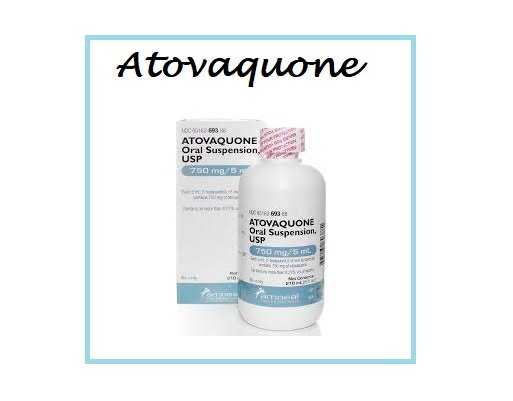
Atovaquone inhibits the reproduction of protozoal infections. [select-faq faq_id='7360'] It is used to treat the following conditions:
-
Prevention of PCP in adults and adolescents 13 years and older who cannot tolerate trimethoprim-sulfamethoxazole
-
Acute oral treatment of mild to moderate PCP infection in adults and adolescents 13 years and older who cannot tolerate TMP-SMZ
-
Off Label Uses of Atovaquone in Adults include:
-
Babesiosis
-
Prophylaxis, treatment, and chronic maintenance therapy for Toxoplasma gondii encephalitis in HIV Patients
-
Atovaquone Dose in Adults
Dose in the prevention of Pneumocystis jirovecii pneumonia (PCP):
- 1,500 mg orally OD daily with food
Dose in the treatment of mild to moderate PCP:
- 750 mg orally BID daily with food for 3 weeks
Dose in the treatment of Babesiosis (off-label):
- 750 mg orally BID daily with azithromycin for at least 7-10 days;
Dose in the treatment of Toxoplasma gondii encephalitis in HIV-infected patients:
-
Prophylaxis:
- 1,500 mg orally once daily is given with food either as monotherapy or with pyrimethamine plus leucovorin.
- Primary prophylaxis is used for Toxoplasma IgG-positive patients with CD4 count less than 100 cells/mm³.
- Primary prophylaxis should be continued following initiation of ART until CD4 count >200 cells/mm³ for more than 3 months.
- Some experts recommend discontinuing primary prophylaxis in patients with a CD4 count between 100 to 200 cells/mm who are using ART and have had an undetectable viral load for 3 - 6 months
-
Treatment:
- 1,500 mg orally twice a day with food either with pyrimethamine plus leucovorin, or with sulfadiazine, or as monotherapy) for at least 6 weeks (longer if extensive disease or incomplete response)
-
Secondary prophylaxis:
- 750 - 1,500 mg orally two times a day with food either with pyrimethamine plus leucovorin, or with sulfadiazine, or as monotherapy)
- Can be discontinued when asymptomatic and CD4 count >200 cells/mm for >6 months in response to antiretrovirals.
Atovaquone Dose in Childrens
Dose in the treatment of Pneumocystis jirovecii pneumonia (PCP) in HIV-exposed/-positive patients:
-
Primary or secondary Prophylaxis :
- Infants and Children:
- In age 1 to 3 months:
- 30 mg/kg/day orally once daily is recommended.
- In age 4 to 24 months:
- 45 mg/kg/day orally once daily is recommended.
- In age greater than 24 months:
- 30 mg/kg/day orally once daily to a maximum daily dose of 1,500 mg/day is given
- In age 1 to 3 months:
- Adolescents:
- Oral: 1,500 mg OD daily
- Infants and Children:
Treatment of mild to moderate infection:
Treatment duration:3 Weeks
- Infants and Children:
- 1 to 3 months:
- 30 to 40 mg/kg/day orally divided dose given once or twice daily
- 4 to 24 months:
- 45 mg/kg/day orally divided dose given once or twice daily
- older than 24 months:
- 30 - 40 mg/kg/day orally divided dose given once or twice daily to a maximum daily dose of 1,500 mg/day
- 1 to 3 months:
- Adolescent:
- 750 mg orally twice daily
Dose in the treatment of Toxoplasmosis (Toxoplasma gondii) and encephalitis caused by Toxoplasma gondii in HIV-exposed/-positive patients:
-
Primary prophylaxis:
- Infants and Children:
- 1 to 3 months:
- 30 mg/kg/day orally is used once daily
- 4 to 24 months:
- 45 mg/kg/day orally is used once a day; with or without pyrimethamine/leucovorin
- older than 24 months:
- 30 mg/kg/day orally used once daily to a maximum daily dose of 1,500 mg/day
- 1 to 3 months:
- Adolescents:
- 1,500 mg orally used once a day with or without pyrimethamine/ leucovorin
- Infants and Children:
-
Treatment of encephalitis:
- Adolescents:
- 1,500 mg orally twice daily is recommended for at least 6 weeks (longer treatment is recommended if an extensive disease or incomplete response)
- Use in combination with pyrimethamine/ leucovorin or sulfadiazine is advised
- Adolescents:
-
Secondary prophylaxis and chronic maintenance suppressive therapy:
- Infants and Children:
- 1 to 3 months:
- 30 mg/kg/day once daily along with leucovorin
- 4 to 24 months:
- 45 mg/kg/day once a day with or without pyrimethamine/ leucovorin
- older than 24 months:
- 30 mg/kg/day once daily to a maximum daily dose of 1,500 mg/day with leucovorin
- 1 to 3 months:
- Adolescents:
- 750 - 1,500 mg orally twice daily
- Use in combination with pyrimethamine/ leucovorin or sulfadiazine is given priority
- Infants and Children:
Dose in the treatment of Babesiosis:
- Infants and Children:
- 40 mg/kg/day orally in two divided doses daily to a maximum daily dose of 1,500 mg/day with azithromycin for 7 - 10 days
- Adolescents:
- 750 mg orally in two divided doses daily for 7 to 10 days with azithromycin
Pregnancy Risk Factor: C
- It is not possible to provide information specific to atovaquone use during pregnancy.
- The treatment and diagnosis of Pneumocystis Jirovecii Pneumonia (PCP), in pregnant women are the same as for nonpregnant patients.
- When necessary, Atovaquone may be used in lieu of Toxoplasma gondii and PCP infections during pregnancy.
Atovaquone use during breastfeeding:
- It is unknown if atovaquone can be found in breast milk.
- To reduce the risk of HIV transmission, pregnant women with HIV should not breastfeed.
Atovaquone Dose in Renal Disease:
- There are no dosage adjustments provided in the manufacturer’s labeling.
- However, atovaquone is not appreciably renally excreted.
Atovaquone Dose in Liver Disease:
- There are no dosage adjustments provided in the manufacturer’s labeling.
- Atovaquone undergoes enterohepatic cycling and primarily hepatic excretion.
- Use caution in patients with severe impairment and monitor closely.
- Frequency not always defined. Adverse reaction statistics have been compiled from studies including patients with advanced HIV disease.
- Consequently, it is difficult to distinguish reactions attributed to atovaquone from those caused by the underlying disease or a combination thereof.
Common Side Effects of Atovaquone Include:
- Central Nervous System:
- Headache
- Insomnia
- Depression
- Pain
- Dermatologic:
- Skin Rash
- Pruritus
- Diaphoresis
- Gastrointestinal:
- Diarrhea
- Nausea
- Vomiting
- Abdominal Pain
- Infection:
- Infection
- Neuromuscular & Skeletal:
- Weakness
- Myalgia
- Respiratory:
- Cough
- Rhinitis
- Dyspnea
- Sinusitis
- Flu-Like Symptoms
- Miscellaneous:
- Fever
Less Common Side Effects of Atovaquone Include:
- Cardiovascular:
- Hypotension
- Central Nervous System:
- Dizziness
- Anxiety
- Endocrine & Metabolic:
- Hyponatremia
- Hyperglycemia
- Increased Amylase
- Hypoglycemia
- Gastrointestinal:
- Oral Candidiasis
- Anorexia
- Dyspepsia
- Constipation
- Dysgeusia
- Hematologic & Oncologic:
- Anemia
- Neutropenia
- Hepatic:
- Increased Liver Enzymes
- Renal:
- Increased Blood Urea Nitrogen
- Increased Serum Creatinine
- Respiratory:
- Bronchospasm
Contraindication to Atovaquone Include:
- Allergic reactions to atovaquone or any component of the formulation
Warnings and Precautions
- Diarrhea, vomiting and other symptoms:
- Patients with diarrhea or vomiting may have less absorption
- Take care and be aware of the possibility of using an antiemetic.
- Consider using an antiprotozoal alternative if the symptoms are severe.
- Hypersensitivity
- Hypersensitivity reactions such as angioedema and bronchospasm or throat tightness, urticaria, and bronchospasm may occur.
- Gastrointestinal disorders:
- Patients who are unable to take atovaquone with their food should consider parenteral therapy using alternative agents.
- Gastrointestinal conditions can limit the absorption of oral medication and cause low plasma levels.
- Hepatic impairment
- Patients with severe hepatic impairment should be cautious and closely monitored.
- Reports of rare cases of cholestatic liver disease, liver function tests that are elevated, and even fatal liver failure have been made.
- Pneumocystis jirovecii pneumonia (PCP):
- It is not indicated for use in treatment.
- It is not recommended for severe PCP.
- Atovaquone has less adverse effects than trimethoprim-sulfamethoxazole (TMP-SMZ) (the treatment of choice for mild to moderate PCP), although atovaquone is less effective than TMP-SMZ.
Atovaquone: Drug Interaction
Note: Drug Interaction Categories:
- Risk Factor C: Monitor When Using Combination
- Risk Factor D: Consider Treatment Modification
- Risk Factor X: Avoid Concomitant Use
Risk Factor C (Monitor therapy). |
|
| Etoposide | Etoposide may be increased by atovaquone. Management: It is worth separating atovaquone from etoposide for at least one to two days. |
| Etoposide Phosphate | Etoposide Phosphate may be increased by atovaquone. Management: It is worth separating atovaquone administration from etoposide for at least one to two days. |
| Indinavir | Indinavir serum concentration may be decreased by Atovaquone |
| Ritonavir | May lower the serum level of Atovaquone. |
| Tetracycline (Systemic) | May lower the serum level of Atovaquone. |
Risk Factor D (Regard therapy modification) |
|
| Efavirenz | It may cause a decrease in serum Atovaquone concentration. Management: If possible, consider alternatives to atovaquone and efavirenz. Monitor for evidence of decreased atovaquone clinical efficacy if this combination is necessary. |
| Metoclopramide | It may cause a decrease in serum Atovaquone concentration. Management: If metoclopramide is not available, consider other options. Atovaquone should be used only with metoclopramide. |
Risk Factor X (Avoid Combination) |
|
| Rifamycin Derivatives | May lower the serum level of Atovaquone. |
Monitor:
- Hepatic function at baseline (monitor closely during treatment in patients with severe hepatic impairment)
- Hypersensitivity reactions
- CD4 count (for chronic maintenance treatment in toxoplasmosis)
- Patient’s food tolerance (ability to take atovaquone)
- Post-dose vomiting
- Diarrhea
How to administer Atovaquone?
- It must be administered orally with food.
- Shake the suspension gently before use.
- Once opened, a foil pouch can be emptied on a dosing spoon, in a cup, or directly into the mouth.
Mechanism of action of Atovaquone:
It blocks electron transport in mitochondria, resulting in inhibition of key metabolic enzymes that are responsible for the synthesis nucleic acid and ATP.
Absorption:
- Enhanced about 2-fold with food
Protein binding:
- >99%
Metabolism:
- Unknown
Bioavailability:
- When the suspension is administered with food: 47% ± 15%
Half-life elimination:
- Range: 67 ± 33.4 hours to 77.6 ± 23.1 hours
Excretion:
- Feces (greater than 94% as unchanged drug); urine (<1%)
International Brands of Atovaquone:
- Mepron
- Samtirel
- Wellvone
Atovaquone brands in Pakistan:
|
Atovaquone [Tabs 250 Mg] |
|
| Proqon | Hilton Pharma (Pvt) Limited |
| Proqon | Hilton Pharma (Pvt) Limited |
|
Atovaquone [Tabs 62.5 Mg] |
|
| Proqon | Hilton Pharma (Pvt) Limited |
| Proqon | Hilton Pharma (Pvt) Limited |
.png)


