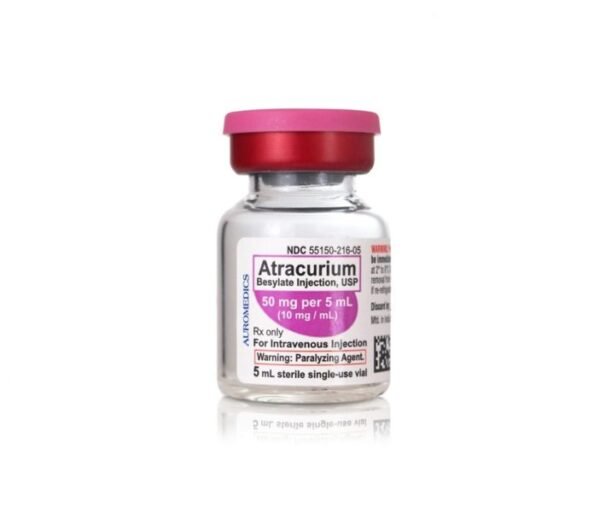
Atracurium binds to the cholinergic receptors and blocks the neuromuscular transmission.
It is used in the following situations:
- As an adjunct to general anesthesia
- To facilitate endotracheal intubation
- As a muscle relaxant during surgery and mechanical ventilation in a sedated patient.
Off Label Use of Atracurium in Adults:
- ARDS (Acute respiratory distress syndrome)
- Shivering secondary to therapeutic hypothermia after a cardiac Arrest
Atracurium Dose in Adults
Dose in the treatment of Intensive care unit paralysis (off-label dosing):
- Initial bolus of 0.4 - 0.5 mg/kg intravenous, followed by 4 - 20 mcg/kg/minute (0.24 - 1.2 mg/kg/hour)
Dose in the treatment of Neuromuscular blockade for endotracheal intubation, surgery, or mechanical ventilation (as an adjunct to general anesthesia):
- Intravenous bolus of 0.4 - 0.5 mg/kg initially
- 0.08 to 0.1 mg/kg administered 20 - 45 minutes after the initial dose to maintain neuromuscular block
- A repeat dose at 15 - 25 minute intervals amy be aministered if needed.
Note: Because of the increased risk of hypotension, patients with significant cardiovascular disease may be administered a lower initial dose i.e. 0.3 - 0.4 mg/kg. The dose should also be reduced in asthmatics.
-
Initial dose after succinylcholine for intubation (balanced anesthesia):
- 0.3 - 0.4 mg/kg
-
Pre-treatment or priming:
- 10% of intubating dose (0.04 - 0.05 mg/kg) given 2 - 4 minutes before the larger second dose.
-
Maintenance infusion for continued surgical relaxation during extended surgical procedures:
- A continuous infusion at a rate of 9 - 10 mcg/kg/minute (0.54 - 0.6 mg/kg/hour) may be administered initially.
- The block usually is maintained by a rate of 5 - 9 mcg/kg/minute (0.3 - 0.54 mg/kg/hour) under balanced anesthesia
- The usual range is 2 - 15 mcg/kg/minute (0.12 - 0.9 mg/kg/hour)
Atracurium Dose in Childrens
Dose in the treatment of neuromuscular blockade as an adjunct to surgical anesthesia:
- Initial dose in Infants and Children less than 2 years of age:
- 0.3 - 0.4 mg/kg intravenous (to maintain adequate neuromuscular blockade, additional doses of 0.3 - 0.4 mg/kg may be repeated as needed)
- Initial dose in children older than 2 years and Adolescents:
- 0.4 - 0.5 mg/kg orally once followed by 0.08 - 0.1 mg/kg 20 - 45 minutes after initial dose to maintain neuromuscular block (the dose may be repeated at 15 - 25 minute intervals as needed)
-
Maintenance infusion (for continued surgical relaxation during extended surgical procedures):
- Infants and Children less than 2 years of age:
- 6 - 14 mcg/kg/minute as a continuous intravenous infusion (0.4 - 0.8 mg/kg/hour).
- Children older than 2 years and Adolescents:
- 9 - 10 mcg/kg/minute intially as a continuous intravenous infusion (0.54 - 0.6 mg/kg/hour)
- Neuromuscular block is usually maintained by a rate of 5 - 9 mcg/kg/minute (0.3 - 0.54 mg/kg/hour)
- The usual range is 2 - 15 mcg/kg/minute (0.1 - 0.9 mg/kg/hour)
- Infants and Children less than 2 years of age:
Dose in the treatment of paralysis in the ICU setting in sedated patients:
- 0.3 - 0.6 mg/kg intravenous as initial bolus, followed by a continuous Intravenous infusion of 5 - 28 mcg/kg/minute (0.3 - 1.7 mg/kg/hour).
Pregnancy Risk Factor C
- When administered during cesarean section, small amounts of the drug have been shown to pass the placental boundary.
- Animal studies have shown adverse fetal events.
Use of Atracurium while breastfeeding
- It is best to avoid breastfeeding while using it.
Atracurium Dose in Renal Disease:
- The manufacturer has not recommended any dose adjustment in patients with renal disease.
Atracurium Dose in Liver Disease:
- The manufacturer has not recommended any dose adjustment in patients with liver disease.
Side effects :
Frequency not defined.
Mild adverse reactions may be seen secondary to the release of histamine.
Less Common Side Effects of Atracurium Include:
- Cardiovascular:
- Flushing
Contraindication to Atracurium Include:
- Allergy to atracurium and any component of the formulation
- There is a known allergy to benzyl alcohol.
Warnings and Precautions
- Anaphylaxis
- It is possible to have severe allergic reactions, including anaphylactic reactions that can lead to death.
- Epinephrine should always be available in the injection settings to allow immediate use.
- Patients who have had anaphylactic reactions in the past should be cautious about taking this drug.
- Bradycardia
- It is possible to develop Bradycardia. It is more common when using atracurium than other neuromuscular blockers.
- Burn injury
- Atracurium may not be effective for patients with burns greater than 20% of their body surface.
- After wound healing, resistance to atracurium can persist for many months.
- These conditions may reduce the neuromuscular-blocking effects of atracurium:
- Respiratory alkalosis
- Hypercalcemia
- Demyelinating lesion
- Peripheral neuropathies
- Denervation
- Muscle trauma
- These conditions may increase the neuromuscular blocking effects atracurium.
- Hypermagnesemia and severe hypocalcemia are examples of electrolyte abnormalities.
- Neuromuscular diseases
- Metabolic acidosis
- Respiratory acidosis
- Eaton-Lambert syndrome
- Myasthenia gravis
Atracurium: Drug Interaction
Note: Drug Interaction Categories:
- Risk Factor C: Monitor When Using Combination
- Risk Factor D: Consider Treatment Modification
- Risk Factor X: Avoid Concomitant Use
Risk Factor C (Monitor therapy). |
|
| Acetylcholinesterase inhibitors | May reduce the neuromuscular-blocking effects of Neuromuscular Blocking Agents (Nondepolarizing). |
| Aminoglycosides | May increase the effect of Neuromuscular Blocking Agents on the respiratory system. |
| Bacitracin (Systemic). | May increase the neuromuscular-blocking effects of NeuromuscularBlocking agents. |
| Botulinum Toxin-Containing Product | May increase the neuromuscular-blocking effects of Neuromuscular Blocking Agents. |
| Bromperidol | May increase the neuromuscular-blocking effects of Neuromuscular Blocking Agents. |
| Calcium Channel Blockers | May increase the neuromuscular-blocking effects of NeuromuscularBlocking agents (Nondepolarizing). |
| Capreomycin | May increase the neuromuscular-blocking effects of Neuromuscular Blocking Agents. |
| CarBAMazepine | This may decrease serum concentrations of Neuromuscular-Blocking Agents. |
| Cardiac Glycosides | Cardiac Glycosides can be enhanced by neuromuscular-blocking agents. |
| Clindamycin (Topical). | May increase the neuromuscular-blocking effects of NeuromuscularBlocking agents. |
| CycloSPORINE Systemic | May increase the neuromuscular-blocking effects of NeuromuscularBlocking agents. |
| Fosphenytoin - Phenytoin | May decrease the neuromuscular-blocking effects of NeuromuscularBlocking agents (Nondepolarizing). Fosphenytoin - Phenytoin could increase the neuromuscularblocking effects of Neuromuscular-Blocking Agents. Fosphenytoin–Phenytoin could decrease serum levels of Neuromuscular Blocking Agents (Nondepolarizing). |
| Inhalational Anesthesia | May increase the neuromuscular-blocking effects of NeuromuscularBlocking agents (Nondepolarizing). |
| Ketorolac, (Nasal). | This may increase the toxic/adverse effects of Neuromuscular Blocking Agents (Nondepolarizing). Patients who have used this combination have experienced episodes of apnea. |
| Ketorolac Systemic | This may increase the toxic/adverse effects of Neuromuscular Blocking Agents (Nondepolarizing). Patients who have used this combination have experienced episodes of apnea. |
| Lincosamide Antbiotics | May increase the neuromuscular-blocking effects of NeuromuscularBlocking agents. |
| Lithium | May increase the neuromuscular-blocking effects of Neuromuscular Blocking Agents. |
| Local Anesthesia | May increase the neuromuscular-blocking effects of Neuromuscular Blocking Agents. Exceptions: Benzocaine, Benzydamine, Cocaine (Topical); Dibucaine. Dyclonine. Hexylresorcinol. Lidocaine. |
| Loop Diuretics | May reduce the neuromuscular-blocking effects of NeuromuscularBlocking Agents. NeuromuscularBlocking agents may have a neuromuscular-blocking effect that loop diuretics can increase. |
| Magnesium Salts | May increase the neuromuscular-blocking effects of Neuromuscular Blocking Agents. |
| Minocycline | May increase the neuromuscular-blocking effects of Neuromuscular Blocking Agents. |
| Pholcodine | Can increase the toxic/adverse effects of Neuromuscular Blocking Agents. Anaphylaxis was reported in particular. |
| Procainamide | May increase the neuromuscular-blocking effects of Neuromuscular Blocking Agents. |
| QuiNIDine | May increase the neuromuscular-blocking effects of Neuromuscular Blocking Agents. |
| Spironolactone | May increase the neuromuscular-blocking effects of Neuromuscular Blocking Agents (Nondepolarizing). |
| Tetracyclines | May increase the neuromuscular-blocking effects of Neuromuscular Blocking Agents. |
| Thiazide and Thiazide -Like Diuretics | May increase the neuromuscular-blocking effects of Neuromuscular Blocking Agents (Nondepolarizing). |
| Trimebutine | May increase the neuromuscular-blocking effects of Neuromuscular Blocking Agents (Nondepolarizing). |
| Vancomycin | May increase the neuromuscular-blocking effects of Neuromuscular Blocking Agents. |
Risk Factor D (Consider therapy modifications) |
|
| Colistimethate | May increase the neuromuscular-blocking effects of Neuromuscular Blocking Agents. |
| Systemic Corticosteroids | Neuromuscular-Blocking agents (Nondepolarizing), may increase the neuromuscular side effects of Corticosteroids. It is possible to experience increased muscle weakness that could lead to myopathies or polyneuropathies. |
| Polymyxin A | May increase the neuromuscular-blocking effects of Neuromuscular Blocking Agents. |
Risk Factor X (Avoid Combination) |
|
| QuiNINE | May increase the neuromuscular-blocking effects of Neuromuscular Blocking Agents. |
Monitoring Parameters:
- Vital signs like heart rate, blood pressure, and the respiratory rate.
- Monitor for muscle movements i.e. the degree of muscle paralysis, ventilator asynchrony, and shivering.
How to administer Atracurium?
- You should administer it as an intravenous injection in bolus form.
- Because of tissue irritation, do not give intramuscular injections!
- You can administer it via continuous intravenous injection via an infusion pump.
- After 24 hours, the preparation or solution should be stopped.
Mechanism of action of Atracurium:
- It blocks neural transmission at a neuromuscular junction through binding to cholinergic receptors sites
- Dose-dependent, the onset of action takes between 2 and 3 minutes.
The peak effect lasts for 3 to 5 minutes. The initial dose of 0.4-0.5 mg/kg under balanced sedation is sufficient to start recovery.
However, it may take up to 60-70 minutes for greater than 95% power to return. Hypothermia patients may experience a longer duration of action. It is subject to ester hydrolysis and Hofmann removal. The metabolites are not active and have no neuromuscular blocking properties. Laudanosine, which acts as a CNS stimulant, is one of the metabolites. It can accumulate over time.
The liver then converts it to other compounds. The half-life elimination varies with age. It is about 20 minutes in infants, 17 minutes in children, and biphasic in adults (initial 2 minutes and terminal 20 minutes). The drug contains less than 5%ExcretedIn the urine.
International Brands of Atracurium:
- Acris
- Acrium
- Aculex
- Acurmil
- Atacure
- Atra
- Atracor
- Atradnor
- Atralex
- Atravell
- Atrium
- Farelax
- Genso
- Notrixum
- Relaston
- Relatrac
- Tarcum
- Trac
- Tracrrium
- Tracur
- Tracurix
- Tramus
- Trarium
Atracurium brands in Pakistan:
|
Atracurium (Besylate) [Inj 10 Mg/Ml] |
|
| Acuron | Brookes Pharmaceutical Laboratories (Pak.) Ltd. |
| Acuron | Brookes Pharmaceutical Laboratories (Pak.) Ltd. |
| Atramed | Mediceena Pharma (Pvt) Ltd. |
| Atramed | Mediceena Pharma (Pvt) Ltd. |
| Curim | Global Pharmaceuticals |
| Efacurim | Surge Laboratories (Pvt) Ltd. |
| Efacurim | Surge Laboratories (Pvt) Ltd. |
| Relaxtron | Zafa Pharmaceutical Laboratories (Pvt) Ltd. |
| Tracrium | Glaxosmithkline |
| Tracrium | Glaxosmithkline |
| Trarium | Hoffman Health Pakistan Ltd. |
| Trarium | Hoffman Health Pakistan Ltd. |
|
Atracurium (Besylate) [Inj 50 Mg/Ml] |
|
| A-Care | Caraway Pharmaceuticals |
|
Atracurium (Besylate) [Inj 50 Mg/5ml] |
|
| Atrelax | Abbott Laboratories (Pakistan) Limited. |
|
Atracurium (Besylate) [Inj 25 Mg/2.5ml] |
|
| Atrelax | Abbott Laboratories (Pakistan) Limited. |
.png)


