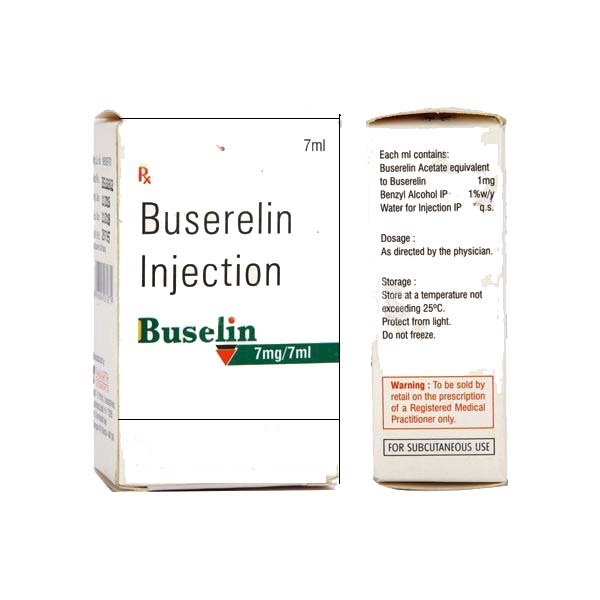
Buserelin is a synthetic gonadotrophin releasing-hormone agonist that when chronically administered results in the reduction of testicular and ovarian hormones in males and females respectively. It is used to treat the following conditions:
-
Endometriosis in women who are not candidates for surgical intervention.
-
For the palliative treatment in patients with advanced prostatic cancer that is hormone-dependent.
Other drugs for prostatic carcinoma are abemaciclib and bicalutimide
Buserelin Dose in Adults
Dose in the treatment of advanced Prostate cancer:
Note: Patients must be started on an antiandrogen therapy 7 days prior to initiating buserelin therapy and continuing for up to 5 weeks.
- SubQ administration:
- Suprefact:
- 500 mcg thrice daily for seven days then 200 mcg once a day.
- Suprefact Depot 2-month:
- 6.3 mg implant every two months
- Suprefact Depot 3-month:
- 9.45 mg implant every 3 months
- Suprefact:
- Intranasal:
- 200 mcg into each nostril three times a day.
Dose in the treatment of Endometriosis:
- Intranasal:
- 200 mcg into each nostril thrice daily for 6 to 9 months.
Buserelin Dose in Childrens
Not applicable
Pregnancy Risk Factor: X
- Pregnant women should not use it.
- Patients should be encouraged to use non-hormonal contraceptives.
- Before starting treatment, it is important to have a pregnancy test.
- If pregnancy is confirmed, treatment must be stopped.
Buserelin use during breastfeeding:
- It is not recommended for use during breastfeeding.
Buserelin Dose in Renal Disease:
- Adjustment in the dose has not been recommended by the manufacturer in patients with renal disease.
Buserelin Dose in Liver Disease:
- Adjustment in the dose has not been recommended by the manufacturer in patients with liver disease.
Common Side Effects of Buserelin Include:
- Central nervous system:
- Headache
- Endocrine & metabolic:
- Loss of libido
- Prostatic cancer
- Hot flash
- Hypermenorrhea
- Endometriosis
- Decreased libido
- Endometriosis
- Prostatic
- Cancer
- Loss of libido
- Gastrointestinal:
- Flatulence
- Genitourinary:
- Impotence
- Prostatic cancer
- Vaginal dryness
- Endometriosis
- Impotence
- Neuromuscular & skeletal:
- Back pain
- Weakness
- Respiratory:
- Nasal mucosa irritation (intranasal)
Less Common Side Effects Of Buserelin Include:
- Cardiovascular:
- Edema
- Hypertension
- Peripheral edema
- Palpitations
- Central nervous system:
- Dizziness
- Depression
- Malaise
- Emotional lability
- Insomnia
- Nervousness
- Pain
- Anxiety
- Hostility
- Sleep disorder
- Dermatologic:
- Acne vulgaris
- Dermatological reaction
- Urticaria at injection site
- Xeroderma
- Daphoresis
- Pruritus
- Endocrine & metabolic:
- Gynecomastia
- Prostatic cancer
- Weight gain
- Premenstrual syndrome
- Endometriosis
- Weight loss
- Menstrual disease
- Endometriosis
- Hirsutism
- Endometriosis
- Increased testosterone level
- Clinical flare
- Prostatic cancer
- Gynecomastia
- Gastrointestinal:
- Diarrhea
- Nausea
- Increased appetite
- Sore throat
- Vomiting
- Gastrointestinal fullness
- Xerostomia
- Gastrointestinal distress
- Dysgeusia
- Constipation
- Genitourinary:
- Leukorrhea
- Mastalgia
- Dyspareunia
- Vaginal discharge
- Vaginitis
- Pelvic pain
- Vaginal discomfort
- Hematologic & oncologic:
- Purpura
- Infection:
- Infection
- Local:
- Application site reaction
- Pain at injection site
- Injection site reaction
- Application site irritation
- Irritation at injection site
- Swelling at injection site
- Neuromuscular & skeletal:
- Arthralgia
- Myalgia
- Limb pain
- Neck stiffness
- Respiratory:
- Dry nose
- Rhinitis
- Upper respiratory tract infection
Contraindication to Buserelin include:
- Allergy to buserelin and any component of this formulation
- Patients with prostate cancer that is not hormone dependent
- Patients who had orchiectomy
Solution Nasal: Other contraindications: Pregnancy; women with undiagnosed abnormal ovarian bleeding.
Warnings and Precautions
- Anemia:
- Anemia can occur in patients receiving androgen-deprivation treatment.
- CNS effects
- It is important to be cautious when operating heavy machinery, or performing tasks that require mental alertness.
- Monitor mood changes in patients.
- Reduced bone density[Canadian Boxed Warn]
- Because of its effects upon bone mineral density, androgen-deprivation therapy can increase the risk of osteoporosis-related bone fractures.
- Patients who have been treated for more than six months and those taking steroids are at greater risk of osteoporosis and bone loss.
- Inflammation of disease: [Canadian Boxed Warn]
- A temporary exacerbation may occur in patients who have undergone therapy. This usually lasts less than 10 days.
- Patients with prostate cancer might experience hematuria, neuropathic symptoms and worsening bone pains.
- Hypersensitivity
- Allergy reactions, including urticaria, pruritus and rash, as well as allergic asthma with dyspnea and local erythema, may occur.
- Implants may be removed if patients have severe reactions.
- Hypogonadism
- Hypogonadism refers to the condition or target of patients who have been prescribed buserelin.
- Hypogonadism can be reversed by discontinuing treatment.
- Pituitary adenoma
- Pituitary adenomas can develop over time if long-term therapy is not used.
- Cardiovascular disease
- Patients without androgens may develop cardiovascular disease.
- An increase in QT-interval is also seen in androgen-deprivation, especially in patients with congenital long QT syndrome, electrolyte imbalance, cardiac failure, or those taking antiarrhythmic medications.
- Before you start therapy, it is important to correct any electrolyte imbalances.
- QTc prolongation is a sign that a patient should stop taking therapy.
- Patients with hypertension should be cautious with it due to the risk of hypertensive crises.
- Diabetes:
- Diabetes patients should be aware that the drug can cause complications.
- Patients should monitor their blood glucose as they may experience a decreased tolerance, which could lead to a reduction in dosage.
- Endometriosis:
- Endometriosis patients may experience a temporary exacerbation in their symptoms and signs after starting therapy.
- Patients who have progressive symptoms or a worsening medical condition may need to stop receiving therapy.
- Patients should be informed to use non-hormonal contraceptives.
- Before starting treatment, it is important to stop using oral contraceptives.
- Obstructive urinary:
- Patients with prostate cancer might develop transient symptoms of urinary retention or obstruction.
Buserelin (United States: Not available): Drug Interaction
|
Antidiabetic Agents |
Hyperglycemia-Associated Agents may diminish the therapeutic effect of Antidiabetic Agents. |
|
Choline C 11 |
Luteinizing Hormone-Releasing Hormone Analogs may diminish the therapeutic effect of Choline C 11. |
|
Haloperidol |
QT-prolonging Agents (Indeterminate Risk - Caution) may enhance the QTcprolonging effect of Haloperidol. |
|
QT-prolonging Agents (Highest Risk) |
QT-prolonging Agents (Indeterminate Risk - Caution) may enhance the QTc-prolonging effect of QT-prolonging Agents (Highest Risk). Management: Monitor for QTc interval prolongation and ventricular arrhythmias when these agents are combined. Patients with additional risk factors for QTc prolongation may be at even higher risk. |
|
Corifollitropin Alfa |
Luteinizing Hormone-Releasing Hormone Analogs may enhance the therapeutic effect of Corifollitropin Alfa. |
|
Indium 111 Capromab Pendetide |
Luteinizing Hormone-Releasing Hormone Analogs may diminish the diagnostic effect of Indium 111 Capromab Pendetide. |
Monitor:
- Blood glucose levels
- Blood pressure
- Signs and symptoms of depression
Prostate cancer:
- Serum testosterone levels at 4 to 6 weeks after treatment initiation and periodically at 3 months interval
- Prostate-specific antigen
- Prostatic acid phosphatase
- Bone scan
- Clinical features of obstructive uropathy
- Digital rectal exam
- ECG in patients at risk for QTc prolongation
- Serum electrolytes like calcium, magnesium, and potassium
- Cardiovascular risk assessment before initiating therapy.
Endometriosis:
- Serum estradiol levels
How to administer Buserelin?
- Intranasal administration:
- Prime the bottle before administering the drug.
- Administer at an equal time interval.
- SubQ administration:
- Administer the drug at an equal time interval and rotate the injection sites.
- Depot injection administration:
- Administer the injection into the lateral abdominal wall.
- A local anesthetic drug may be administered prior to implantation.
Mechanism of action of Buserelin:
- It is a synthetic analog to gonadotropin hormone-releasinghormone (GnRH). It is a GnRH agonist with a longer duration of action.
- It causes an acute increase in gonadotrophins LH and FSH after administration.
- Buserelin chronic administration has the opposite effect. It reduces LH, FSH, and interferes with the production and use of ovarian or testicular steroids.
- This causes a decrease in the amount of gonadal steroids that are castrated when they are taken chronically.
The Mean time It takes about ten days for testosterone levels to reach casting levels after the 3-month depot injection. 15% of the drug is protein-bound. It is Metabolized to inactive metabolites via peptidases. Bioavailability Subcutaneous injections are 70%, while nasal preparations range from 1 to 3%.
The half-life elimination The subcutaneous immediate-release injection takes 80 minutes. The depot implant takes 20-30 minutes. It takes 1 - 2 hours to prepare the nasal passages. Time to get there peak plasma concentrationIt is one-day for 3-month depot injection. It is excreted Primarily via urine
International brands of Buserelin:
- Suprefact
- Suprefact Depot 2 Months
- Suprefact Depot 3 Months
- Bigonist
- Bucel
- Busarlin
- Buserin
- Metrelef
- Profact
- Supradopin
- Suprefact
- Suprefact Depo
- Suprefact E
- Suprfact Depot
- Zerelin
Buserelin Brands in Pakistan:
No brands available in Pakistan
.png)


