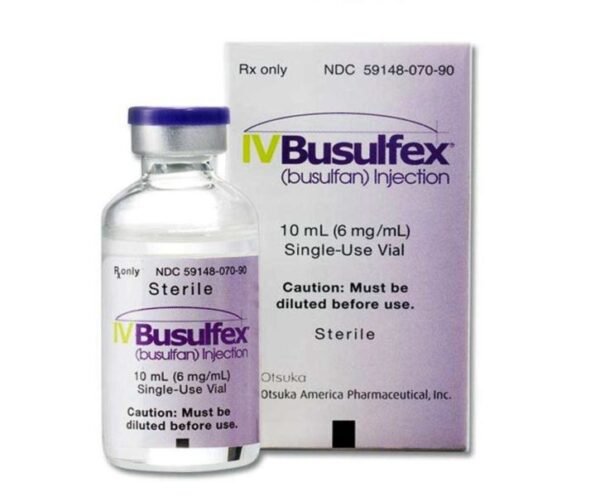
Busulfan is a chemotherapeutic drug that is interferes with DNA by cross-linking it. It is used in the treatment of the following conditions:
-
CML (Chronic myeloid leukemia):
-
Conditioning regimen in combination with cyclophosphamide before the allogeneic hematopoietic progenitor cell transplantation for chronic myeloid leukemia (CML).
-
-
Off Label Use of Busulfan in Adults include:
-
Essential thrombocythemia resistant to therapy
-
For refractory or resistant polycythemia vera.
-
As oral therapy in conditioning regimen in patients with hematopoietic stem cell transplant (HSCT).
-
Busulfan Dose in Adults
Note:
Patients should be premedicated with prophylactic anticonvulsant therapy 12 hours before high-dose busulfan treatment and continuing for 24 hours after the last busulfan dose. Antiemetics may be advised to prevent nausea and vomiting.
Dose in the treatment of resistant Essential thrombocythemia:
- Adults older than 60 years of age:
- 2 - 4 mg orally once a day
- Treatment should be withheld if the platelets count drop to less than 200,000/mm³ or WBC is less than 3,000/mm³.
- Treatment should be resumed at a lower dose i.e. 2 mg once a day.
Hematopoietic stem cell (HSCT) conditioning regimen:
- 0.8 mg/kg/dose intravenous every 6 hours for four days to a total of 16 doses beginning 7 days before the transplant followed by cyclophosphamide (actual body weight or ideal body weight, whichever is lower should be used).
- The manufacturer recommends adjusting the dose in obese and morbidly obese patients as [IBW + 0.25 x (actual – IBW)].
Conditioning regimens (off-label):
Note: Myeloablative conditioning regimens include total busulfan doses of more than 8 mg/kg per course and reduced-intensity conditioning regimens include total busulfan doses of less than 8 mg/kg per course.
- Bu4/Cy regimen:
- 0.8 mg/kg intravenous every 6 hours for 16 doses (total busulfan dose of 12.8 mg/kg over four days
- This is followed by 2 days of cyclophosphamide, then allogeneic HSCT after one day of rest.
- Flu/Bu4 regimen:
- 0.8 mg/kg intravenous every 6 hours for 16 doses beginning six days before allogeneic transplant (total busulfan dose 12.8 mg/kg over four days in combination with four days of fludarabine or
- Reduced-intensity conditioning regimen:
- 0.8 mg/kg intravenous once a day for four days beginning 5 days before allogeneic transplant (total busulfan dose 3.2 mg/kg over 4 days in combination with 4 days of fludarabine).
- Flu/Bu4 (once a day) regimen:
- 130 mg/m² intravenous over three hours once a day for four days in combination with 4 days of fludarabine ± thymoglobulin, followed by allogeneic transplant
- Busulfan should be administered after fludarabine each day.
- Bu/Cy regimens:
- 1 mg/kg orally every six hours for 16 doses (total busulfan dose of 16 mg/kg over four days; followed by two days of cyclophosphamide, then allogeneic HSCT two days later on day 8) or
- 1 mg/kg orally every six hours for 16 doses (total busulfan dose of 16 mg/kg over four days followed by two days of cyclophosphamide, followed by allogeneic marrow transplant) or
- 1 mg/kg orally every 6 hours for 16 doses beginning nine days prior to transplant (total busulfan dose of 16 mg/kg over four days followed by 4 days of cyclophosphamide, followed by allogeneic or autologous marrow transplant).
- Bu/Mel regimen:
- 1 mg/kg orally every six hours for 16 doses beginning six days prior to transplant (total busulfan dose of 16 mg/kg over four days followed by Intravenous melphalan, followed by autologous transplant).
- Bu/Mel/TT regimen:
- 1 mg/kg orally every six hours for 12 doses beginning eight days prior to transplant (total busulfan dose of 12 mg/kg over three days, followed by two days of Intravenous melphalan and then two days of thiotepa)
- Flu/Bu2 regimen:
- 1 mg/kg orally every 6 hours for 8 doses beginning six days prior to transplant (total busulfan dose of 8 mg/kg over two days in combination with 6 days of fludarabine and 4 days of ATG)
- Flu/Bu4:
- 1 mg/kg orally every six hours for 16 doses (total busulfan dose of 16 mg/kg over four days in combination with 4 days of fludarabine).
Dose in the treatment of refractory or resistant Polycythemia vera:
- 2 - 4 mg orally once a day.
- Withhold treatment when the platelets count drop to less than 200,000/mm³ or WBC is less than 3,000/mm³.
- The treatment should be resumed at a lower dose of 2 mg once a day.
Busulfan Dose in Childrens
Note:
- Patients should be premedicated with prophylactic anticonvulsant therapy 12 hours before high-dose busulfan treatment and continuing for 24 hours after the last busulfan dose.
- Antiemetics may be advised to prevent nausea and vomiting.
Dose in Hematopoietic stem cell transplant (HSCT) conditioning regimen:
Note:
- Dosing is based on the actual body weight, including obese individuals Initial:
- Therapeutic drug monitoring should be considered early in the regimen and doses should be adjusted accordingly.
- 12 kg or less:
- 1.1 mg/kg/dose intravenous every 6 hours for 16 doses over four days followed by cyclophosphamide.
- More than 12 kgs:
- 0.8 mg/kg/dose intravenous every 6 hours for 16 doses over four days followed by cyclophosphamide
- 12 kg or less:
Reduced-intensity conditioning regimens:
- 12-dose regimen:
- Children older than 2 years and Adolescents:
- 0.8 mg/kg/dose intravenous every 6 hours for 12 doses starting on Day 6.
- It is used in combination with melphalan and fludarabine for patients receiving haploidentical, peripheral blood HSCT for acute leukemia.
- Children older than 2 years and Adolescents:
- 8-dose regimen:
- Infants, Children, and Adolescents:
- 0.8 mg/kg/dose intravenous for one dose on either day 7 (related donor) or day 10 (unrelated donor or cord recipient) before the transplant
- This is followed by 7 additional doses of 0.8 mg/kg/dose every six hours beginning on days 3 and 2 (related donor) or days 6 and 5 (unrelated donor or cord recipient) before the transplant.
- It is used in combination with fludarabine and anti-thymocyte globulin (rabbit).
- Infants, Children, and Adolescents:
- Once-Daily Dosing:
- Infants less than 1 year:
- 80 mg/m²/dose intravenous over three hours once a day for four days prior to HSCT, starting on Day 8 in combination with cyclophosphamide or fludarabine and etoposide.
- Children more than 1 year and Adolescents:
- 120 mg/m²/dose Intravenous over three hours once a day for 4 days prior to HSCT, starting on Day 8 in combination with cyclophosphamide or fludarabine and etoposide.
- 120 mg/m²/dose Intravenous over three hours once a day for 4 days prior to HSCT, starting on Day 8 in combination with cyclophosphamide or fludarabine and etoposide.
- Infants less than 1 year:
Acute Myeloid Leukemia:
- Adolescents older than 16 years:
- 1 mg/kg/dose orally every 6 hours for 16 doses on days 9 to 6 in combination with cyclophosphamide.
- 1 mg/kg/dose orally every 6 hours for 16 doses on days 9 to 6 in combination with cyclophosphamide.
Thalassemia major:
- Class 1 or Class 2 (ie, low-risk for GVHD or transplant mortality):
- Infants and Children less than 3 years:
- 1.25 mg/kg orally every six hours for 16 doses on day 9 to day 6 prior to transplant in combination with cyclophosphamide and anti-thymocyte globulin (horse).
- Children older than 3 years and Adolescents:
- 1 mg/kg/dose orally every six hours for 16 doses prior to transplant on days 9 to 6 in combination with cyclophosphamide and anti-thymocyte globulin (horse).
- Infants and Children less than 3 years:
- Class 3 (i.e, high-risk disease):
- Children older than 10 years and Adolescents:
- 2 mg/kg/dose orally twice daily for 4 doses on days 8 and 7 in combination with fludarabine and anti-thymocyte globulin (horse).
- Children older than 10 years and Adolescents:
Pregnancy Risk Factor D
- Busulfan can cause adverse effects in the fetus, including teratogenic effects, if taken during pregnancy.
- Effective contraception should be used by females with reproductive potential during therapy and for six months following its completion.
- Effective contraception should be used by males with a female partner who has reproductive potential during treatment, and for the three months following.
- It can also affect fertility in males and females.
Busulfan is used during breastfeeding
- It is unknown if the drug can be absorbed into breastmilk.
- When deciding whether to continue breastfeeding or stop, it is important to consider both the maternal benefits and the potential benefits for the neonate.
- Intravenous busulfan is contraindicated for breastfeeding.
Busulfan Dose in Renal Disease:
Adjustment in the dose has not been recommended by the manufacturer in patients with renal disease.
Busulfan Dose in Liver Disease:
Adjustment in the dose has not been recommended by the manufacturer in patients with liver disease.
Common Side Effects Of Busulfan injection Include:
- Cardiovascular:
- Edema
- Tachycardia
- Hypertension
- Thrombosis
- Chest pain
- Vasodilatation
- Central nervous system:
- Insomnia
- Anxiety
- Headache
- Chills
- Pain
- Dizziness
- Depression
- Dermatologic:
- Skin rash
- Pruritus
- Endocrine & metabolic:
- Hypomagnesemia
- Hyperglycemia
- Hypokalemia
- Hypocalcemia
- Gastrointestinal:
- Vomiting
- Nausea
- Mucositis
- Stomatitis
- Anorexia
- Diarrhea
- Abdominal pain
- Dyspepsia
- Constipation
- Xerostomia
- Rectal disease
- Gastrointestinal fullness
- Hematologic & oncologic:
- Neutropenia
- Bone marrow depression
- Thrombocytopenia
- Lymphocytopenia
- Anemia
- Hepatic:
- Hyperbilirubinemia
- Increased serum ALT
- Hepatic sinusoidal obstruction syndrome
- Hypersensitivity:
- Hypersensitivity reaction
- Immunologic:
- Graft versus host disease
- Local:
- Inflammation at the injection site
- Neuromuscular & skeletal:
- Weakness
- Back pain
- Renal:
- Increased serum creatinine
- Respiratory:
- Rhinitis
- Pulmonary disease
- Cough
- Dyspnea
- Epistaxis
- Pneumonia
- Miscellaneous:
- Fever
Less Common Side Effects Of Busulfan Include:
- Cardiovascular:
- Cardiac tamponade
Frequency not defined:
- Cardiovascular:
- Atrial fibrillation
- Cardiac arrhythmia
- Cardiomegaly
- Catheter site thrombosis
- Central venous catheter
- Complete atrioventricular block
- ECG abnormality
- Flushing
- Hypotension
- Left heart failure
- Pericardial effusion
- Ventricular premature contractions
- Central nervous system:
- Agitation
- Brain disease
- Cerebral hemorrhage
- Coma
- Confusion
- Delirium
- Drowsiness
- Hallucination
- Lethargy
- Dermatologic:
- Acne vulgaris
- Alopecia
- Erythema nodosum
- Exfoliative dermatitis
- Maculopapular rash
- Skin discoloration
- Vesicular eruption
- Vesiculobullous dermatitis
- Endocrine & metabolic:
- Hot flash
- Hypervolemia
- Hyponatremia
- Hypophosphatemia
- Weight gain
- Gastrointestinal:
- Esophagitis
- Hematemesis
- Hiccups
- Intestinal obstruction
- Pancreatitis
- Rectal pain
- Genitourinary:
- Dysuria
- Hematuria
- Hemorrhagic
- Cystitis
- Oliguria
- Hematologic & oncologic:
- Prolonged prothrombin time
- Hepatic:
- Hepatomegaly
- Increased serum alkaline phosphatase
- Jaundice
- Immunologic:
- Graft versus host disease
- Infection:
- Infection
- Local:
- Pain at the injection site
- Neuromuscular & skeletal:
- Arthralgia
- Myalgia
- Otic:
- Ear disease
- Renal:
- Increased blood urea nitrogen
- Respiratory:
- Asthma
- Atelectasis
- Hemoptysis
- Hyperventilation
- Hypoxia
- Pharyngitis
- Pleural effusion
- Pulmonary alveolar hemorrhage
- Pulmonary interstitial fibrosis
- Sinusitis
Common Side Effects Of Oral Busulfan Include:
- Central nervous system:
- Seizure
- despite prophylactic seizure therapy
- Seizure
- Dermatologic:
- Skin hyperpigmentation
Frequency not defined:
- Endocrine & metabolic:
- Amenorrhea
- Ovarian failure
- Hematologic & oncologic:
- Bone marrow depression
- Anemia
- Leukopenia
- Thrombocytopenia pancytopenia
- Bone marrow depression
- Respiratory:
- Pulmonary interstitial fibrosis
Contraindication to Busulfan Include:
- Allergy reactions to busulfan and any component of this formulation
- Busulfan resistance is a problem
- Neutropenia andthrombocytopenia.
Warnings and Precautions
- Suppression of bone marrow [US Boxed Warning]
- It is possible to experience bone marrow suppression, which can be severe and persistent.
- This is manifested as severe neutropenia, anemia, and thrombocytopenia.
- You may need to reduce or withhold the dose. A repeat bone marrow biopsy may be required by some patients.
- Monitor CBC with differential counts when used for transplantation until engraftment
- Neutropenia is a condition that occurs within 4 days of transplantation. Recovery can be seen in 13 days with prophylactic filgrastim.
- Thrombocytopenia can be diagnosed in as little as 5 to 6 days.
- Monitor patients for signs and symptoms of bleeding or infection.
- Cardiovascular:
- Patients with Thalassemic Disease may get cardiac tamponade if they are treated with high doses of oral busulfan and cyclophosphamide.
- Children often experience abdominal pain and vomiting before they have a cardiac tamponade.
- It is important to monitor patients for signs and symptoms of cardiac tamponade, and treat them immediately.
- Gastrointestinal toxicities:
- It can also cause severe nausea and vomiting.
- Antiemetics should always be discussed before starting therapy.
- Sinusoidal obstruction syndrome of the liver
- Busulfan therapy is known to increase the risk of hepatic sinoidal obstruction syndrome (venoocclusive disease). This can be especially true for patients who have received high doses of busulfan therapy or those who have had prior radiation therapy, chemotherapy, alkylating agents used, or stem cell transplantation.
- To detect hepatotoxicity, liver function tests must be performed every day for 28 days following transplant.
- Toxicity in the lungs:
- Chronic busulfan therapy is associated with pulmonary fibrosis (Busulfan lung), and bronchopulmonary dysplasia.
- Sometimes symptoms may not appear until four years after treatment, and can be fatal.
- A cough, shortness or fever may develop in patients.
- Tests of pulmonary function may show decreased lung compliance or reduced lung capacity.
- Before identifying the patient, it is important to rule out leukemic pulmonary infection and opportunistic pneumonia infections.
- Treatment should be stopped if toxicemia develops.
- If busulfan causes toxicity, discontinue use.
- Secondary malignancies
- It is possible for chromosomal alterations to occur.
- Acute leukemia can lead to other types of cancer.
- Seizures
- There have been reports of seizures resulting from high-dose intravenous therapy and oral therapy.
- Before the transplant regimen begins, patients should be treated with prophylactic anticonvulsant medication.
- Patients who have had seizures or head trauma should not take the drug.
- Tissue dysplasia
- Busulfan has been linked to cellular dysplasia in several organs, in addition to lung dysplasia.
- In the adrenal glands and liver, pancreas, lymphodes, thyroid, bone marrow, and liver, giant hyperchromatic nuclei were observed.
- It can obscure routine diagnostic tests like the cervical smear.
Busulfan: Drug Interaction
Note: Drug Interaction Categories:
- Risk Factor C: Monitor When Using Combination
- Risk Factor D: Consider Treatment Modification
- Risk Factor X: Avoid Concomitant Use
Risk Factor C (Monitor therapy). |
|
| Acetaminophen | Busulfan serum concentration may be increased |
| Antifungal Agents (Azole derivatives, Systemic). | Busulfan serum concentration may be increased. Isavuconazonium Considerations are dealt with in separate monographs. Isavuconazonium Sulfate is an exception. |
| Blinatumomab | Busulfan serum concentration may be increased |
| Chloramphenicol Ophthalmic | May increase the toxic/adverse effects of Myelosuppressive Agents. |
| CloZAPine | CloZAPine's toxic/adverse effects may be exacerbated by myelosuppressive agents. Particularly, there may be an increase in the risk of neutropenia. |
| Coccidioides immitis skin test | Coccidioides immitis Skin Test may be affected by immunosuppressants. |
| Denosumab | Might increase the toxic/adverse effects of Immunosuppressants. In particular, there may be an increase in the risk of serious infections. |
| Fosphenytoin | Busulfan serum concentration may be decreased |
| Ifosfamide | Busulfan could increase the toxic/adverse effects of Ifosfamide. The risk of hemorhagic cystitis and other complications may be elevated. |
| Ocrelizumab | May increase the immunosuppressive effects of Immunosuppressants. |
| Phenytoin | Busulfan serum concentration may be decreased |
| Pidotimod | Pidotimod's therapeutic effects may be diminished by immunosuppressants. |
| Promazine | May increase the myelosuppressive effects of myelosuppressive agents. |
| Propacetamol | Busulfan serum concentration may be increased |
| Siponimod | Siponimod's immunosuppressive effects may be enhanced by taking immunosuppressants. |
| Sipuleucel - T | Sipuleucel T's therapeutic effects may be diminished by immunosuppressants |
| Tertomotide | Tertomotide's therapeutic effects may be diminished by immunosuppressants. |
| Trastuzumab | May increase the neutropenic effects of Immunosuppressants. |
Risk Factor D (Regard therapy modification) |
|
| Baricitinib | Baricitinib's immunosuppressive effects may be enhanced by immunosuppressants. Baricitinib should not be used in combination with immunosuppressants like azathioprine and cyclosporine. It is permissible to use methotrexate antirheumatically or nonbiologic disease-modifying antirheumatic drug (DMARDs), concurrently. |
| Deferasirox | The serum Busulfan concentration may increase. Before starting busulfan, discontinue deferasirox for approximately 2 to 3 days (approximately five half-lives). Monitor for elevated busulfan effects and concentrations if combined. Concomitant use may require reduced busulfan doses. |
| Echinacea | Might decrease the therapeutic effects of Immunosuppressants. |
| Fingolimod | Fingolimod may be immunosuppressed by immunosuppressants. When possible, avoid the use of fingolimod with other immunosuppressants. Patients should be closely monitored for any additive immunosuppressant effects, such as infections, if they are used together. |
| Leflunomide | Leflunomide's toxic/adverse effects may be exacerbated by immunosuppressants. The risk of hematologic toxicities such as pancytopenia and agranulocytosis may increase. Patients on immunosuppressants should not be given a leflunomide loading dosage. Patients who are receiving leflunomide or another immunosuppressant must be checked for bone marrow suppression at minimum monthly. |
| Lenograstim | Antineoplastic Agents can reduce the therapeutic effects of Lenograstim. Management: Lenograstim should be avoided 24 hours prior to and 24 hours following the completion of myelosuppressive, cytotoxic chemotherapy. |
| Lipegfilgrastim | Antineoplastic agents may reduce the therapeutic effects of Lipegfilgrastim. Management: It is important to avoid the simultaneous use of lipegfilgrastim with myelosuppressive, cytotoxic chemotherapy. After myelosuppressive chemotherapy has been completed, lipegfilgrastim must be given at least 24 hours. |
| MetroNIDAZOLE Systemic | Busulfan serum concentration may increase Concomitant use with metronidazole may increase the toxic effects of Busulfan. Combinations of metronidazole and busulfan should be avoided whenever possible. Busulfan toxicities should be monitored more closely if these agents are used together. |
| Nivolumab | Nivolumab's therapeutic effects may be diminished by immunosuppressants. |
| Palifermin | Can increase the toxic/adverse effects of Antineoplastic Agents. In particular, oral mucositis can be more severe and prolonged. Management: Avoid palifermin administration within the first 24 hours of infusion or 24 hours following myelotoxic chemotherapy. |
| Roflumilast | May increase the immunosuppressive effects of Immunosuppressants. |
| Tofacitinib | Tofacitinib's immunosuppressive effects may be enhanced by immunosuppressants. Management: It is permissible to use Tofacitinib in combination with antirheumatic methotrexate and nonbiologic disease modifying antirheumatic drug (DMARDs). This warning appears to be particularly targeted at more potent immunosuppressants. |
| Vaccines (Inactivated). | Immunosuppressants can reduce the therapeutic effects of Vaccines (Inactivated). Management: The effectiveness of vaccines may be decreased. All age-appropriate vaccines must be completed at least two weeks before you start an immunosuppressant. Re-vaccinate anyone who was vaccinated while on immunosuppressant therapy. |
Risk Factor X (Avoid Combination) |
|
| BCG (Intravesical). | The therapeutic effects of BCG (Intravesical) may be diminished by immunosuppressants |
| BCG (Intravesical). | Myelosuppressive agents may reduce the therapeutic effects of BCG (Intravesical). |
| Cladribine | May increase the immunosuppressive effects of Immunosuppressants. |
| Cladribine | May increase the myelosuppressive effects of Myelosuppressive Drugs. |
| Deferiprone | Deferiprone may have a neutropenic effect that myelosuppressive agents can increase. |
| Dipyrone | May increase the toxic/adverse effects of Myelosuppressive Agents. In particular, there may be an increase in the risk of pancytopenia and agranulocytosis. |
| Natalizumab | Natalizumab's toxic/adverse effects may be exacerbated by immunosuppressants. Particularly, concurrent infections may increase. |
| Pimecrolimus | May increase the toxic/adverse effects of Immunosuppressants |
| Tacrolimus - Topical | May increase the toxic/adverse effects of Immunosuppressants |
| Vaccines (Live). | Immunosuppressants can increase the toxic/adverse effects of Vaccines (Live). Immunosuppressants can decrease the therapeutic effects of Vaccines. Management: Live-attenuated vaccines should be avoided for at least three months following immunosuppressants. |
Monitor:
-
How can you monitor therapeutic drug concentrations
- Blood CP with differential, platelet count and blood CP once per week for palliative care and daily until engraftment to HSCT
- Daily liver function tests for at least 28 consecutive days following transplant
- For signs and symptoms of sinusoidal obstruction syndrome, monitor closely.
- Monitor for cardiac tamponade clinical signs.
- It is important to take the sample at the right time
- During the infusion, it is not recommended to take a blood sample.
- You should collect the blood sample from a different location than that used for infusions.
- After collection, immediately place the blood sample on ice and centrifuge at 4°C (39.2°F) within an hour.
- You should immediately freeze the plasma at -20°C (-4°F) after it is collected.
- For determination of plasma busulfan concentrations, plasma samples must be sent frozen on dry ice.
How to administer Busulfan?
Antiemetics should be administered with busulfan as it is associated with a moderate emetic potential.
-
Intravenous busulfan:
- It should be infused over two hours via a central venous line.
- The line should be flushed with 5 ml Dextrose water before and after each infusion.
- It is not compatible with polycarbonate.
- Syringes, filters, intravenous tubings that contain polycarbonate should be avoided.
-
Oral Busulfan (used for Hematopoietic Stem Cell Transplant only):
- High oral doses may be administered by placing multiple tablets into an empty gelatin capsule.
Mechanism of action of Busulfan:
- Busulfan, an alkylating Agent, cross-links DNA and interferes with DNA transcription.
- It reacts with the N-7 position guanosine. It is more toxic to myeloid cells that it is to lymphoid cells, and has a stronger effect on myeloid cells.
It's fast and complete.Intake. 32% of the drug's total isPlasma proteins boundWhile 47% are bound to red blood cell, It isMetabolizedThe liver is responsible for a lot of this through conjugation with glutathione and subsequent oxidation. It has been abioavailability68% for children under six years old and 80% for adults and older children.
It has been aEliminating half-lifeBetween 2 and 3 hours depending on the distance to be covered.Peak plasma concentrationIt is five minutes after intravenous administration, and one hour after oral administration. It is primarilyExcretedVia urine
International Brands of Busulfan:
- Busilvex
- Busulf
- Busulfex
- Myleran
- Myleran-2
- Myran
Busulfan brands in Pakistan:
|
Busulphan [Tabs 2 Mg] |
|
| Busulf | Pharmedic (Pvt) Ltd |
.png)