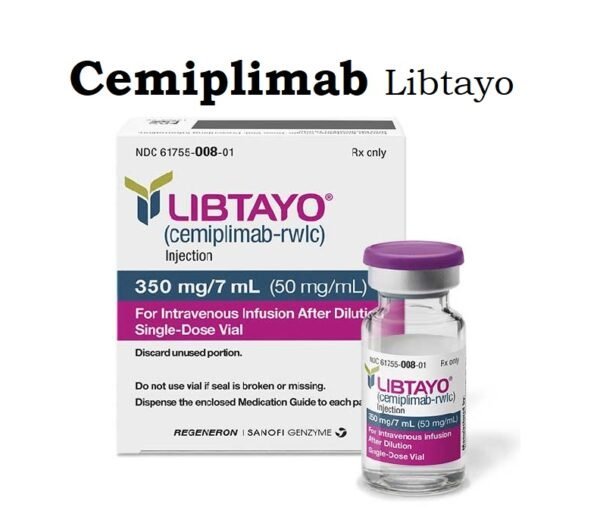
Cemiplimab (Libtayo) is a fully human monoclonal antibody that targets immune checkpoints. It has been approved for the treatment of advanced skin cancer.
Cemiplimab (Libtayo) Use:
-
Metastatic or locally advanced cutaneous squamous cell carcinoma:
- Treatment of metastatic cutaneous squamous cell carcinoma (CSCC) or locally advanced CSCC in patients who are not candidates for curative surgery or curative radiation.
Cemiplimab (Libtayo) Dose in Adults
Cemiplimab (Libtayo) Dose in the treatment of metastatic or locally advanced cutaneous squamous cell carcinoma:
- IV: 350 mg once 3 weekly, continue till disease progression or unacceptable toxicity.
Cemiplimab (Libtayo) Dose in Childrens
Not recommended for use in children.
Pregnancy Risk Category: Not Assigned
- Cemiplimab, a monoclonal antibody to recombinant human IgG4 (IgG4) is known to cross over the placenta.
- Fetal harm can result from the use of cemiplimab in pregnancy, based on its mechanism of action and information gleaned from animal reproduction studies.
- Before starting therapy, assess your pregnancy.
- Effective contraceptive methods should be used by females with reproductive potential during therapy, and at least for 4 months following the last dose of cemiplimab.
Use of cemiplimab during breastfeeding
- It is unknown if breast milk contains cemiplimab.
- The manufacturer doesn't recommend breastfeeding during therapy, or for more than 4 months after receiving the last dose of cemiplimab.
Cemiplimab (Libtayo) Dose in Kidney disease:
-
Renal impairment prior to treatment initiation:
-
CrCl (determined with Cockcroft-Gault) ≥25 mL/minute:
- There are no dosage adjustments provided in the manufacturer’s labeling; however, CrCl 25 to 420 mL/minute had no clinically important effect on cemiplimab pharmacokinetics.
-
CrCl <25 mL/minute:
- There are no dosage adjustments provided in the manufacturer’s labeling.
-
-
Renal toxicity during treatment:
-
Immune-mediated nephritis:
- Administer systemic corticosteroids (1 to 2 mg/kg/day prednisone [or equivalent]) or other appropriate therapy for grade 3 or 4 immune-mediated adverse reactions until improvement to grade 1 or lower, then follow with a corticosteroid taper.
-
Grade 3:
- Withhold treatment; may resume with complete or partial resolution of toxicity (grade 0 or 1) after corticosteroid taper.
-
Grade 4:
- Permanently discontinue cemiplimab.
-
Cemiplimab (Libtayo) Dose in Liver disease:
-
Hepatic impairment prior to treatment initiation:
-
Mild impairment:
- There are no dosage adjustments provided in the manufacturer’s labeling; however, mild hepatic impairment had no clinically important effect on cemiplimab pharmacokinetics.
-
Moderate to severe impairment:
- There are no dosage adjustments provided in the manufacturer’s labeling (has not been studied).
-
-
Hepatotoxicity during treatment:
-
Immune-mediated hepatitis:
- Administer systemic corticosteroids (1 to 2 mg/kg/day prednisone [or equivalent]) or other appropriate therapy for grade 3 or 4 immune-mediated adverse reactions until improvement to grade 1 or lower, then follow with a corticosteroid taper.
-
ALT or AST >3 to 10 times the upper limit of normal (ULN) or total bilirubin up to 3 times ULN:
- Withhold treatment; may resume with complete or partial resolution of toxicity (grade 0 or 1) after corticosteroid taper.
-
ALT or AST >10 times ULN or total bilirubin >3 times ULN:
- Permanently discontinue.
-
Common Side Effects of Cemiplimab (Libtayo):
-
Central Nervous System:
- Fatigue
-
Dermatologic:
- Skin Rash
- Dermatologic Disorders
- Pruritus
-
Gastrointestinal:
- Diarrhea
- Nausea
- Constipation
-
Neuromuscular & Skeletal:
- Musculoskeletal Pain
Less Common Side Effects Of Cemiplimab (Libtayo):
-
Cardiovascular:
- Hypertension
-
Dermatologic:
- Cellulitis
- Skin Infection
- Erythema Multiforme
- Pemphigoid
-
Endocrine & Metabolic:
- Hypothyroidism
- Hypophosphatemia
- Hyponatremia
- Hyperthyroidism
- Hypercalcemia
- Hypoalbuminemia
-
Gastrointestinal:
- Decreased Appetite
-
Genitourinary:
- Urinary Tract Infection
-
Hematologic & Oncologic:
- Lymphocytopenia
- Anemia
- Increased INR
-
Hepatic:
- Increased Serum Aspartate Aminotransferase
- Hepatitis
-
Immunologic:
- Antibody Development
-
Infection:
- Sepsis
-
Respiratory:
- Pneumonia
- Pneumonitis
Rare Side effects of Libtayo:
-
Dermatologic:
- Stevens-Johnson Syndrome
- Toxic Epidermal Necrolysis
Contraindications to Cemiplimab (Libtayo):
- The manufacturer's labeling does not list any contraindications.
Warnings and precautions
-
Insufficiency of the adrenals:
- Rarely, adrenal insufficiency can occur.
-
Negative events (immune-mediated).
- PD-1/PD-L1 inhibitors, including cemiplimab, inhibit the immune response and allow for the induction of immune-mediated adverse effects.
- Any tissue or organ can be affected by immune-mediated adverse events that can be fatal or severe.
- Although most adverse reactions to treatment are caused by immune mechanisms, they can also be experienced after cemiplimab is stopped.
- It is important to identify and manage PD-1/PDL1 antibodies early in order to avoid the use of these blocking agents.
- Be on the lookout for immune-mediated adverse effects.
- At baseline and during treatment, evaluate serum chemistries (including thyroid function and hepatic tests).
- Medical management can be initiated immediately and includes specialty consultation, if necessary.
- Withhold cemiplimab in grade 3 or 4, and for some immune-mediated side effects of grade 2.
- Cemiplimab should be permanently discontinued for any grade 4 (or some grade 3) immune-mediated adverse reaction.
- Systemic corticosteroids (or equivalent) should be administered at 1 to 2 mg/kg/day to treat grade 3 or 4, and certain grade 2 immune-mediated adverse reactions. Once the grade is stable, taper off.
- Consider administering other systemic immunosuppressants if the immune-mediated adverse reaction cannot be controlled with systemic corticosteroids.
- Endocrinopathies may require hormone replacement therapy if it is clinically indicated.
-
Dermatologic toxicities:
- Cemiplimab has been used to study immune-mediated dermatologic toxic events including erythema multiforme, pemphigoid and erythema multiforme.
- Stevens-Johnson syndrome and toxic epidermal necrolysis have been seen with cemiplimab, as well as other products from the same class.
- All patients suffering from dermatologic reactions required systemic corticosteroids. Most of these patients needed prednisone (or an equivalent) at 40 mg/day.
- One-third of the patients had dermatologic reactions that resolved. However, more than one-fifth of the patients experienced a relapse in dermatologic toxicities after re-initiation cemiplimab.
-
Diabetes mellitus
- Type 1 diabetes mellitus, which may present with diabetic ketoacidosis, has been seen in a small number of patients. This includes grade 3 and 4.
- A small percentage of Type 1 diabetics were able to stop taking their medications permanently.
-
Toxicity to the GI:
- Patients treated with cemiplimab, including grade 2 and 3, have been shown to develop immune-mediated colitis.
- A small percentage of patients with colitis experienced permanent discontinuation.
- All patients with colitis required systemic corticosteroids. More than half received prednisone >=40mg/day (or an equivalent).
- Most patients with colitis are successful.
- Pancreatitis (including elevated serum amylase levels and lipase level), gastritis and duodenitis were also reported.
-
Hepatitis
- It has been reported that immune-mediated hepatitis can be observed. Some fatalities have occurred in grade 3 and higher.
- A small number of patients were able to stop taking their medication permanently due to hepatitis.
- All patients with hepatitis required systemic corticosteroids. Most patients needed prednisone >=40mg/day (or the equivalent).
- Nearly two-thirds (33%) of patients with hepatitis were successful in resolving the disease.
-
Hypophysitis
- Hypophysitis, including grade 3 events, has been reported (rarely).
- Hypophysitis can lead to hypopituitarism.
-
Infusion reactions
- Rarely, patients who received cemiplimab have experienced infusion-related reactions (grade 3),
- Be on the lookout for symptoms and signs of infusion-related reactions.
- Depending on the severity of the reaction, you may interrupt or slow down the infusion rate or discontinue cemiplimab permanently.
-
Nephrotoxicity
- A small number of patients who received cemiplimab have experienced immune-mediated nephritis and renal dysfunction.
- Permanent cemiplimab discontinuation was rare in the case of Nephritis.
- All patients with nephritis required systemic corticosteroids, with two-thirds of them requiring prednisone >=40mg/day (or an equivalent).
- All patients are cured of nephritis.
-
Ocular disorders
- Ocular events include uveitis and iritis, as well as visual impairment (various grade; may include blindness) and other ocular inflammatory toxicities.
- Some cases have been linked to retinal detachment.
- Consider a Vogt Koyanagi-Harada-like condition if uveitis is present in combination with other immune-mediated adverse effects.
- To reduce the chance of permanent vision loss, you may need systemic corticosteroid injections.
-
Pneumonitis
- Cemiplimab has been shown to prevent immune-mediated pneumonitis, some of which can be fatal.
- A small number of patients were able to stop taking their medication permanently due to pneumonitis.
- All patients with pneumonitis required systemic corticosteroids. Most received prednisone >=40mg/day (or an equivalent).
- Over half of patients with pneumonitis are successfully treated.
-
Thyroid disorders
- Patients who received cemiplimab (including grade 2 and 3, hypothyroidism) have experienced hypothyroidism.
- There have been cases of hyperthyroidism in grade 2 and 3, which was resolved in more than one-third.
-
Other immune-mediated toxicities
- Cemiplimab and other medications of the same class have also been associated with clinically significant immune-mediated side effect (some were severe, some fatal).
- Meningitis, encephalitis and myelitis were some of the events.
Monitoring parameters:
- Evaluate serum chemistries, hepatic function tests, and thyroid function tests (at baseline and periodically during treatment).
- Pregnancy test (prior to therapy in females of reproductive potential).
- Monitor for signs/symptoms of adrenal insufficiency, dermatologic toxicity, diabetes mellitus, diarrhea/colitis, hepatitis, hypophysitis, ocular disorders, pneumonitis, thyroid disorders, and other immune-mediated adverse reactions.
- Monitor for signs/symptoms of infusion-related reactions.
How to administer Cemiplimab (Libtayo)?
- IV: Infuse over 30 minutes through a 0.2 to 5 micron inline or add-on filter.
- Allow the solution to reach room temperature before infusion.
- Monitor for infusion reactions (may require infusion rate reduction, infusion interruption, or discontinuation depending on the severity).
Mechanism of action of cemiplimab (Libtayo):
- Cemiplimab, a recombinant monoclonal human IgG4 antibody that inhibits programmed deaths-1 (PD-1) activity, binds to PD-1 and blocks the interactions with ligands PD-L1 & PD-L2, releasing PD-1 pathway-mediated inhibition immune response including the anti-tumor reaction. PD1 ligand elevation may be seen in certain tumors. This pathway can also contribute to the inhibition of active T-cell immune surveillance.
- Reduced tumor growth has been achieved by blocking PD-1 activity.
Half-life elimination:
- 19 days
Excretion:
- Clearance: First dose: 0.32 L/day; steady state: 0.21 L/day.
International Brands of Cemiplimab:
- Libtayo
Cemiplimab Brand Names in Pakistan:
No Brands Available in Pakistan.
.png)


