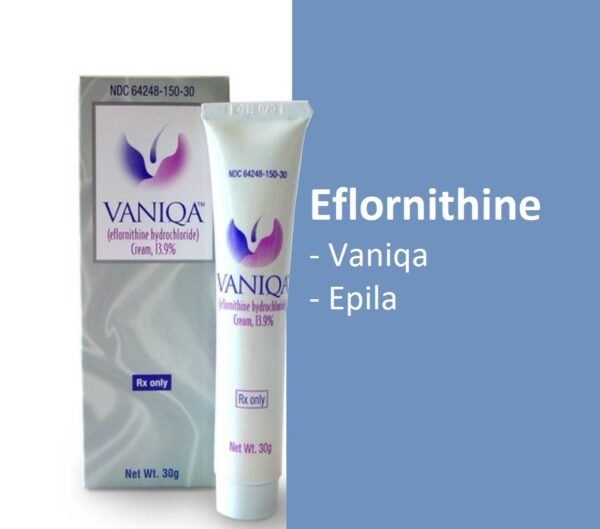
Eflornithine (Vaniqa) inhibits the enzyme Ornithine decarboxylase that is required for cellular replication and differentiation. The topical cream is used in the treatment of excessive unwanted facial hair. The injection formulation is used as an off-label medicine for the treatment of sleeping sickness.
Eflornithine (Vaniqa) Uses:
-
Facial hair reduction:
- It is indicated in female patients with excessive facial and chin hair. It is applied as a topical cream to reduce unwanted hair in females.
-
Off Label Use of Eflornithine in Adults:
- The intravenous formulation is used as an off-label drug for the treatment of sleeping sickness (meningoencephalitic stage of Trypanosoma brucei gambiense infection)
Eflornithine (Vaniqa) Dose in Adults
Eflornithine (Vaniqa) Dose in the treatment of Facial hair reduction in females:
- A thin layer of the topical cream is applied over the affected areas of the face and chin two times a day at least eight hours apart.
Eflornithine (Vaniqa) Dose in the Treatment of Sleeping sickness (caused by Trypanosoma brucei gambiense infection (off-label):
- Intravenous infusion:
- 100 mg/kg/dose is administered every six hours for two weeks.
Eflornithine (Vaniqa) Dose in Childrens
Eflornithine (Vaniqa) Dose in the treatment of unwanted facial hair: Topical:
- Cream: Female Children ≥12 years and Adolescents:
- Apply a thin layer of cream to affected areas of the face and chin two times a day, at least eight hours apart
Eflornithine (Vaniqa) Dose in the Treatment of Sleeping sickness (caused by Trypanosoma brucei gambiense infection:
-
NECT regimen:
- Children and Adolescents:
- 200 mg/kg/dose intravenously administered every 12 hours for seven days.
- It is given in combination with nifurtimox
- Children and Adolescents:
-
Monotherapy: IV:
- Children <12 years:
- 150 mg/kg/dose IV every six hours for two weeks.
- Children ≥12 years and Adolescents:
- 100 mg/kg/dose every six hours for two weeks
- Children <12 years:
Eflornithine (Vaniqa) Pregnancy Risk Factor C
- In animal reproduction studies, there has not been any evidence that topical creams are associated with teratogenic effect.
- It is possible to discontinue treatment, but data on its use in human pregnancy are not available.
Use of eflornithine during lactation
- It is unknown if the drug will be excreted into breastmilk.
- The manufacturer suggests that lactating mothers use the drug with caution.
Eflornithine (Vaniqa) Dose in Kidney disease:
In the manufacturer's labeling, adjustments in the dose have not been provided in patients with kidney disease. The dose of the injection should be adjusted, however, no specific guidelines have been prepared.
Eflornithine (Vaniqa) Dose in Liver disease:
In the manufacturer's labeling, adjustments in the dose have not been provided in patients with liver disease. The dose of the injection should be adjusted, however, no specific guidelines have been prepared.
Injection:
Common Side Effects of Eflornithine Injection:
-
Cardiovascular:
- Cardiac Arrhythmia
- Hypertension
- Chest Pain
-
Central Nervous System:
- Headache
- Dizziness
-
Dermatologic:
- Pruritus
- Skin Rash
-
Gastrointestinal:
- Abdominal Pain
- Diarrhea
- Nausea
- Vomiting
- Anorexia
-
Hematologic & Oncologic:
- Neutropenia
-
Infection:
- Infection
-
Local:
- Injection Site Reaction
-
Neuromuscular & Skeletal:
- Arthralgia
- Myalgia
- Weakness
-
Miscellaneous:
- Fever
Less Common Side Effects Of Eflornithine Injection:
-
Cardiovascular:
- Edema
- Hypotension
- Shock
-
Central Nervous System:
- Insomnia
- Seizure
- Anxiety
- Peripheral Neuropathy
- Coma
- Amnesia
- Ataxia
- Confusion
- Depression
- Hallucination
- Lethargy
-
Endocrine & Metabolic:
- Dehydration
-
Gastrointestinal:
- Dysphagia
- Xerostomia
- Constipation
- Dysgeusia
- Hiccups
-
Genitourinary:
- Urinary Frequency
- Urinary Urgency
- Urinary Incontinence
- Change In Creatinine
-
Hematologic & Oncologic:
- Anemia
- Leukopenia
- Thrombocytopenia
-
Hepatic:
- Abnormal Bilirubin Levels
- Increased Serum Transaminases
-
Local:
- Extravasation
-
Neuromuscular & Skeletal:
- Tremor
-
Otic:
- Inner Ear Disturbance
-
Respiratory:
- Cough
- Epistaxis
- Dyspnea
- Respiratory Distress
Topical application:
Common Side Effects Of Eflornithine (Vaniqa):
-
Dermatologic:
- Acne Vulgaris
- Pseudofolliculitis Barbae
Less Common Side Effects Of Eflornithine (Vaniqa):
-
Central Nervous System:
- Headache
- Tingling Of Skin
- Dizziness
-
Dermatologic:
- Stinging Of The Skin
- Burning Sensation Of Skin
- Pruritus
- Skin Rash
- Xeroderma
- Erythema
- Alopecia
- Skin Irritation
- Folliculitis
- Ingrown Hair
-
Gastrointestinal:
- Dyspepsia
- Anorexia
Contraindications to Eflornithine (Vaniqa):
Allergic reactions to eflornithine or any component of the formulation
Monitoring parameters:
- Monitor CBC with platelet counts
How to administer Eflornithine (Topical and Injection)?
Cream:
- The cream should be applied over the affected areas of the skin only.
- A thin layer may be applied over the affected areas of the face and chin and rubbed in thoroughly.
- Patients may be asked to continue other measures of hair removal.
- The cream should be applied after a minimum of five minutes after hair is removed and the face should not be washed for at least four hours when the drug is applied.
- Makeup and sunscreen may be applied over the skin after the cream has dried.
Injection:
- It should be administered intravenously only.
- The injection should be diluted before administering it and infused over 45 to 120 minutes.
- Avoid administering it IM.
Mechanism of action of Eflornithine:
Cream
- The drug slows hair growth by blocking the enzyme ornithine descarboxylase (ODC), which inhibits cell division, and synthesized functions.
Injection:
- The drug is antiprotozoal as well as antitumor. It inhibits irreversibly the enzyme ornithine descarboxylase.
- Ornithine, the enzyme decarboxylase, inhibits major polyamines within nucleated cells. It is the rate-limiting enzyme necessary in the biosynthesis putrescine and spermine.
- Because polyamines are necessary for cell growth, cell differentiation, and the synthesis DNA,RNA, and proteins, they are vital.
- Polyamines can be produced in plants and other organisms by alternative pathways. However, mammalian cells rely on the enzyme ornithine descarboxylase.
- The drug inhibits ornithine-decarboxylase and rapidly depletes cells of putrescine, spermidine. The concentration of Spermine may increase or remain the same.
- The most common are cells that are rapidly dividing or differentiating.
The onset of action:
- It takes 4 - 8 weeks for hair growth to decrease.
Duration of action:
- Hair growth is decreased until 8 weeks after the treatment is discontinued.
Absorption when applied over the skin:
- Topical: Less than 1%
Half-life elimination:
- IV: 3-3.5 hours;
- Topical: 8 hours
Excretion:
- The injection is primarily excreted via urine (as unchanged drug)
International Brand Names of Eflornithine:
- Vaniqa
- Clearoswab
- Florexa
- Flornith
- Malsa
- Vanihair
Eflornithine Brand Names in Pakistan:
Eflornithine Cream 11.5 % w/w in Pakistan |
|
| Depilus | Atco Laboratories Limited |
| Eflogen | Zam Zam Corporation |
Eflornithine Cream 11.5 % w/w in Pakistan |
|
| Epila | Valor Pharmaceuticals |
Eflornithine Cream 13.9 % w/w in Pakistan |
|
| Epila | Valor Pharmaceuticals |
.png)


