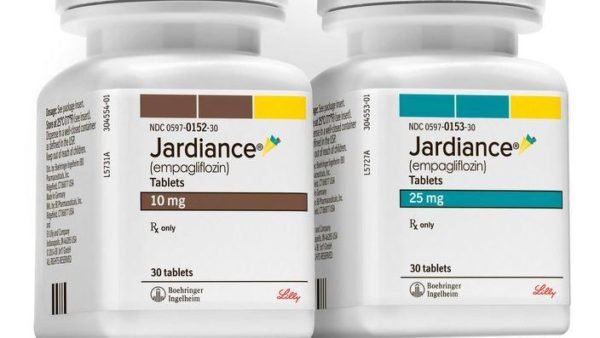
Empagliflozin (Jardiance) is used to treat adults with type 2 diabetes mellitus. It belongs to the SGLT2 inhibitor class of anti-diabetic medicines. It acts by inhibiting the filtered glucose from the renal tubules back into the circulation. This results in the loss of calories, loss of fluid, and sodium from the body. It thus reduces the extra fluid from the body, apart from improving hyperglycemia. It reduces the risk of cardiovascular death in patients with established cardiovascular disease. Other drugs belonging to the same class (SGLT 2 inhibitors) are Dapagliflozin, canagliflozin, and ertugliflozin.
Empagliflozin metformin & Empagliflozin, linagliptin, & metformin Combinations:
Empagliflozin is available as a single drug and in combination with metformin (Synjardy). It has recently been approved as a triple combination regimen by the name of TRIJARDY XR that contains empagliflozin, linagliptin, and metformin extended-release. Compared to sitagliptin, empagliflozin is associated with significantly lower cardiovascular-related mortality, all-cause mortality, and hospitalizations due to heart failure [Ref]. It is also associated with significantly greater weight loss and is more cost-effective [Ref].
Empagliflozin Contraindications and Warnings:
It is contraindicated in the following group of patients:
- Allergy patientsEmpagliflozinor the ingredients of it, including a history angioedema.
- Type 1 and diabetic ketoacidosis:
- Patients with low pancreatic reserves are more likely to develop ketoacidosis, even though their plasma glucose level is below 250 mg/dl.
- This is known as euglycemic ketoacidosis.
- Dehydration, volume depletion, and hypotension:
- Because SGLT2 inhibitors prevent glucose absorption from your kidneys.
- They can also cause fluid loss and osmotic dilution. If patients are taking diuretics or ACE inhibitors concurrently, hypotension may occur.
- Patients should be instructed to drink adequate fluids.
- Dialysis, or advanced renal disease:
- It is contraindicated for severe renal impairment, defined as creatinine clearance below 30ml/min/1.73m2, end stage renal failure, and dialysis patients.
- Acute renal failure can also be caused by volume contraction.
- After initiating treatment, patients should be checked for signs of renal dysfunction.
- Recurrent urinary tract infections, and urogenital infections including severe tissue necrosis:
- Patients with diabetes are more likely to get genitourinary infections.
- These infections should be treated if patients experience flank pain, fever burning micturition and urgency.
- It has been associated with severe genital infections such as Necrotizing fasciitis, which can lead to fatalities.
- Patients who are prone to develop hypoglycemia like those with adrenal, thyroid and pituitary diseases should take the drug with caution.
- Patients with these conditions should start on a lower dose at first.
- Conditions that predispose patients to develop hyperglycemia like burns, hyperthyroidism, surgery, and infections may alter its efficacy.
- Hyperglycemia can be caused by drug interactions, hormonal changes in females, psychological stress and endocrine disorders.
- Patients with these conditions should have their blood glucose monitored more often.
- Hypercholesterolemia:
- Patients might need to adjust statin doses or seek out alternative therapies such as Empagliflozin, which may cause an increase in LDL cholesterol (LDL)
- After starting therapy, monitor and treat LDL-C according to the recommendations.
- Geriatric:
- Older patients should use it with caution, as there are greater risks of adverse reactions.
- Pregnancy:
- It is not recommended for pregnant women, lactations, or children under 18 years old as the drug has not yet been extensively studied in this population.
Empagliflozin (Jardiance) dose in adults:
- 10 mg orally once daily with or without food, preferably in the morning.
- The dose may be increased to 25 mg orally once daily if glycemic targets are not achieved.
- The maximum dose is 25 mg per day.
Empagliflozin Use in Children:
Dapagliflozin has recently been approved for use in children and obese type 1 diabetic patients by the European Commission and NICE. Empagliflozin has not been approved for use in children.
Empagliflozin dose in Renal disease:
- No dosage adjustment needed with a creatinine clearance of more than 45 ml/min
- Patients with a creatinine clearance of less than 45 ml/min and more than 30 ml/min may be given the drug with caution
- It is contraindicated in patients with a creatinine clearance of less than 30 ml/min
Jardiance Dose in liver disease:
No dose adjustment is necessary.
How to take Empagliflozin?
You can take the drug with or without meals, but it is best to do so in the morning.
Empagliflozin Pregnancy Category C
It is not recommended to use during pregnancy, especially in the second and third trimesters. It should not be advised to breastfeeding mothers.
Severe side effects of empagliflozin (Jardiance):
-
Rapid:
- Angioedema
-
Early:
- Tissue necrosis
-
Delayed:
- Phimosis,
- diabetic ketoacidosis,
- renal failure,
- necrotizing fasciitis
Empagliflozin Side effects (Moderate):
-
Rapid:
- Hypotension
-
Early:
- Hypovolemia and
- Hypoglycemia
-
Delayed:
- Cystitis,
- Hypercholesterolemia,
- candidiasis,
- vaginitis,
- hyperlipidemia,
- balanitis, and
- dehydration
Jardiance side effects (Mild):
-
Rapid:
- Urticaria
-
Early:
- Rash,
- Syncope,
- Diuresis,
- Nocturia,
- Nausea,
- Polydipsia,
- Polyuria, and
- Increased urinary frequency
-
Delayed:
- Infections,
- Pharyngitis,
- Arthralgias, and
- Orthostatic hypotension
Empagliflozin: Drug Interaction
Note: Drug Interaction Categories:
- Risk Factor C: Monitor When Using Combination
- Risk Factor D: Consider Treatment Modification
- Risk Factor X: Avoid Concomitant Use
| Risk Factor C (Monitor therapy) | |
| Alpha-Lipoic Acid | May enhance the hypoglycemic effect of Antidiabetic Agents. |
| Androgens | May enhance the hypoglycemic effect of Blood Glucose Lowering Agents. Exceptions: Danazol. |
| Direct Acting Antiviral Agents (HCV) | May enhance the hypoglycemic effect of Antidiabetic Agents. |
| Guanethidine | May enhance the hypoglycemic effect of Antidiabetic Agents. |
| Hyperglycemia-Associated Agents | May diminish the therapeutic effect of Antidiabetic Agents. |
| Hypoglycemia-Associated Agents | Antidiabetic Agents may enhance the hypoglycemic effect of Hypoglycemia-Associated Agents. |
| Loop Diuretics | Empagliflozin may enhance the hypotensive effect of Loop Diuretics. |
| Maitake | May enhance the hypoglycemic effect of Blood Glucose Lowering Agents. |
| Monoamine Oxidase Inhibitors | May enhance the hypoglycemic effect of Blood Glucose Lowering Agents. |
| Pegvisomant | May enhance the hypoglycemic effect of Blood Glucose Lowering Agents. |
| Prothionamide | May enhance the hypoglycemic effect of Blood Glucose Lowering Agents. |
| Quinolones | May enhance the hypoglycemic effect of Blood Glucose Lowering Agents. Quinolones may diminish the therapeutic effect of Blood Glucose Lowering Agents. Specifically, if an agent is being used to treat diabetes, loss of blood sugar control may occur with quinolone use. |
| Ritodrine | May diminish the therapeutic effect of Antidiabetic Agents. |
| Salicylates | May enhance the hypoglycemic effect of Blood Glucose Lowering Agents. |
| Selective Serotonin Reuptake Inhibitors | May enhance the hypoglycemic effect of Blood Glucose Lowering Agents. |
| Teriflunomide | May increase the serum concentration of OAT3 Substrates. |
| Thiazide and Thiazide-Like Diuretics | May diminish the therapeutic effect of Antidiabetic Agents. |
| Risk Factor D (Consider therapy modification) | |
| Insulins | Sodium-Glucose Cotransporter 2 (SLGT2) Inhibitors may enhance the hypoglycemic effect of Insulins. Management: Consider a decrease in insulin dose when initiating therapy with a sodium-glucose cotransporter 2 inhibitor and monitor patients for hypoglycemia. |
| Sulfonylureas | Sodium-Glucose Cotransporter 2 (SLGT2) Inhibitors may enhance the hypoglycemic effect of Sulfonylureas. Management: Consider a decrease in sulfonylurea dose when initiating therapy with a sodium-glucose cotransporter 2 inhibitor and monitor patients for hypoglycemia. |
| Tolvaptan | May increase the serum concentration of OAT3 Substrates. |
Monitor:
- Glycemic control,
- urea & creatinine
- volume status of the patient and lipid profile.
- Patients with deep breathing and symptoms of hyperglycemia like polyuria and polydipsia should be investigated for diabetic ketoacidosis.
Empagliflozin (Jardiance) Mechanism of action:
- It inhibits the sodium-glucose transporter 2 (SGLT2) within the proximal renal tubes. It also inhibits glucose reabsorption from the kidneys.
- Osmotic diuresis is when excess glucose is eliminated via the kidneys.
- This may prove beneficial for hypertensive patients, those suffering from cardiac disease or fluid overload.
- It can also lead to recurrent infections of the urinary tract, volume depletion and dehydration.
Pharmacokinetics:
It can be taken orally. 86.2% of it is protein-bound, and it is metabolized by glucuronidation.
Half-life is estimated to be 12.4 hours.
Affected cytochrome P450 (CYP450) enzymes and drug transporters: None Peak plasma concentrations (Cmax): 1.5 hours post-dose. [/bg_collapse]
Empagliflozin Brands (International):
- Jardiance (Boehringer-Ingelheim)
Empagliflozin in combination with metformin:
- Glyxambi
- Synjardy,
- Synjardy XR
Empagliflozin in combination with Linaglipptin and Metformin XR:
Empagliflozin brands in Pakistan:
Diampa (Getz Pharma)
14 tablets pack:
10 mg: Rs. 266
25 mg: Rs. 336
Diampa-M (empagliflozin + metformin)
12.5/1000 mg: Rs. 308
Empa (Horizon)
14 tablets Pack
10 mg: Rs. 238
Jardy (CCL)
14 tablets pack
10 mg: Rs. 275
25 mg: Rs. 383
.png)


