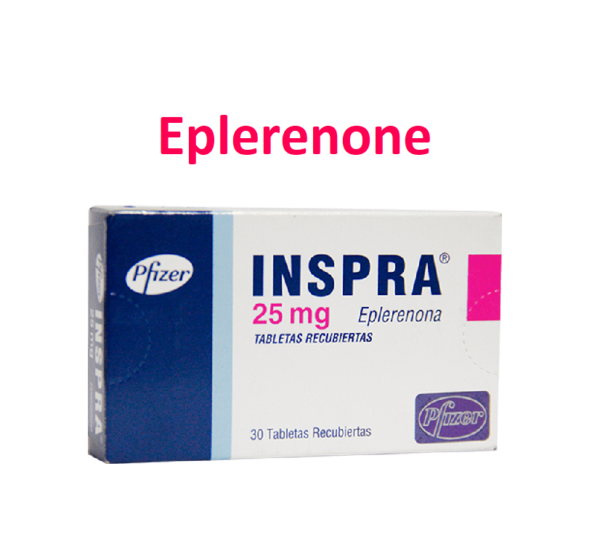
Eplerenone (Inspra) is a mineralocorticoid receptor inhibitor (like spironolactone). It is used to treat hypertension and heart failure post-myocardial infarction in patients with a left ventricular ejection fraction of less than 40%. It prevents cardiac and vascular remodeling and fibrosis. It should be used with extreme caution in patients at risk of hyperkalemia.
Eplerenone Uses:
-
Heart failure post-MI:
- Eplerenone is used to improve the survivability of patients with symptomatic heart failure but not in critical condition, having LVEF ≤40% after acute MI
- Guideline recommendations:
- The American College of Cardiology and the American Heart Association (ACCF/AHA) 2013 guidelines advocate the use of aldosterone antagonists along with other standard therapies.
- This all is done to reduce the morbidity and mortality in patients with LVEF of less than 40% after acute CAD who is having symptomatic heart failure or have a history of diabetes mellitus.
-
Hypertension:
- Eplerenone is not recommended as a first-line treatment for hypertension.
-
Use: Off-Label: Adult
- Acute coronary syndromes
- Heart failure (NYHA class II-IV) with left ventricular ejection fraction ≤35%
- In the treatment of primary aldosteronism
Eplerenone (Inspra) Dose in Adults
Eplerenone (Inspra) Dose as an alternative agent in the treatment of Hypertension:
- Oral: Initially it is given as 50 mg once daily and may be increased to 50 mg two times a day if the response is not adequate.
- The maximum allowed dose is 100 mg/day
-
Dose modification during concurrent use with moderate CYP3A4 inhibitors:
- Initial: 25 mg once daily orally and may increase up to 25 mg twice daily if the response is not adequate (maximum: 50 mg/day).
Eplerenone (Inspra) Dose in the treatment of Heart failure:
-
Heart failure (post-MI):
- Oral: Initially can be given 25 mg once a day.
- The ideal dosage is to titrate to 50 mg once daily within 4 weeks, as tolerated
-
Dosage adjustment per serum potassium concentrations for HF (post-MI):
-
<5 mEq/L:
- Increase dose from 25 mg every other day to 25 mg once daily OR
- Increase dose from 25 mg once daily to 50 mg once daily
-
5 to 5.4 mEq/L:
- No adjustment is needed
-
5 to 5.9 mEq/L:
- Decrease the dose from 50 mg once a day to 25 mg once daily OR
- Decrease the dose from 25 mg once daily to 25 mg every other day OR
- Modify dose from 25 mg every other day to withhold medication
-
≥6 mEq/L:
- Withhold medication until potassium <5.5 mEq/L, then restart at 25 mg every other day
- Alternatively, the ACCF/AHA 2013 HF guidelines recommend withholding treatment if potassium exceeds 5.5 mEq/L or when there is a progressive decline in renal functions.
- The treatment may be withheld until potassium is less than 5 mEq/L.
- Consider restarting with a reduced dose after confirming resolution of hyperkalemia/renal insufficiency for at least 72 hours.
-
Dose modification during concurrent use with moderate CYP3A4 inhibitors:
- Initial: 25 mg once daily;
- The maximum dose: 25 mg/day.
-
Eplerenone (Inspra) Dose in the treatment of Heart failure (NYHA class II-IV with LVEF ≤35%) (off-label dose):
- Initial: 25 mg once a day;
- The maximum dose: 50 mg/daily.
Eplerenone (Inspra) Dose in the treatment of primary aldosteronism (off-label):
- Oral: Initial: 25 mg two times a day.
Use in Children:
Not indicated.
Eplerenone Pregnancy Category: B
- The case reports pertaining to the use of eplerenone in pregnancy are the only source of information.
- Both untreated hypertension, and heart failure can lead to adverse pregnancy outcomes.
- Mineralocorticoid receptor inhibitors should not be used to treat uncomplicated chronic hypertension in pregnant women.
- They should also be avoided in women with reproductive potential.
Use during breastfeeding:
- This drug secreted in breastmilk is yet to be studied.
Eplerenone (Inspra) Dose in Kidney Disease:
-
Hypertension:
- CrCl ≥50 mL/minute:
- No dose adjustment required
- CrCl <50 mL/minute or serum creatinine >2 mg/dL (males) or >1.8 mg/dL (females):
- Absolute contraindication due to the risk of hyperkalemia increases with declining renal function.
- CrCl ≥50 mL/minute:
-
Heart failure (post-MI):
- CrCl >50 mL/minute:
- No dose adjustment is required
- CrCl 31 to 50 mL/minute or serum creatinine >2 mg/dL (males) or >1.8 mg/dL (females):
- Use with caution is advised and no dose adjustment is required according to the manufacturer
- CrCl ≤30 mL/minute:
- Absolutely contraindicated
- CrCl >50 mL/minute:
-
Heart failure (including post-MI):
- eGFR ≥50 mL/minute/1.73 m²:
- Initial dose: 25 mg once daily per orally.
- After 4 weeks of treatment if potassium remains ≤5 mEq/L) then titrate up to 50 mg once daily.
- eGFR 30 to 49 mL/minute/1.73 m²:
- Initial dose: 25 mg once every other day.
- Maintenance dose after 4 weeks of treatment and if potassium remains ≤5 mEq/L):
- The dose can be titrated up to 25 mg once daily
- eGFR <30 mL/minute/1.73 m²:
- Not recommended.
- Hemodialysis:
- Not effective
- eGFR ≥50 mL/minute/1.73 m²:
Dose in Liver disease:
- There are no dosage adjustments required in liver disease as per the manufacturer's labeling.
- Systemic bioavailability is increased in moderate hepatic impairment (Child-Pugh class B).
Common Side Effects of Eplerenone (Inspra):
-
Endocrine & metabolic:
- Hyperkalemia
- Hypertriglyceridemia
Less Common Side Effects of Eplerenone (Inspra):
-
Central Nervous System:
- Dizziness
- Fatigue
-
Endocrine & Metabolic:
- Hyponatremia
- Albuminuria
- Gynecomastia
- Hypercholesterolemia
-
Gastrointestinal:
- Diarrhea
- Abdominal Pain
-
Genitourinary:
- Abnormal Vaginal Hemorrhage
- Mastalgia
-
Renal:
- Increased Serum Creatinine
-
Respiratory:
- Cough
- Flu-Like Symptoms
Contraindications to Eplerenone (Inspra):
- Serum potassium >5.5 mEq/L at initiation
- CrCl = 30 mL/minute
- Use of strong CYP3A4 inhibitors, such as ketoconazole or itraconazole, troleandomycine, clarithromycine, troleandomycine, clarithromycine, ritonavir and nelfinavir, concurrently.
- Hypertension patients should be aware of the following contraindications:
- Type 2 diabetes mellitus (noninsulin-dependent, NIDDM) with microalbuminuria,
- Serum creatinine levels exceeding 2.0 mg/dL for males and 1.8 mg/dL for females are alarming.
- CrCl 50mL/minute
- Concomitant use of potassium supplements or potassium–sparing diuretics (eg amiloride, stronolactone, triamterene)
- According to the Endocrine Society clinical guidelines, Addison disease patients should not be treated.
Canadian labeling:Additional contraindications not listed in the US labeling:
- The use of any component or hypersensitivity to eplerenone could limit its effectiveness.
- At the beginning of treatment, serum potassium should not exceed 5 mEq/L.
- Severe liver impairment (Child Puugh class C).
- Use potassium-sparing diuretics or potassium supplements concurrently.
Hypertension patients should be aware of the following contraindications:
- Maximum serum creatinine concentrations exceeding 1.5 mg/dL (132 micromole/L) in males and 1.3 mg/dL (115 micromole/L) in females
Warnings and precautions
-
Hyperkalemia:
- Eplerenone therapy may cause hyperkalemia. Hyperkalemia can be more common in patients with kidney impairment, protein nephropathy and diabetes mellitus who are also taking ACE inhibitors, angiotensin II blockers, NSAIDs and/or moderate CYP3A inhibits.
- Hyperkalemia should be monitored closely. Hyperkalemia due to dosing may occur.
- Hyperkalemia can be treated by reducing doses or interrupting treatment.
- Reduce the dosage of eplerenone if you have to take CYP3A4 inhibitor therapy.
- If serum potassium is higher than 5.5 mEq/L, it is contraindicated.
-
Diabetes:
- Patients with diabetes and heart failure after MI (especially those with diabetic nephropathy), should exercise caution due to the possibility of hyperkalemia.
-
Heart failure:
- If a patient with heart failure is being evaluated for treatment with a mineralocorticoid-receptor inhibitor, their eGFR must not be lower than 30 mL/minute/1.73m2, and creatinine should not exceed 2.5 mg/dL (for men) or 2 mg/dL (for women).
- The renal function must be stable and not have experienced any severe hyperkalemia. Serum potassium should not exceed 5mEq/L.
- It is important to monitor serum potassium levels and manage any elevated levels.
- If serum potassium is higher than 6 mEq/L, the manufacturer suggests withholding treatment.
- ACCF/AHA recommends discontinuing treatment if serum potassium is higher than 5.5 mEq/L, or if renal function is declining.
- Combining ARB and ACE inhibitors is not recommended.
- Patients with heart disease should be instructed to stop taking diuretic medication if they experience diarrhea, dehydration, or if loop diuretic therapy has been stopped.
-
Hepatic impairment
- It should be used with caution for patients with severe or moderate hepatic impairment.
-
Renal impairment
- As the renal function declines, the risk of hyperkalemia increases.
- It should be used with caution in patients with mild renal impairment. Patients with severe renal impairment should not use it.
Eplerenone: Drug Interaction
Note: Drug Interaction Categories:
- Risk Factor C: Monitor When Using Combination
- Risk Factor D: Consider Treatment Modification
- Risk Factor X: Avoid Concomitant Use
Risk Factor C (Monitor therapy) |
|
| Alfuzosin | May enhance the hypotensive effect of Blood Pressure Lowering Agents. |
| Amphetamines | May diminish the antihypertensive effect of Antihypertensive Agents. |
| Angiotensin II Receptor Blockers | Eplerenone may enhance the hyperkalemic effect of Angiotensin II Receptor Blockers. |
| Angiotensin-Converting Enzyme Inhibitors | Eplerenone may enhance the hyperkalemic effect of Angiotensin-Converting Enzyme Inhibitors. |
| Antipsychotic Agents (Second Generation [Atypical]) | Blood Pressure Lowering Agents may enhance the hypotensive effect of Antipsychotic Agents (Second Generation [Atypical]). |
| Barbiturates | May enhance the hypotensive effect of Blood Pressure Lowering Agents. |
| Benperidol | May enhance the hypotensive effect of Blood Pressure Lowering Agents. |
| Bosentan | May decrease the serum concentration of CYP3A4 Substrates (High risk with Inducers). |
| Brigatinib | May diminish the antihypertensive effect of Antihypertensive Agents. Brigatinib may enhance the bradycardic effect of Antihypertensive Agents. |
| Brimonidine (Topical) | May enhance the hypotensive effect of Blood Pressure Lowering Agents. |
| Cardiac Glycosides | Potassium-Sparing Diuretics may diminish the therapeutic effect of Cardiac Glycosides. In particular, the inotropic effects of digoxin appear to be diminished. PotassiumSparing Diuretics may increase the serum concentration of Cardiac Glycosides. This particular effect may be unique to Spironolactone. |
| Clofazimine | May increase the serum concentration of CYP3A4 Substrates (High risk with Inhibitors). |
| CYP3A4 Inducers (Moderate) | May decrease the serum concentration of CYP3A4 Substrates (High risk with Inducers). |
| Deferasirox | May decrease the serum concentration of CYP3A4 Substrates (High risk with Inducers). |
| Dexmethylphenidate | May diminish the therapeutic effect of Antihypertensive Agents. |
| Diacerein | May enhance the therapeutic effect of Diuretics. Specifically, the risk for dehydration or hypokalemia may be increased. |
| Diazoxide | May enhance the hypotensive effect of Blood Pressure Lowering Agents. |
| Drospirenone | May enhance the hyperkalemic effect of Potassium-Sparing Diuretics. |
| DULoxetine | Blood Pressure Lowering Agents may enhance the hypotensive effect of DULoxetine. |
| Erdafitinib | May decrease the serum concentration of CYP3A4 Substrates (High risk with Inducers). |
| Erdafitinib | May increase the serum concentration of CYP3A4 Substrates (High risk with Inhibitors). |
| Fosaprepitant | May increase the serum concentration of CYP3A4 Substrates (High risk with Inhibitors). |
| Heparin | May enhance the hyperkalemic effect of Eplerenone. |
| Heparins (Low Molecular Weight) | May enhance the hyperkalemic effect of Eplerenone. |
| Herbs (Hypertensive Properties) | May diminish the antihypertensive effect of Antihypertensive Agents. |
| Herbs (Hypotensive Properties) | May enhance the hypotensive effect of Blood Pressure Lowering Agents. |
| Hypotension-Associated Agents | Blood Pressure Lowering Agents may enhance the hypotensive effect of Hypotension-Associated Agents. |
| Ivosidenib | May decrease the serum concentration of CYP3A4 Substrates (High risk with Inducers). |
| Larotrectinib | May increase the serum concentration of CYP3A4 Substrates (High risk with Inhibitors). |
| Levodopa-Containing Products | Blood Pressure Lowering Agents may enhance the hypotensive effect of Levodopa-Containing Products. |
| Lithium | Eplerenone may increase the serum concentration of Lithium. |
| Lormetazepam | May enhance the hypotensive effect of Blood Pressure Lowering Agents. |
| Methylphenidate | May diminish the antihypertensive effect of Antihypertensive Agents. |
| Molsidomine | May enhance the hypotensive effect of Blood Pressure Lowering Agents. |
| Naftopidil | May enhance the hypotensive effect of Blood Pressure Lowering Agents. |
| Nicergoline | May enhance the hypotensive effect of Blood Pressure Lowering Agents. |
| Nicorandil | May enhance the hyperkalemic effect of Potassium-Sparing Diuretics. |
| Nicorandil | May enhance the hypotensive effect of Blood Pressure Lowering Agents. |
| Nitrofurantoin | May enhance the hyperkalemic effect of Eplerenone. |
| Nitroprusside | Blood Pressure Lowering Agents may enhance the hypotensive effect of Nitroprusside. |
| Nonsteroidal Anti-Inflammatory Agents | May diminish the antihypertensive effect of Eplerenone. Nonsteroidal Anti-Inflammatory Agents may enhance the hyperkalemic effect of Eplerenone. |
| Opioid Agonists | May enhance the adverse/toxic effect of Diuretics. Opioid Agonists may diminish the therapeutic effect of Diuretics. |
| Palbociclib | May increase the serum concentration of CYP3A4 Substrates (High risk with Inhibitors). |
| Pentoxifylline | May enhance the hypotensive effect of Blood Pressure Lowering Agents. |
| Pholcodine | Blood Pressure Lowering Agents may enhance the hypotensive effect of Pholcodine. |
| Phosphodiesterase 5 Inhibitors | May enhance the hypotensive effect of Blood Pressure Lowering Agents. |
| Prostacyclin Analogues | May enhance the hypotensive effect of Blood Pressure Lowering Agents. |
| Quinagolide | May enhance the hypotensive effect of Blood Pressure Lowering Agents. |
| QuiNIDine | Potassium-Sparing Diuretics may diminish the therapeutic effect of QuiNIDine. |
| Sarilumab | May decrease the serum concentration of CYP3A4 Substrates (High risk with Inducers). |
| Siltuximab | May decrease the serum concentration of CYP3A4 Substrates (High risk with Inducers). |
| Simeprevir | May increase the serum concentration of CYP3A4 Substrates (High risk with Inhibitors). |
| Tocilizumab | May decrease the serum concentration of CYP3A4 Substrates (High risk with Inducers). |
| Tolvaptan | May enhance the hyperkalemic effect of Potassium-Sparing Diuretics. |
| Trimethoprim | May enhance the hyperkalemic effect of Eplerenone. |
| Yohimbine | May diminish the antihypertensive effect of Antihypertensive Agents. |
Risk Factor D (Consider therapy modification) |
|
| Amifostine | Blood Pressure Lowering Agents may enhance the hypotensive effect of Amifostine. Management: When amifostine is used at chemotherapy doses, blood pressure lowering medications should be withheld for 24 hours prior to amifostine administration. If blood pressure lowering therapy cannot be withheld, amifostine should not be administered. |
| Ammonium Chloride | Potassium-Sparing Diuretics may enhance the adverse/toxic effect of Ammonium Chloride. Specifically the risk of systemic acidosis. |
| CYP3A4 Inducers (Strong) | May increase the metabolism of CYP3A4 Substrates (High risk with Inducers). Management: Consider an alternative for one of the interacting drugs. Some combinations may be specifically contraindicated. Consult appropriate manufacturer labeling. |
| CYP3A4 Inhibitors (Moderate) | May increase the serum concentration of Eplerenone. Management: When used concomitantly with moderate inhibitors of CYP3A4, eplerenone dosing recommendations vary by indication and international labeling. See full drug interaction monograph for details. |
| Dabrafenib | May decrease the serum concentration of CYP3A4 Substrates (High risk with Inducers). Management: Seek alternatives to the CYP3A4 substrate when possible. If concomitant therapy cannot be avoided, monitor clinical effects of the substrate closely (particularly therapeutic effects). |
| Enzalutamide | May decrease the serum concentration of CYP3A4 Substrates (High risk with Inducers). Management: Concurrent use of enzalutamide with CYP3A4 substrates that have a narrow therapeutic index should be avoided. Use of enzalutamide and any other CYP3A4 substrate should be performed with caution and close monitoring. |
| Fluconazole | May increase the serum concentration of Eplerenone. Management: Reduce the starting dose of eplerenone to 25 mg/day; monitor patients closely for increased eplerenone effects. |
| Lorlatinib | May decrease the serum concentration of CYP3A4 Substrates (High risk with Inducers). Management: Avoid concurrent use of lorlatinib with any CYP3A4 substrates for which a minimal decrease in serum concentrations of the CYP3A4 substrate could lead to therapeutic failure and serious clinical consequences. |
| Mitotane | May decrease the serum concentration of CYP3A4 Substrates (High risk with Inducers). Management: Doses of CYP3A4 substrates may need to be adjusted substantially when used in patients being treated with mitotane. |
| Obinutuzumab | May enhance the hypotensive effect of Blood Pressure Lowering Agents. Management: Consider temporarily withholding blood pressure lowering medications beginning 12 hours prior to obinutuzumab infusion and continuing until 1 hour after the end of the infusion. |
| Pitolisant | May decrease the serum concentration of CYP3A4 Substrates (High risk with Inducers). Management: Combined use of pitolisant with a CYP3A4 substrate that has a narrow therapeutic index should be avoided. Other CYP3A4 substrates should be monitored more closely when used with pitolisant. |
| Potassium Salts | Eplerenone may enhance the hyperkalemic effect of Potassium Salts. Management: This combination is contraindicated in patients receiving eplerenone for treatment of hypertension. |
| Potassium-Sparing Diuretics | Eplerenone may enhance the hyperkalemic effect of PotassiumSparing Diuretics. Management: This combination is contraindicated in patients receiving eplerenone for treatment of hypertension. |
| Sodium Phosphates | Diuretics may enhance the nephrotoxic effect of Sodium Phosphates. Specifically, the risk of acute phosphate nephropathy may be enhanced. Management: Consider avoiding this combination by temporarily suspending treatment with diuretics, or seeking alternatives to oral sodium phosphate bowel preparation. If the combination cannot be avoided, hydrate adequately and monitor fluid and renal status. |
| St John's Wort | May decrease the serum concentration of CYP3A4 Substrates (High risk with Inducers). Management: Consider an alternative for one of the interacting drugs. Some combinations may be specifically contraindicated. Consult appropriate manufacturer labeling. |
| Stiripentol | May increase the serum concentration of CYP3A4 Substrates (High risk with Inhibitors). Management: Use of stiripentol with CYP3A4 substrates that are considered to have a narrow therapeutic index should be avoided due to the increased risk for adverse effects and toxicity. Any CYP3A4 substrate used with stiripentol requires closer monitoring. |
Risk Factor X (Avoid combination) |
|
| Bromperidol | May diminish the hypotensive effect of Blood Pressure Lowering Agents. Blood Pressure Lowering Agents may enhance the hypotensive effect of Bromperidol. |
| Conivaptan | May increase the serum concentration of CYP3A4 Substrates (High risk with Inhibitors). |
| CycloSPORINE (Systemic) | Eplerenone may enhance the hyperkalemic effect of CycloSPORINE (Systemic). |
| CYP3A4 Inhibitors (Strong) | May increase the serum concentration of Eplerenone. |
| Fusidic Acid (Systemic) | May increase the serum concentration of CYP3A4 Substrates (High risk with Inhibitors). |
| Idelalisib | May increase the serum concentration of CYP3A4 Substrates (High risk with Inhibitors). |
| Itraconazole | May increase the serum concentration of Eplerenone. |
| Ketoconazole (Systemic) | May increase the serum concentration of Eplerenone. |
| Posaconazole | May increase the serum concentration of Eplerenone. |
| Tacrolimus (Systemic) | Eplerenone may enhance the hyperkalemic effect of Tacrolimus (Systemic). |
| Voriconazole | May increase the serum concentration of Eplerenone. |
Monitoring parameters:
- Vital signs like blood pressure.
- Pre-treatment, serum potassium within the first week, 1 month, or after dose adjustment. Then, periodically as clinically indicated.
- Also, monitor serum potassium and serum creatinine for at least 3-7 days following the start of concurrent therapy with moderate a CYP3A4 or ACE inhibitors, ARBs, or NSAIDs.
- Heart failure:
- Initiation should be completed within 3 days, 1 week, and 3 months. Then, the renal function and serum potassium should be tested every 3 months.
- It is important to monitor the patient's response to any concomitant ACE inhibitors and/or ARBs by starting a new monitoring cycle.
- Keep potassium levels at a minimum of 5.5 mEq/L. If renal function is worsening, you should hold potassium doses until potassium is below 5 mEq/L. After 72 hours, confirm that hyperkalemia/renal impairment has been resolved.
How to administer Eplerenone (Inspra)?
It can be taken orally with or without food.
Mechanism of action of Eplerenone (Inspra):
- Eplerenone (Inspra), is a mineralocorticoid-receptor inhibitor.
- It inhibits the mineralocorticoid-receptors selectively in a dose-dependent way.
- The inhibition of mineralocorticoid-receptors could prevent vascular or myocardial fibrillation.
- Mineralocorticoids can cause water and sodium retention.
- Myocardial or vascular fibrosis may be caused by the overexpression of mineralocorticoid-receptors, especially after myocardial injury.
- Mineralocorticoid receptors can be found in the kidney, myocardium and blood vessels.
Protein binding:
- About 50%; primarily to alpha-1-acid glycoproteins
Metabolism:
- It is metabolized primarily in the liver via CYP3A4 to inactive metabolites.
Bioavailability:
- 69%
Half-life elimination:
- About 3 to 6 hours
Time to peak, plasma:
- About 1.5 to 2 hours;
- It may take up to 4 weeks for the full antihypertensive effect
Excretion:
- Urine (~67%);
- feces (~32%);
- Less than 5% as unchanged drug in urine and feces
International Brand Names of Eplerenone:
- Inspra
- MINT-Eplerenone
- Aldonist
- Aldospira
- Diuron
- Elecor
- Epleron
- Eplerona
- Eplerone
- Epletor
- Epnone
- Eptus
- Eraloner
- Espler
- Fliven
- Heperona
- Idirenone
- Inpler
- Inspra
- Inspra IC
- Oldren
- Renial
- Selara
- Tensopleron
Eplerenone Brand Names in Pakistan:
Eplerenone 25 mg Tablets in Pakistan |
|
| Macrenone | Macter International (Pvt) Ltd. |
| Urenon | Tabros Pharma |
Eplerenone 50 mg Tablets in Pakistan |
|
| EPLER | PLATINUM PHARMACEUTICALS (PVT.) LTD. |
| MACRENONE | MACTER INTERNATIONAL (PVT) LTD. |
| URENON | TABROS PHARMA |
Correct spelling: Eplerenone, Inspra Incorrect Spelling: Eplarenone, Epleranone, Eplerenon, Enspra
.png)


