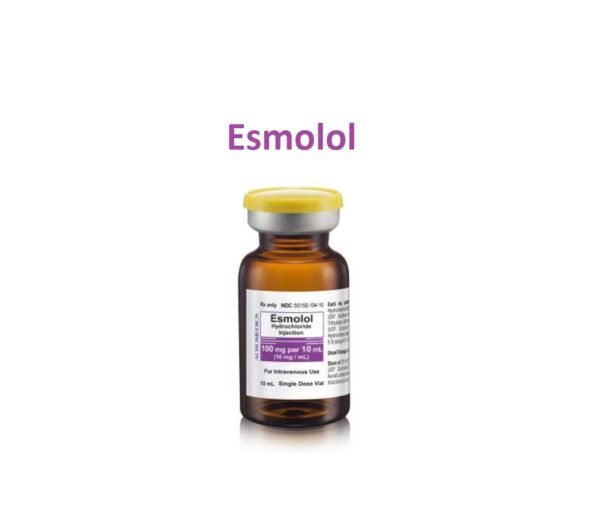
Esmolol is a cardioselective short-acting beta-1 receptor blocker with no significant sympathomimetic effects, available by the brand name of Brevibloc (among others).
Esmolol Uses:
-
Intraoperative and postoperative tachycardia and/or hypertension:
- Use in the treatment of intraoperative and postoperative tachycardia and/or hypertension
-
Sinus tachycardia:
- Used in the treatment of non-compensatory sinus tachycardia
-
Supraventricular tachycardia and atrial fibrillation/flutter:
- Control of ventricular rate in patients with supraventricular tachycardia or atrial fibrillation/flutter
-
Off Label Use of Esmolol in Adults:
- Used in electroconvulsive therapy (attenuation of adrenergic response)
- Used in hypertensive emergencies
- Used in intubation (attenuation of adrenergic response)
- Used in thyroid storm
- Used in thyrotoxicosis
- Used in ventricular tachycardia
Esmolol Dose in Adults
Esmolol Dose in the treatment of Intraoperative and postoperative tachycardia and/or hypertension: IV:
-
Immediate control:
- Initial bolus: 1,000 mcg per kg over 30 seconds, followed by a 150 mcg per kg per minute infusion, if necessary.
- Adjust the infusion rate as needed to maintain the desired heart rate and or blood pressure (up to 300 mcg per kg per minute).
-
Gradual control:
- Initial bolus: 500 mcg per kg over 1 minute, followed by a 50 mcg per kg per minute infusion for 4 minutes.
- The Infusion may be continued at 50 mcg per kg per minute or, if the response is inadequate, titrated upward in 50 mcg per kg per minute increments (increased no more frequently than every 4 minutes) to a maximum of 300 mcg per kg per minute;
- An optional loading dose equal to the initial bolus (500 mcg per kg over 60 seconds) prior to each increase in the infusion rate may be administered.
- For control of tachycardia, doses longer than 200 mcg per kg per minute provide the minimal additional effect.
- For control of postoperative hypertension, as many as one-third of patients may require higher doses (250 to 300 mcg per kg per minute) to control blood pressure; the safety of doses longer than 300 mcg per kg per minute has not been studied.
Esmolol Dose in the treatment of Hypertensive emergencies (off-label):
- IV: Loading dose: 500 to 1,000 mcg per kg over 1 minute, followed by a 50 mcg per kg per minute infusion.
- For additional blood pressure control, repeat the loading dose, and increase infusion by 50 mcg per kg per minute increments up to a maximum dose of 200 mcg/kg/minute.
Esmolol Dose in the treatment of Supraventricular tachycardia and atrial fibrillation/flutter or non-compensatory sinus tachycardia:
- IV: Loading dose (optional): 500 mcg per kg over 1 minute;
- follow with a 50 mcg per kg per minute infusion for 4 minutes;
- response to this initial infusion rate may be a rough indication of the responsiveness of the ventricular rate.
- The infusion may be continued at 50 mcg per kg per minute or, if the response is inadequate, titrated upward in 50 mcg per kg per minute increments (increased no more frequently than every 4 minutes) to a maximum of 200 mcg per kg per minute.
- To achieve a more rapid response, following the initial loading dose and 50 mcg per kg per minute infusion, re-bolus with a second 500 mcg per kg loading dose over 1 minute, and increase the maintenance infusion to 100 mcg per kg per minute for 4 minutes.
- If necessary, a third (and final) 500 mcg per kg loading dose may be administered, prior to increasing to an infusion rate of 150 mcg per kg per minute.
- After 4 minutes of the 150 mcg per kg per minute infusion, the infusion rate may be increased to a maximum rate of 200 mcg per kg per minute (without a bolus dose).
- The ACC/AHA/HRS supraventricular tachycardia guidelines recommend a maximum dose of 300 mcg/kg/minute.
Note:
- If a loading dose is not administered, a continuous infusion at a fixed dose reaches a steady-state in ~30 minutes.
- In general, the usual effective dose is 50 to 200 mcg per kg per minute;
- Doses as low as 25 mcg per kg per minute may be adequate.
- Maintenance infusions may be continued for up to 48 hours.
Esmolol Dose in the treatment of Electroconvulsive therapy (off-label):
- IV: 1,000 mcg per kg administered 1 minute prior to the induction of anesthesia.
Esmolol Dose for Intubation (off-label):
- IV: 1,000 to 2,000 mcg per kg given 1.5 to 3 minutes prior to intubation.
Esmolol Dose in the treatment of Thyrotoxicosis or thyroid storm (off-label):
- IV: 50 to 100 mcg per kg per minute.
Esmolol Dose in the treatment of Ventricular tachycardia (off-label):
- IV: 500 mcg per kg bolus followed by 50 mcg per kg per minute.
Guidelines for transfer to oral therapy (beta-blocker, calcium channel blocker):
- The infusion should be reduced by 50 percent thirty minutes following the first dose of the alternative agent
- The manufacturer suggests following the second dose of the alternative drug, the patient's response should be monitored and if control is adequate for the first hour, esmolol may be discontinued.
Esmolol Dose in Childrens
Note: Dose must be titrated to individual response and tolerance.
Esmolol Dose in the treatment of Hypertensive emergency/urgency:
-
Infants, Children, and Adolescents:
- Continuous IV infusion:
- 100 to 500 mcg per kg per minute infusion;
- another approach is to initiate therapy with a bolus of 100 to 500 mcg/kg over 1 minute, followed by an infusion of 25 to 100 mcg per kg per minute;
- Titrate the dose as needed up to 500 mcg per kg per minute.
- Continuous IV infusion:
Esmolol Dose in the treatment of Postoperative hypertension:
-
Infants and Children:
- Initial IV bolus:
- 100 to 500 mcg per kg, followed by continuous IV infusion at an initial rate: 100 to 500 mcg per kg per minute;
- Titrate to effect;
- The range of effective doses: 125 to 1,000 mcg per kg per minute.
- Initial IV bolus:
Esmolol Dose in the treatment of Supraventricular tachycardia (SVT):
-
Children and Adolescents:
- Initial IV bolus: 100 to 500 mcg per kg over 1 minute followed by a continuous IV infusion at an initial rate: 25 to 100 mcg per kg per minute,
- Titrate in 25 to 50 mcg per kg per minute increments;
- The usual maintenance dose: 50 to 500 mcg per kg per minute;
- Doses up to 1,000 mcg per kg per minute have been reported.
Esmolol Pregnancy Risk Category: C
- In some studies on animal reproduction, adverse events were reported.
- Supraventricular Tachycardia (SVT) is treated with Esmolol. However, pregnant women may prefer other agents.
- Fetal bradycardia has been linked to Esmolol.
- Chronic use of beta-blockers during pregnancy can also lead to adverse fetal/neonatal outcomes.
- However, esmolol has a short-acting beta blocker and is not recommended for long-term use.
Esmolol use during breastfeeding:
- It is unknown if breast milk contains esmolol.
- The manufacturer suggests that the mother decide whether to stop breastfeeding or discontinue the drug. This is in consideration of the risk of serious adverse reactions in breastfed babies.
- Its short half-life and inability to be used for prolonged periods should limit exposure to breastfeeding infants.
Esmolol Dose in Kidney Disease:
No dosage adjustment required. Not removed by hemo- or peritoneal dialysis. A supplemental dose is not necessary.
Esmolol Dose in Liver disease:
No dosage adjustment required.
Common Side Effects of Esmolol:
-
Cardiovascular:
- Asymptomatic hypotension
- Symptomatic hypotension
Less Common Side Effects of Esmolol:
-
Cardiovascular:
- Peripheral Ischemia
-
Central Nervous System:
- Dizziness
- Drowsiness
- Headache
- Agitation
- Confusion
-
Gastrointestinal:
- Nausea
- Vomiting
-
Local:
- Infusion site reaction
Contraindications to Esmolol:
- Hypersensitivity to esmolol and any component of the formulation
- Grave sinus bradycardia
- Heart block of greater than the first degree is not possible (except for patients who have a working artificial ventricular pacemaker);
- sick sinus syndrome;
- Decompensated Heart Failure
- Cardiogenic shock
- IV administration of calcium channel blocking agents (eg verapamil), in close proximity of esmolol (ie while cardiac effects from other drugs are still present).
- Pulmonary hypertension
Canadian labeling: Additional contraindications not in US labeling
- Patients who require inotropic drugs and/or vasopressors for maintaining cardiac output and systolic pressure;
- Hypotension
- Right ventricular failure secondary pulmonary hypertension
- Untreated pheochromocytoma
Warnings and precautions
-
Anaphylactic reactions
- Patients who have had severe allergic reactions to allergens in the past should be cautious. Beta-blockers can make it more difficult for patients to react to repeated challenges.
- Treatment of anaphylaxis (eg, epinephrine) in patients taking beta-blockers may be ineffective or promote undesirable effects.
-
Extravasation:
- It is a vesicant. Ensure proper catheter or needle placement before and during infusion.
- Avoid extravasation. Avoid extravasation.
-
Hyperkalemia:
- Esmolol has been linked to elevated serum potassium and hyperkalemia in patients with risk factors (eg renal impairment). It is important to monitor serum potassium levels during treatment.
-
Hypotension
- Hypotension is a common condition.
- Patients require close monitoring of blood pressure.
- Hypotension can be reversed if blood pressure drops beyond acceptable levels. Usually, this happens within 30 minutes.
-
Bronchospastic Disease:
- Patients with bronchospastic diseases should not be given beta-blockers. However, it is possible to use esmolol with B-1 selectivity with caution and close monitoring.
-
Conductive abnormality
- Bradycardia can include sinus pause, heart block and severe bradycardia.
- Before you start, consider preexisting conditions like sick sinus syndrome or first degree AV blocking.
- Patients with sick sinus syndrome, second- or third degree AV block or patients with an artificial ventricular pacemaker are not advised to use this medication.
-
Diabetes:
- Patients with diabetes mellitus should be cautious.
- It can increase hypoglycemia or mask symptoms.
-
Heart failure (HF):
- Patients with compensated cardiac failure should be cautious and monitored for signs of deterioration.
- Patients with decompensated cardiac failure should not be used.
-
Myasthenia gravis:
- Patients with myasthenia gravis should be cautious.
-
Raynaud and peripheral vascular disease (PVD).
- Patients with Raynaud and PVD may experience symptoms that can either precipitate or aggrave arterial insufficiency.
- Be cautious and watch for arterial obstruction.
-
Untreated Pheochromocytoma
- Patients with pheochromocytoma must have adequate alpha-blockade before any beta-blocker can be used.
-
Renal impairment
- Patients with impaired renal function should be cautious; active metabolite must be retained.
-
Thyroid disease:
- Hyperthyroidism should be suspected and treated accordingly.
- Rapid withdrawal can worsen hyperthyroidism symptoms or cause a thyroid storm.
- Hyperthyroidism may be disguised (eg, Tachycardia).
Esmolol: Drug Interaction
Note: Drug Interaction Categories:
- Risk Factor C: Monitor When Using Combination
- Risk Factor D: Consider Treatment Modification
- Risk Factor X: Avoid Concomitant Use
Risk Factor C (Monitor therapy) |
|
| Acetylcholinesterase Inhibitors | May enhance the bradycardic effect of Beta-Blockers. |
| Alfuzosin | May enhance the hypotensive effect of Blood Pressure Lowering Agents. |
| Alpha1-Blockers | Beta-Blockers may enhance the orthostatic hypotensive effect of Alpha1Blockers. The risk associated with ophthalmic products is probably less than systemic products. |
| Aminoquinolines (Antimalarial) | May decrease the metabolism of Beta-Blockers. |
| Amiodarone | May enhance the bradycardic effect of Beta-Blockers. Possibly to the point of cardiac arrest. Amiodarone may increase the serum concentration of Beta-Blockers. |
| Amphetamines | May diminish the antihypertensive effect of Antihypertensive Agents. |
| Antipsychotic Agents (Phenothiazines) | May enhance the hypotensive effect of Beta-Blockers. Beta-Blockers may decrease the metabolism of Antipsychotic Agents (Phenothiazines). Antipsychotic Agents (Phenothiazines) may decrease the metabolism of Beta-Blockers. |
| Antipsychotic Agents (Second Generation [Atypical]) | Blood Pressure Lowering Agents may enhance the hypotensive effect of Antipsychotic Agents (Second Generation [Atypical]). |
| Barbiturates | May decrease the serum concentration of Beta-Blockers. |
| Barbiturates | May enhance the hypotensive effect of Blood Pressure Lowering Agents. |
| Benperidol | May enhance the hypotensive effect of Blood Pressure Lowering Agents. |
| Beta2-Agonists | Beta-Blockers (Beta1 Selective) may diminish the bronchodilatory effect of Beta2-Agonists. Of particular concern with nonselective beta-blockers or higher doses of the beta1 selective beta-blockers. |
| Bradycardia-Causing Agents | May enhance the bradycardic effect of other Bradycardia-Causing Agents. |
| Bretylium | May enhance the bradycardic effect of Bradycardia-Causing Agents. Bretylium may also enhance atrioventricular (AV) blockade in patients receiving AV blocking agents. |
| Brigatinib | May diminish the antihypertensive effect of Antihypertensive Agents. Brigatinib may enhance the bradycardic effect of Antihypertensive Agents. |
| Brimonidine (Topical) | May enhance the hypotensive effect of Blood Pressure Lowering Agents. |
| Bupivacaine | Beta-Blockers may increase the serum concentration of Bupivacaine. |
| Cardiac Glycosides | Beta-Blockers may enhance the bradycardic effect of Cardiac Glycosides. |
| Cholinergic Agonists | Beta-Blockers may enhance the adverse/toxic effect of Cholinergic Agonists. Of particular concern are the potential for cardiac conduction abnormalities and bronchoconstriction. Management: Administer these agents in combination with caution, and monitor for conduction disturbances. Avoid methacholine with any beta blocker due to the potential for additive bronchoconstriction. |
| Dexmethylphenidate | May diminish the therapeutic effect of Antihypertensive Agents. |
| Diazoxide | May enhance the hypotensive effect of Blood Pressure Lowering Agents. |
| Dipyridamole | May enhance the bradycardic effect of Beta-Blockers. |
| Disopyramide | May enhance the bradycardic effect of Beta-Blockers. Beta-Blockers may enhance the negative inotropic effect of Disopyramide. |
| DULoxetine | Blood Pressure Lowering Agents may enhance the hypotensive effect of DULoxetine. |
| EPINEPHrine (Nasal) | Beta-Blockers (Beta1 Selective) may diminish the therapeutic effect of EPINEPHrine (Nasal). |
| EPINEPHrine (Oral Inhalation) | Beta-Blockers (Beta1 Selective) may diminish the therapeutic effect of EPINEPHrine (Oral Inhalation). |
| Epinephrine (Racemic) | Beta-Blockers (Beta1 Selective) may diminish the therapeutic effect of Epinephrine (Racemic). |
| EPINEPHrine (Systemic) | Beta-Blockers (Beta1 Selective) may diminish the therapeutic effect of EPINEPHrine (Systemic). |
| Herbs (Hypertensive Properties) | May diminish the antihypertensive effect of Antihypertensive Agents. |
| Herbs (Hypotensive Properties) | May enhance the hypotensive effect of Blood Pressure Lowering Agents. |
| Hypotension-Associated Agents | Blood Pressure Lowering Agents may enhance the hypotensive effect of Hypotension-Associated Agents. |
| Insulins | Beta-Blockers may enhance the hypoglycemic effect of Insulins. |
| Ivabradine | Bradycardia-Causing Agents may enhance the bradycardic effect of Ivabradine. |
| Lacosamide | Bradycardia-Causing Agents may enhance the AV-blocking effect of Lacosamide. |
| Levodopa-Containing Products | Blood Pressure Lowering Agents may enhance the hypotensive effect of Levodopa-Containing Products. |
| Lidocaine (Systemic) | Beta-Blockers may increase the serum concentration of Lidocaine (Systemic). |
| Lidocaine (Topical) | Beta-Blockers may increase the serum concentration of Lidocaine (Topical). |
| Lormetazepam | May enhance the hypotensive effect of Blood Pressure Lowering Agents. |
| Mepivacaine | Beta-Blockers may increase the serum concentration of Mepivacaine. |
| Methoxyflurane | May enhance the hypotensive effect of Beta-Blockers. |
| Methylphenidate | May diminish the antihypertensive effect of Antihypertensive Agents. |
| Midodrine | May enhance the bradycardic effect of Bradycardia-Causing Agents. |
| Molsidomine | May enhance the hypotensive effect of Blood Pressure Lowering Agents. |
| Morphine (Systemic) | May increase the serum concentration of Esmolol. |
| Naftopidil | May enhance the hypotensive effect of Blood Pressure Lowering Agents. |
| Nicergoline | May enhance the hypotensive effect of Blood Pressure Lowering Agents. |
| Nicorandil | May enhance the hypotensive effect of Blood Pressure Lowering Agents. |
| NIFEdipine | May enhance the hypotensive effect of Beta-Blockers. NIFEdipine may enhance the negative inotropic effect of Beta-Blockers. |
| Nitroprusside | Blood Pressure Lowering Agents may enhance the hypotensive effect of Nitroprusside. |
| Nonsteroidal Anti-Inflammatory Agents | May diminish the antihypertensive effect of BetaBlockers. |
| Opioids (Anilidopiperidine) | May enhance the bradycardic effect of Beta-Blockers. Opioids (Anilidopiperidine) may enhance the hypotensive effect of Beta-Blockers. |
| Pentoxifylline | May enhance the hypotensive effect of Blood Pressure Lowering Agents. |
| Pentoxifylline | Blood Pressure Lowering Agents may enhance the hypotensive effect of Pholcodine. |
| Phosphodiesterase 5 Inhibitors | May enhance the hypotensive effect of Blood Pressure Lowering Agents. |
| Propafenone | May increase the serum concentration of Beta-Blockers. Propafenone possesses some independent beta blocking activity. |
| Prostacyclin Analogues | May enhance the hypotensive effect of Blood Pressure Lowering Agents. |
| Quinagolide | May enhance the hypotensive effect of Blood Pressure Lowering Agents. |
| Regorafenib | May enhance the bradycardic effect of Beta-Blockers. |
| Reserpine | May enhance the hypotensive effect of Beta-Blockers. |
| Rifamycin Derivatives | May decrease the serum concentration of Beta-Blockers. Exceptions: Rifabutin. |
| Ruxolitinib | May enhance the bradycardic effect of Bradycardia-Causing Agents. Management: Ruxolitinib Canadian product labeling recommends avoiding use with bradycardia-causing agents to the extent possible. |
| Succinylcholine | Esmolol may enhance the neuromuscular-blocking effect of Succinylcholine. |
| Sulfonylureas | Beta-Blockers may enhance the hypoglycemic effect of Sulfonylureas. Cardio-selective beta-blockers (eg, acebutolol, atenolol, metoprolol, and penbutolol) may be safer than nonselective beta-blockers. All beta-blockers appear to mask tachycardia as an initial symptom of hypoglycemia. Ophthalmic beta-blockers are probably associated with lower risk than systemic agents. |
| Terlipressin | May enhance the bradycardic effect of Bradycardia-Causing Agents. |
| Theophylline Derivatives | Beta-Blockers (Beta1 Selective) may diminish the bronchodilatory effect of Theophylline Derivatives. Management: Monitor for reduced theophylline efficacy during concomitant use with any beta-blocker. Beta-1 selective agents are less likely to antagonize theophylline than nonselective agents, but selectivity may be lost at higher doses. |
| Tofacitinib | May enhance the bradycardic effect of Bradycardia-Causing Agents. |
| Yohimbine | May diminish the antihypertensive effect of Antihypertensive Agents. |
Risk Factor D (Consider therapy modification) |
|
| Alpha2-Agonists | May enhance the AV-blocking effect of Beta-Blockers. Sinus node dysfunction may also be enhanced. Beta-Blockers may enhance the rebound hypertensive effect of Alpha2Agonists. This effect can occur when the Alpha2-Agonist is abruptly withdrawn. Management: Closely monitor heart rate during treatment with a beta blocker and clonidine. Withdraw beta blockers several days before clonidine withdrawal when possible, and monitor blood pressure closely. Recommendations for other alpha2-agonists are unavailable. Exceptions: Apraclonidine. |
| Amifostine | Blood Pressure Lowering Agents may enhance the hypotensive effect of Amifostine. Management: When amifostine is used at chemotherapy doses, blood pressure lowering medications should be withheld for 24 hours prior to amifostine administration. If blood pressure lowering therapy cannot be withheld, amifostine should not be administered. |
| Calcium Channel Blockers (Nondihydropyridine) | May enhance the bradycardic effect of Esmolol. Management: Administration of IV verapamil or diltiazem together with esmolol is contraindicated if one agent is given while the effects of the other are still present. Canadian esmolol labeling specifies that use within 24 hours is contraindicated. |
| Ceritinib | Bradycardia-Causing Agents may enhance the bradycardic effect of Ceritinib. Management: If this combination cannot be avoided, monitor patients for evidence of symptomatic bradycardia, and closely monitor blood pressure and heart rate during therapy. Exceptions are discussed in separate monographs. |
| Dronedarone | May enhance the bradycardic effect of Beta-Blockers. Dronedarone may increase the serum concentration of Beta-Blockers. This likely applies only to those agents that are metabolized by CYP2D6. Management: Use lower initial beta-blocker doses; adequate tolerance of the combination, based on ECG findings, should be confirmed prior to any increase in betablocker dose. |
| Ergot Derivatives | Beta-Blockers may enhance the vasoconstricting effect of Ergot Derivatives. Exceptions: Nicergoline. |
| Grass Pollen Allergen Extract (5 Grass Extract) | Beta-Blockers may enhance the adverse/toxic effect of Grass Pollen Allergen Extract (5 Grass Extract). More specifically, Beta-Blockers may inhibit the ability to effectively treat severe allergic reactions to Grass Pollen Allergen Extract (5 Grass Extract) with epinephrine. Some other effects of epinephrine may be unaffected or even enhanced (e.g., vasoconstriction) during treatment with Beta-Blockers. |
| Obinutuzumab | May enhance the hypotensive effect of Blood Pressure Lowering Agents. Management: Consider temporarily withholding blood pressure lowering medications beginning 12 hours prior to obinutuzumab infusion and continuing until 1 hour after the end of the infusion. |
| Siponimod | Bradycardia-Causing Agents may enhance the bradycardic effect of Siponimod. Management: Avoid coadministration of siponimod with drugs that may cause bradycardia. |
Risk Factor X (Avoid combination) |
|
| Bromperidol | May diminish the hypotensive effect of Blood Pressure Lowering Agents. Blood Pressure Lowering Agents may enhance the hypotensive effect of Bromperidol. |
| Fingolimod | Esmolol may enhance the bradycardic effect of Fingolimod. |
| Floctafenine | May enhance the adverse/toxic effect of Beta-Blockers. |
| Methacholine | Beta-Blockers may enhance the adverse/toxic effect of Methacholine. |
| Rivastigmine | May enhance the bradycardic effect of Beta-Blockers. |
Monitoring parameters:
- MAP (mean arterial pressure),
- heart rate,
- continuous ECG,
- Blood pressure,
- respiratory rate,
- Monitor IV site for extravasation;
- serum potassium (especially with renal impairment).
How to administer Esmolol?
IV:
- Loading doses may be administered over 30 seconds to 1 minute depending on how urgent the need for effect.
- Infusion into small veins or through a butterfly catheter should be avoided (can cause thrombophlebitis).
- Medication port of premixed bags should be used to withdraw only the initial bolus, if necessary (not to be used for withdrawal of additional bolus doses).
- It is a vesicant; Ensure proper needle or catheter placement prior to and during infusion; Avoid extravasation.
Extravasation management:
- If extravasation occurs, stop infusion immediately and disconnect (leave cannula/needle in place); gently aspirate extravasated solution (do NOT flush the line);
- remove needle/cannula;
- Elevate the extremity.
Mechanism of action of Esmolol:
Antiarrhythmic class II: Competitively blocks beta-adrenergic stimulation at high doses with little to no beta-2 receptor effect, no intrinsic synthomimetic activity and no membrane stabilizing activities.
The beginning of action:
- Beta-blockade IV: 2-10 min (fastest when loading doses of beta-blockade are administered).
- Hemodynamic effects last between 10-30 minutes. They can be prolonged after higher cumulative doses or extended use.
Protein binding:
- Esmolol: 55 percent ;
- Acid metabolite: 10 percent
Metabolism:
- It is metabolized in the blood by red blood cell esterases; forms acid metabolite (negligible activity; produces no clinically important effects) and methanol (does not achieve concentrations associated with methanol toxicity)
Half-life elimination:
- Children ≥18 months and Adolescents ≤16 years: Variable; mean range: 2.7 to 4.8 minutes (reported full range: 0.2 to 9.9 minutes).
- Adults: Esmolol: 9 minutes; Acid metabolite: 3.7 hours; elimination of metabolite decreases with end-stage renal disease
Excretion:
- Urine (~73% to 88% as acid metabolite, <2% unchanged drug)
International Brand Names of Esmolol:
- Brevibloc
- Brevibloc
- Cardesmo
- Esbloc
- Escord
- Esmocard
- Brevibloc in NaCl
- Brevibloc Premixed
- Brevibloc Premixed DS
- Ai Luo
- Breviblo
- Nevopax HP
Esmolol Brand Names in Pakistan:
There is no brand available in Pakistan.
.png)


