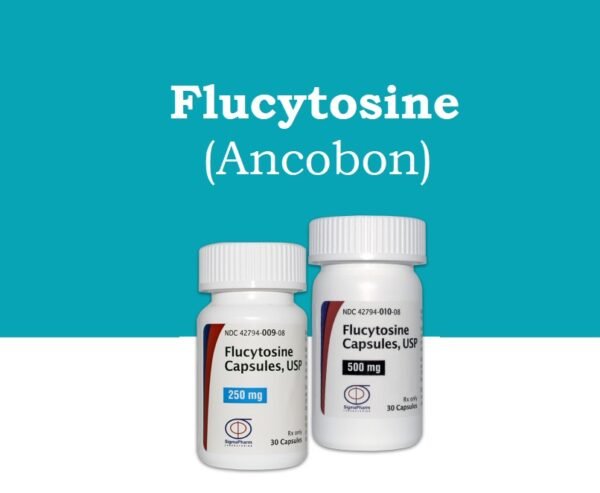
Flucytosine (Ancobon) is a synthetic antifungal medicine that is used to treat serious infections caused by candida and cryptococcus.
Indications of Flucytosine:
-
Candida/Cryptococcus infections:
- It is used as adjunctive therapy for systemic fungal infections (eg, septicemia, endocarditis, UTI, meningitis, or pulmonary) caused by susceptible strains of Candida or Cryptococcus
Flucytosine (Ancobon) dose in adults:
Usual dosage ranges:
- 50 to 150 mg/kg/day per oral in divided doses every 6 hours.
Flucytosine (Ancobon) dose in candidiasis (off-label dose):
-
Candidiasis of the central nervous system (eg, meningitis):
- 25 mg/kg/dose per oral 4 times daily (with amphotericin B [liposomal]) until step-down therapy is clinically appropriate.
-
Symptomatic Cystitis:
- Fluconazole-resistant C. glabrata: 25 mg/kg/dose 4 per oral times daily for 7 to 10 days as single agent.
-
Endocarditis (native or prosthetic valve) or infected implantable cardiac devices (eg, pacemaker, ICD, VAD):
- 25 mg/kg/dose per oral 4 times daily (with an amphotericin B lipid formulation).
- Treatment should be continued for at least 6 weeks following valve replacement surgery (longer durations in patients with abscesses or other complications) for native or prosthetic valve endocarditis.
- Treatment should be continued for 4 to 6 weeks post-surgery (4 weeks for infections limited to generator pockets and at least 6 weeks for infections involving the wire for patients with implantable cardiac devices.
- Note: If the patient is clinically stable with fluconazole-susceptible isolates in whom Candida has cleared from the bloodstream, the transition to fluconazole can be done.
-
Endophthalmitis (with or without vitritis):
- Fluconazole- or voriconazole-resistant isolates: 25 mg/kg/dose per oral 4 times daily (with amphotericin B [liposomal]) for at least 4 to 6 weeks until examination indicates the resolution.
- Intravitreal injection with voriconazole or amphotericin B deoxycholate should be given to patients with vitritis or with macular involvement (with or without vitritis).
-
Symptomatic Pyelonephritis:
- Fluconazole-resistant C. glabrata: 25 mg/kg/dose per oral 4 times daily in combination with amphotericin B deoxycholate for 1 to 7 days or as monotherapy for 14 days.
Flucytosine (Ancobon) dose in the treatment of Cryptococcal meningitis:
-
Non-HIV-infected, non-transplant:
- Induction: 25 mg/kg/dose (with amphotericin B) per oral every 6 hours for at least 4 weeks.
- Both amphotericin and flucytosine can be stopped and an extended course of fluconazole can be given in case of clinical improvement.
-
HIV-infected or solid organ transplant recipients:
- Induction: 25 mg/kg/dose (with amphotericin B) per oral every 6 hours for at least 2 weeks.
- Both amphotericin and flucytosine should be stopped and an extended course of fluconazole should be given in case of improvement.
-
Cerebral cryptococcomas:
- Induction: 25 mg/kg/dose (with amphotericin B and corticosteroids) per oral every 6 hours for at least 6 weeks, followed with an extended course of fluconazole.
Flucytosine (Ancobon) dose in children:
Note: Due to the chance of resistance,combination with amphotericin B or another susceptible antifungal should be used.
Flucytosine (Ancobon) General dosing in susceptible infections:
-
Infants, Children, and Adolescents:
- 50 to 150 mg/kg/day per oral in divided doses every 6 hours.
Flucytosine (Ancobon) Dose in the treatment of Aspergillosis and endocarditis: Limited data available:
-
Children and Adolescents:
- 37.5 mg/kg/dose per oral every 6 hours in combination with amphotericin B.
Candidiasis:
Flucytosine (Ancobon) Dose in the treatment of Chorioretinitis caused by candida:
-
Infants, Children, and Adolescents:
- 25 mg/kg/dose per oral every 6 hours in combination with amphotericin B.
Flucytosine (Ancobon) dose in the treatment of CNS disease caused by candida:
-
Infants, Children, and Adolescents:
- 25 mg/kg/dose per oral every 6 hours in combination with amphotericin B.
Flucytosine (Ancobon) dose in the candidal endocarditis or implanted cardiovascular device:
-
Infants:
- 25 mg/kg/dose per oral every 6 hours in combination with amphotericin B;
- Valve replacement or removal of hardware is strongly recommended.
-
Children and Adolescents:
- 25 to 37.5 mg/kg/dose per oral every 6 hours in combination with amphotericin B; valve replacement or removal of hardware is strongly recommended.
Flucytosine (Ancobon) dose in the treatment of Urinary tract infections caused by Candida:
-
Infants, Children, and Adolescents:
-
Symptomatic Cystitis:
- 25 mg/kg/dose per oral every 6 hours for 7 to 10 days.
-
Pyelonephritis:
- 25 mg/kg/dose per oral every 6 hours for 2 weeks with or without amphotericin B.
- A combination with amphotericin B should be given and treatment duration should be until symptom resolution and clear urine culture in case of fungal balls.
-
Flucytosine (Ancobon) dose in the treatment of disseminated Cryptococcal disease including CNS disease (independent of HIV status):
-
Infants, Children, and Adolescents:
- 25 mg/kg/dose per oral every 6 hours in combination with amphotericin B or fluconazole;
- minimum treatment duration: ≥2 weeks.
- Duration of treatment depends on HIV status, source of infection, and concomitant antifungal therapy.
Flucytosine pregnancy Risk Category: N (Not assigned)
- Studies on animal reproduction revealed negative outcomes.
- Flucytosine can cause side effects in pregnancy when it is metabolized into fluorouracil.
- For more information, refer to the Fluorouracil Systemic monograph
Use flucytosine while breastfeeding
- It is unknown if breast milk secretes flucytosine.
- The potential for serious adverse reactions in breastfeeding infants should be considered.
- The decision to discontinue breastfeeding or to take the drug is dependent on the importance to the mother.
Flucytosine (Ancobon) Dose adjustment in kidney disease:
- Dose reduction is neededfor elevated BUN or serum creatinine (or other signs of renal impairment) as per manufacturer, however, no specific dosage adjustments are provided.
-
The following adjustments have been recommended (based on a usual dose of 25 mg/kg/dose every 6 hours):
- CrCl >40 mL/minute:
- No dosage adjustment necessary.
- CrCl 20 to 40 mL/minute:
- 25 mg/kg/dose every 12 hours.
- CrCl 10 to 20 mL/minute:
- 25 mg/kg/dose every 24 hours.
- CrCl <10 mL/minute:
- 25 mg/kg/dose every 48 hours.
- ESRD on intermittent hemodialysis (IHD):
- 25 to 50 mg/kg/dose every 48 to 72 hours.
- The dose should be given after hemodialysis.
- CrCl >40 mL/minute:
Flucytosine (Ancobon) Dose adjustment in liver disease:
There are no dosage adjustments provided in the manufacturer's labeling; Use with caution.
Side effects of Flucytosine (Ancobon):
-
Cardiovascular:
- Cardiotoxicity
- Chest Pain
- Ventricular Dysfunction
-
Central Nervous System:
- Ataxia
- Confusion
- Fatigue
- Hallucination
- Headache
- Paresthesia
- Parkinsonian-Like Syndrome
- Peripheral Neuropathy
- Psychosis
- Sedation
- Seizure
- Vertigo
-
Dermatologic:
- Pruritus
- Skin Photosensitivity
- Skin Rash
- Toxic Epidermal Necrolysis
- Urticaria
-
Endocrine & Metabolic:
- Hypoglycemia
- Hypokalemia
-
Gastrointestinal:
- Abdominal Pain
- Anorexia
- Diarrhea
- Duodenal Ulcer
- Enterocolitis
- Gastrointestinal Hemorrhage
- Nausea
- Ulcerative Colitis
- Vomiting
- Xerostomia
-
Genitourinary:
- Azotemia
- Crystalluria
-
Hematologic & Oncologic:
- Agranulocytosis
- Anemia
- Aplastic Anemia
- Bone Marrow Aplasia
- Eosinophilia
- Leukopenia
- Pancytopenia
- Thrombocytopenia
-
Hepatic:
- Hepatic Injury (Acute)
- Hepatic Insufficiency
- Hepatic Necrosis
- Increased Liver Enzymes
- Increased Serum Bilirubin
- Jaundice
-
Hypersensitivity:
- Hypersensitivity Reaction
-
Neuromuscular & Skeletal:
- Weakness
-
Otic:
- Hearing Loss
-
Renal:
- Increased Blood Urea Nitrogen
- Increased Serum Creatinine
- Renal Failure
-
Respiratory:
- Dyspnea
-
Miscellaneous:
- Fever
Contraindications to Flucytosine (Ancobon):
Hypersensitivity to flucytosine and any component of the formulation
Warnings and precautions
-
Hematologic disease
- Flucytosine can cause irreversible suppression of bone marrow.
- This risk is higher if you have a history of bone marrow disease, hematologic diseases, or treatment with radiation.
-
Hepatic impairment
- Flucytosine can cause hepatotoxicity, so patients with hepatic impairment should be cautious.
-
Renal impairment: [US-Boxed Warning]
- Patients with kidney disease should be cautious and adjust their dosages.
Flucytosine: Drug Interaction
|
Risk Factor C (Monitor therapy) |
|
|
Amphotericin B |
May enhance the adverse/toxic effect of Flucytosine. This may be related to the adverse effects of amphotericin B on renal function. |
|
Chloramphenicol (Ophthalmic) |
May enhance the adverse/toxic effect of Myelosuppressive Agents. |
|
CloZAPine |
Myelosuppressive Agents may enhance the adverse/toxic effect of CloZAPine. Specifically, the risk for neutropenia may be increased. |
|
Promazine |
May enhance the myelosuppressive effect of Myelosuppressive Agents. |
|
Risk Factor D (Consider therapy modification) |
|
|
Cytarabine (Conventional) |
May diminish the therapeutic effect of Flucytosine. |
|
Risk Factor X (Avoid combination) |
|
|
BCG (Intravesical) |
Myelosuppressive Agents may diminish the therapeutic effect of BCG (Intravesical). |
|
Cladribine |
May enhance the myelosuppressive effect of Myelosuppressive Agents. |
|
Deferiprone |
Myelosuppressive Agents may enhance the neutropenic effect of Deferiprone. |
|
Dipyrone |
May enhance the adverse/toxic effect of Myelosuppressive Agents. Specifically, the risk for agranulocytosis and pancytopenia may be increased |
|
Gimeracil |
May increase serum concentrations of the active metabolite(s) of Flucytosine. Specifically, gimeracil may increase concentrations of fluorouracil. |
|
Saccharomyces boulardii |
Antifungal Agents (Systemic, Oral) may diminish the therapeutic effect of Saccharomyces boulardii. |
Monitoring parameters:
Pretreatment:
- CBC with differential
- RFTs,BUN
- Serum electrolytes (especially potassium)
- Blood culture
During treatment:
- CBC with differential
- LFTs (eg, alkaline phosphatase, AST/ALT)
- RFTs
- serum flucytosine concentrations (2 hours after administration of a dose) after 3 days of treatment and as clinically indicated (eg, following dosage adjustment, change in renal function, bone marrow toxicity).
How to administer Flucytosine (Ancobon)?
- To promote less variation in peak and trough serum levels, it should be given in divided doses.
- A few capsules should be given at a time over 15 minutes until full dose is taken to prevent nausea and vomiting.
Mechanism of action of Flucytosine (Ancobon):
Flucytosine is a fungal-cell-permeable drug that converts to fluorouracil. This interferes with fungal protein synthesis and fungal RNA by competing with uracil.
Absorption:
- Serum concentrations in neonates are very variable and rapid. Close monitoring is required. Children aged 12 years had higher serum concentrations.
Distribution:
- Into CSF (aqueous humor), joints, peritoneal fluid; v : 0.6 L/kg
Protein binding:
- 3% to 4%.
Metabolism:
- Minimally hepatic; deaminated both in yeasts and possibly via gut bacteria to 5 fluorouracil.
Bioavailability:
- 78% to 89%; decreased in neonates.
Half-life elimination:
- Neonates: 4 to 34 hours. Infants: 7.4 hours. Adults: 2 to 5 hours. Anuria: 85 hours. End-stage renal disease (ESRD): 75 to 200 hours.
Time to peak, serum:
- 1 to 2 hours. Neonates: 2.5 ± 1.3 hours. Adults: 1 to 2 hours.
Excretion:
- Urine (>90% as unchanged drug).
International Brands of Flucytosine:
- Ancobon
- Alcobon
- Ancotil
- Ancotyl
- Cocol
- Flusine
Flucytosine Brand Names in Pakistan:
No Brands Available in Pakistan.
.png)


