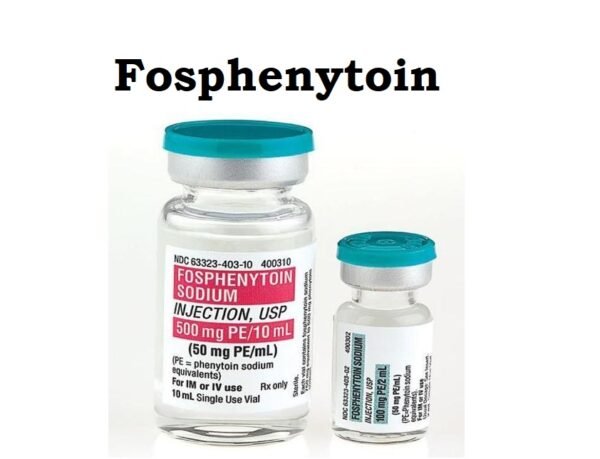
Fosphenytoin is a prodrug of phenytoin. It is available only as a parenteral formulation for the treatment of seizures.
Indications of Fosphenytoin:
-
Seizures:
- It is effective in controlling generalized tonic-clonic status epilepticus and the prevention and treatment of seizures occurring during neurosurgery;
- short-term parenteral administration when oral phenytoin is not possible.
-
Guideline recommendations:
- Status epilepticus:
- The first-line treatment is a benzodiazepine (eg, lorazepam, diazepam, midazolam).
- In patients with failed first-line management, IV fosphenytoin among other antiepileptics (eg, IV valproic acid or IV levetiracetam) is an option.
Fosphenytoin dose in adults:
Note:
- The dose, concentration, and infusion rates for fosphenytoin are expressed as phenytoin equivalents (PE);
- fosphenytoin should always be prescribed and dispensed in phenytoin equivalents (PE);
- fosphenytoin 1.5 mg is equivalent to phenytoin 1 mg and is referred to as 1 mg PE.
Fosphenytoin Dose in Status epilepticus:
-
American Epilepsy Society recommendations:
- 20 mg PE/kg I/V as a single dose.
- The maximum dose: 1500 mg PE
-
Neurocritical Care Society recommendations:
- Loading dose:
- 20 mg PE/kg I/V (maximum rate of administration: 150 mg PE/minute); if necessary, may give an additional 5 mg PE/kg 10 minutes after the loading dose.
- Loading dose:
-
Manufacturer's labeling:
- Dosing in the prescribing information may not reflect current clinical practice.
- Loading dose: 15 to 20 mg PE/kg I/V at 100 to 150 mg PE/minute followed by maintenance doses of either fosphenytoin or phenytoin.
-
Nonemergent loading and maintenance dosing: IM, IV:
Note:
- After administration of a loading dose, start maintenance dose at next identified dosing interval (ie, if intended dose frequency is every 12 hours, start maintenance dosing 12 hours after loading dose).
- Transition to oral phenytoin is necessary when possible due to cardio and local toxicity.
- Loading dose:
- 10 to 20 mg PE/kg (IV rate: Infuse more slowly [eg, over 30 minutes]; maximum rate: 150 mg PE/minute).
- Initial daily maintenance dose:
- 4 to 6 mg PE/kg/day in divided doses.
- Loading dose:
-
Substitution for oral phenytoin therapy:
- IM, IV: May be substituted for oral phenytoin at the same total daily dose.
- Dilantin capsules are ~90% bioavailable by the oral route; phenytoin, supplied as fosphenytoin, is 100% bioavailable by both the IM and IV routes, for this reason, plasma phenytoin concentrations may modestly increase when IM or IV fosphenytoin is substituted for oral phenytoin.
- In clinical trials, IM fosphenytoin was administered as a single daily dose utilizing either 1 or 2 injection sites; some patients may require more frequent dosing.
Fosphenytoin dose in children:
The dose, concentration in solutions, and infusion rates for fosphenytoin are expressed as PHENYTOIN SODIUM EQUIVALENTS (PE). Fosphenytoin should ALWAYS be prescribed and dispensed in mg of PE; otherwise, significant medication errors may occur.
Note:
- It should be given intravenously in children.
- The dosage depends on clinical response and serum concentrations.
- Based on pharmacokinetic studies, experts recommend using the pediatric IV phenytoin dosing guidelines to dose fosphenytoin using doses in PE equal to the phenytoin doses (ie, phenytoin 1 mg = fosphenytoin 1 mg PE).
- Transition to oral phenytoin should be done as soon as possible due to the risk of toxicity.
Fosphenytoin Dose in Status epilepticus:
-
Infants, Children, and Adolescents:
- Loading dose: IV (preferred), IM: 15 to 20 mg PE/kg.
- maximum dose: 1,500 mg PE; experts recommend a loading dose of 20 mg PE/kg.
- Note: Optimal therapy for refractory status epilepticus is not defined, if status epilepticus does not resolve, expert recommendations vary.
- Some experts suggest an additional load of 5 mg PE/kg administered 10 minutes after initial loading infusion while others recommend repeating the initial loading dose or changing to another agent.
Fosphenytoin Dose in the Seizures (nonemergent):
-
Infants, Children, and Adolescents:
- Loading dose (if required): IV (preferred), IM: 10 to 15 mg PE/kg;
- then initiate maintenance doses ≥12 hours after the loading dose.
Fosphenytoin Dose in the maintenance therapy of Seizures (short-term when oral route not available or appropriate):
-
Infants, Children, and Adolescents:
-
IV (preferred), IM: Initial:
- 4 to 8 mg PE/kg/day in 2 divided doses;
- initiate maintenance dose ≥12 hours after loading dose.
- Some experts suggest higher maintenance doses (8 to 10 mg PE/kg/day) may be necessary for infants and young children.
- In adult patients, treatment duration >5 days has not been evaluated.
-
Fosphenytoin Dose in Seizures, substitution for oral phenytoin therapy:
-
Infants, Children, and Adolescents:
-
IV (preferred), IM:
- May be substituted for oral phenytoin sodium at the same total daily dose; however, phenytoin capsules are ~90% bioavailable by the oral route;
- phenytoin, supplied as fosphenytoin, is 100% bioavailable by both the IM and IV routes; for this reason, plasma phenytoin concentrations may increase when IM or IV fosphenytoin is substituted for oral phenytoin sodium therapy.
- Serum concentrations should be closely monitored.
- In adult clinical trials, IM fosphenytoin was administered as a single daily dose utilizing either 1 or 2 injection sites, some patients may require more frequent dosing
-
Fosphenytoin dose in the prophylaxis of seizures in patients with Traumatic brain injury: Dosing based on experience with phenytoin:
-
Infants, Children, and Adolescents:
-
IV:
- Initial: 18 mg PE/kg loading dose, followed by 6 mg PE/kg/day divided every 8 hours for 48 hours.
-
Note:
- In order to minimize the incidence of early posttraumatic seizures in children with severe traumatic brain injuries, prophylactic phenytoin can be used but it does not decrease the risk of long-term seizures or improve neurologic outcome.
Fosphenytoin Pregnancy Risk Category: D
- Fosphenytoin, the prodrug for phenytoin, is called Fosphenytoin.
- Increased risk of congenital malformations in the womb from phenytoin-induced in utero exposure
- After delivery, coagulation defects and malignancies like neuroblastoma or neonatal fibroblastoma are seen.
- Vitamin K should be administered to the mother before birth and to the baby after birth to reduce the chance of fatal bleeding.
- This is due to the decreased levels of vitamin K dependent clotting factors in the uterus following phenytoin-induced clot formation.
- Other malformations caused by phenytoin include cardiac defects, orofacial clefts and dysmorphic facial features.
- Nail/digit hypoplasia, growth abnormalities, microcephaly, mental deficiency, and nail/digit hypoplasia are just a few.
Use fosphenytoin while breastfeeding
- Fosphenytoin, the prodrug for phenytoin, is called Fosphenytoin.
- It is unknown if fosphenytoin was secreted in breast milk before conversion to phenytoin.
- According to the manufacturer's instructions, the decision about whether to continue or stop breastfeeding during therapy is based on the risks of infant exposure, the benefits to the mother and the benefits to the infant.
- For more information, refer to the Phenytoin monograph
Fosphenytoin Dose adjustment in kidney disease:
- The manufacturer's labeling does not include any dosage adjustments.
- Patients with kidney disease or hypoalbuminemia need to be closely monitored for phenytoin levels.
- Fosphenytoin clearance may increase in renal disease without an equal increase in phenytoin.
- This can lead to increased severity and frequency of adverse events.
Fosphenytoin Dose adjustment in liver disease:
- The manufacturer's labeling does not include any dosage adjustments.
- Patients with hepatic disease and those with hypoalbuminemia need to be closely monitored for phenytoin levels.
- Fosphenytoin clearance may increase in the presence of hepatic disease.
- However, phenytoin clearance may not be as high.
- This can lead to an increase in severity and frequency of adverse events.
Common Side Effects of Fosphenytoin:
-
Central Nervous System:
- Burning Sensation
- Paresthesia
- Dizziness
- Drowsiness
- Ataxia
-
Dermatologic:
- Pruritus
-
Ophthalmic:
- Nystagmus Disorder
Less common Side Effects Of Fosphenytoin:
-
Cardiovascular:
- Hypotension
- Vasodilatation
- Tachycardia
- Facial Edema
- Hypertension
- Atrial Flutter
- Bundle Branch Block
- Cardiac Failure
- Cardiomegaly
- Cerebral Infarction
- Edema
- Orthostatic Hypotension
- Palpitations
- Prolonged QT Interval On ECG
- Pulmonary Embolism
- Shock
- Sinus Bradycardia
- Subdural Hematoma
- Syncope
- Thrombophlebitis
- Ventricular Premature Contractions
-
Central Nervous System:
- Headache
- Stupor
- Paresthesia
- Extrapyramidal Reaction
- Absent Reflexes
- Agitation
- Vertigo
- Cerebral Edema
- Dysarthria
- Hypoesthesia
- Abnormality In Thinking
- Chills
- Hyperreflexia
- Intracranial Hypertension
- Myasthenia
- Nervousness
- Speech Disturbance
- Akathisia
- Altered Sense Of Smell
- Amnesia
- Aphasia
- Brain Disease
- Central Nervous System Depression
- Cerebral Hemorrhage
- Coma
- Confusion
- Delirium
- Depersonalization
- Depression
- Emotional Lability
- Encephalitis
- Hemiplegia
- Hostility
- Hyperacusis
- Hyperesthesia
- Hypotonia
- Insomnia
- Malaise
- Meningitis
- Migraine
- Myoclonus
- Paralysis
- Personality Disorder
- Positive Babinski Sign
- Psychoneurosis
- Psychosis
- Seizure
- Twitching
-
Dermatologic:
- Ecchymoses
- Skin Rash
- Contact Dermatitis
- Cutaneous Nodule
- Diaphoresis
- Maculopapular Rash
- Pustular Rash
- Skin Discoloration
- Skin Photosensitivity
- Urticaria
-
Endocrine & Metabolic:
- Hypokalemia
- Acidosis
- Albuminuria
- Alkalosis
- Cachexia
- Dehydration
- Diabetes Insipidus
- Hyperglycemia
- Hyperkalemia
- Hypophosphatemia
- Ketosis
-
Gastrointestinal:
- Nausea
- Tongue Disease
- Xerostomia
- Dysgeusia
- Vomiting
- Constipation
- Ageusia
- Anorexia
- Diarrhea
- Dyspepsia
- Dysphagia
- Flatulence
- Gastritis
- Gastrointestinal Hemorrhage
- Intestinal Obstruction
- Oral Paresthesia
- Sialorrhea
- Tenesmus
-
Genitourinary:
- Pelvic Pain
- Dysuria
- Genital Edema
- Oliguria
- Urethral Pain
- Urinary Incontinence
- Urinary Retention
- Vaginitis
- Vulvovaginal Candidiasis
-
Hematologic & Oncologic:
- Anemia
- Hypochromic Anemia
- Leukocytosis
- Leukopenia
- Lymphadenopathy
- Petechia
- Thrombocytopenia
-
Hepatic:
- Abnormal Hepatic Function Tests
-
Hypersensitivity:
- Tongue Edema
-
Infection:
- Infection
- Cryptococcosis
- Sepsis
-
Local:
- Injection Site Reaction
- Pain At Injection Site
- Bleeding At Injection Site
- Inflammation At Injection Site
- Swelling At Injection Site
-
Neuromuscular & Skeletal:
- Tremor
- Asthenia
- Back Pain
- Arthralgia
- Hyperkinetic Muscle Activity
- Hypokinesia
- Lower Limb Cramp
- Myalgia
- Myopathy
-
Ophthalmic:
- Diplopia
- Amblyopia
- Conjunctivitis
- Eye Pain
- Mydriasis
- Photophobia
- Visual Field Defect
-
Otic:
- Tinnitus
- Deafness
- Otalgia
-
Renal:
- Polyuria
- Renal Failure Syndrome
-
Respiratory:
- Pneumonia
- Apnea
- Aspiration Pneumonia
- Asthma
- Atelectasis
- Bronchitis
- Cyanosis
- Dyspnea
- Epistaxis
- Flu-Like Symptoms
- Hemoptysis
- Hyperventilation
- Hypoxia
- Increased Bronchial Secretions
- Increased Cough
- Pharyngitis
- Pneumothorax
- Rhinitis
- Sinusitis
-
Miscellaneous:
- Fever
Rare Side effects of Fosphenytoin :
-
Cardiovascular:
- Cardiac arrhythmia
- Severe hypotension
Contraindications to Fosphenytoin:
- Hypersensitivity to fosphenytoin or phenytoin, or any other hydantoins or any component of this formulation
- Stokes Adams syndrome
- Sinus bradycardia
- Sinoatrial block, second and third-degree AV blocks
- Fosphenytoin and phenytoin have been linked to acute livertoxicity in the past
- Combination therapy with delavirdine
Warnings and precautions
-
Blood dyscrasias
- Phenytoin can lead to fatal hematological toxicities, with or without bone-marrow suppression. This includes thrombocytopenia, leukopenia and granulocytopenia.
- Patients with a history of an adverse hematologic reaction to any drug are at greater risk.
- Management, early evaluation and close monitoring are essential.
-
Cardiovascular events: [US Boxed Warn]
- Rapid administration can cause severe hypotension and cardiac arrhythmias, including bradycardia or heart block, QT prolongation, bradycardia or ventricular fibrillation.
- This risk is higher in the elderly, hypotension, critically ill patients and severe myocardial impairment.
- Close monitoring of the heart and respiratory system is essential during and after IV fosphenytoin treatment.
- It may be necessary to stop therapy or reduce the rate of administration.
- Adults should not consume more than 150 mg of fosphenytoin IV equivalents (PE) per minute.
- When treating epilepticus in children, a maximum IV rate of 2 mg/kg/minute (upto 150 mg PE/minute) should be maintained.
- Maintenance doses should not exceed 1 to 2- mg/kg/minute (upto 100 mg PE/minute).
- Although cardiovascular toxicity is more likely when infusion rates are higher than the recommended, they have been reported as occurring at or below the recommended rate.
-
Dermatologic reactions
- Phenytoin can cause serious dermatological reactions, including Steven Johnsons syndrome, toxic Epidermal Necrolysis (TEN), drug reaction eosinophilia systemic symptoms (DRESS), and exanthematous pustulosis. This usually occurs within 28 days but may occur later.
- Research suggests that patients of Asian descent are more susceptible to serious skin reactions.
- If you notice any of these symptoms, it is important to stop all therapy immediately.
-
Hepatotoxicity
- Acute hepatic failure, jaundice and hepatomegaly can all be caused by phenytoin.
- Acute phenytoin livertoxicity can lead to life-threatening complications.
- If acute hepatotoxicity is suspected, treatment should be stopped immediately.
-
Hypersensitivity
- Hypersensitivity reactions like angioedema can be caused by Phenytoin.
- In such cases, therapy should be stopped.
- Alternate treatment should be provided for patients who are hypersensitive to structurally related drugs, such as carboxamides (eg carbamazepine), barbiturates and succinimides (eg trimethadione).
-
Toxicity local:
- Fosphenytoin IV can cause "purple gloves syndrome", i.e. discoloration with edema, and pain in the distal limb. This may be caused by drug extravasation.
- Although the condition is usually resolved spontaneously, it can lead to skin necrosis or limb ischemia.
- Fosphenytoin causes less venous irritation than a comparable dose of phenytoin and causes less phlebitis.
-
Lymphadenopathy
- It is possible to have benign lymph node hyperplasia or pseudolymphoma, lymphoma or Hodgkin's disease. This should be considered for discontinuation of therapy.
-
Multiorgan hypersensitivity reactions
- Antiepileptic drugs may cause fatal multiorgan hypersensitivity reactions (also called drug reaction with eosinophilia systemic symptoms [DRESS]).
- You should monitor your symptoms and signs for possible manifestations of lymphatic, hepatic and renal organ systems.
- You should consider therapy withdrawal and alternative agents.
-
Sensory disturbances
- Maximum administration can cause extreme burning, itching, or paresthesias, most commonly perineal, lasting for minutes to hours.
- Milder sensory disturbances can last up to 24 hours.
- The ability to slow down or temporarily stop infusions can reduce their frequency and intensity.
-
Cardiovascular disease
- Hypotension and severe myocardial dysfunction should not be treated with phenytoin.
- Sinus bradycardia, sinoatrial and second-degree block or Adam-Stokes syndrome are all contraindicated.
-
Diabetes:
- Patients with diabetes mellitus should be cautious.
- Phenytoin may cause diabetes or inhibit insulin production in patients with hyperglycemia.
-
Hepatic impairment
- Patients with hepatic impairment should be cautious.
- Patients with hypoalbuminemia may have a higher level of unbound Phenytoin.
- Therefore, it is important to interpret total plasma phenytoin levels with caution.
- Unbound Phenytoin concentrations might be more helpful.
-
Hyperbilirubinemia
- Patients with hyperbilirubinemia have a higher free fraction and pharmacologic response.
- It should therefore be used with caution when dealing with such situations.
- Patients with hyperbilirubinemia may have a higher fraction of unbound Phenytoin.
- Therefore, it is important to interpret total plasma phenytoin levels with caution. Unbound Phenytoin concentrations might be more helpful.
-
Hypoalbuminemia
- Hypoalbuminemia increases the free fraction and pharmacologic response of phenytoin. Therefore, caution should be taken when using the drug.
- Patients with hypoalbuminemia may have a higher level of unbound Phenytoin.
- Therefore, it is important to interpret total plasma phenytoin levels with caution. Unbound phenytoin concentrations might be more helpful.
-
Hypothyroidism
- Hypothyroidism patients should be treated with caution.
- Long-term phenytoin therapy can cause a decrease in thyroid hormone serum levels.
-
Porphyria
- Patients with porphyria should be treated with caution.
-
Renal impairment
- Patients with impaired renal function should be cautious.
- You should check the phosphate load for fosphenytoin (0.0037 mg phosphate/mgPE fosphenytoin).
- The fraction of unbound Phenytoin in renal impairment is higher, so total plasma levels should be interpreted with caution.
- Concentrations of unbound phenytoin may be more effective.
Fosphenytoin: Drug Interaction
|
Risk Factor C (Monitor therapy) |
|
|
Acemetacin |
May increase the serum concentration of Fosphenytoin-Phenytoin. |
|
Acetaminophen |
Fosphenytoin-Phenytoin may decrease the serum concentration of Acetaminophen. Specifically, serum concentrations of acetaminophen may be decreased (leading to decreased efficacy), but the formation of the toxic N-acetyl-p-benzoquinone imine (NAPQI) metabolite may be increased (leading to increased hepatotoxicity). |
|
Alcohol (Ethyl) |
May enhance the CNS depressant effect of Fosphenytoin. Alcohol (Ethyl) may decrease the serum concentration of Fosphenytoin. This may be particularly applicable with chronic, heavy alcohol consumption. Alcohol (Ethyl) may increase the serum concentration of Fosphenytoin. This may be particularly applicable with acute, heavy alcohol consumption. |
|
Bazedoxifene |
Fosphenytoin may decrease the serum concentration of Bazedoxifene. This may lead to loss of efficacy or, if bazedoxifene is combined with estrogen therapy, an increased risk of endometrial hyperplasia. |
|
Benperidol |
CYP3A4 Inducers (Strong) may decrease the serum concentration of Benperidol. |
|
Benzhydrocodone |
CYP3A4 Inducers (Strong) may decrease the serum concentration of Benzhydrocodone. Specifically, the serum concentrations of hydrocodone may be reduced. |
|
Benzodiazepines |
May increase the serum concentration of Fosphenytoin. Short-term exposure to benzodiazepines may not present as much risk as chronic therapy. Exceptions: ALPRAZolam. |
|
Brentuximab Vedotin |
CYP3A4 Inducers (Strong) may decrease the serum concentration of Brentuximab Vedotin. Specifically, concentrations of the active monomethyl auristatin E (MMAE) component may be decreased. |
|
Brentuximab Vedotin |
P-glycoprotein/ABCB1 Inducers may decrease the serum concentration of Brentuximab Vedotin. Specifically, concentrations of the active monomethyl auristatin E (MMAE) component may be decreased. |
|
Buprenorphine |
CYP3A4 Inducers (Strong) may decrease the serum concentration of Buprenorphine. |
|
Busulfan |
Fosphenytoin may decrease the serum concentration of Busulfan. |
|
Calcifediol |
CYP3A4 Inducers (Strong) may decrease the serum concentration of Calcifediol. |
|
Cannabidiol |
CYP3A4 Inducers (Strong) may decrease the serum concentration of Cannabidiol. |
|
Cannabis |
CYP3A4 Inducers (Strong) may decrease the serum concentration of Cannabis. More specifically, tetrahydrocannabinol and cannabidiol serum concentrations may be decreased. |
|
Carbonic Anhydrase Inhibitors |
May enhance the adverse/toxic effect of Fosphenytoin-Phenytoin. Specifically, the risk for osteomalacia or rickets may be increased. Exceptions: Brinzolamide; Dorzolamide. |
|
CeFAZolin |
May decrease the protein binding of Fosphenytoin. |
|
Celiprolol |
P-glycoprotein/ABCB1 Inducers may decrease the serum concentration of Celiprolol. |
|
Chloramphenicol (Systemic) |
Fosphenytoin may decrease the serum concentration of Chloramphenicol (Systemic). Fosphenytoin may increase the serum concentration of Chloramphenicol (Systemic). Chloramphenicol (Systemic) may increase the serum concentration of Fosphenytoin. |
|
Chlorpheniramine |
May increase the serum concentration of Fosphenytoin-Phenytoin. |
|
ChlorproPAMIDE |
CYP3A4 Inducers (Strong) may decrease the serum concentration of ChlorproPAMIDE. |
|
Ciprofloxacin (Systemic) |
Fosphenytoin may enhance the QTc-prolonging effect of Ciprofloxacin (Systemic). Ciprofloxacin (Systemic) may diminish the therapeutic effect of Fosphenytoin. Ciprofloxacin (Systemic) may decrease the serum concentration of Fosphenytoin. |
|
Cladribine |
P-glycoprotein/ABCB1 Inducers may decrease the serum concentration of Cladribine. |
|
Clindamycin (Systemic) |
CYP3A4 Inducers (Strong) may decrease the serum concentration of Clindamycin (Systemic). Refer to the specific clindamycin (systemic) - rifampin drug interaction monograph for information concerning that combination. |
|
ClonazePAM |
Fosphenytoin may decrease the serum concentration of ClonazePAM. Clonazepam may also alter concentrations of Phenytoin (active metabolite of Fosphenytoin). |
|
Codeine |
CYP3A4 Inducers (Strong) may decrease serum concentrations of the active metabolite(s) of Codeine. |
|
Corticosteroids (Systemic) |
CYP3A4 Inducers (Strong) may decrease the serum concentration of Corticosteroids (Systemic). Exceptions: Hydrocortisone (Systemic); PrednisoLONE (Systemic); PredniSONE. |
|
CYP2C19 Inducers (Moderate) |
May decrease the serum concentration of CYP2C19 Substrates (High risk with Inducers). |
|
CYP2C19 Inhibitors (Moderate) |
May decrease the metabolism of CYP2C19 Substrates (High risk with Inhibitors). |
|
Dexketoprofen |
May enhance the adverse/toxic effect of Fosphenytoin-Phenytoin. |
|
Dexmethylphenidate |
May increase the serum concentration of Fosphenytoin. |
|
Diazoxide |
May decrease the serum concentration of Fosphenytoin. Total phenytoin concentrations may be affected more than free phenytoin concentrations. |
|
Diethylstilbestrol |
CYP3A4 Inducers (Strong) may decrease the serum concentration of Diethylstilbestrol. |
|
Doxercalciferol |
CYP3A4 Inducers (Strong) may increase serum concentrations of the active metabolite(s) of Doxercalciferol. |
|
Doxofylline |
Fosphenytoin-Phenytoin may decrease the serum concentration of Doxofylline. |
|
Dronabinol |
CYP3A4 Inducers (Strong) may decrease the serum concentration of Dronabinol. |
|
Elagolix |
CYP3A4 Inducers (Strong) may decrease the serum concentration of Elagolix. |
|
Eslicarbazepine |
Fosphenytoin may decrease the serum concentration of Eslicarbazepine. (based on studies with phenytoin) Eslicarbazepine may increase the serum concentration of Fosphenytoin. (based on studies with phenytoin) |
|
Estriol (Systemic) |
CYP3A4 Inducers (Strong) may decrease the serum concentration of Estriol (Systemic). |
|
Estriol (Topical) |
CYP3A4 Inducers (Strong) may decrease the serum concentration of Estriol (Topical). |
|
Ethosuximide |
May enhance the CNS depressant effect of Fosphenytoin. Fosphenytoin may decrease the serum concentration of Ethosuximide. Ethosuximide may increase the serum concentration of Fosphenytoin. |
|
Etizolam |
CYP3A4 Inducers (Strong) may decrease the serum concentration of Etizolam. |
|
Evogliptin |
CYP3A4 Inducers (Strong) may decrease the serum concentration of Evogliptin. |
|
FentaNYL |
CYP3A4 Inducers (Strong) may decrease the serum concentration of FentaNYL. |
|
Flunarizine |
Fosphenytoin may decrease the serum concentration of Flunarizine. |
|
Fluorouracil (Topical) |
May increase the serum concentration of Fosphenytoin. |
|
FluvoxaMINE |
May increase the serum concentration of Fosphenytoin. |
|
Folic Acid |
May decrease the serum concentration of Fosphenytoin. |
|
Fosamprenavir |
Fosphenytoin may increase the serum concentration of Fosamprenavir. Fosamprenavir may decrease the serum concentration of Fosphenytoin. |
|
Gestrinone |
Fosphenytoin-Phenytoin may decrease the serum concentration of Gestrinone. |
|
Halothane |
May increase the serum concentration of Fosphenytoin. |
|
HYDROcodone |
CYP3A4 Inducers (Strong) may decrease the serum concentration of HYDROcodone. |
|
Hydrocortisone (Systemic) |
CYP3A4 Inducers (Strong) may decrease the serum concentration of Hydrocortisone (Systemic). |
|
Ifosfamide |
CYP3A4 Inducers (Strong) may increase serum concentrations of the active metabolite(s) of Ifosfamide. CYP3A4 Inducers (Strong) may decrease serum concentrations of the active metabolite(s) of Ifosfamide. |
|
Lacosamide |
Antiepileptic Agents (Sodium Channel Blockers) may enhance the adverse/toxic effect of Lacosamide. Specifically the risk for bradycardia, ventricular tachyarrhythmias, or a prolonged PR interval may be increased. |
|
Letermovir |
May decrease the serum concentration of Fosphenytoin-Phenytoin. |
|
Leucovorin Calcium-Levoleucovorin |
May decrease the serum concentration of Fosphenytoin. |
|
LevETIRAcetam |
Fosphenytoin-Phenytoin may decrease the serum concentration of LevETIRAcetam. |
|
Levodopa-Containing Products |
Fosphenytoin-Phenytoin may diminish the therapeutic effect of Levodopa-Containing Products. |
|
Levomefolate |
May decrease the serum concentration of Fosphenytoin. |
|
Levomethadone |
Fosphenytoin may decrease the serum concentration of Levomethadone. |
|
Lithium |
Fosphenytoin may enhance the adverse/toxic effect of Lithium. |
|
Loop Diuretics |
Fosphenytoin may diminish the diuretic effect of Loop Diuretics. |
|
Lumacaftor |
May decrease the serum concentration of CYP2C9 Substrates (High Risk with Inhibitors or Inducers). Lumacaftor may increase the serum concentration of CYP2C9 Substrates (High Risk with Inhibitors or Inducers). |
|
Lumacaftor |
May decrease the serum concentration of CYP2C19 Substrates (High risk with Inducers). |
|
Mebendazole |
Fosphenytoin may decrease the serum concentration of Mebendazole. |
|
Meperidine |
Fosphenytoin may decrease the serum concentration of Meperidine. |
|
Methadone |
Fosphenytoin may decrease the serum concentration of Methadone. |
|
Methotrexate |
May decrease the serum concentration of Fosphenytoin-Phenytoin. FosphenytoinPhenytoin may increase the serum concentration of Methotrexate. Specifically, fosphenytoinphenytoin may displace methotrexate from serum proteins, increasing the concentration of free, unbound drug. |
|
Methylfolate |
May decrease the serum concentration of Fosphenytoin. |
|
Methylphenidate |
May increase the serum concentration of Fosphenytoin. |
|
MetroNIDAZOLE (Systemic) |
Fosphenytoin may decrease the serum concentration of MetroNIDAZOLE (Systemic). MetroNIDAZOLE (Systemic) may increase the serum concentration of Fosphenytoin. |
|
Mexiletine |
Fosphenytoin may decrease the serum concentration of Mexiletine. |
|
Mianserin |
May diminish the therapeutic effect of Fosphenytoin. Fosphenytoin may decrease the serum concentration of Mianserin. |
|
Miconazole (Oral) |
May increase the serum concentration of Fosphenytoin. |
|
Multivitamins/Minerals (with ADEK, Folate, Iron) |
May decrease the serum concentration of Fosphenytoin-Phenytoin. |
|
Nelfinavir |
Fosphenytoin may decrease the serum concentration of Nelfinavir. Nelfinavir may decrease the serum concentration of Fosphenytoin. |
|
Neuromuscular-Blocking Agents (Nondepolarizing) |
Fosphenytoin-Phenytoin may diminish the neuromuscular-blocking effect of Neuromuscular-Blocking Agents (Nondepolarizing). Fosphenytoin-Phenytoin may enhance the neuromuscular-blocking effect of NeuromuscularBlocking Agents (Nondepolarizing). Fosphenytoin-Phenytoin may decrease the serum concentration of Neuromuscular-Blocking Agents (Nondepolarizing). |
|
Omeprazole |
May increase the serum concentration of Fosphenytoin. Fosphenytoin may decrease the serum concentration of Omeprazole. |
|
glycoprotein/ABCB1 Substrates |
P-P-glycoprotein/ABCB1 Inducers may decrease the serum concentration of P-glycoprotein/ABCB1 Substrates. P-glycoprotein inducers may also further limit the distribution of p-glycoprotein substrates to specific cells/tissues/organs where p-glycoprotein is present in large amounts (e.g., brain, T-lymphocytes, testes, etc.). |
|
PHENobarbital |
Fosphenytoin may enhance the CNS depressant effect of PHENobarbital. Fosphenytoin may increase the serum concentration of PHENobarbital. PHENobarbital may decrease the serum concentration of Fosphenytoin. |
|
Phenylbutazone |
May increase the serum concentration of Fosphenytoin-Phenytoin. |
|
Pimavanserin |
CYP3A4 Inducers (Strong) may decrease the serum concentration of Pimavanserin. |
|
Pitolisant |
CYP3A4 Inducers (Strong) may decrease the serum concentration of Pitolisant. |
|
Platinum Derivatives |
May decrease the serum concentration of Fosphenytoin-Phenytoin. |
|
PrednisoLONE (Systemic) |
CYP3A4 Inducers (Strong) may decrease the serum concentration of PrednisoLONE (Systemic). |
|
PredniSONE |
CYP3A4 Inducers (Strong) may decrease the serum concentration of PredniSONE. |
|
Primidone |
Fosphenytoin may increase the metabolism of Primidone. The ratio of primidone:phenobarbital is thus changed. |
|
Propacetamol |
Fosphenytoin-Phenytoin may decrease serum concentrations of the active metabolite(s) of Propacetamol. Specifically, serum concentrations of acetaminophen may be decreased (leading to decreased efficacy), but the formation of its toxic N-acetyl-p-benzoquinone imine (NAPQI) metabolite may be increased (leading to increased hepatotoxicity). |
|
Propafenone |
CYP3A4 Inducers (Strong) may decrease the serum concentration of Propafenone. |
|
Pyridoxine |
May increase the metabolism of Fosphenytoin. This is most apparent in high pyridoxine doses (e.g., 80 mg to 200 mg daily) |
|
Ramelteon |
CYP3A4 Inducers (Strong) may decrease the serum concentration of Ramelteon. |
|
Reboxetine |
CYP3A4 Inducers (Strong) may decrease the serum concentration of Reboxetine. |
|
Rifapentine |
May decrease the serum concentration of CYP2C9 Substrates (High risk with Inducers). |
|
Rufinamide |
Fosphenytoin may decrease the serum concentration of Rufinamide. Rufinamide may increase the serum concentration of Fosphenytoin. |
|
Ruxolitinib |
CYP3A4 Inducers (Strong) may decrease the serum concentration of Ruxolitinib. |
|
SAXagliptin |
CYP3A4 Inducers (Strong) may decrease the serum concentration of SAXagliptin. |
|
Sertraline |
Fosphenytoin may decrease the serum concentration of Sertraline. Sertraline may increase the serum concentration of Fosphenytoin. |
|
SUFentanil |
CYP3A4 Inducers (Strong) may decrease the serum concentration of SUFentanil. |
|
SulfADIAZINE |
May increase the serum concentration of Fosphenytoin-Phenytoin. |
|
Sulfinpyrazone |
May increase the serum concentration of Fosphenytoin-Phenytoin. |
|
Sulthiame |
May increase the serum concentration of Fosphenytoin-Phenytoin. |
|
Tacrolimus (Systemic) |
Fosphenytoin may decrease the serum concentration of Tacrolimus (Systemic). Tacrolimus (Systemic) may increase the serum concentration of Fosphenytoin. |
|
Tetrahydrocannabinol |
CYP3A4 Inducers (Strong) may decrease the serum concentration of Tetrahydrocannabinol. |
|
Tetrahydrocannabinol and Cannabidiol |
CYP3A4 Inducers (Strong) may decrease the serum concentration of Tetrahydrocannabinol and Cannabidiol. |
|
Thiothixene |
Fosphenytoin-Phenytoin may decrease the serum concentration of Thiothixene. |
|
Thyroid Products |
Fosphenytoin may decrease the serum concentration of Thyroid Products. Phenytoin may also displace thyroid hormones from protein binding sites. |
|
Ticlopidine |
May increase the serum concentration of Fosphenytoin. |
|
TOLBUTamide |
May decrease the protein binding of Fosphenytoin-Phenytoin. Specifically concentrations of free phenytoin may be increased. |
|
Topiramate |
Fosphenytoin may decrease the serum concentration of Topiramate. Topiramate may increase the serum concentration of Fosphenytoin. |
|
TraMADol |
CYP3A4 Inducers (Strong) may decrease the serum concentration of TraMADol. |
|
TraZODone |
Fosphenytoin may decrease the serum concentration of TraZODone. TraZODone may increase the serum concentration of Fosphenytoin. |
|
Tropisetron |
CYP3A4 Inducers (Strong) may decrease the serum concentration of Tropisetron. |
|
Udenafil |
CYP3A4 Inducers (Strong) may decrease the serum concentration of Udenafil. |
|
Valproate Products |
May decrease the protein binding of Fosphenytoin-Phenytoin. This appears to lead to an initial increase in the percentage of unbound (free) phenytoin and to a decrease in total phenytoin concentrations. Whether concentrations of free phenytoin are increased is unclear. With long-term concurrent use, total phenytoin concentrations may increase. Fosphenytoin-Phenytoin may decrease the serum concentration of Valproate Products. |
|
Vigabatrin |
May decrease the serum concentration of Fosphenytoin. |
|
VinCRIStine |
Fosphenytoin may decrease the serum concentration of VinCRIStine. VinCRIStine may decrease the serum concentration of Fosphenytoin. |
|
Zolpidem |
CYP3A4 Inducers (Strong) may decrease the serum concentration of Zolpidem. |
|
Zonisamide |
Fosphenytoin may decrease the serum concentration of Zonisamide. |
|
Zuclopenthixol |
CYP3A4 Inducers (Strong) may decrease the serum concentration of Zuclopenthixol. |
|
|
Risk Factor D (Consider therapy modification) |
|
Abiraterone Acetate |
CYP3A4 Inducers (Strong) may decrease the serum concentration of Abiraterone Acetate. Management: Avoid whenever possible. If such a combination cannot be avoided, increase abiraterone acetate dosing frequency from once daily to twice daily during concomitant use. |
|
Acalabrutinib |
CYP3A4 Inducers (Strong) may decrease the serum concentration of Acalabrutinib. Management: Avoid co-administration of strong CYP3A inducers in patients taking acalabrutinib. If strong CYP3A inducers cannot be avoided, increase the dose of acalabrutinib to 200 mg twice daily. |
|
Afatinib |
P-glycoprotein/ABCB1 Inducers may decrease the serum concentration of Afatinib. Management: Per US labeling: if requiring chronic use of P-gp inducers, increase afatinib dose by 10mg as tolerated; reduce to original afatinib dose 2-3 days after stopping P-gp inducers. Per Canadian labeling: avoid combination if possible. |
|
Amiodarone |
Fosphenytoin may enhance the QTc-prolonging effect of Amiodarone. Fosphenytoin may decrease the serum concentration of Amiodarone. Amiodarone may increase the serum concentration of Fosphenytoin. Management: Seek alternatives when possible. Monitor patients receiving this combination for QT interval prolongation or changes in cardiac rhythm, and for decreased serum concentrations/effects of amiodarone and increased concentrations/effects of phenytoin. |
|
Antifungal Agents (Azole Derivatives, Systemic) |
Fosphenytoin may decrease the serum concentration of Antifungal Agents (Azole Derivatives, Systemic). Antifungal Agents (Azole Derivatives, Systemic) may increase the serum concentration of Fosphenytoin. Applicable Isavuconazonium considerations are addressed in separate monographs. Exceptions: Isavuconazonium Sulfate. |
|
ARIPiprazole |
CYP3A4 Inducers (Strong) may decrease the serum concentration of ARIPiprazole. Management: Double the oral aripiprazole dose and closely monitor. Reduce oral aripiprazole dose to 10-15 mg/day (for adults) if the inducer is discontinued. Avoid use of strong CYP3A4 inducers for more than 14 days with extended-release injectable aripiprazole. |
|
ARIPiprazole Lauroxil |
CYP3A4 Inducers (Strong) may decrease serum concentrations of the active metabolite(s) of ARIPiprazole Lauroxil. Management: Patients taking the 441 mg dose of aripiprazole lauroxil increase their dose to 662 mg if used with a strong CYP3A4 inducer for more than 14 days. No dose adjustment is necessary for patients using the higher doses of aripiprazole lauroxil. |
|
Bictegravir |
Fosphenytoin-Phenytoin may decrease the serum concentration of Bictegravir. Management: When possible consider using an alternative anticonvulsant with concurrent bictegravir, emtricitabine, and tenofovir alafenamide. If the combination must be used, monitor closely for evidence of reduced antiviral effectiveness. |
|
Brexpiprazole |
CYP3A4 Inducers (Strong) may decrease the serum concentration of Brexpiprazole. Management: If brexpiprazole is used together with a strong CYP3A4 inducer, the brexpiprazole dose should gradually be doubled over the course of 1 to 2 weeks. |
|
BusPIRone |
CYP3A4 Inducers (Strong) may decrease the serum concentration of BusPIRone. Management: Consider alternatives to this combination. If coadministration of these agents is deemed necessary, monitor patients for reduced buspirone effects and increase buspirone doses as needed. |
|
Cabozantinib |
CYP3A4 Inducers (Strong) may decrease the serum concentration of Cabozantinib. Management: Avoid use of strong CYP3A4 inducers with cabozantinib if possible. If combined, cabozantinib dose adjustments are recommended and vary based on the cabozantinib product used and the indication for use. See monograph for details. |
|
Calcium Channel Blockers |
May increase the serum concentration of Fosphenytoin. Management: Monitor for phenytoin toxicity with concomitant use of a calcium channel blocker (CCB) or decreased phenytoin effects with CCB discontinuation. Monitor for decreased CCB therapeutic effects. Nimodipine Canadian labeling contraindicates use with phenytoin. Exceptions: Clevidipine. |
|
Canagliflozin |
Fosphenytoin may decrease the serum concentration of Canagliflozin. Management: Consider increasing canagliflozin dose to 300 mg/day in patients with estimated GFR >60 mL/min/1.73 m2 who tolerate canagliflozin 100 mg/day and require greater glycemic control. Consider alternatives in patients with estimated GFR 45-60 mL/min/1.73 m2. |
|
Capecitabine |
May increase the serum concentration of Fosphenytoin. |
|
CarBAMazepine |
Fosphenytoin may decrease the serum concentration of CarBAMazepine. CarBAMazepine may decrease the serum concentration of Fosphenytoin. CarBAMazepine may increase the serum concentration of Fosphenytoin. Possibly by competitive inhibition at sites of metabolism. |
|
Cimetidine |
May enhance the adverse/toxic effect of Fosphenytoin-Phenytoin. Cimetidine may increase the serum concentration of Fosphenytoin-Phenytoin. Management: Consider using an alternative H -antagonist to avoid this interaction. Monitor for toxic effects of hydantoin anticonvulsants if cimetidine is initiated/dose increased. |
|
Clarithromycin |
CYP3A4 Inducers (Strong) may increase serum concentrations of the active metabolite(s) of Clarithromycin. Clarithromycin may increase the serum concentration of CYP3A4 Inducers (Strong). CYP3A4 Inducers (Strong) may decrease the serum concentration of Clarithromycin. Management: Consider alternative antimicrobial therapy for patients receiving a CYP3A inducer. Drugs that enhance the metabolism of clarithromycin into 14hydroxyclarithromycin may alter the clinical activity of clarithromycin and may impair clarithromycin efficacy. |
|
CycloSPORINE (Systemic) |
Fosphenytoin may decrease the serum concentration of CycloSPORINE (Systemic). |
|
CYP2C19 Inducers (Strong) |
May increase the metabolism of CYP2C19 Substrates (High risk with Inducers). Management: Consider an alternative for one of the interacting drugs. Some combinations may be specifically contraindicated. Consult appropriate manufacturer labeling. |
|
CYP3A4 Substrates (High risk with Inducers) |
CYP3A4 Inducers (Strong) may increase the metabolism of CYP3A4 Substrates (High risk with Inducers). Management: Consider an alternative for one of the interacting drugs. Some combinations may be specifically contraindicated. Consult appropriate manufacturer labeling. Exceptions: Benzhydrocodone; Buprenorphine; CarBAMazepine; Etizolam; HYDROcodone; TraMADol; Zolpidem. |
|
Dabrafenib |
May decrease the serum concentration of CYP2C9 Substrates (High risk with Inducers). Management: Seek alternatives to the CYP2C9 substrate when possible. If concomitant therapy cannot be avoided, monitor clinical effects of the substrate closely (particularly therapeutic effects). |
|
Dabrafenib |
May decrease the serum concentration of CYP2C19 Substrates (High risk with Inducers). Management: Seek alternatives to the CYP2C19 substrate when possible. If concomitant therapy cannot be avoided, monitor clinical effects of the substrate closely (particularly therapeutic effects). |
|
Dasatinib |
CYP3A4 Inducers (Strong) may decrease the serum concentration of Dasatinib. Management: Avoid when possible. If such a combination cannot be avoided, consider increasing dasatinib dose and monitor clinical response and toxicity closely. |
|
Deferasirox |
Fosphenytoin may decrease the serum concentration of Deferasirox. Management: Avoid combination when possible; if the combination must be used, consider a 50% increase in initial deferasirox dose, with monitoring of serum ferritin concentrations and clinical responses to guide further dosing. |
|
Dexamethasone (Systemic) |
Fosphenytoin may decrease the serum concentration of Dexamethasone (Systemic). Dexamethasone (Systemic) may decrease the serum concentration of Fosphenytoin. Dexamethasone (Systemic) may increase the serum concentration of Fosphenytoin. Management: Consider dexamethasone dose increases when combined with fosphenytoin and monitor closely for reduced steroid efficacy. Monitor phenytoin levels closely, both increased and decreased phenytoin levels have been reported. |
|
Disopyramide |
May enhance the QTc-prolonging effect of Fosphenytoin. Fosphenytoin may decrease the serum concentration of Disopyramide. Management: Seek alternatives when possible. Monitor patients receiving this combination closely for evidence of QT interval prolongation or changes in cardiac rhythm, as well as for decreased serum concentrations/therapeutic effects of disopyramide. |
|
Disulfiram |
May increase the serum concentration of Fosphenytoin. Management: Avoid concomitant use of disulfiram and phenytoin when possible. Phenytoin dose adjustment will likely be necessary when starting and/or stopping concurrent disulfiram. Monitor phenytoin response and concentrations closely. |
|
DOXOrubicin (Conventional) |
CYP3A4 Inducers (Strong) may decrease the serum concentration of DOXOrubicin (Conventional). Management: Seek alternatives to strong CYP3A4 inducers in patients treated with doxorubicin. One U.S. manufacturer (Pfizer Inc.) recommends that these combinations be avoided. |
|
DOXOrubicin (Conventional) |
P-glycoprotein/ABCB1 Inducers may decrease the serum concentration of DOXOrubicin (Conventional). Management: Seek alternatives to P-glycoprotein inducers in patients treated with doxorubicin whenever possible. One U.S. manufacturer (Pfizer Inc.) recommends that these combinations be avoided. |
|
Doxycycline |
Fosphenytoin may decrease the serum concentration of Doxycycline. |
|
Efavirenz |
May increase the serum concentration of Fosphenytoin. Fosphenytoin may decrease the serum concentration of Efavirenz. |
|
Eravacycline |
CYP3A4 Inducers (Strong) may decrease the serum concentration of Eravacycline. Management: Increase the eravacycline dose to 1.5 mg/kg every 12 hours when combined with strong CYP3A4 inducers. |
|
Estrogen Derivatives (Contraceptive) |
Fosphenytoin may diminish the therapeutic effect of Estrogen Derivatives (Contraceptive). Contraceptive failure is possible. Management: Use of an alternative, nonhormonal means of contraception is recommended. |
|
Etoposide |
CYP3A4 Inducers (Strong) may decrease the serum concentration of Etoposide. Management: When possible, seek alternatives to strong CYP3A4-inducing medications in patients receiving etoposide. If combined, monitor patients closely for diminished etoposide response and need for etoposide dose increases. |
|
Etoposide Phosphate |
CYP3A4 Inducers (Strong) may decrease the serum concentration of Etoposide Phosphate. Management: When possible, seek alternatives to strong CYP3A4inducing medications in patients receiving etoposide phosphate. If these combinations cannot be avoided, monitor patients closely for diminished etoposide phosphate response. |
|
Everolimus |
CYP3A4 Inducers (Strong) may decrease the serum concentration of Everolimus. Management: Avoid concurrent use of strong CYP3A4 inducers if possible. If coadministration cannot be avoided, double the daily dose of everolimus using increments of 5 mg or less. Monitor everolimus serum concentrations closely when indicated. |
|
Exemestane |
CYP3A4 Inducers (Strong) may decrease the serum concentration of Exemestane. Management: Exemestane U.S. product labeling recommends using an increased dose (50 mg/day) in patients receiving concurrent strong CYP3A4 inducers. The Canadian product labeling does not recommend a dose adjustment with concurrent use of strong CYP3A4 inducers. |
|
Ezogabine |
Fosphenytoin-Phenytoin may decrease the serum concentration of Ezogabine. Management: Consider increasing the ezogabine dose when adding phenytoin. Patients using this combination should be monitored closely for evidence of adequate ezogabine therapy. |
|
Felbamate |
Fosphenytoin may decrease the serum concentration of Felbamate. Felbamate may increase the serum concentration of Fosphenytoin. Management: Decreased phenytoin dose will likely be needed when adding felbamate; some reports suggest an empiric 20% decrease in phenytoin dose. Additional reductions may be needed if felbamate dose is increased or as otherwise guided by monitoring. |
|
Floxuridine |
May increase the serum concentration of Fosphenytoin. |
|
Fluconazole |
May increase the serum concentration of Fosphenytoin. |
|
Fluorouracil (Systemic) |
May increase the serum concentration of Fosphenytoin. |
|
FLUoxetine |
Fosphenytoin may enhance the QTc-prolonging effect of FLUoxetine. FLUoxetine may increase the serum concentration of Fosphenytoin. |
|
Gefitinib |
CYP3A4 Inducers (Strong) may decrease the serum concentration of Gefitinib. Management: In the absence of severe adverse reactions, increase gefitinib dose to 500 mg daily in patients receiving strong CYP3A4 inducers; resume 250 mg dose 7 days after discontinuation of the strong inducer. Carefully monitor clinical response. |
|
GuanFACINE |
CYP3A4 Inducers (Strong) may decrease the serum concentration of GuanFACINE. Management: Increase the guanfacine dose by up to double when initiating guanfacine in a patient taking a strong CYP3A4 inducer. Increase guanfacine dose gradually over 1 to 2 weeks if initiating strong CYP3A4 inducer therapy in a patient already taking guanfacine. |
|
HMG-CoA Reductase Inhibitors (Statins) |
Fosphenytoin may decrease the serum concentration of HMG-CoA Reductase Inhibitors (Statins). Exceptions: Pitavastatin; Rosuvastatin. |
|
Imatinib |
CYP3A4 Inducers (Strong) may decrease the serum concentration of Imatinib. Management: Avoid concurrent use of imatinib with strong CYP3A4 inducers when possible. If such a combination must be used, increase imatinib dose by at least 50% and monitor the patient's clinical response closely. |
|
Isoniazid |
May increase the serum concentration of Fosphenytoin. Management: Consider alternatives. If concomitant therapy cannot be avoided, monitor for increased phenytoin concentrations/effects with isoniazid initiation/dose increase, or decreased concentrations/effects with isoniazid discontinuation/dose decrease. |
|
Ixabepilone |
CYP3A4 Inducers (Strong) may decrease the serum concentration of Ixabepilone. Management: Avoid this combination whenever possible. If this combination must be used, a gradual increase in ixabepilone dose from 40 mg/m to 60 mg/m (given as a 4-hour infusion), as tolerated, should be considered. |
|
LamoTRIgine |
Fosphenytoin may decrease the serum concentration of LamoTRIgine. |
|
Larotrectinib |
CYP3A4 Inducers (Strong) may decrease the serum concentration of Larotrectinib. Management: Avoid use of strong CYP3A4 inducers with larotrectinib. If this combination cannot be avoided, double the larotrectinib dose. Reduced to previous dose after stopping the inducer after a period of 3 to 5 times the inducer half-life. |
|
LinaGLIPtin |
CYP3A4 Inducers (Strong) may decrease the serum concentration of LinaGLIPtin. Management: Strongly consider using an alternative to any strong CYP3A4 inducer in patients who are being treated with linagliptin. If this combination is used, monitor patients closely for evidence of reduced linagliptin effectiveness. |
|
LinaGLIPtin |
P-glycoprotein/ABCB1 Inducers may decrease the serum concentration of LinaGLIPtin. Management: Strongly consider using an alternative to any strong P-glycoprotein inducer in patients who are being treated with linagliptin. If this combination is used, monitor patients closely for evidence of reduced linagliptin effectiveness. |
|
Lopinavir |
Fosphenytoin may decrease the serum concentration of Lopinavir. Lopinavir may decrease the serum concentration of Fosphenytoin. Management: The manufacturer of lopinavir/ritonavir recommends avoiding once-daily administration if used together with phenytoin. |
|
Manidipine |
CYP3A4 Inducers (Strong) may decrease the serum concentration of Manidipine. Management: Consider avoiding concomitant use of manidipine and strong CYP3A4 inducers. If combined, monitor closely for decreased manidipine effects and loss of efficacy. Increased manidipine doses may be required. |
|
Maraviroc |
CYP3A4 Inducers (Strong) may decrease the serum concentration of Maraviroc. Management: Increase maraviroc adult dose to 600 mg twice daily when used with strong CYP3A4 inducers. This does not apply to patients also receiving strong CYP3A4 inhibitors. Do not use maraviroc with strong CYP3A4 inducers in patients with CrCl less than 30 mL/min. |
|
Mefloquine |
May diminish the therapeutic effect of Anticonvulsants. Mefloquine may decrease the serum concentration of Anticonvulsants. Management: Mefloquine is contraindicated for malaria prophylaxis in persons with a history of convulsions. Monitor anticonvulsant concentrations and treatment response closely with concurrent use. |
|
MethylPREDNISolone |
CYP3A4 Inducers (Strong) may decrease the serum concentration of MethylPREDNISolone. Management: Consider methylprednisolone dose increases in patients receiving strong CYP3A4 inducers and monitor closely for reduced steroid efficacy. |
|
MetyraPONE |
Fosphenytoin may decrease the serum concentration of MetyraPONE. The oral metyrapone test would thus be unreliable unless the metapyrone dosage was substantially increased (e.g., 750 mg every 2 hours). |
|
Mirodenafil |
CYP3A4 Inducers (Strong) may decrease the serum concentration of Mirodenafil. Management: Consider avoiding the concomitant use of mirodenafil and strong CYP3A4 inducers. If combined, monitor for decreased mirodenafil effects. Mirodenafil dose increases may be required to achieve desired effects. |
|
Osimertinib |
CYP3A4 Inducers (Strong) may decrease the serum concentration of Osimertinib. |
|
OXcarbazepine |
Fosphenytoin-Phenytoin may decrease serum concentrations of the active metabolite(s) of OXcarbazepine. Specifically, concentrations of the major active 10-monohydroxy metabolite may be reduced. OXcarbazepine may increase the serum concentration of Fosphenytoin-Phenytoin. Management: Consider increasing the initial adult oxcarbazepine extended release tablet (Oxtellar XR) dose to 900 mg/day. No specific recommendations are available for other oxcarbazepine formulations. |
|
Paliperidone |
Inducers of CYP3A4 (Strong) and P-glycoprotein may decrease the serum concentration of Paliperidone. Management: Avoid using the 3-month extended-release injectable suspension (Invega Trinza) with inducers of both CYP3A4 and P-glycoprotein during the 3-month dosing interval if possible. If combination is necessary, consider using extendedrelease tablets. |
|
Perampanel |
Fosphenytoin may decrease the serum concentration of Perampanel. Management: Increase the perampanel starting dose to 4 mg/day when perampanel is used with phenytoin/fosphenytoin. Patients receiving this combination should be followed closely for response, especially with any changes to phenytoin/fosphenytoin therapy. |
|
Progestins (Contraceptive) |
Fosphenytoin may diminish the therapeutic effect of Progestins (Contraceptive). Contraceptive failure is possible. Management: Contraceptive failure is possible. Use of an alternative, nonhormonal contraceptive is recommended. |
|
QUEtiapine |
CYP3A4 Inducers (Strong) may decrease the serum concentration of QUEtiapine. Management: An increase in quetiapine dose (as much as 5 times the regular dose) may be required to maintain therapeutic benefit. Reduce the quetiapine dose back to the previous/regular dose within 7-14 days of discontinuing the inducer. |
|
QuiNIDine |
Fosphenytoin may enhance the QTc-prolonging effect of QuiNIDine. Fosphenytoin may decrease the serum concentration of QuiNIDine. Management: Consider alternatives when possible. Monitor patients receiving this combination closely forsigns and symptoms of excessive QTc interval prolongation and arrhythmia, as well as for decreased serum concentrations/therapeutic effects of quinidine. |
|
QuiNINE |
Fosphenytoin may decrease the serum concentration of QuiNINE. |
|
Radotinib |
CYP3A4 Inducers (Strong) may decrease the serum concentration of Radotinib. Management: Consider alternatives to this combination when possible as the risk of radotinib treatment failure may be increased. |
|
RifAMPin |
May decrease the serum concentration of Fosphenytoin. Management: Seek alternatives when possible. If used together, monitor closely for decreased serum phenytoin concentrations following rifampin initiation/dose increase, or increased concentrations and toxic effects following rifampin discontinuation/dose decrease. |
|
RisperiDONE |
CYP3A4 Inducers (Strong) may decrease the serum concentration of RisperiDONE. Management: Consider increasing the dose of oral risperidone (to no more than double the original dose) if a strong CYP3A4 inducer is initiated. For patients on IM risperidone, consider an increased IM dose or supplemental doses of oral risperidone. |
|
Ritonavir |
Fosphenytoin may decrease the serum concentration of Ritonavir. Ritonavir may decrease the serum concentration of Fosphenytoin. |
|
Rolapitant |
CYP3A4 Inducers (Strong) may decrease the serum concentration of Rolapitant. Management: Avoid rolapitant use in patients requiring chronic administration of strong CYP3A4 inducers. Monitor for reduced rolapitant response and the need for alternative or additional antiemetic therapy even with shorter-term use of such inducers. |
|
Sirolimus |
CYP3A4 Inducers (Strong) may decrease the serum concentration of Sirolimus. Management: Avoid concomitant use of strong CYP3A4 inducers and sirolimus if possible. If combined, monitor for reduced serum sirolimus concentrations. Sirolimus dose increases will likely be necessary to prevent subtherapeutic sirolimus levels. |
|
SUNItinib |
CYP3A4 Inducers (Strong) may decrease the serum concentration of SUNItinib. Management: Avoid when possible. If such a combination cannot be avoided, sunitinib dose increases are recommended, and vary by indication. See full monograph for details. |
|
Tadalafil |
CYP3A4 Inducers (Strong) may decrease the serum concentration of Tadalafil. Management: Erectile dysfunction: monitor for decreased effectiveness - no standard dose adjustments recommended. Avoid use of tadalafil for pulmonary arterial hypertension in patients receiving a strong CYP3A4 inducer. |
|
Tamoxifen |
CYP3A4 Inducers (Strong) may decrease serum concentrations of the active metabolite(s) of Tamoxifen. CYP3A4 Inducers (Strong) may decrease the serum concentration of Tamoxifen. Management: Consider alternatives to concomitant use of strong CYP3A4 inducers and tamoxifen. If the combination cannot be avoided, monitor for reduced therapeutic effects of tamoxifen. |
|
Tegafur |
May increase the serum concentration of Fosphenytoin-Phenytoin. Management: Phenytoin dose reductions may be necessary when used together with fluorouracil, which is the active metabolite of tegafur. |
|
Temsirolimus |
Fosphenytoin may decrease the serum concentration of Temsirolimus. Concentrations of the active metabolite, sirolimus, are also likely to be decreased (and maybe to an even greater degree). Management: Temsirolimus prescribing information recommends against coadministration with strong CYP3A4 inducers such as phenytoin; however, if concurrent therapy is necessary, an increase in temsirolimus adult dose to 50 mg/week should be considered. |
|
Teniposide |
Fosphenytoin may decrease the serum concentration of Teniposide. Management: Consider alternatives to combined treatment with phenytoin and teniposide due to the potential for decreased teniposide concentrations. If the combination cannot be avoided, monitor teniposide response closely. |
|
Theophylline Derivatives |
Fosphenytoin may decrease the serum concentration of Theophylline Derivatives. Theophylline Derivatives may decrease the serum concentration of Fosphenytoin. Management: Seek alternatives when possible. If used together, monitor for decreased concentrations/effects of phenytoin or theophylline if the other agent is initiated/dose increased, or increased concentrations/effects if the other is discontinued/dose decreased. Exceptions: Dyphylline. |
|
Thiotepa |
CYP3A4 Inducers (Strong) may increase serum concentrations of the active metabolite(s) of Thiotepa. CYP3A4 Inducers (Strong) may decrease the serum concentration of Thiotepa. Management: Thiotepa prescribing information recommends avoiding concomitant use of thiotepa and strong CYP3A4 inducers. If concomitant use is unavoidable, monitor for adverse effects. |
|
TiaGABine |
CYP3A4 Inducers (Strong) may decrease the serum concentration of TiaGABine. Management: Approximately 2-fold higher tiagabine doses and a more rapid dose titration will likely be required in patients concomitantly taking a strong CYP3A4 inducer. |
|
Tipranavir |
Fosphenytoin may decrease the serum concentration of Tipranavir. Tipranavir may decrease the serum concentration of Fosphenytoin. |
|
Topotecan |
Fosphenytoin-Phenytoin may decrease the serum concentration of Topotecan. Management: Monitor topotecan response closely, and consider alternatives to phenytoin when possible. No specific guidelines for topotecan dose adjustment are available. |
|
Trimethoprim |
Fosphenytoin may decrease the serum concentration of Trimethoprim. Trimethoprim may increase the serum concentration of Fosphenytoin. Management: Consider alternatives to this combination when possible, to avoid potential decreased trimethoprim efficacy and increased phenytoin concentrations/effects. Monitor patients receiving this combination closely for both of these possible effects. |
|
Vemurafenib |
CYP3A4 Inducers (Strong) may decrease the serum concentration of Vemurafenib. Management: Avoid concurrent use of vemurafenib with a strong CYP3A4 inducer and replace with another agent when possible. If a strong CYP3A4 inducer is indicated and unavoidable, the dose of vemurafenib may be increased by 240 mg (1 tablet) as tolerated. |
|
Vilazodone |
CYP3A4 Inducers (Strong) may decrease the serum concentration of Vilazodone. Management: Consider increasing vilazodone dose by as much as 2-fold (do not exceed 80 mg/day), based on response, in patients receiving strong CYP3A4 inducers for > 14 days. Reduce to the original vilazodone dose over 1-2 weeks after inducer discontinuation. |
|
Vitamin K Antagonists (eg, warfarin) |
Fosphenytoin may enhance the anticoagulant effect of Vitamin K Antagonists. Vitamin K Antagonists may increase the serum concentration of Fosphenytoin. Management: Anticoagulant dose adjustment will likely be necessary when phenytoin is initiated or discontinued. Monitor patients extra closely (INR and signs/symptoms of bleeding) when using this combination. |
|
Vortioxetine |
CYP3A4 Inducers (Strong) may decrease the serum concentration of Vortioxetine. Management: Consider increasing the vortioxetine dose to no more than 3 times the original dose when used with a strong drug metabolism inducer for more than 14 days. The vortioxetine dose should be returned to normal within 14 days of stopping the strong inducer. |
|
Zaleplon |
CYP3A4 Inducers (Strong) may decrease the serum concentration of Zaleplon. Management: Consider the use of an alternative hypnotic that is not metabolized by CYP3A4 in patients receiving strong CYP3A4 inducers. If zalephon is combined with a strong CYP3A4 inducer, monitor for decreased effectiveness of zaleplon. |
|
Risk Factor X (Avoid combination) |
|
|
Abemaciclib |
CYP3A4 Inducers (Strong) may decrease the serum concentration of Abemaciclib. |
|
Antihepaciviral Combination Products |
CYP3A4 Inducers (Strong) may decrease the serum concentration of Antihepaciviral Combination Products. |
|
Apixaban |
CYP3A4 Inducers (Strong) may decrease the serum concentration of Apixaban. |
|
Apremilast |
CYP3A4 Inducers (Strong) may decrease the serum concentration of Apremilast. |
|
Aprepitant |
CYP3A4 Inducers (Strong) may decrease the serum concentration of Aprepitant. |
|
Artemether |
CYP3A4 Inducers (Strong) may decrease serum concentrations of the active metabolite(s) of Artemether. Specifically, dihydroartemisinin concentrations may be reduced. CYP3A4 Inducers (Strong) may decrease the serum concentration of Artemether. |
|
Asunaprevir |
CYP3A4 Inducers (Strong) may decrease the serum concentration of Asunaprevir. |
|
Axitinib |
CYP3A4 Inducers (Strong) may decrease the serum concentration of Axitinib. |
|
Bedaquiline |
CYP3A4 Inducers (Strong) may decrease the serum concentration of Bedaquiline. |
|
Bortezomib |
CYP3A4 Inducers (Strong) may decrease the serum concentration of Bortezomib. |
|
Bosutinib |
CYP3A4 Inducers (Strong) may decrease the serum concentration of Bosutinib. |
|
Brigatinib |
CYP3A4 Inducers (Strong) may decrease the serum concentration of Brigatinib. |
|
Cariprazine |
CYP3A4 Inducers (Strong) may decrease the serum concentration of Cariprazine. |
|
Ceritinib |
CYP3A4 Inducers (Strong) may decrease the serum concentration of Ceritinib. |
|
CloZAPine |
CYP3A4 Inducers (Strong) may decrease the serum concentration of CloZAPine. |
|
Cobicistat |
Fosphenytoin-Phenytoin may decrease the serum concentration of Cobicistat. |
|
Cobimetinib |
CYP3A4 Inducers (Strong) may decrease the serum concentration of Cobimetinib. |
|
Copanlisib |
CYP3A4 Inducers (Strong) may decrease the serum concentration of Copanlisib. |
|
Crizotinib |
CYP3A4 Inducers (Strong) may decrease the serum concentration of Crizotinib. |
|
Dabigatran Etexilate |
P-glycoprotein/ABCB1 Inducers may decrease the serum concentration of Dabigatran Etexilate. Management: Avoid concurrent use of dabigatran with P-glycoprotein inducers whenever possible. |
|
Daclatasvir |
CYP3A4 Inducers (Strong) may decrease the serum concentration of Daclatasvir. |
|
Darunavir |
Fosphenytoin may decrease the serum concentration of Darunavir. |
|
Dasabuvir |
CYP3A4 Inducers (Strong) may decrease the serum concentration of Dasabuvir. |
|
Deflazacort |
CYP3A4 Inducers (Strong) may decrease serum concentrations of the active metabolite(s) of Deflazacort. |
|
Delamanid |
CYP3A4 Inducers (Strong) may decrease the serum concentration of Delamanid. |
|
Delavirdine |
Fosphenytoin may decrease the serum concentration of Delavirdine. Delavirdine may increase the serum concentration of Fosphenytoin. |
|
Dienogest |
CYP3A4 Inducers (Strong) may decrease the serum concentration of Dienogest. Management: Avoid use of dienogest for contraception when using medications that induce CYP3A4 and for at least 28 days after discontinuation of a CYP3A4 inducer. An alternative form of contraception should be used during this time. |
|
Dolutegravir |
Fosphenytoin-Phenytoin may decrease the serum concentration of Dolutegravir. |
|
Doravirine |
CYP3A4 Inducers (Strong) may decrease the serum concentration of Doravirine. |
|
Dronedarone |
CYP3A4 Inducers (Strong) may decrease the serum concentration of Dronedarone. |
|
Duvelisib |
CYP3A4 Inducers (Strong) may decrease the serum concentration of Duvelisib. |
|
Elbasvir |
CYP3A4 Inducers (Strong) may decrease the serum concentration of Elbasvir. |
|
Eliglustat |
CYP3A4 Inducers (Strong) may decrease the serum concentration of Eliglustat. |
|
Elvitegravir |
Fosphenytoin-Phenytoin may decrease the serum concentration of Elvitegravir. |
|
Encorafenib |
CYP3A4 Inducers (Strong) may decrease the serum concentration of Encorafenib. |
|
Enzalutamide |
May decrease the serum concentration of Fosphenytoin-Phenytoin. |
|
Erdafitinib |
CYP3A4 Inducers (Strong) may decrease the serum concentration of Erdafitinib. |
|
Erlotinib |
May increase the serum concentration of Fosphenytoin-Phenytoin. FosphenytoinPhenytoin may decrease the serum concentration of Erlotinib. Management: Avoid use of erlotinib with phenytoin when possible. If required, increase erlotinib dose by 50 mg increments at 2 week intervals, as tolerated, to a max of 450 mg/day. |
|
Etravirine |
CYP3A4 Inducers (Strong) may decrease the serum concentration of Etravirine. |
|
Flibanserin |
CYP3A4 Inducers (Strong) may decrease the serum concentration of Flibanserin. |
|
Fosaprepitant |
CYP3A4 Inducers (Strong) may decrease the serum concentration of Fosaprepitant. Specifically, CYP3A4 Inducers (Strong) may decrease serum concentrations of the active metabolite aprepitant. |
|
Fosnetupitant |
CYP3A4 Inducers (Strong) may decrease serum concentrations of the active metabolite(s) of Fosnetupitant. |
|
Fostamatinib |
CYP3A4 Inducers (Strong) may decrease serum concentrations of the active metabolite(s) of Fostamatinib. |
|
Fotemustine |
Fosphenytoin-Phenytoin may decrease the serum concentration of Fotemustine. Fotemustine may decrease the serum concentration of Fosphenytoin-Phenytoin. Specifically, fotemustine may decrease concentrations of orally administered phenytoin. |
|
Gemigliptin |
CYP3A4 Inducers (Strong) may decrease serum concentrations of the active metabolite(s) of Gemigliptin. CYP3A4 Inducers (Strong) may decrease the serum concentration of Gemigliptin. |
|
Gilteritinib |
Combined Inducers of CYP3A4 and P-glycoprotein may decrease the serum concentration of Gilteritinib. |
|
Glasdegib |
CYP3A4 Inducers (Strong) may decrease the serum concentration of Glasdegib. |
|
Glecaprevir and Pibrentasvir |
Fosphenytoin-Phenytoin may decrease the serum concentration of Glecaprevir and Pibrentasvir. |
|
Grazoprevir |
CYP3A4 Inducers (Strong) may decrease the serum concentration of Grazoprevir. |
|
Ibrutinib |
CYP3A4 Inducers (Strong) may decrease the serum concentration of Ibrutinib. |
|
Idelalisib |
CYP3A4 Inducers (Strong) may decrease the serum concentration of Idelalisib. |
|
Irinotecan Products |
CYP3A4 Inducers (Strong) may decrease serum concentrations of the active metabolite(s) of Irinotecan Products. Specifically, serum concentrations of SN-38 may be reduced. CYP3A4 Inducers (Strong) may decrease the serum concentration of Irinotecan Products. |
|
Isavuconazonium Sulfate |
CYP3A4 Inducers (Strong) may decrease serum concentrations of the active metabolite(s) of Isavuconazonium Sulfate. Specifically, CYP3A4 Inducers (Strong) may decrease isavuconazole serum concentrations. |
|
Itraconazole |
CYP3A4 Inducers (Strong) may decrease the serum concentration of Itraconazole. |
|
Ivabradine |
CYP3A4 Inducers (Strong) may decrease the serum concentration of Ivabradine. |
|
Ivacaftor |
CYP3A4 Inducers (Strong) may decrease the serum concentration of Ivacaftor. |
|
Ivosidenib |
CYP3A4 Inducers (Strong) may decrease the serum concentration of Ivosidenib. |
|
Ixazomib |
CYP3A4 Inducers (Strong) may decrease the serum concentration of Ixazomib. |
|
Lapatinib |
CYP3A4 Inducers (Strong) may decrease the serum concentration of Lapatinib. Management: If therapy overlap cannot be avoided, consider titrating lapatinib gradually from 1,250 mg/day up to 4,500 mg/day (HER2 positive metastatic breast cancer) or 1,500 mg/day up to 5,500 mg/day (hormone receptor/HER2 positive breast cancer) as tolerated. |
|
Ledipasvir |
P-glycoprotein/ABCB1 Inducers may decrease the serum concentration of Ledipasvir. |
|
Lorlatinib |
CYP3A4 Inducers (Strong) may decrease the serum concentration of Lorlatinib. |
|
Lumefantrine |
CYP3A4 Inducers (Strong) may decrease the serum concentration of Lumefantrine. |
|
Lurasidone |
CYP3A4 Inducers (Strong) may decrease the serum concentration of Lurasidone. |
|
Macimorelin |
CYP3A4 Inducers (Strong) may decrease the serum concentration of Macimorelin. |
|
Macitentan |
CYP3A4 Inducers (Strong) may decrease the serum concentration of Macitentan. |
|
Midostaurin |
CYP3A4 Inducers (Strong) may decrease the serum concentration of Midostaurin. |
|
MiFEPRIStone |
CYP3A4 Inducers (Strong) may decrease the serum concentration of MiFEPRIStone. |
|
Naldemedine |
CYP3A4 Inducers (Strong) may decrease the serum concentration of Naldemedine. |
|
Naloxegol |
CYP3A4 Inducers (Strong) may decrease the serum concentration of Naloxegol. |
|
Neratinib |
CYP3A4 Inducers (Strong) may decrease the serum concentration of Neratinib. |
|
Netupitant |
CYP3A4 Inducers (Strong) may decrease the serum concentration of Netupitant. |
|
NIFEdipine |
CYP3A4 Inducers (Strong) may decrease the serum concentration of NIFEdipine. |
|
Nilotinib |
CYP3A4 Inducers (Strong) may decrease the serum concentration of Nilotinib. |
|
NiMODipine |
CYP3A4 Inducers (Strong) may decrease the serum concentration of NiMODipine. |
|
Nintedanib |
Combined Inducers of CYP3A4 and P-glycoprotein may decrease the serum concentration of Nintedanib. |
|
Nisoldipine |
CYP3A4 Inducers (Strong) may decrease the serum concentration of Nisoldipine. |
|
Olaparib |
CYP3A4 Inducers (Strong) may decrease the serum concentration of Olaparib. |
|
Palbociclib |
CYP3A4 Inducers (Strong) may decrease the serum concentration of Palbociclib. |
|
Panobinostat |
CYP3A4 Inducers (Strong) may decrease the serum concentration of Panobinostat. |
|
PAZOPanib |
CYP3A4 Inducers (Strong) may decrease the serum concentration of PAZOPanib. |
|
Piperaquine |
CYP3A4 Inducers (Strong) may decrease the serum concentration of Piperaquine. |
|
PONATinib |
CYP3A4 Inducers (Strong) may decrease the serum concentration of PONATinib. |
|
Praziquantel |
CYP3A4 Inducers (Strong) may decrease the serum concentration of Praziquantel. Management: Use of praziquantel with strong CYP3A4 inducers is contraindicated. Discontinue rifampin 4 weeks prior to initiation of praziquantel therapy. Rifampin may be resumed the day following praziquantel completion. |
|
Ranolazine |
CYP3A4 Inducers (Strong) may decrease the serum concentration of Ranolazine. |
|
Regorafenib |
CYP3A4 Inducers (Strong) may decrease the serum concentration of Regorafenib. |
|
Ribociclib |
CYP3A4 Inducers (Strong) may decrease the serum concentration of Ribociclib. |
|
Rilpivirine |
Fosphenytoin may decrease the serum concentration of Rilpivirine. |
|
Rivaroxaban |
CYP3A4 Inducers (Strong) may decrease the serum concentration of Rivaroxaban. |
|
Roflumilast |
CYP3A4 Inducers (Strong) may decrease the serum concentration of Roflumilast. Management: Roflumilast U.S. prescribing information recommends against combining strong CYP3A4 inducers with roflumilast. The Canadian product monograph makes no such recommendation but notes that such agents may reduce roflumilast therapeutic effects. |
|
RomiDEPsin |
CYP3A4 Inducers (Strong) may decrease the serum concentration of RomiDEPsin. |
|
Simeprevir |
CYP3A4 Inducers (Strong) may decrease the serum concentration of Simeprevir. |
|
Sofosbuvir |
P-glycoprotein/ABCB1 Inducers may decrease the serum concentration of Sofosbuvir. |
|
Sonidegib |
CYP3A4 Inducers (Strong) may decrease the serum concentration of Sonidegib. |
|
SORAfenib |
CYP3A4 Inducers (Strong) may decrease the serum concentration of SORAfenib. |
|
Tasimelteon |
CYP3A4 Inducers (Strong) may decrease the serum concentration of Tasimelteon. |
|
Tenofovir Alafenamide |
Fosphenytoin-Phenytoin may decrease the serum concentration of Tenofovir Alafenamide. |
|
Ticagrelor |
CYP3A4 Inducers (Strong) may decrease serum concentrations of the active metabolite(s) of Ticagrelor. CYP3A4 Inducers (Strong) may decrease the serum concentration of Ticagrelor. |
|
Tofacitinib |
CYP3A4 Inducers (Strong) may decrease the serum concentration of Tofacitinib. |
|
Tolvaptan |
CYP3A4 Inducers (Strong) may decrease the serum concentration of Tolvaptan. Management: If concurrent use is necessary, increased doses of tolvaptan (with close monitoring for toxicity and clinical response) may be needed. |
|
Toremifene |
CYP3A4 Inducers (Strong) may decrease the serum concentration of Toremifene. |
|
Trabectedin |
CYP3A4 Inducers (Strong) may decrease the serum concentration of Trabectedin. |
|
Ulipristal |
CYP3A4 Inducers (Strong) may decrease the serum concentration of Ulipristal. |
|
Valbenazine |
CYP3A4 Inducers (Strong) may decrease the serum concentration of Valbenazine. |
|
Vandetanib |
CYP3A4 Inducers (Strong) may decrease the serum concentration of Vandetanib. |
|
Velpatasvir |
CYP3A4 Inducers (Strong) may decrease the serum concentration of Velpatasvir. |
|
Velpatasvir |
P-glycoprotein/ABCB1 Inducers may decrease the serum concentration of Velpatasvir. |
|
Venetoclax |
CYP3A4 Inducers (Strong) may decrease the serum concentration of Venetoclax. |
|
VinCRIStine (Liposomal) |
CYP3A4 Inducers (Strong) may decrease the serum concentration of VinCRIStine (Liposomal). |
|
VinCRIStine (Liposomal) |
P-glycoprotein/ABCB1 Inducers may decrease the serum concentration of VinCRIStine (Liposomal). |
|
Vinflunine |
CYP3A4 Inducers (Strong) may decrease the serum concentration of Vinflunine. |
|
Vorapaxar |
CYP3A4 Inducers (Strong) may decrease the serum concentration of Vorapaxar. |
|
Voxilaprevir |
CYP3A4 Inducers (Strong) may decrease the serum concentration of Voxilaprevir. |
Monitoring parameters:
- Vital signs
- Blood pressure
- ECG
- Respiratory function monitoring with a loading dose and for 10 to 20 minutes following infusion
- CBC
- LFTS
- Plasma phenytoin concentration monitoring (plasma concentrations should not be measured until conversion to phenytoin is complete, 2 hours after an IV infusion or ~4 hours after an IM injection).
Note:
- In patients with hepatic/renal impairment, hypoalbuminemia, or hyperbilirubinemia, free (unbound) phenytoin concentrations should be checked if possible.
- If free (unbound) phenytoin concentrations are unavailable, the adjusted total phenytoin concentration may be determined based upon equations in adult patients.
- Total phenytoin levels should be checked with caution due to an increased fraction of unbound phenytoin in these patients.
- Trough concentrations are generally recommended for routine monitoring.
- Consult individual institutional policies and procedures.
How to administer Fosphenytoin?
IM:
- You can administer it using one to four injection sites (up 20 mL per site that is well tolerated by adults).
IV:
- Infusion rates should not exceed 150 mg PE/minute In non-emergent cases, the loading dose should not be administered as quickly (eg, over 30 mins [33 mg PE/minute to 1,000 mg PE or 50 to 100m PE/minute]).
- Fosphenytoin should be administered slowly to patients who are extremely sensitive (eg elderly patients, patients with preexisting heart conditions).
- Slow administration reduces the risk of cardiovascular events, such as hypotension and arrhythmia, as well as the severity paresthesias or pruritus.
Mechanism of action of Fosphenytoin:
- Diphosphate ester salt is phenytoin's water-soluble prodrug.
- Fosphenytoin can be converted to formaldehyde, phosphate (not expected to have clinically significant consequences), and phenytoin by plasma esterases.
- Phenytoin regulates neuronal membrane stability and decreased efflux or influx sodium ions across cell membranes of the motor cortex during nerve impulse generation.
- This reduces seizure activity. For more information, see the Phenytoin monograph.
Notification
- Patients with hypoalbuminemia and renal impairment may have a higher fraction of unbound Phenytoin.
Protein binding:
- Fosphenytoin: 95 to 99% (primarily to Albumin); fosphenytoin binding to protein is saturable (the percentage bound decreases with increasing total concentration).
- Fosphenytoin can displace phenytoin from the protein binding sites and the unbound fraction can rise up to 30% during this period.
Metabolism:
- Hydrolysis converts fosphenytoin quickly to phenytoin. Phenytoin is then metabolized by the liver, where it forms metabolites.
Bioavailability:
- Fosphenytoin: IM: 100%.
Half-life elimination:
- Pediatric patients (ages: 1 day to 16.7 years):
- 8.3 minutes (range: 2.5 to 18.5 minutes).
- Adults:
- Fosphenytoin: IV 15 minutes; IM: 30 minutes.
- Phenytoin: Variable (mean: 12 to 29 hours);
- pharmacokinetics of phenytoin are saturable
Time to peak:
- Conversion to phenytoin:
- IV:
- Adults: Following IV administration (maximum rate of administration): 15 minutes
- IM:
- Neonates and Infants ≤6 months: 1-3 hours was reported in a case series (n=3; PNA: 15 to 47 days).
- Pediatric patients >7 months: Therapeutic concentrations within 30 minutes; time to maximum serum concentration not reported.
- Adults: 3 hours; therapeutic phenytoin concentrations may be achieved as early as 5 to 20 minutes following IM (gluteal) administration.
- IV:
Excretion:
- Phenytoin: Urine (as inactive metabolites).
International Brands of Fosphenytoin:
- Cerebyx
- Cereneu
- Epanutin
- Fosolin
- Fostoin
- Pro-Epanutin
- ProDilantin
Fosphenytoin Brand Names in Pakistan:
No Brands Available in Pakistan.
.png)