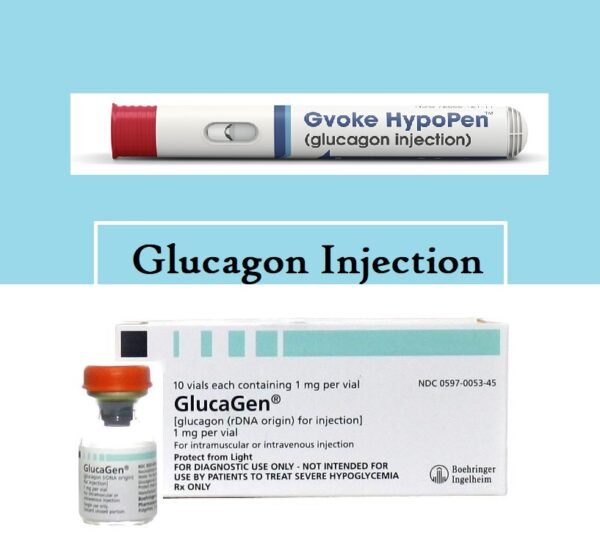
Glucagon is a pancreatic hormone produced by the alpha cells of the pancreas. It is available as injections for intramuscular and intravenous use to treat refractory hypoglycemia, beta-blockers, and calcium-channel blocker toxicity (refractory to epinephrine), and as a diagnostic agent.
Indications of Glucagon:
-
Diagnostic aid:
- During radiologic examinations, it is used as a diagnostic tool as it temporarily inhibits movement of the GI tract in adults.
-
Hypoglycemia:
- Used in the management of severe hypoglycemia in both pediatric and adult patients.
- Note: As per ADA, prescribe glucagon in all diabetic patients at increased risk of level 2 hypoglycemia (<54 mg/dl). Caregivers, school personnel, or family members of such patients should be educated on when and how to administer glucagon.
- Limitations of use: Products not packaged with a syringe and diluent necessary for rapid preparation and administration during an emergency outside of a health care facility are not indicated for the emergency treatment of hypoglycemia.
-
Off Label Use of Glucagon in Adults:
- Anaphylaxis
- Beta-blocker overdose
- Calcium channel blocker overdose
Glucagon dose in adults:
Glucagon dose as a diagnostic aid:
-
Relaxation of the stomach, duodenal bulb, duodenum, and small bowel:
- IM: 1 mg.
- IV: 0.2 to 0.5 mg.
-
Relaxation of colon:
- IM: 1 to 2 mg.
- IV: 0.5 to 0.75 mg.
Glucagon dose in the treatment of Hypoglycemia:
- IM, IV, SubQ: 1 mg; may be repeated in 15 minutes as required.
- Intranasal: 3 mg (one actuation) into a single nostril (the dose may be repeated in 15 minutes)
- Note: Administer IV dextrose as soon as it is available; if there is no response to glucagon, must give IV dextrose.
Glucagon dose in the treatment of Anaphylaxis (refractory to epinephrine) in patients on beta-blocker therapy (off-label):
- IV: Initial: 1 to 5 mg bolus; followed by an infusion of 5 to 15 mcg/minute; the infusion rate should be titrated for the achievement of an adequate clinical response.
Glucagon dose in the treatment of Beta-blocker overdose (off-label):
- IV: 3 to 10 mg bolus; bolus dose may be repeated if there is no clinical response; if there is a clinical response with bolus dose, the continuous infusion should be started at 3 to 5 mg/hour; titrate infusion rate to achieve an adequate hemodynamic response.
Glucagon dose in the treatment of Calcium channel blocker overdose (off-label):
- IV: 3 to 10 mg bolus; bolus dose may be repeated if there is no clinical response; if there is a clinical response with bolus dose, the continuous infusion should be started at 3 to 5 mg/hour; titrate infusion rate to achieve an adequate hemodynamic response.
Glucagon Dose in Childrens
Glucagon Dose in the treatment of severe Hypoglycemia:
-
Weight-directed dosing:
-
Manufacturer's labeling:
- Infants, Children, or Adolescents weighing less than 20 kg:
- Glucagon: IM, IV, SubQ: 0.02-0.03 mg/kg.
- max dose: 0.5 mg
-
Alternate dosing:
- Infants, Children, and Adolescents:
- AAP: IM, IV, Subcutaneous: 0.03 mg/kg; max dose: 1 mg.
- IDF-ISPAD: IM, Subcutaneous: 0.01-0.03 mg/kg; max dose-dependent on age: <12 years: 0.5 mg; ≥12 years: 1 mg.
- Infants, Children, and Adolescents:
-
-
Fixed dosing; age-directed:
-
Manufacturer's labeling: GlucaGen: IM, IV, SubQ:
- Infants and Children <6 years: 0.5 mg
- Children and Adolescents ≥6 years: 1 mg
-
Alternate dosing: IM, Subcutaneous:
-
IDF-ISPAD (IDF-ISPAD, 2011):
- Infants and Children <12 years: 0.5 mg
- Children and Adolescents ≥12 years: 1 mg
-
CDA (Canadian Diabetes Association, 2013):
- Infants and Children ≤5 years: 0.5 mg
- Children and Adolescents >5 years: 1 mg
-
-
-
Fixed dosing; weight-directed:
-
Infants, Children, and Adolescents:
-
Manufacturer's labeling: IM, IV, SubQ:
-
Glucagon: Patient weight:
- <20 kg: 0.5 mg
- ≥20 kg: 1 mg
-
GlucaGen: Patient weight:
- <25 kg: 0.5 mg
- ≥25 kg: 1 mg
-
-
-
Glucagon dose for the prevention of Hypoglycemia, during illness (fixed dosing, mini-dose): SubQ:
Note: These doses are lower than those used for the treatment of hypoglycemia and in illnesses that are associated with hypoglycemia (eg, gastroenteritis, nausea/vomiting), these have been shown to prevent hypoglycemia for several hours.
-
Infants and Children <2 years:
- 0.02 mg.
-
Children and Adolescents 2-15 years:
- 0.01 mg per year of age.
-
Adolescents >15 years:
- 0.15 mg.
Glucagon dose for the treatment of Beta-blocker or calcium channel blocker toxicity/overdose:
-
Infants and Children: Limited data available : IV:
- Loading dose: 0.03-0.15 mg/kg.
- Continuous IV infusion: 0.07 mg/kg/hour; max rate: 0.5 mg/hour.
-
Adolescents: IV:
- Loading dose: 5-10 mg over several minutes.
- Continuous IV infusion: 1-5 mg/hour.
Pregnancy Risk Category: B
- During animal reproduction studies, there were no adverse events.
Glucagon use during breastfeeding:
- Breastfeeding infants are less likely to experience side effects because glucagon is not absorbed through the GI tract.
Dose adjustment in renal disease:
No dosage adjustments are provided in the manufacturer’s labeling.
Dose adjustment in liver disease:
No dosage adjustments are provided in the manufacturer’s labeling.
Side Effects of Glucagon:
-
Gastrointestinal:
- Nausea (With Rapid Administration Of High Doses)
- Vomiting (With Rapid Administration Of High Doses)
-
Cardiovascular:
- Hypotension (Up To 2 Hours After GI Procedures)
- Increased Blood Pressure
- Increased Pulse
-
Dermatologic:
- Skin Rash
-
Hypersensitivity:
- Anaphylactic Shock
- Hypersensitivity Reaction
-
Respiratory:
- Dyspnea
Contraindications to Glucagon:
- Hypersensitivity to glucagon, lactose or any other component of the formulation
- Pheochromocytoma
- Insulinoma
- Glucagonoma (excluding GlucaGen)
Warnings and precautions
-
Hypersensitivity reactions
- Allergic reactions to glucagon have been reported and are usually associated with endoscopic patients
- These reactions include anaphylactic shock and skin rash (with hypotension or respiratory problems).
-
Necrolytic migratory Erythema:
- Necrolytic migratory Erythema (NME) is rarely reported after continuous glucagon injections.
- This is a skin condition that is often associated with glucagonomas (glucagon producing tumors). It is characterised by erythematous bullae and erythematous plaques.
- It can affect the face, legs, groin, perineum and legs.
- NME can lead to serious side effects. You should consider all options.
-
Insufficiency of the adrenals:
- Patients with adrenal insufficiency should be cautious as the glucose stores in their liver may be reduced.
-
Cardiac disease
- Be careful.
-
Hypoglycemia chronic:
- Patients with hypoglycemia should be cautious as the liver glucose stores can be reduced.
-
Diabetes:
- Use it as a diagnostic tool for diabetics on insulin.
-
Glucagonoma
- Be careful.
- Patients with this condition (except GlucaGen) are not advised to use glucagon.
-
Insulinoma
- Exogenous glucagon may cause a rise in blood glucose, followed by rebound hypoglycemia.
- Patients with this condition should not take glucagon.
-
Pheochromocytoma:
- Exogenous glucagon may release catecholamines, causing an increase in blood pressure.
- Patients with this condition should not take glucagon.
-
Fasting and starvation:
- Use caution with prolonged fasting or starvation as it may cause liver glycogen loss.
Glucagon: Drug Interaction
|
Risk Factor C (Monitor therapy) |
|
|
Anticholinergic Agents |
May enhance the adverse/toxic effect of Glucagon. Specifically, the risk of gastrointestinal adverse effects may be increased. |
|
Antidiabetic Agents |
Hyperglycemia-Associated Agents may diminish the therapeutic effect of Antidiabetic Agents. |
|
Indomethacin |
May diminish the therapeutic effect of Glucagon. |
|
Vitamin K Antagonists (eg, warfarin) |
Glucagon may enhance the anticoagulant effect of Vitamin K Antagonists. |
Monitoring parameters:
- Bp
- Heart rate
- Blood glucose levels
- Electrocardiogram
- Mentation
- Signs or symptoms of a hypersensitivity reaction.
How to administer Glucagon?
Diagnostic aid:
- For IM or IV administration. Intravenous administration should be over 1 minute.
- After the diagnostic procedure, oral carbohydrates should be given to patients who have been fasting, if this is compatible with the diagnostic procedure applied. It is not recommended to give bolus intravenous doses of more than 1 mg.
Hypoglycemia:
- Intravenous or a Subcutaneous or Intramuscular injection may be given in the upper arms, thighs, or buttocks. After the response to treatment, fast and long-acting oral carbohydrates should be given to the patient as soon as possible.
IV:
- Nausea and vomiting may occur as a result of rapid intravenous injection; for protection of the airway and for prevention of choking when consciousness returns, the patient should be placed in a lateral recumbent position.
- IV bolus over 5 minutes should be given in patients on beta-blockers if they develop epinephrine refractory anaphylaxis.
Beta-blocker/calcium channel blocker toxicity:
- IV bolus should be given over 3 to 5 mins; may use continuous infusions.
Mechanism of action of Glucagon:
- Stimulation of adenylate cyclase results in an increased production of cyclic AMP.
- This causes hepatic glucose to rise and gluconeogenesis.
- Extrahepatic effects include relaxation of the smooth muscles of the stomach, duodenum and small bowel.
The onset of action: Blood glucose levels:
- Peak effect seen with IV administration is 5 to 20 minutes with IM is 30 minutes and with subcutaneous administration, it is 30 to 45 minutes.
Duration:
- It takes 60-90 minutes for glucose elevation with IV, IM, SubQ injection.
- GI relaxation occurs in 9-25 minutes with IV and in 12-32 mins in case of IM injection.
Metabolism:
- The primary site is the liver with some inactivation occurring in kidneys and in plasma
Half-life elimination,
- The plasma half-life is 8-18 mins in case of IV and 26-45mins in case of IM injection
Time to peak:
- Almost 10-12.5 mins in IM and 20 mins in case of subcutaneous injection.
International Brand Names of Glucagon:
- GlucaGen Diagnostic
- GlucaGen HypoKit
- Glucagon Emergency
- Garcon
- Glucagen
- GlucaGen
- Glucagen G
- Glucagen Novo
- Glucagon Novo Nordisk
- R-Glucagon Lil
Glucagon Brand Names in Pakistan:
No Brands Available in Pakistan.
.png)


