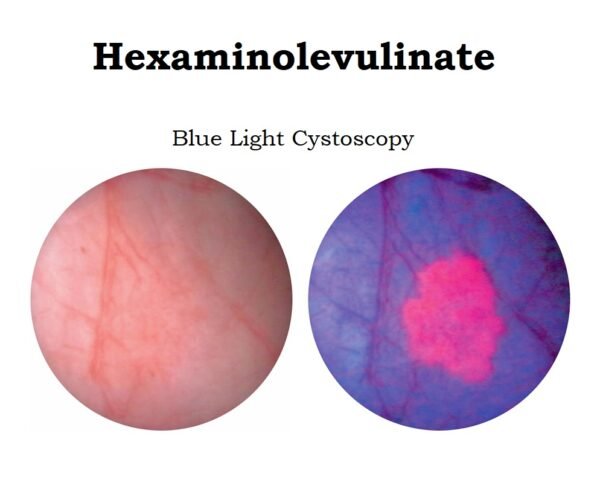
Hexaminolevulinate (Cysview) is a precursor of photoactive porphyrin that has got photodynamic properties. It accumulates in the tumor cells and is visualized by blue-light cystoscopy.
Hexaminolevulinate (Cysview) Uses:
-
Detection of bladder cancer:
- It is used as the imaging solution to detect bladder cancer including CIS (carcinoma in situ) in patients with:
- known or suspected lesions based on the previous cystoscopy or
- In patients who are undergoing surveillance cystoscopy for bladder cancer.
- Hexaminolevulinate solution is used as an adjunct to the white light cystoscopy with the Karl Storz D-Light C Photodynamic Diagnostic (PDD) system to perform Blue Light Cystoscopy (BLC).
- It is used as the imaging solution to detect bladder cancer including CIS (carcinoma in situ) in patients with:
-
Limitations of use:
- It should not be used as a replacement for tissue biopsies that are used to detect bladder cancers.
Hexaminolevulinate Dose in Adults
Hexaminolevulinate Dose in the Detection of bladder cancer:
-
Intravesical instillation:
- 100 mg equivalent to 50 mL is instilled into the empty bladder via a urinary catheter 1 to 3 hours before the procedure.
Use in Children:
Not indicated. The safety and efficacy in children are not established.
Pregnancy Risk Category: C
- It has not yet been tested in human pregnancies.
- The drug is not instilled into the bladder and systemic absorption occurs so exposure to the fetus should be minimal.
Hexaminolevulinate use during breastfeeding:
- It is unknown if the drug will be excreted into breast milk.
- The risk of systemic absorption is low. Manufacturers recommend weighing the risks to the infant from drug exposure and the benefits of diagnostic imaging for the mother.
Cysview Dose in Kidney Disease:
The manufacturer has not recommended any dose adjustment in patients with kidney disease.
Cysview Dose in Liver Disease:
The manufacturer has not recommended any adjustments in the dose.
Side Effects of Hexaminolevulinate (Cysview):
-
Central Nervous System:
- Headache
- Procedural Pain
-
Genitourinary:
- Bladder Spasm
- Bladder Pain
- Dysuria
- Hematuria
Contraindications to Hexaminolevulinate (Cysview):
- Allergy reactions to hexaminolevulinate or any derivative of aminolevulinic acids, or any component in the formulation
- porphyria
- Gross hematuria
Warnings and precautions
-
Hypersensitivity
- After the administration of the drug, allergic reactions such as anaphylaxis or anaphylactic shock can occur.
- The procedure site should immediately provide treatment for anaphylactic reactions.
Hexaminolevulinate: Drug Interaction
|
Risk Factor X (Avoid combination) |
|
|
BCG (Intravesical) |
May diminish the diagnostic effect of Hexaminolevulinate. |
Hexaminolevulinate: Drug Interaction
|
Risk Factor X (Avoid combination) |
|
|
BCG (Intravesical) |
May diminish the diagnostic effect of Hexaminolevulinate. |
Monitoring parameters:
Monitor for allergic reactions.
How to administer Hexaminolevulinate (Cysview)?
Intravesical instillation:
- Instill 50 ml of the solution into the emptied urinary bladder slowly via a bladder catheter.
- The bladder catheter must have a proximal funnel opening to accommodate a lure lock adapter.
- Catheters that are vinyl (coated in hydrogel or uncoated), amber or red-colored latex, or silicone catheters may be used for the instillation of the solution.
- Catheters that are embedded with silver or coated with antibiotics should not be used.
- Indwelling catheters such as foley's catheters may be used if they are inserted shortly before the procedure and removed following the administration of the drug.
- After the instillation of the solution, instruct the patient not to void for one to three hours (so as to retain the solution). The maximum time to retain it is 3 hours.
- During this time the patient may stand, sit, or move around.
- The solution is evacuated immediately before the cystoscopic procedure.
- After evacuating the bladder, the perineal skin should be washed with soap and water and dried. The solution should not come in contact with the drug.
- The cystoscopic procedure should be performed within 30 minutes of the evacuating the bladder (the procedure should not be performed after 3 hours of evacuating the bladder).
Mechanism of action of Hexaminolevulinate (Cysview):
- It is an ester and precursor to aminolevulinic acids that enters the bladder epithelial cells.
- It forms photoactive intermediate porphyrin IX, (PpIX), and other photoactive porphyrins in neoplastic cell preferentially.
- Cystoscopy can be performed using the Karl Storz D–Light Photodynamic Diagnostic (PDD), which uses white and blue light.
- PpIX fluorescence light can be used to visualize malignant lesions. Fluorescence from cancer tissue appears bright and clearly demarcated.
Bioavailability:
- 7% when administered into the bladder.
Half-life elimination is biphasic:
- Initial: 39 minutes;
- Terminal: about 76 hours
International Brands of Hexaminolevulinate:
- Cysview
- Hexvix
Hexaminolevulinate Brand Names in Pakistan:
No Brands Available in Pakistan.
.png)


