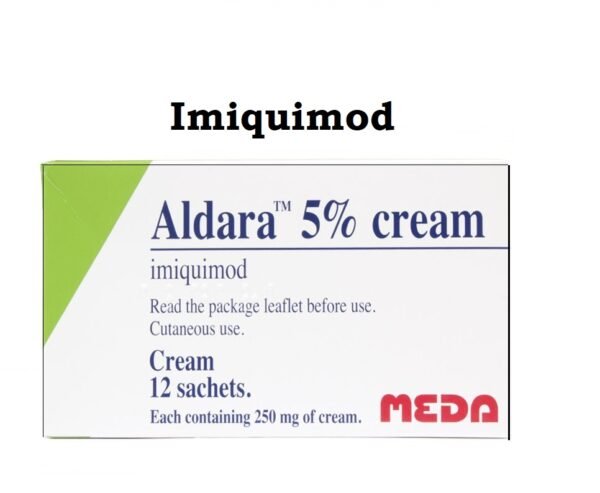
Imiquimod (Aldara) is an immune-modulator drug that is used in the treatment of topical skin conditions including genital warts and basal cell carcinoma.
Imiquimod Uses:
-
(2.5 percent, 3.75 percent, and 5 percent cream) Actinic keratosis:
- Topical therapy for immunocompetent adults with clinically typical actinic keratoses that are palpable, visible, and neither hypertrophic nor hyperkeratotic on the entire face or scalp.
-
Genital and perianal warts (3.75% and 5% cream):
- Used to treat external perianal and genital warts caused by condyloma acuminata in people 12 years of age and older.
-
Basal cell carcinoma of the skin (Aldara 5% cream):
- Primary superficial basal cell carcinoma in immunocompetent adults with a maximum tumour diameter of 2 centimetres that is located on the trunk (excluding anogenital skin), neck, or extremities should only be treated with confirmed topical therapy after biopsy if surgical options are medically less suitable and patient follow-up can be reasonably guaranteed (excluding hands and feet).
-
Limitations of use:
- Patients who have had autoimmune diseases in the past should use imiquimod with caution. Imiquimod has been tested in pediatric patients with molluscum contagiosum ages 2 to 12; however, trials did not show efficacy.
- In immunosuppressed patients, patients with basal cell nevus syndrome or xeroderma pigmentosum, as well as for the transmission or prevention of HPV, efficacy, and safety have not been shown.
-
Off Label Use of Imiquimod in Adults:
- Cutaneous flat wart
- Acyclovir-resistant herpes simplex virus (HSV) infection,
Imiquimod dose in adults:
Imiquimod Dose in the therapy of Actinic keratosis:
-
5% and 3.75% cream:
- Apply a thin layer to the skin of the affected area just before night for two weeks, up to two packets or two complete pump actuation (either the entire face or balding scalp, but not both concurrently).
- After around 8 hours, remove with gentle soap and water. Immediately following a 2-week time without therapy, repeat with a second 2-week treatment (do not extend treatment cycles because of missed doses or rest periods).
- Per two cycles of treatment, a maximum prescription of 56 packets or 2 x 7.5 g pumps is allowed. Even if all actinic keratoses seem to have disappeared, treatment should continue for the entire prescribed period of time (Due to missing doses or rest periods, do not extend the course of therapy.).
-
5% cream:
- Apply up to two times per week to one or more designated treatment areas on the face or scalp, but not both at once (using up to one packet per application). As always, do this before going to bed.
- Areas under 25 cm should not be treated.
- Leave on for about 8 hours, then wash off with warm water and mild soap.
- Per a 16-week treatment session, a maximum prescription of 36 packets should be used. The recommended treatment period is 16 weeks. (do not extend the treatment period beyond 16 weeks because of missed doses or rest periods).
Imiquimod Dose in the treatment of Cutaneous flat warts (off-label):
- Topical (5% cream): Until warts completely disappear up to a maximum of 12 weeks, apply once daily at bedtime.
- To further define the role of imiquimod additional data may be necessary for this condition.
Treatment for genital and perianal warts with imiquimod dosage:
-
Topical 75% cream:
- Apply a little coating just before going to bed each day (using up to 1 packet or 1 full actuation of the pump).
- After around 8 hours, remove with gentle soap and water. Continue the treatment for as long as the warts are completely gone or for a maximum of 8 weeks of therapy.
- The maximum prescription per course of treatment should be 56 packets or 2 × 7.5 g pumps.
-
5% cream:
- Apply a little coating before night three times each week (on alternate days).
- Remove with gentle soap and water after leaving on the skin for 6 to 10 hours. Continue the procedure for a maximum of sixteen weeks of therapy or until the perianal/genital warts are completely gone.
Imiquimod Dose in the treatment of acyclovir-resistant Herpes simplex virus (HSV) infection:
- Topical: For five days straight, apply to lesions once daily.
Note: Although recommendations do not specify imiquimod strength, case reports have used 5 percent cream.
Imiquimod Dose for the therapy of Superficial basal cell carcinoma (Aldara 5% cream):
- Use the dose five days a week on a daily basis, just before going to bed, for a period of six weeks.
- Remove with moderate soap and water after a few hours. The treatment area should be thoroughly covered with cream, including the 1 cm of skin around the tumor. To treat the tumor, a maximum of 3 centimeters should be employed (a maximum of 2 cm tumor diameter plus a 1 cm margin of skin around the tumor).
- For tumor areas of 0.5 centimeters to 2 centimeters, the cream droplet applied should have a diameter between 4 millimeters and 7 millimeters.
- 36 packets should be the most that can be prescribed for the entire six-week course of treatment.
- In a place that has already received treatment, recurrent use has not been proven to be safe or effective.
Imiquimod does in children:
Imiquimod Dose in Genital and perianal warts (3.75% and 5% cream):
-
Children aged 12 years and above and Adolescents:
- Topical: Similar to adult dosing
-
Imiquimod Dosing adjustment for toxicity:
-
Children aged 12 years and above and Adolescents:
- local skin responses (such as erythema, edema, skin erosion/weeping, and scabbing): For severe or unbearable reactions, temporarily halt treatment for up to several days.
- May think about starting therapy again after the reaction passes.
-
Vulvar swelling:
- Interrupt or discontinue therapy for severe vulvar swelling.
-
Systemic/flu-like reactions (eg, malaise, fever, rigors):
- Consider temporary interruption of therapy.
-
Pregnancy Risk Factor C
- Some adverse reactions to oral administration were seen in animal reproduction studies.
- Vaginal diaphragms and condoms can become weaker.
- Although Imiquimod seems to be low-risk, pregnant women should not use it until more data are available.
Imiquimod use during breastfeeding:
- It is unknown if breast milk contains imiquimod.
- The manufacturer recommends that breastfeeding mothers be cautious when using imiquimod.
Imiquimod Dose in Kidney Disease:
- In the manufacturer's labeling, there are no dosage adjustments provided.
Imiquimod Dose in Liver disease:
- In the manufacturer's labeling, there are no dosage adjustments provided.
Note:
- The severity of the disease being treated, the medication formulation, the number of weekly administrations, and individual sensitivity all affect how frequently reactions occur.
Common Side Effects of Imiquimod:
-
Local:
- Application Site Discharge
- Local Pruritus
- Localized Edema
- Localized Burning
-
Respiratory:
- Upper Respiratory Tract Infection
-
Dermatologic:
- Crusted Skin
- Xeroderma
- Localized Vesiculation
- Dermal Ulcer
- Skin Sclerosis
- Excoriation
- Localized Erythema
-
Infection:
- Fungal Infection
Less Common Side Effects of Imiquimod:
-
Cardiovascular:
- Chest Pain
- Localized Blanching
-
Genitourinary:
- Bacterial Vaginosis
- Urinary Tract Infection
-
Central Nervous System:
- Pain
- Fatigue
- Rigors
- Headache
- Anxiety
- Tingling Of Skin
- Dizziness
- Local Discomfort
-
Gastrointestinal:
- Diarrhea
- Anorexia
- Nausea
- Vomiting
- Dyspepsia
-
Dermatologic:
- Eczema
- Cheilitis
- Alopecia
- Skin Pain
- Seborrhoeic Keratosis
- Tinea
- Skin Tenderness
- Stinging Of The Skin
- Localized Rash
- Skin Hypertrophy
- Skin Infection
- Dermal Hemorrhage
- Papule
-
Endocrine & Metabolic:
- Increased Serum Glucose
-
Local:
- Local Irritation
-
Hematologic & Oncologic:
- Squamous Cell Carcinoma
- Lymphadenopathy
-
Respiratory:
- Sinusitis
- Flu-Like Symptoms
- Cough
- Pharyngitis
- Rhinitis
-
Infection:
- Herpes Simplex
-
Neuromuscular & Skeletal:
- Arthralgia
- Back Pain
- Myalgia
-
Miscellaneous:
- Fever
Contraindications to Imiquimod:
- The US labeling of the manufacturer states that there are no contraindications.
-
Canadian labeling:
- Hypersensitivity to imiquimod and any other component of the formulation
Warnings and precautions
-
Local inflammatory reactions
- Following repeated administrations, there may be extremely inflammatory local reactions (including skin bleeding or erosion).
- Systemic symptoms including fever, malaise, or myalgia may accompany it.
- Some reactions might spread past the application location.
- Imiquimod can lead to persistent graft-versus-host disease and skin inflammation.
-
Photosensitivity
- It is crucial to tell patients to wear protective clothing, like a hat, while receiving therapy.
- For at least a week, patients who have sunburns shouldn't take imiquimod.
- Patients who may be exposed to the sun (because of their jobs or innate sensitivity, for example) should use caution when getting imiquimod treatment.
- Avoid sunlight exposure or reduce it as this can increase sensitivity (including sunlamps and artificial sunlight exposure) during treatment.
-
Systemic reactions
- May require treatment interruption.
- Flu-like symptoms, such as arthralgias, chills, weariness, and nausea, can accompany local inflammatory reactions.
-
Vulvar swelling
- Females with significant localized inflammation of the external genitalia may experience substantial vulvar enlargement or retention.
- If severe symptoms remain, stop or stop the course of treatment.
Actinic keratosis:
- Safety and efficacy in treating actinic Keratosis by repeat treatment (more than one treatment course) have not been proven.
- It has not been proven safe to apply imiquimod 5 percent to skin areas larger than 25 cm.
- Lymphadenopathy can occur in patients who are being treated for actinic Keratosis.
- After four weeks of treatment, lymphadenopathy disappeared.
-
Autoimmune disorders:
- It has not been proven that immunosuppressed patients are safe and effective.
- Patients with preexisting autoimmune conditions (onset or exacerbation) should be cautious.
-
Basal cell carcinoma
- Additional types of basal cell carcinoma (BCC), head, face, and anogenital area lesions, as well as other subtypes (such as nodular or morphea-form), have not been demonstrated to be risk-free or effective.
- Regular follow-up is necessary for patients who had imiquimod treatment for superficial BCC.
- Use ought to be restricted to superficial carcinomas with a 2 cm maximum diameter.
-
Human papillomavirus disease:
- For the treatment of intravaginal, cervical, or rectal HPV illness, imiquimod is not licensed.
Monitoring parameters:
- Regularly assess the effectiveness of the treatment (reduction in lesion size is indicative of a therapeutic response).
- Monitor for local skin reactions and for signs and symptoms of hypersensitivity to imiquimod.
How to administer Imiquimod?
Topical:
- Hands should be washed both before and after applying.
- Only for topical application; not for ocular, oral, intra-anal, or intravaginal usage.
- Don't use it near or on your lips or nostrils.
- Use far from or away from the eyes.
- Keep the application site clear.
- The Pump (Zyclara) should only be primed before use by repeatedly pressing the top of the pump completely down until cream appears.
- Discard the cream you collected during priming.
- No further priming is needed during therapy.
Actinic keratosis:
- Before application, the treatment area needs to be well washed with mild soap and allowed to dry (10 minutes).
- Apply either 2.5 percent and 3.75 percent cream over a region on the face or scalp, or 5 percent cream over a single contiguous area (around 25 cm).
- It is not advisable to treat the scalp and face simultaneously.
- Apply a tiny application to the affected region and gently rub it in until the cream is no longer noticeable.
- A brief rise in the number of actinic keratosis lesions may be seen during treatment.
Perianal and Genital warts:
- The external or perianal wart area should receive a little coating of cream, which should be thoroughly rubbed in.
- Be careful not to use too much cream.
- Skin reactions may be treated with non-occlusive treatments (such as cotton gauze or cotton underwear).
Superficial basal cell carcinoma (Aldara):
- On the trunk, neck, or extremities, the treatment area should have a maximum diameter of no more than 2 centimeters (excluding the hands, feet, and anogenital skin).
- A 1-centimeter buffer should surround the tumor in the treatment region.
- Before using the treatment, wash and well dry the affected region.
- When the cream is no longer visible, apply a tiny layer to the affected region (including the margin) and gently rub in.
Mechanism of action of Imiquimod:
- A Toll-like receptor 7 is how the immune response modulator imiquimod stimulates immune cells.
- The topical treatment stimulates the skin's immunological system.
Absorption:
- Minimal; Systemic absorption is more influenced by the application's surface area than by the dose.
Time to peak:
- 9 to 12 hours
Excretion:
- 3% of the applied dose of imiquimod and its metabolites are found in urine.
International Brands of Imiquimod:
- Aldara
- Zyclara
- Zyclara Pump
- Aldara P
- APO-Imiquimod
- TARO-Imiquimod Pump
- Vyloma
- Zyclara
- Akdara
- Aldara
- Aldiq
- Aquimod Cream
- Beselna
- Imimore
- Imiquad
- Imoxy
- Imunocare
- Inmuderm
- Miquimod
- Modik
- Perrimod
- Quimara
- Qumara
- You Care
- Youbiqing
Imiquimod Brand Names in Pakistan:
No Brands Available in Pakistan.
.png)