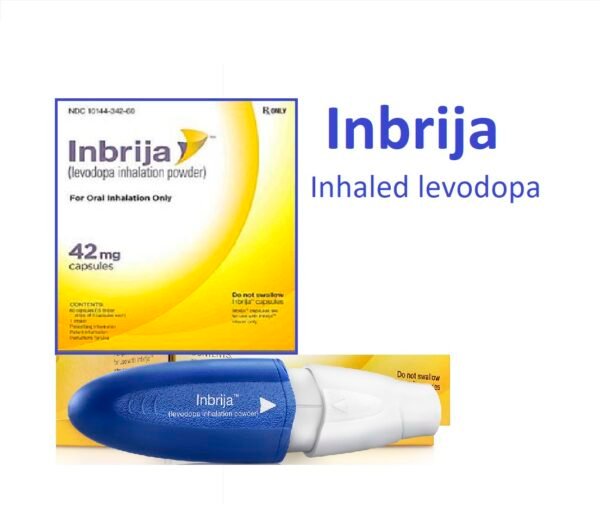
Inbrija (Inhaled levodopa) is a rapidly acting inhalational formulation of levodopa that has a faster onset of action than oral levodopa. It is indicated for the "off episodes" in patients with Parkinson's disease that may manifest as worsening motor functions, difficulty in initiating movement, and increased body rigidity.
Inbrija (Inhaled levodopa) Uses:
-
Parkinson disease:
- It is prescribed for the management of "off episodes" in Parkinson's disease patients receiving levodopa/carbidopa therapy.
Inhaled levodopa Dose in Adults:
Parkinson's disease treatment with Inbrija (inhaled levodopa) (as a supplement to carbidopa/levodopa):
-
Oral inhalation:
- The highest dose is 84 mg/dose and 420 mg/24 hours.
- 84 mg per inhalation is administered up to five times a day and when required up to 5 times a day as required when signs of an OFF period return
Use in Children:
Not applicable.
Use in Pregnancy: C
- Orally administered Levodopa may cross the placental boundary
- Limited data are available on the pregnancy effects of levodopa.
Breastfeeding: Inhaled Levodopa
- Levodopa can be absorbed into breast milk.
- Manufacturers recommend that breastfeeding mothers use the drug with caution. They should weigh the benefits and risks of the treatment for both mother and baby.
Dose in Kidney Disease:
Dose adjustment has not been provided in the manufacturer's labeling. The drug has not been studied in patients with kidney disease.
Dose in Liver disease:
Dose adjustment has not been provided in the manufacturer's labeling. The drug has not been studied in patients with kidney disease.
Common Side Effects of Inbrija (Inhaled levodopa):
-
Respiratory:
- Cough
Less Common Side Effects of Inbrija (Inhaled levodopa):
-
Central Nervous System:
- Falling
- Headache
- Insomnia
- Hallucination
-
Respiratory:
- Upper Respiratory Tract Infection
- Discoloration Of Sputum
- Nasopharyngitis
- Oropharyngeal Pain
- Rhinorrhea
- Bronchitis
- Pneumonia
-
Gastrointestinal:
- Nausea
- Vomiting
-
Hematologic & Oncologic:
- Decreased Red Blood Cells
-
Dermatologic:
- Excoriation Of Skin
-
Neuromuscular & Skeletal:
- Dyskinesia
- Limb Pain
-
Miscellaneous:
- Laceration
-
Cardiovascular:
- Chest Discomfort
- Decreased Blood Pressure
- Orthostatic Hypotension
-
Hepatic:
- Increased Serum Bilirubin
Contraindications to Inbrija (Inhaled levodopa):
Patients who are taking concomitant MAOIs such as phenelzine or tranylcypromine, or within 14 days of MAOIs, should not take it.
Warnings and precautions
-
Abnormal thinking and behavior changes:
- A patient may experience abnormal mental state changes, such as agitation, aggression or delirium, confusion, and disorientation.
-
Depression in the CNS:
- It can cause central nervous system depression and somnolence, which could lead to impairment of mental and physical abilities. It is important to remind patients that they should not perform tasks that require mental alertness or higher mental functions, such as driving heavy machinery or operating heavy machinery.
- CNS depression symptoms can occur at any time after treatment, even if they are present for as long as one year.
- Concomitant sleep disorders or the use of medications that can cause somnolence should be checked.
- Monitoring patients for signs of somnolence or drowsiness is important. Treatment may be stopped if there is significant somnolence during the day.
- Limited data are available on dose adjustments to relieve symptoms.
-
Dyskinesias
- Patients with treatment-induced dyskinesia may need to be treated by discontinuing or increasing the dose.
-
Hallucinations
- Patients who experience confusion, excessive dreaming, or sleep disturbances may need to be reduced in dosage.
-
Disorders of impulse control:
- Compulsive disorders can be seen in patients who have lost impulse control or developed an intense desire to spend money.
- These symptoms have been described by people who use dopamine agonists to treat their Parkinson's disease or restless leg syndrome.
- Some cases have seen a reversal in compulsive behavior after treatment discontinuation or a reduction of the dose.
-
Neuroleptic malignant Syndrome:
- Rapid withdrawal or reduction of drug doses can lead to clinical signs that look like NMS (neuroleptic malignant Syndrome).
- Hyperthermia, rigidity, and altered mental status must be checked. Patients should also be monitored for involuntary movements, and sweating, especially if the dose is being rapidly decreased.
- As soon as symptoms become apparent, it is important to initiate the appropriate treatment.
-
Glaucoma
- Patients with glaucoma should monitor their intraocular pressure as the drug can cause an increase in intraocular pressure.
-
Psychotic disorders
- It is best to avoid it for patients with schizophrenia or other major psychotic disorders.
-
Respiratory disease
- Patients with asthma and other bronchospastic conditions should not inhale levodopa.
Monitoring parameters:
Monitor liver function tests, BUN, Blood CBC (Blood CP), and the direct antiglobulin test. Monitor the patient for raised intraocular pressure if clinically indicated.
How to administer Inhaled levodopa?
It is available as oral capsules for inhalational purposes only. It should not be ingested and the capsules should be discarded after use. The capsule should be inhaled via the Inbrija inhaler only and discarded after use.
Mechanism of action of Inbrija (Inhaled levodopa):
Levodopa crosses into the blood-brain barrier and is released from the circulation, where it's converted to dopamine via striatal enzymes. Levodopa is used to replace the deficient striatal Dopamine in Parkinson's Disease. This results in a reduction in clinical symptoms and signs.
Bioavailability:
- About 70% relative to availability from immediate-release formulation
Time to peak:
- Median 0.5 hours (range: 0.17 to 2 hours)
Half-life elimination:
- 2.3 hours
Metabolism:
- Extensive methylation and decarboxylation metabolism
International Brand Names of Inhaled levodopa:
- Inbrija
Inhaled Levodopa Brand Names in Pakistan:
No Brands Available in Pakistan.
.png)


