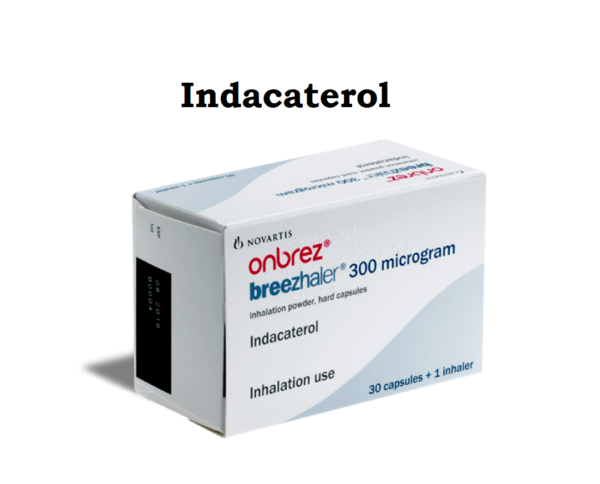
Novartis created the ultra-long acting beta-agonist called Indacaterol. Patients with uncontrolled COPD use it as an oral inhalation medication once daily (chronic obstructive pulmonary disease). This condition reduces the restriction of airflow that causes coughing, chest tightness, wheezing, and shortness of breath.
Indications of Indacaterol:
-
Chronic obstructive pulmonary disease:
- It is indicated to use as a long-term maintenance medication for patients with COPD (chronic obstructive pulmonary disease), which includes chronic bronchitis and emphysema.
Indacaterol dose in adults:
Indacaterol dosage for chronic obstructive pulmonary disease maintenance:
Note: The 2018 GOLD Guidelines recommend a dose of 75 to 300 mcg once a day.
-
Dry powder inhaler:
- One capsule (75 mcg of indacaterol) is inhaled once a day via the recommended inhalational device.
Indacaterol use in Children:
The drug's effectiveness and safety in children have not been shown.
Pregnancy Risk Factor C
- Studies on animal reproduction have not shown adverse effects from Beta-agonists.
- It can also interfere with uterine contractions during labor.
Indacaterol use during breastfeeding:
- It is unknown if the drug will be excreted into breastmilk.
- It is recommended that you use it with caution if you are lactating.
Dose adjustment in Renal Disease:
- Adjustment in the dose is not necessary.
Indacaterol Dose in Liver Disease:
-
Mild-to-moderate impairment:
- Adjustment in the dose is not necessary.
-
Severe impairment:
- It has not been studied in severe hepatic impairment. The manufacturer has not provided any adjustments in the dose in patients with severe liver disease.
Common Side Effects of Indacaterol:
-
Respiratory:
- Cough
Less Common Side Effects of Indacaterol:
-
Central nervous system:
- Headache
-
Respiratory:
- Nasopharyngitis
- Oropharyngeal pain
-
Gastrointestinal:
- Nausea
Contraindications to Indacaterol:
- Patients who are allergic to any component of the drug or the drug's formulation should not take it.
- Patients with asthma should not use it if they aren't taking an inhaled corticosteroid.
Warnings and precautions
-
Asthma-related Deaths:
- Indacaterol should not be used to treat asthma.
- Inhaled corticosteroids should be initiated prior to LABA therapy in patients with asthma. LABA can be added to therapy.
- Patients with COPD are not at greater risk for death if they use LABA.
-
Bronchospasm
- Paradoxical bronchospasm has been linked to the use of inhaled medications, including inhaled bronchodilators. This could be potentially life-threatening.
- Paradoxical bronchospasm can be life-threatening. It may be hard to distinguish between an ineffective bronchodilator response and paradoxical bronchospasm.
- If a paradoxical response is suspected, treatment must be stopped immediately
-
Hypersensitivity
- It has been linked to severe hypersensitivity reactions in the immediate aftermath.
- These include urticaria (difficulty breathing and swallowing), and swelling of the lips, tongue, and face.
- If you suspect an allergic reaction, stop taking any medication immediately.
-
Deaths and serious effects:
- Do not take more than the suggested dosage because doing so can have fatal negative effects.
-
Cardiovascular disease
- Beta-2 agonists can cause an increase in blood pressure and heart rate.
- Patients with hypotension, arrhythmias, or coronary insufficiency should not use it.
- Beta-2 agonist use is linked to ECG alterations such as ST-segment depression and QTc interval lengthening.
-
Use it in the right way:
- Patients with acute bronchospasm or acute exacerbation of COPD should not use it.
- Indacaterol should not be given to patients with severe illnesses or worsening conditions.
-
Diabetes:
- Pre-existing diabetes or diabetic ketoacidosis may be exacerbated by beta-agonists.
- It should not be used in diabetic patients.
-
Hyperthyroidism:
- Beta-agonists can stimulate the thyroid. Patients with hyperthyroidism should not use it.
-
Hypokalemia
- Beta-2 agonists cause transient shifts in serum potassium from the extracellular space to the cells. Hypokalemia is the result.
- Patients taking Potassium-losing Diuretics or at high risk for hypokalemia need to be closely monitored.
-
Seizures:
- Patients who are at high risk for seizures and CNS stimulation with beta-2 agonists include those who have brain abnormalities or other underlying conditions.
Indacaterol: Drug Interaction
|
Risk Factor C (Monitor therapy) |
|
|
AtoMOXetine |
Possibly makes beta2-agonists' tachycardic impact stronger. |
|
AtoMOXetine |
Could make sympathomimetics' hypertensive effects stronger. The tachycardic impact of sympathomimetics may be increased by atoMOXetine. |
|
Atosiban |
Beta2-Agonists may intensify Atosiban's harmful or hazardous effects. Particularly, pulmonary edema and/or dyspnea may be at higher risk. |
|
Beta-Blockers (Beta1 Selective) |
May lessen beta2-agonists' bronchodilator effects. Particular attention should be paid to nonselective beta-blockers or beta1 selective beta-blockers at larger doses. |
|
Betahistine |
May lessen beta2-agonists' therapeutic efficacy. |
|
Caffeine and Caffeine Containing Products |
May intensify Indacaterol's harmful or hazardous effects. The hypokalemic impact of indacaterol may be enhanced by caffeine and products containing caffeine. |
|
Cannabinoid-Containing Products |
Perhaps makes sympathomimetics' tachycardic effect stronger. Cannabidiol is an exception. |
|
Corticosteroids (Systemic) |
The effect of corticosteroids being hypokalemic may be enhanced by indacaterol (Systemic). |
|
Doxofylline |
Sympathomimetic drugs may intensify Doxofylline's harmful or hazardous effects. |
|
Guanethidine |
Could make sympathomimetics more arrhythmogenic. Guanethidine might make sympathomimetic drugs more hypertensive. |
|
Haloperidol |
QT-prolonging drugs may increase the QTc-prolonging effects of haloperidol (Indeterminate Risk - Caution). |
|
Loop Diuretics |
Beta2-Agonists may increase the hypokalemic effects of loop diuretics. |
|
Monoamine Oxidase Inhibitors |
May intensify the hazardous or harmful effects of beta2-agonists. |
|
QT-prolonging Agents (Highest Risk) |
QT-prolonging Agents may improve the QTc-prolonging activity of QT-prolonging Agents (Indeterminate Risk - Caution) (Highest Risk). Management: Monitor for QTc interval prolongation and cardiac arrhythmias when these drugs are used together. Patients who have extra risk factors may be even more susceptible to QTc prolongation. |
|
Solriamfetol |
Sympathomimetics may intensify Solriamfetol's hypertensive effects. |
|
Sympathomimetics |
Could intensify the hazardous or harmful effects of other sympathomimetics. Could make sympathomimetics' hypertensive effects stronger. |
|
Tedizolid |
The tachycardic impact of sympathomimetics may be increased by tedizolid. |
|
Theophylline Derivatives |
May intensify Indacaterol's harmful or hazardous effects. The hypokalemic action of indacaterol may be strengthened by theophylline derivatives. |
|
Thiazide and Thiazide-Like Diuretics |
Thiazide and Thiazide-Like Diuretics may have an enhanced hypokalemic impact when beta2-Agonists are present. |
|
Tricyclic Antidepressants |
May intensify the hazardous or harmful effects of beta2-agonists. |
|
Risk Factor D (Consider therapy modification) |
|
|
Cocaine (Topical) |
Could make sympathomimetics' hypertensive effects stronger. Management: Whenever possible, look at alternatives to using this combo. When used concurrently, keep a close eye out for noticeably elevated blood pressure or heart rate as well as any signs of myocardial ischemia. |
|
Linezolid |
Could make sympathomimetics' hypertensive effects stronger. Reduce initial sympathomimetic doses and keep a close eye out for patients taking linezolid who exhibit an elevated pressor response. There are currently no suggestions for specific dose adjustments. |
|
Methacholine |
Long-Acting Beta2-Agonists may reduce methacholine's therapeutic efficacy. Treatment: Wait 36 hours before using methacholine when taking long-acting beta-agonists. |
|
Risk Factor X (Avoid combination) |
|
|
Beta-Blockers (Nonselective) |
May lessen beta2-agonists' bronchodilator effects. |
|
Loxapine |
Medication for respiratory illness may worsen the side effects or dangers of loxapine. In other words, using agents to treat respiratory disease is likely a sign of someone who is more likely to be vulnerable to severe bronchospasm from loxapine inhalation. Management: This only pertains to the Adasuve-branded inhaled loxapine formulation. This prohibition does not apply to loxapine formulations that are not breathed in. |
| Beta2-Agonists (Long-Acting) | May intensify the negative or harmful effects of additional beta2-agonists (Long-Acting). |
Monitor:
- Monitor for clinical features of improvement or deterioration (increased use of Beta-agonists may be suggestive of a worsening clinical condition).
- Pulmonary function tests including FEV-1 and FVC.
- Serum glucose
- Blood pressure
- Serum potassium
- Heart rate
- CNS stimulation.
How to administer Indacaterol?
Dry powder inhaler for Oral inhalation:
- Indacaterol is administered using a Neohaler inhaler or Onbrez Breezhaler through oral inhalation everyday at a similar time.
- The capsules should not be swallowed.
- With each prescription, a new inhaler is given that should be used.
- The blister of capsules for oral inhalation should be opened just prior to use.
- The capsule is placed in the inhaler device and closed until a "click" is heard.
- The capsules should then be pierced by pressing the red button on the sides of the inhaler device.
- Inhalation should be continued until the powder is inhaled completely.
- The inhaler device should be kept dry and the mouthpiece should not be washed.
- If the capsules are not used immediately and exposed to air, they should be discarded.
Mechanism of action of Indacaterol:
Indacaterol acts as a Beta-2 receptor antagonist. By acting on the Beta-2 receptors within the lungs, it relaxes the smooth muscle cells of the bronchial walls. It has no effect on the heart.
- The onset of action is within 5 minutes
- The Peak effect is seen in 1-4 hours
- The duration of treatment lasts 24 hours
- Absorption: Systemic: Inhalation: 43% to 45% bioavailable
- Protein binding: about 95%
- Metabolism: It is metabolized in the liver by hydroxylation via CYP3A4, CYP2D6, and CYP1A1
- The Time to reach peak serum concentration is about 15 minutes
- Excretion after oral administration: Feces (>90%; 54% as unchanged drug); urine (<2% as unchanged drug)
- The half-life elimination of the drug is 40-56 hours
International Brands of Indacaterol:
- Arcapta Neohaler
- Onbrez Breezhaler
- Dilinda
- Hirobriz Breezhaler
- Introventa
- Onbrez
- Onbrez Breezhaler
- Onbrise Breezhaler
- Onbrize
- Onbrize Breezhaler
- Onriva
- Oslif
Indacaterol Brand Names in Pakistan:
OnBreze Breezehaler
.png)