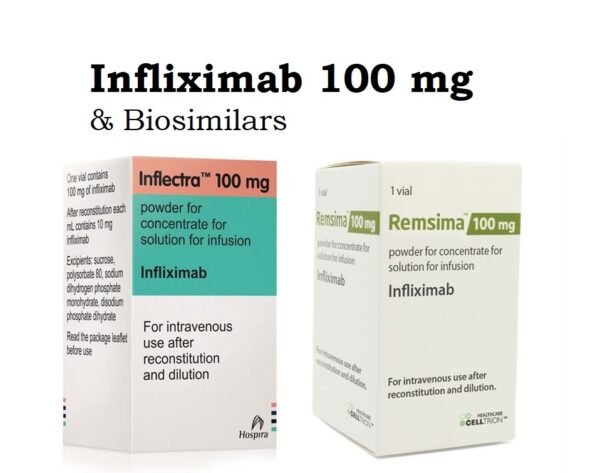
Infliximab (Remicade) is a chimeric monoclonal antibody that acts by inhibiting TNF-alpha. It is used to treat autoimmune disorders like rheumatoid arthritis and Crohn's colitis.
Infliximab Uses (Indications):
-
Ankylosing spondylitis:
- Adults with active Ankylosing Spondylitis (to reduce symptoms/signs)
-
Crohn disease:
- Adults and children aged >=6 with Crohn's disease. This treatment is for patients who have not responded to conventional therapy. It is used to relieve signs and to cause or support clinical remission.
-
Plaque psoriasis
- Adults with plaque psoriasis may benefit from it as a therapy for their chronic, severe, and/or disabling plaque psoriasis as a substitute for systemic therapy.
-
Psoriatic arthritis
- Adults with psoriatic arthritis (to reduce symptoms and prevent progression of structural damage, improve physical function, and reduce the signs/symptoms associated with active arthritis).
-
Rheumatoid arthritis
- Methotrexate is used to treat adults suffering from moderately severe rheumatoid arthritis (or other forms of active arthritis). It reduces the symptoms and prevents further structural damage. It also improves physical function.
-
Ulcerative colitis
- Adult and pediatric patients aged >=6 with severe or moderately active ulcerative colitis. This treatment is intended to reduce symptoms, induce and maintain clinical remission, and aid in mucosal healing.
- Notice:
- Renflexis (infliximab–abda), and Inflectra, (infliximab–dyyb), are biosimilars to Remicade.
- Remsima (infliximab) is also a biosimilar in Canada.
-
Off-Label Use Infliximab for Adults:
- Crohn's disease (management following surgical resection).
- Pustular psoriasis
- Pyoderma Gangrenosum
Infliximab dose in Adults:
-
Note:
- Premedication with antihistamines (H-1 antagonist +/- H-2 antagonist), acetaminophen, and/or corticosteroids may be considered for prophylaxis and/or to manage infusion-related reactions.
- Renflexis (infliximab-abda) and Inflectra (infliximab-dyyb) are labelled as biosimilars to Remicade (infliximab).
- In Canada, Remsima is also labeled as a biosimilar to Remicade (infliximab).
Infliximab Dose in the treatment of Crohn's disease:
- IV: 5 mg/kg at 0, 2, and 6 weeks,
- followed by 5 mg/kg every 2 months thereafter;
- The dose may be increased to 10 mg per kg in patients who respond but then lose their response.
- If no response by week 14, consider discontinuation of therapy.
Infliximab Dose in the treatment of Crohn's disease management after surgical resection (off-label):
- IV: 5 mg/kg at 0, 2, and 6 weeks, followed by 5 mg/kg every 8 weeks thereafter or 5 mg/kg every 8 weeks.
- Note: Administer the first infusion within 4 weeks after surgery in high-risk patients.
Infliximab Dose in the treatment of Plaque psoriasis:
- IV: 5 mg/kg at 0, 2, and 6 weeks,
- followed by 5 mg/kg every 2 months thereafter.
Infliximab Dose in the treatment of Psoriatic arthritis (with or without methotrexate):
- IV: 5 mg/kg at 0, 2, and 6 weeks,
- followed by 5 mg/kg every 2 months thereafter.
Infliximab Dose in the treatment of Rheumatoid arthritis (in combination with methotrexate therapy):
- IV 3 mg/kg at 0, 2, and 6 weeks,
- followed by 3 mg/kg every 8 weeks thereafter;
- Remicade doses have ranged from 3 to 10 mg/kg repeated at 4- to 8-week intervals.
Infliximab Dose in the treatment of Ulcerative colitis:
- IV: 5 mg/kg at 0, 2, and 6 weeks,
- followed by 5 mg/kg every 2 months thereafter.
- Doses up to 10 mg/kg was observed in clinical trials with similar efficacy with both doses.
Infliximab Dose in the treatment of Pustular psoriasis (off-label):
- IV: 5 mg/kg at weeks 0, 2, and 6,
- followed by 5 mg/kg every 2 months for up to 46 weeks.
Infliximab Dosage adjustment with heart failure (HF):
-
Weigh risk versus benefits for an individual patient:
-
Mild HF (NYHA Class I/II):
- No dosage adjustment is required; use with caution and monitor closely for worsening of HF.
-
Moderate to severe (NYHA Class III or IV):
- ≤5 mg/kg.
-
Infliximab Use in Childern:
- Note:
- Premedication with antihistamines (H-1 antagonist and/or H-2 antagonist), acetaminophen, and/or corticosteroids may be considered to prevent and/or manage infusion-related reactions.
- Renflexis (infliximab-abda) and Inflectra (infliximab-dyyb) are approved as a biosimilar to Remicade.
- Approved uses for biosimilar agents may differ (consult product labeling).
Infliximab Dose in the treatment of Crohn's disease: Remicade/Inflectra/Renflexis:
-
Children ≥6 years and Adolescents:
- IV: Initial: 5 mg/kg/dose at 0, 2, and 6 weeks, followed by maintenance: 5 mg/kg/dose every 2 months thereafter.
- Note:
- If the response is incomplete, the dose has been increased up to 10 mg per kg;
- in adult patients with Crohn's disease, it has been reported that patients who do not respond by week 14 are unlikely to respond with continued dosing;
- consider therapy discontinuation in these patients.
Infliximab Dose in the treatment of Juvenile idiopathic arthritis refractory to conventional disease-modifying drugs:
-
Children ≥4 years and Adolescents:
- IV: Initial: 3 mg/kg at 0, 2, and 6 weeks; then 3 to 6 mg/kg/dose every 8 weeks thereafter, in combination with methotrexate during induction and maintenance.
- Alternatively, some studies used 6 mg/kg/dose starting at week 14 of a methotrexate induction regimen (weeks 0 to 13);
- repeat dose (6 mg/kg/dose) at weeks 16 and 20, then every 8 weeks thereafter.
- Note: Trials performed with Remicade product.
Infliximab Dose in the treatment of Kawasaki disease, refractory to IVIG:
-
Infants and Children:
- IV: 5 mg/kg per dose as a single infusion;
Infliximab Dose in the treatment of Ulcerative colitis: Remicade:
-
Children ≥6 years and Adolescents:
- IV: Initial: 5 mg/kg/dose at 0, 2, and 6 weeks, followed by maintenance: 5 mg/kg/dose every 2 months thereafter.
- Note: If the response is incomplete, the dose may be titrated up to 10 mg per kg
Infliximab Pregnancy Risk Category: N (Not assigned)
- Infliximab crosses over to the placenta.
- Infliximab (IgG-1) is a monoclonal humanized antibody (humanized).
- The placental transfer of human IgG depends on the IgG subclass and maternal serum concentrations. Also, the weight at birth and the age of the gestation will affect the outcome.
- The 3-8 week period of pregnancy would see the lowest level of exposure.
- Pregnant females with inflammatory bowel diseases, cord blood, and newborn concentrations are recommended.
- On average, it took 7.3 months to remove infliximab (range: 6.2 to 83 percent months in a study of 44 infants exposed in-utero).
- The serum concentration of Infliximab was detectable in one infant up to 1 year old.
- The authors detail the treatment of agranulocytosis in four newborns, three of whom were triplets, with granulocyte-colony-stimulating factors.
- A singleton neonatal serum contained infliximab three months after the last maternal dosage. It was not found in the mother, though.
- The triplets did not have any Infliximab serum levels.
-
Tumor necrosis factor alpha (TNFa)-blocking medications represent a modest to moderate danger to expectant mothers, according to the information that is currently available, albeit that information is constantly evolving.
-
After being exposed to infliximab in utero, a baby who received the live BCG vaccine suffered a catastrophic outcome.
-
Infliximab 10mg/kg was administered to the mother once per week as monotherapy for steroid-resistant Crohn's disease.
-
The baby was healthy at birth and not breastfed.
-
BCG vaccination is done at 3 months of age; the infant expired at 4.5 months of age due to disseminated BCG.
-
TNFa blocking drugs may increase the risk of immunosuppression in third-trimester mothers. The neonate, fetus, and infant should be considered immunosuppressed during the 4-12 week period following in utero exposure.
-
Live vaccinations, such as the rotavirus vaccine, should not be administered if a biological agent is discovered during the third trimester (>27 weeks).
- Bowel inflammation is connected to a poor pregnancy outcome. This includes a high risk of miscarriage, early delivery, low birth weight in the baby, and inadequate weight gain in the mother.
- Pregnancy should not be a time for relapse.
- The treatment reduces the severity of disease flares and disease activity as well as the likelihood of adverse pregnancy outcomes.
- Individuals should consider whether or not to use immune-modulating treatments during pregnancy in order to maximize maternal health and improve pregnancy outcomes.
- According to the American Academy of Dermatology, TNFa-blocking agents used in the treatment of psoriasis are compatible with pregnancy.
- If treatment of inflammatory bowel diseases is necessary for pregnant women, it can be continued with appropriate biologic therapy.
- Pregnancy weight can be used to determine the dose. It can also be adjusted based on serum concentrations and disease activity.
- It is important to evaluate serum levels before conception. This will ensure that you avoid high levels of serum which can cause the placental transfer.
- The lowest serum concentrations are necessary for delivery.
- Infliximab can be administered as a final injection 6-10 weeks prior to the expected delivery date. Then, continue with postpartum care for 48 hours.
- TNFa-blocking drugs for the treatment of psoriasis are considered compatible by the AAD for male patients who plan to have a child.
- Infliximab may be continued for women with psoriasis who wish to have a baby.
- If you have well-controlled psoriasis and don't want to expose your baby to it, you can discontinue infliximab for 50 days before trying for pregnancy.
- For Crohn's disease patients who desire to have a baby, there are treatment algorithms.
- Continuous data collection is underway to monitor the outcomes of infliximab-exposed babies and pregnant women.
- The Organization of Teratology Information Specialists is available at 877-311-8972.
Infliximab use during breastfeeding:
- Breast milk contains Infliximab.
- Multiple studies have evaluated the possibility of infliximab being transferred to breast milk.
- Three postpartum women were given infliximab 5mg/kg within the first 24 hours after delivery.
- Infliximab could be detected in as little as 12 hours. The highest milk concentrations were observed 2 to 3 days after the maternal dosage.
- A study of 29 women revealed that 19 had detectable levels of breast milk. The highest concentrations occurred between 24 and 48 hours following the infusion.
- A smaller study that involved 3 postpartum women showed that breast milk concentrations could vary within one woman during a single dosing period.
- Some studies did not show Infliximab in breast milk.
- One case report showed that subtherapeutic levels of infliximab were found in breastfed infants who had been exposed only during breastfeeding.
- Breastfed infants did not experience adverse events in studies that showed detectable milk concentrations.
- According to the drug manufacturer, the decision to breastfeed during treatment should consider the risks to infants, the benefits to the mother, and the benefits to the mother.
- Breastfeeding is compatible with tumor necrosis factor-alpha (TNFa), however.
Infliximab Dose in Kidney Disease:
- There are no dosage adjustments provided in the drug manufacturer's labeling.
Infliximab Dose in Liver disease:
-
Hepatic impairment prior to treatment initiation:
- There are no dosage adjustments provided in the drug manufacturer's labeling.
-
Hepatotoxicity during treatment:
- Jaundice and/or marked increase in liver enzymes (≥5 times ULN):
- Discontinue treatment.
- Jaundice and/or marked increase in liver enzymes (≥5 times ULN):
As reported in adults with rheumatoid arthritis, unless otherwise noted.
Infliximab Adverse effects (Common):
-
Central nervous system:
- Headache
-
Gastrointestinal:
- Abdominal Pain
- Nausea
-
Hematologic & Oncologic:
- Anemia
-
Hepatic:
- Increased Serum Alanine Aminotransferase
-
Immunologic:
- Antibody Development
- Increased ANA Titer
- Antibody Development
-
Infection:
- Infection
- Serious Infection
- Abscess
-
Respiratory:
- Upper Respiratory Tract Infection
- Sinusitis
- Cough
- Pharyngitis
-
Miscellaneous:
- Infusion Related Reaction
Infliximab Adverse effects (Less common):
-
Cardiovascular:
- Flushing
- Hypertension
-
Central Nervous System:
- Fatigue
- Pain
-
Dermatologic:
- Skin Rash
- Pruritus
-
Gastrointestinal:
- Dyspepsia
-
Genitourinary:
- Urinary Tract Infection
-
Hematologic & Oncologic:
- Leukopenia
- Neutropenia
-
Hypersensitivity:
- Hypersensitivity Reaction
- Type IV Hypersensitivity Reaction
- Serum Sickness
-
Infection:
- Viral Infection
- Bacterial Infection
- Candidiasis
-
Neuromuscular & Skeletal:
- Arthralgia
- Bone Fracture
-
Respiratory:
- Bronchitis
- Pneumonia
-
Miscellaneous:
- Fever
Contraindications to Infliximab:
- Hypersensitivity/Allergy to infliximab, murine proteins, or any component of the formulation;
- Doses >5 mg/kg in patients suffering from severe or moderate heart failure (NYHA Class II/IV).
-
Canadian labeling: Additional contraindications not in US labeling
- Severe infections (eg sepsis and abscesses, tuberculosis and opportunistic infection)
- Use in patients with severe or moderate heart failure (NYHA Class III/IV).
Black Box Warning and Precautions for Infliximab
-
Autoimmune disorder:
- Patients with negative baselines have had positive antinuclear antibody levels.
- Rare cases of autoimmune disorders, including Lupus-like syndrome, were observed. If such symptoms appear, discontinue treatment.
-
During and after infusion, there are both cardiovascular and cerebrovascular reactions
- There have been reports of cerebrovascular accidents, MI (some fatal), hypotension, hypertension, and arrhythmias within a day after receiving the infusion.
- Also, transient vision loss was reported within two hours of the infusion.
- If you experience a severe reaction, discontinue treatment.
-
Hematologic disorders
- Hematologic toxicities, such as leukopenia and neutropenia, have been reported. These could be deadly.
- Patients who experience signs and symptoms of blood dyscrasias should see a doctor (e.g. persistent fevers). Stop using the medication if substantial hematologic abnormalities are discovered.
- Patients should exercise caution if they have a history of hematologic disorders.
-
Hepatic reactions
- Severe hepatic responses during therapy have been documented, including cholestasis, jaundice, and abrupt hepatic failure.
- Some cases required liver transplantation or were fatal.
- If the patient experiences jaundice or a marked increase in liver enzymes (>=5x ULN), discontinue use.
-
Hepatitis B:
- Chronic carriers of the virus have experienced reactivation, particularly in patients who are taking immunosuppressants. This can be fatal.
- Prior to starting treatment, HBV testing should be performed on all patients.
- Patients with HBV should be followed up on during the treatment and for a few months after stopping it.
- Stop therapy and begin antiviral therapy if there is a reactivation. If the patient needs to restart therapy, exercise caution, and strict supervision.
-
Hypersensitivity or Infusion reactions
- There is a chance of having severe infusion responses.
- Within 2 hours of receiving the infusion, hypersensitivity reactions (including anaphylaxis) may occur.
- You should have immediate access to medication and equipment for managing hypersensitivity reactions.
- You may need to interrupt the flow of traffic and/or restart it at a slower pace (consult protocols).
- Patients with previous infusion reactions may need to be pretreated.
- It has been reported that serum sickness-like reactions can occur; this may lead to a reduced response to treatment.
- Infusion reactions and/or hypersensitivity are made more likely by infliximab antibodies. Immunosuppressants, however, may be combined with anti-infliximab medications to lessen the chance of antibody development.
- Infusion responses may become more likely if maintenance therapy is restarted after being interrupted or stopped.
- Psoriasis sufferers should receive care as part of a maintenance regimen without induction dosages.
- For re-treatment of any other patients, it is important to use an induction protocol with caution.
-
Infections [US Boxed Warning]
- Infliximab patients are at risk of developing serious infections, which could lead to death or hospitalization.
- infections are usually developed in those who were also on concomitant immunosuppressive agents (eg, methotrexate or corticosteroids) and may present as a disseminated disease rather than local.
- Reports of active tuberculosis or reactivation of latent tuberculosis, invasive fungal (including blastomycosis. coccidioidomycosis. histoplasmosis. and pneumocystosis), and bacterial, viral, or other opportunistic infection (including legionellosis.
- Pay attention to any signs or symptoms of infection.
- Stop using if you have a serious infection or sepsis.
- Before using this medicine, patients with a history of chronic or persistent infection should consider the advantages and disadvantages.
- Patients at high risk of invasive fungal infections should be considered for empiric antifungal therapy.
- When administering this medication to elderly patients, those who are susceptible to infection (such as those with diabetes), those who reside in or have recently traveled to areas where endemic mycoses, such as blastomycosis, coccidioidomycosis, or histoplasmosis, are common, it is essential to use caution.
- Patients with active infections should not begin infliximab treatment, especially if they are clinically severe localized infections.
- Patients with a new infection that develops while receiving treatment must be closely monitored.
-
Malignancy: [US Boxed Warning]
- Children and adolescents who have received TNF-blocking drugs, such as infliximab, have had lymphoma and other malignancies that may be fatal.
- Both Hodgkin and non-Hodgkin lymphomas account for the majority of instances. Malignancies that are uncommon in this population are present in some other individuals.
- [US Boxed Warning]: Patients treated with infliximab have had post-marketing cases of hepatosplenic lymphoma.
- Nearly all patients had received prior or concurrent treatment with azathioprine/mercaptopurine prior to diagnosis. The majority of cases were reported in young adult males with Crohn's disease or ulcerative colitis.
- Malignancies develop after a median period of 30 months, i.e. 2 and 1/2 years (range: 1 - 84 months). Most of those who received TNF blocker therapy were also on immunosuppressants.
- The effect of infliximab on the development and progression of malignancies is unknown.
- Clinical trials have shown a higher risk of lymphoma than the general population. However, rheumatoid artifacts alone have been associated with a high incidence of lymphoma.
- Due to greater incidences of malignancy documented in individuals who took infliximab, patients with COPD should exercise caution.
- Patients with psoriasis who have had phototherapy in the past were more likely to develop non-melanoma skin tumors.
- Patients who have received TNF-blocking drugs such as infliximab, including melanomas and Merkel cell carcinoma, have had their cases.
- All patients undergoing therapy should have periodic skin exams, especially those who are at greater risk of developing skin cancer.
- Patients with rheumatoid arthritis had a greater incidence of cervical cancer that was invasive. Women who are receiving infliximab therapy ought to keep getting screened.
-
Tuberculosis: [US-Boxed Warning]
- Treatment with Infliximab has been associated with reactivation or disseminated latent infections as well as active tuberculosis (which may spread or be extrapulmonary).
- Evaluate patients for risk factors of tuberculosis and latent tuberculosis infection (with a tuberculin skin test) before and during therapy.
- Before using, it is important to treat latent tuberculosis.
- Patients who have had negative skin tests for tuberculin should continue to be monitored for tuberculosis during treatment.
- Reactivation is most common within the first few months of treatment.
- Patients who have been exposed should exercise caution when using this medication.
-
Demyelinating CNS Disease:
- Patients with demyelinating illnesses of the central nervous system, whether they are new-onset or pre-existing, should use caution.
- There have been a few isolated reports of ocular neuritis and demyelinating illnesses like multiple sclerosis, systemic vasculitis, and Guillain Barre syndromes.
- If the patient experiences severe CNS reactions, discontinue therapy.
-
Heart failure (HF):
- Patients who have mild heart failure (NYHA II or NYHA I) or diminished left ventricular function should exercise caution. There have been cases of CHF that are both getting worse and developing.
- Patients with severe or moderate HF (NYHA Class II/IV) should not receive doses exceeding 5 mg/kg.
- Stop taking medication if you experience new or worsening symptoms.
- The American Heart Association has declared TNF blockers as drugs that can either cause myocardial toxicity directly or increase myocardial dysfunction (magnitude major).
-
Seizure disorders:
- Patients with seizure history should be cautious.
- discontinue if significant CNS adverse reactions develop.
Infliximab (including biosimilars of infliximab): Drug Interaction
|
AzaTHIOprine |
AzaTHIOprine's negative/toxic effects may be amplified by infliximab. Particularly, there may be an increased risk for T-cell non-lymphoma, Hodgkin's which includes hepatosplenic T-cell lymphoma. The active metabolite(s) of azathioprine may have higher serum concentrations when infliximab is administered. |
|
Coccidioides immitis Skin Test |
Immunosuppressants may diminish the diagnostic effect of Coccidioides immitis Skin Test. |
|
Denosumab |
May enhance the adverse/toxic effect of Immunosuppressants. Specifically, the risk for serious infections may be increased. |
|
Ocrelizumab |
May enhance the immunosuppressive effect of Immunosuppressants. |
|
Pidotimod |
Immunosuppressants may diminish the therapeutic effect of Pidotimod. |
|
Siponimod |
Immunosuppressants may enhance the immunosuppressive effect of Siponimod. |
|
Smallpox and Monkeypox Vaccine (Live) |
Immunosuppressants may diminish the therapeutic effect of Smallpox and Monkeypox vaccines (Live). |
|
Tertomotide |
Immunosuppressants may reduce Tertomotide's therapeutic efficacy. |
|
Thiopurine Analogs |
Thiopurine Analogs may have a more negative or toxic effect when taken with anti-TNF agents. Particularly, there may be an increased risk for T-cell non-lymphoma, Hodgkin's which includes hepatosplenic T-cell lymphoma. |
|
Trastuzumab |
May improve the neutropenic impact of Immunosuppressants. |
|
Risk Factor D (Consider therapy modification) |
|
|
Echinacea |
May diminish the therapeutic effect of Immunosuppressants. |
|
Fingolimod |
Immunosuppressants may enhance the immunosuppressive effect of Fingolimod. Management: Avoid the concomitant use of fingolimod and other immunosuppressants when possible. If combined, monitor patients closely for additive immunosuppressant effects (eg, infections). |
|
Leflunomide |
Immunosuppressants may enhance the adverse/toxic effect of Leflunomide. Specifically, the risk for hematologic toxicity such as pancytopenia, agranulocytosis, and/or thrombocytopenia may be increased. Management: Consider not using a leflunomide loading dose in patients receiving other immunosuppressants. Patients receiving both leflunomide and another immunosuppressant should be monitored for bone marrow suppression at least monthly. |
|
Nivolumab |
Immunosuppressants may diminish the therapeutic effect of Nivolumab. |
|
Roflumilast |
May enhance the immunosuppressive effect of Immunosuppressants. |
|
Sipuleucel-T |
Immunosuppressants may diminish the therapeutic effect of Sipuleucel-T. Management: Evaluate patients to see if it is medically appropriate to reduce or discontinue therapy with immunosuppressants prior to initiating sipuleucel-T therapy. |
|
Vaccines (Inactivated) |
Immunosuppressants may diminish the therapeutic effect of Vaccines (Inactivated). Management: Vaccine efficacy may be reduced. Complete all age-appropriate vaccinations at least 2 weeks prior to starting an immunosuppressant. If vaccinated during immunosuppressant therapy, revaccinate at least 3 months after immunosuppressant discontinuation. |
|
Risk Factor X (Avoid combination) |
|
|
Abatacept |
Anti-TNF agents may intensify Abatacept's negative/toxic effects. When used concurrently, there has been information about a higher risk of severe infection. |
|
Anakinra |
Anti-TNF agents may intensify Anakinra's harmful or hazardous effects. When used concurrently, there has been information about an increased risk of serious infection. |
|
BCG (Intravesical) |
Immunosuppressive medications may reduce the therapeutic benefit of BCG (Intravesical). |
|
Belimumab |
Biological Disease-Modifying Antirheumatic Drugs may have an enhanced immunosuppressive impact (DMARDs). |
|
Biologic Anti-Psoriasis Agents |
The immunosuppressive effects of biologic anti-psoriasis drugs may be strengthened by infliximab. |
|
Biologic Disease-Modifying Antirheumatic Drugs (DMARDs) |
may intensify the immunosuppressive effects of further biological disease-modifying antirheumatic medications (DMARDs). |
|
Canakinumab |
Anti-TNF agents may intensify Canakinumab's negative or hazardous effects. Particularly, there may be an elevated risk for severe infections and/or neutropenia. |
|
Certolizumab Pegol |
Certolizumab Pegol's immunosuppressive impact may be strengthened by anti-TNF agents. |
|
Cladribine |
Could make immunosuppressive drugs work more effectively. |
|
Natalizumab |
Immunosuppressants may intensify Natalizumab's harmful or hazardous effects. In particular, there may be an elevated risk of concomitant infection. |
|
Pimecrolimus |
Immunosuppressants' harmful or toxic effects might be amplified. |
|
Rilonacept |
Anti-TNF agents may intensify Rilonacept's negative/toxic effects. |
|
Tacrolimus (Topical) |
Immunosuppressants' harmful or toxic effects might be amplified. |
|
Tocilizumab |
Could make anti-TNF agents' immunosuppressive effects stronger. |
|
Vaccines (Live) |
Immunosuppressive drugs may intensify the negative or harmful effects of vaccines (Live). Immunosuppressive medications may reduce the therapeutic benefit of vaccines (Live). Management: Live attenuated vaccinations shouldn't be administered for at least 3 months following immunosuppressants; avoid using live organism vaccines with immunosuppressants. Smallpox and monkeypox vaccines are exceptions (Live). |
|
Vedolizumab |
Anti-TNF agents may intensify Vedolizumab's negative/toxic effects. |
Monitoring parameters:
- Monitor the improvement of symptoms and physical function assessments.
- During infusion, if a reaction is noted, monitor vital signs every 2 to 10 minutes, depending on reaction severity, until normal.
- If a serious reaction occurs (eg, cardiovascular or cerebrovascular reaction), immediately discontinue the infusion.
- Active and latent TB screening prior to initiating and during therapy;
- signs/symptoms of infection (before, during, and the following therapy);
- CBC with differential;
- signs/symptoms/worsening of heart failure;
- HBV screening before initiating (all patients), HBV carriers (during and for several months after therapy);
- signs and symptoms of hypersensitivity reaction;
- symptoms of the lupus-like syndrome;
- LFTs (discontinue if >5 times ULN);
- signs and symptoms of malignancy (eg, splenomegaly, hepatomegaly, abdominal pain, persistent fever, night sweats, weight loss).
- Psoriasis patients with a history of phototherapy should be monitored for nonmelanoma skin cancer. Women should be screened periodically for cervical cancer.
- The American Gastroenterological Association suggests reactive therapeutic drug monitoring to guide treatment changes in adult patients treated with infliximab for active inflammatory bowel disease.
How to administer Infliximab?
- IV:
- The infusion should be administered within 3 hours of reconstitution and dilution.
- Infuse over at least 2 hours of time, although the use of shortened infusion duration (eg, 1 hour) has been utilized in patients who were previously tolerating at least four 2-hour infusions.
- Do not infuse with other agents;
- Use inline low protein-binding filter (≤1.2 microns).
- Temporarily discontinue or decrease the rate of infusion with infusion-related reactions.
- Antihistamines (H-1 antagonist +/- H-2 antagonist), acetaminophen, and/or corticosteroids may be used to manage reactions.
- The infusion may be restarted at a lower rate upon resolution of mild to moderate symptoms.
Recommendations for treatment and prophylaxis of infusion reactions:
-
Treatment of infusion reactions:
- Medications for the treatment of hypersensitivity reactions should be available for immediate use.
- For mild reactions, the rate of infusion should be decreased to 10 mL/hour.
- Initiate a normal saline infusion (500 to 1,000 mL/hour) and suitable symptomatic treatment (eg, acetaminophen and diphenhydramine);
- monitor vital signs every 10 minutes until normal.
- After 20 minutes, the infusion may be increased at 15-minute intervals, as tolerated, to completion (initial increase to 20 mL/hour, then 40 mL/hour, then 80 mL/hour, etc [maximum of 125 mL/hour]).
- For moderate reactions, the infusion should be stopped or slowed.
- Initiate a normal saline infusion (500 to 1,000 mL/hour) and appropriate symptomatic treatment.
- Monitor vital signs every 5 minutes until normal.
- After 20 minutes, the infusion may be reinstituted at 10 mL/hour; then increased at 15-minute intervals, as tolerated, to completion (initial increase 20 mL/hour, then 40 mL/hour, then 80 mL/hour, etc [maximum of 125 mL/hour]).
- For severe reactions, the infusion should be stopped with the administration of appropriate symptomatic treatment (eg, hydrocortisone/methylprednisolone, diphenhydramine, and epinephrine) and frequent monitoring of vitals (consult institutional policies, if available).
- Re-treatment after a severe reaction should only be done if the benefits outweigh the risks and with appropriate prophylaxis.
- Delayed infusion reactions typically occur after 1 to 7 days of an infusion. Treatment should consist of appropriate symptomatic treatment (eg, acetaminophen, antihistamine, and methylprednisolone).
-
Prophylaxis of infusion reactions:
- Premedication with acetaminophen and diphenhydramine 90 minutes before infusion may be considered in all patients with previous infusion reactions, and in patients with severe reactions, corticosteroid administration is recommended.
- Steroid dosing may be oral (prednisone 50 mg orally every 12 hours for 3 doses prior to infusion) or intravenous (a single dose of hydrocortisone 100 mg or methylprednisolone 20 to 40 mg administered 20 minutes before the infusion).
- On starting the infusion, begin with a test dose at 10 mL/hour for 15 minutes.
- Thereafter, the infusion may be titrated up at every 15-minute intervals, as tolerated, to completion (an initial increase of 20 mL per hour, then 40 mL/hour, then 80 mL/hour, etc).
- A maximum rate of 125 mL/hour is suggested in patients who experienced earlier mild to moderate reactions and 100 mL/hour is recommended in patients who experienced earlier severe reactions.
- In patients with cutaneous flushing, aspirin can be considered.
- For delayed infusion reactions, premedicate with acetaminophen and diphenhydramine 90 minutes prior to infusion.
- On starting the infusion, begin with a test dose at 10 mL/hour for 15 minutes.
- Thereafter, the infusion may be increased to infuse over 3 hours of time.
- Post-infusion treatment with acetaminophen for 72 hours and an antihistamine for 7 days is recommended.
Mechanism of action of Infliximab:
- Infliximab, a chimeric monoclonal antibody that attaches directly to human tumor necrosis factors alpha (TNFa), inhibits endogenous TNFa activity.
- Patients with ankylosing and rheumatoid arthritis, psoriatic, Crohn's, and rheumatoid autoimmune disease have had elevated levels of TNFa in their tissues/fluids.
- The physiologic effects of TNFa include the production of interleukin-6, an inflammatory cytokine, as well as leukocyte and neutrophil activation and acute phase reactants.
- Infliximab is a drug that can be used to prevent and treat polyarthritis in animals.
Notification:
- The pharmacokinetic data of pediatric patients (ages 6-17 years) was similar to adult data.
The onset of action:
- Crohn's disease: 1 to 2 weeks
- Rheumatoid arthritis: 3-7 days
Time of action:
- Crohn's disease: From 8 to 48 weeks.
- Rheumatoid arthritis - 6-12 weeks
Half-life elimination:
- 7 to 12 Days
Infliximab Brand Names (International):
- Inflectra
- Remicade
- Renflexis
- Remsima
- Flixabi
- Infimab
- Inflectra
- Reemsima
- Remicade
- Remsima
- Renflexis
- Revellex
- Zessly
Infliximab Brand Names in Pakistan:
Infliximab Infusion 100 mg |
|
| Remicade |
Bayer Health Care |
.png)


