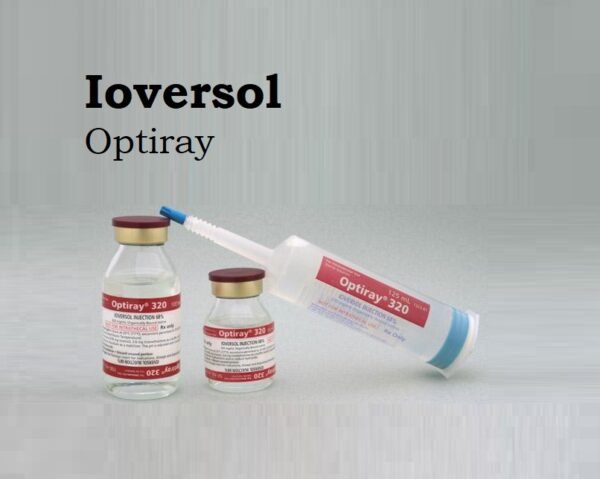
Ioversol (Optiray) is an organoiodine compound that contains a high amount of iodine and is used in various diagnostic procedures.
Ioversol Uses:
-
Ioversol 74%:
- Adults:
- Peripheral and coronary arteriography, left ventriculography, body and head contrast-enhanced computed tomography imaging, IV excretory urography, IV digital subtraction angiography, and venography are all examples of angiography procedures.
- Pediatric:
- Angiocardiography.
- Adults:
-
Ioversol 68%:
- Adults:
- Angiography of the whole cardiovascular system, including the head and body's contrast-enhanced CT scans, IV excretory urography, and cerebral, coronary, peripheral, visceral, renal, and venographic arteriography.
- Pediatric:
- IV excretory urography, head and body contrast-enhanced computed tomography imaging, and angiocardiography
- Adults:
-
Ioversol 64%:
- Adults:
- angiography of the brain and body, IV excretory urography, venography, contrast-enhanced computed tomography imaging, and peripheral arteriography.
- Adults:
-
Ioversol 51%:
- Adults:
- IV excretory urography, head- and body-specific contrast-enhanced computed tomography, cerebral angiography, and venography.
- Adults:
Ioversol dose in adults:
- Dosing is determined by a number of factors, including:
-
- Type of examination,
- route of administration,
- patient age/weight and product;
- consult specific product information for detailed dosing information.
-
Ioversol Pregnancy Risk Category: B/C
- Ioversol crosses the placenta and can be found in the newborn's stomach at birth.
- The theoretical concern about the potential adverse effects of free iodide on the foetus should be addressed.
Ioversol use during breastfeeding:
- Breast milk may contain iodinated contrast media.
- Breastfeeding may continue without interruption due to the low expected excretion of iodinated and contrast agents in breast milk, as well as the low absorption rate from infants' GI tracts.
- Theoretically speaking, milk's taste could be affected if it contains contrast media.
- Women who prefer to temporarily withhold breastfeeding may be able to express or discard breast milk for up to 8 to 24 hours following the administration of contrast media.
- They can store and pump milk prior to the procedure, and then bottle-feed the milk stored during that time.
- According to the drugmaker the decision to breastfeed while on treatment should be weighed against the risks of exposure to the baby and the benefits to the mother who is breastfeeding.
Ioversol dose in Kidney Disease:
- There are no dosage adjustments present in the manufacturer’s labeling.
- Use caution in severe impairment, anuria, and in the setting of combined renal and hepatic disease.
Ioversol dose in Liver disease:
- There are no dosage adjustments present in the manufacturer’s labeling. Use caution in patients with combined hepatic and renal disease.
Common Side Effects of Ioversol:
-
Gastrointestinal:
- Nausea
-
Miscellaneous:
- Fever
Uncommon Side effects of Ioversol:
-
Cardiovascular:
- Bradycardia
- Cardiac complications including
- pulmonary artery systolic pressures
- decreases in systolic
- left ventricular systolic
- cardiac output
- diastolic blood pressures
- end-diastolic pressure
- right ventricular systolic
-
Central nervous system:
- Disorientation
- Headache
- Vertigo
- Drowsiness
- Paresis (transient)
- Seizure
-
Ophthalmic:
- Visual disturbance
Contraindications to Ioversol:
- The manufacturer's labeling does not list any contraindications.
- Canadian labeling: Hypersensitivity or any component of ioversol; clinically significant impairments of both renal and hepatic function
Warnings and precautions
-
Contrast media reactions
- There have been significant adverse responses, including delayed reactions, that have the potential to be fatal.
- Patients who have previously experienced an adverse response to contrast dye, iodine-based media, or those with established clinical hypersensitivity are urged to proceed with extreme care (eg bronchial asthma or hay fever)
- Before administering, obtain allergy and hypersensitivity information.
- It is possible to not accurately predict the possibility of allergic reactions by pretesting.
- To reduce the severity and incidence of allergic reactions, it is worth considering taking antihistamines or corticosteroids.
- After administration, monitor closely for between 30 and 60 minutes.
- Patients who received general anaesthesia had a higher rate of adverse reactions.
-
Contrast-associated Nephropathy
- It may happen.
- Patients who have severe underlying renal impairment or who are also experiencing concurrent renal, hepatic, or both impairments should exercise caution, especially if high dosages are necessary. Patients should drink plenty of water both before and after the examination.
-
Dermatological effects
- One hour after injection, severe cutaneous adverse reactions have been observed (including Stevens-Johnson syndrome [SJS], toxic epidermal necrolysis [TEN], acute exanthematous pustulosis [AGEP], drug response with eosinophilia or systemic symptoms [DRESS]).
- Reaction intensity may get worse and onset time may get quicker with repeated treatments.
- Patients who have experienced severe skin reactions to Ioversol in the past shouldn't be prescribed the medication.
-
Extravasation:
- Perhaps a vesicant. Ensure proper needle/catheter/line positioning prior to and during administration.
- Monitor infusion site.
- Avoid infiltration
- Patients with severe arterial and venous disease may experience tissue necrosis from infiltration.
-
Neurotoxicity:
- Permanent paralysis, cerebral arteriography, and selective spinal arteriography can all lead to serious neurologic events, including permanent paralysis.
- As the underlying disease is not well understood, and as such, cause and effect cannot be established. However, procedural techniques could play a role.
- After vasopressor administration, avoid the injection of a contrast medium through the arterial veins.
-
Seizures:
- Patients with epilepsy history should be cautious; patients who have had focal or generalized motor seizures in the past must be careful.
- It is important to continue antiepileptic treatment.
- Patients who require a large dose or concentrated solution of anticonvulsant medication should consider prophylactic treatment.
- CNS-acting agents, primarily those that lower seizure thresholds (eg, phenothiazines, MAOIs, tricyclic antidepressants, SSRIs), should be discontinued 24 to 72 hours prior to intrathecal use and not resumed for 24 hours post-procedure.
-
Events that are thromboembolic:
- There are significant, but not necessarily fatal, thromboembolic events that can result in MI and stroke, according to angiographic methods utilising both non-ionic and ionic contrast media. Ionic iodinated contrast media have a higher potential to prevent blood coagulation than nonionic media.
- When performing angiographic procedures, ensure that you use meticulous intravascular administration techniques.
- Clotting can occur when in vitro blood is in contact with non-ionic contrast media syringes. Plastic syringes have been reported to reduce, but not eliminate, the risk of in vitro bleeding.
-
Cardiovascular disease
- Take care when you have severe heart disease or HF. A temporary increase in your circulatory osmotic burden could happen.
- After the procedure, observe patients suffering from Heart failure for several hours to identify late-onset hemodynamic disturbances.
- Selective coronary angiography ought to be performed only in cases when the advantages could outweigh the risks.
- Patients with advanced vascular disease may be at risk of developing acute renal failure from pre-hydration. It is important to avoid fluid restrictions and keep these patients hydrated.
-
Diabetes:
- If patients with severe vascular disease are dehydrated, they run the risk of developing acute renal failure.
- Fluid restriction is not recommended
- These patients should be kept hydrated.
-
Hepatic impairment
- Patients with combined renal/hepatic disease should be cautious.
-
Homocystinuria
- Patients with homocystinuria should avoid angiography; they may be at high risk of embolism and thrombosis.
-
Hyperthyroidism:
- After receiving intravascular injections of iodinated contrast medium, patients with hyperthyroidism or those who have an independent thyroid nodule may develop a thyroid storm.
-
Hypothyroidism:
- Thyroid function tests that indicate hypothyroidism, or transient thyroid suppression (uncommon) have been reported in both pediatric and adult patients (including infants). Some patients were also treated for hypothyroidism.
-
Multiple myeloma
- Be cautious with multiple myeloma.
- The use of intravascular contrast agents can cause renal impairment, particularly if there is concurrent dehydration.
- Partially dehydration during preparation for procedures can precipitate myeloma proteins in the renal tubules. This is why it is not recommended for myeloma sufferers.
-
Pheochromocytoma:
- Patients with pheochromocytoma (known, suspected) should be used with caution.
- Reduce the amount of contrast agent and monitor blood pressure closely throughout the procedure.
- Treatment for hypertensive crises should be available immediately.
-
Pulmonary disease
- Patients with chronic pulmonary embolism should be aware of the inherent risks associated with angiocardiography.
-
Renal impairment
- Care should be taken with patients who have severe renal disease, concurrent hepatitis and renal illness, or anuria.
- As a result, serum creatinine may rise or renal function may decline.
-
Sickle cell disease:
- Take care when treating homozygous sickle cell patients.
- Contrast media administration can cause sickness.
Ioversol: Drug Interaction
Risk Factor C (Monitor therapy) |
|
|
Aldesleukin |
Iodinated contrast agents may be more likely to cause allergic or hypersensitive responses. |
Risk Factor D (Consider therapy modification) |
|
|
MetFORMIN |
Iodinated contrast agents may intensify MetFORMIN's unfavourable/toxic effects. Lactic acidosis linked with metformin can be brought on by renal impairment. Management: The guidance on management differs. For further information, consult the medication interaction monograph in its entirety. |
Monitoring parameters:
- ECG,
- vital signs (coronary arteriography and left ventriculography);
- signs and symptoms of hypersensitivity for ≥30 to 60 minutes;
- renal function.
- Monitor infusion site.
How to administer Ioversol?
- Hydrate well prior to and following administration.
- Premedication with antihistamines or corticosteroids may be considered in some patients to minimize the potential for allergic reactions.
- Before delivery, intravenous dosages should be at or near body temperature.
- To reduce the risk of thrombotic events during angiography, careful intravascular administration procedures should be used. These approaches include regular catheter cleansing, the use of plastic syringes, and constant monitoring of catheter and guidewire manipulation.
- A few minutes should pass between each injection when giving big dosages (such as aortography or ventriculography) to allow for the possibility of hemodynamic abnormalities.
- Not for intrathecal use.
NOTE:
- Possibly a vesicant; ensure good needle or catheter insertion before to and throughout infusion; prevent infiltration.
-
Extravasation management:
- If extravasation is occurring
- Immediately cease injection and stop the connection
- Remove needle/cannula
- Elevate extremity.
- The aspiration of extravasated contrast media is not suggested.
- Information conflicts regarding the use of hyaluronidase; the American College of Radiology (ACR) Manual on Contrast Media does not recommend hyaluronidase in the management of contrast media extravasation.
- Other sources recommend its use in extravasation management.
- If extravasation is occurring
-
If using hyaluronidase:
- Intradermal or SubQ:
- Inject a total of 1 to 1.7 mL (15 units/mL) as five separate 0.2 to 0.3 mL injections by using a 25-gauge needle into the area of extravasation at the leading edge in a clockwise manner or injection of a total of 5 mL i.e It has also been used effectively to provide 150 units/mL by five sequential 1 mL injections around the extravasation site.
- Intradermal or SubQ:
Mechanism of action of Ioversol:
- Radiographic visualization is possible by the opacification of vessels or anatomical structures that are in the flow path of the contrast media.
Half-life elimination:
- 1.5 hours; prolonged with renal impairment
Metabolism:
- None
Excretion:
- Urine: >95% eliminated intact in urine 24 hours postadministration
International Brands of Ioversol:
- Optiray 240 Ultraject
- Optiray 320 Ultraject
- Optiray 320
- Optiray 350
- Optiject
- Optiray
- Optiray 240
- Optiray 300
- Optiray 350 Ultraject
Ioversol Brand Names in Pakistan:
No Brands Available in Pakistan.
.png)


