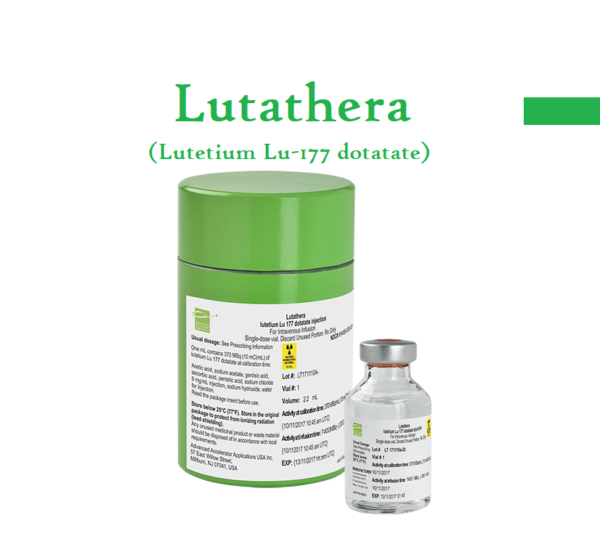
Lutathera (Lutetium Lu-177 dotatate) is a radiolabeled somatostatin analog that destroys somatostatin receptor-positive cells by emitting beta and gamma radiations.
Lutetium Lu-177 dotatate Uses:
-
Gastroenteropancreatic neuroendocrine tumors:
- It is indicated for the treatment of somatostatin receptor-positive gastroenteropancreatic neuroendocrine tumors (GEP-NETs) in adults, including foregut, midgut, and hindgut neuroendocrine tumors.
Lutathera (Lutetium Lu-177 dotatate) Dose in Adults:
Note: Premedications and concomitant medications need to be given.
Lutathera (Lutetium Lu-177 dotatate) Dose in the treatment of Gastroenteropancreatic neuroendocrine tumors:
- IV: 7.4 GBq (200 mCi) every 8 weeks
- Total doses: 4
-
Premedication and concomitant medications:
- Somatostatin analogs:
- Discontinue long-acting somatostatin analogs e.g. octreotide at least 4 weeks before lutetium Lu 177 dotatate therapy.
- If required short acting octreotide can be given and discontinue at least 24 hours before lutetium Lu 177 dotatate therapy
- During lutetium Lu 177 dotatate therapy, long-acting octreotide 30 mg IM between 4 - 24 hours after each lutetium Lu 177 dotatate dose
- Do not use long-acting octreotide within 4 weeks of each subsequent lutetium Lu 177 dotatate dose
- Short-acting octreotide may be given for symptomatic management, but discontinue at least 24 hours before each lutetium Lu 177 dotatate dose
- Continue long-acting octreotide 30 mg IM every 4 weeks after completion of the full course of lutetium Lu 177 dotatate treatment until disease progression or for up to 18 months following treatment initiation.
- Antiemetic: Administer should be given 30 minutes before amino acid administration
- Amino acid solution:
- 30 minutes before lutetium Lu 177 dotatate dose and should be given during and 3 hours after use.
- The solution should contain L-lysine (between 18 - 24 g) and L-arginine (between 18 - 24 g) in a total volume of 1.5 to 2.2 L and have an osmolarity of less than 1,050 mOsmol.
- Somatostatin analogs:
Use in Children:
Not indicated.
Pregnancy Risk Category: N
- If used during pregnancy, it can cause harm to the fetus.
- Before starting treatment, it is important to rule out pregnancy.
- Females of reproductive potential and age should use effective contraception for at least 7 months following the last dose.
- Effective contraception should be used by male patients and their partners during treatment, as well as for the 4 months following the last dose.
- It can lead to infertility in both males and women, whether it is temporary or permanent.
Lutetium Lu-177 dotatate use during breastfeeding:
- It is unknown if Lutetium Lu177 dotatate excretion is in breast milk.
- The manufacturer doesn't recommend breastfeeding during therapy, or for 2.5 years after the last dose.
Dose in Kidney Disease:
Note: Calculate CrCl using the Cockcroft-Gault equation with actual body weight.
-
Renal impairment prior to treatment initiation:
- CrCl ≥30 mL/minute: No dose adjustment required. Monitor renal functions
- CrCl <30 mL/minute: The manufacturer has not provided any dose adjustment in labeling.
- End-stage renal disease (ESRD): Manufacturer has not provided any dose adjustment in labeling.
-
Renal toxicity during treatment:
- CrCl <40 mL/minute, or 40% increase in baseline serum creatinine, or 40% decrease in baseline CrCl:
- Withhold until complete resolution; after that start with a lower dose (3.7 GBq (100 mCi).
- If no renal toxicity with a lower dose, lutetium Lu 177 dotatate 7.4 GBq (200 mCi) can be given for the next dose.
- Permanently discontinue in case of treatment delay of ≥16 weeks, or for recurrent renal toxicity.
- CrCl <40 mL/minute, or 40% increase in baseline serum creatinine, or 40% decrease in baseline CrCl:
Dose in Liver Disease:
-
Hepatic impairment prior to treatment initiation:
- Mild or moderate impairment: No dose adjustment required.
- Severe impairment (bilirubin >3 times ULN and any AST): Manufacturer has not provided any dose adjustment in labeling.
-
Hepatotoxicity during treatment:
- Bilirubin >3 times ULN (grade 3 or 4) or albumin <30 g/L with a prothrombin ratio <70%:
- Withhold until complete resolution; once complete resolution occurs, start with a lower dose (3.7 GBq (100 mCi).
- If no hepatotoxicity with a lower dose, lutetium Lu 177 dotatate 7.4 GBq (200 mCi) can be given for the next dose.
- Permanently discontinue in case of treatment delay of ≥16 weeks, or for recurrent hepatotoxicity.
- Bilirubin >3 times ULN (grade 3 or 4) or albumin <30 g/L with a prothrombin ratio <70%:
Common Side Effects of Lutathera (Lutetium Lu-177 dotatate):
-
Cardiovascular:
- Peripheral Edema
- Flushing
- Hypertension
-
Central Nervous System:
- Fatigue
- Dizziness
- Headache
- Anxiety
-
Dermatologic:
- Alopecia
-
Endocrine & Metabolic:
- Hyperglycemia
- Increased Gamma-Glutamyl Transferase
- Hyperuricemia
- Hypocalcemia
- Hypokalemia
- Hyperkalemia
- Hypernatremia
- Hypoglycemia
-
Gastrointestinal:
- Nausea
- Vomiting
- Abdominal Pain
- Diarrhea
- Decreased Appetite
-
Hematologic & Oncologic:
- Lymphocytopenia
- Anemia
- Leukopenia
- Thrombocytopenia
- Neutropenia
-
Hepatic:
- Increased Serum Alkaline Phosphatase
- Increased Serum AST
- Increased Serum ALT
- Increased Serum Bilirubin
-
Neuromuscular & Skeletal:
- Back Pain
- Limb Pain
-
Renal:
- Increased Serum Creatinine
- Renal Failure
-
Respiratory:
- Cough
Less Common Side Effects of Lutathera (Lutetium Lu-177 dotatate):
-
Cardiovascular:
- Atrial fibrillation
-
Gastrointestinal:
- Constipation
- Dysgeusia
-
Genitourinary:
- Urotoxicity
-
Neuromuscular & skeletal:
- Myalgia
- Neck pain
-
Miscellaneous:
- Fever
Contraindications to Lutathera (Lutetium Lu-177 dotatate):
The manufacturer has not indicated any contraindications on the label.
Warnings and precautions
-
Suppression of bone marrow
- Long-acting octreotide has a higher chance of myelosuppression (anemia and thrombocytopenia [all grades]) than lutetium Lu 177 dotatate.
- Regularly monitor blood counts
- Clinical studies showed that the median time to experience thrombocytopenia was 5.1 weeks after the first dose.
- In less than 2 months, 2/3 of the patients' platelets had returned to baseline.
-
Gastrointestinal toxicity:
- It can cause nausea, vomiting and diarrhea as well as abdominal pain.
- Before using antiemetics, it is important to be aware of the risks.
-
Hepatotoxicity:
- It can cause hepatic tumor hemorhage, edema or necrosis as well as intrahepatic congestion, cholestasis and edema.
- Patients with hepatic metastatic disease have a higher chance of developing hepatotoxicity.
- Monitoring liver functions
-
The neuroendocrine hormonal crisis
- Within 24 hours of the initial dose, neuroendocrine hormonal crises may occur
- Flushing, diarrhea, bronchospasm and hypotension are all possible symptoms. Keep an eye out for any signs or symptoms
- Hypercalcemia is also possible
- Fluids, fluids and/or electrolytes, including analogs of Somatostatin, can be provided if required
-
Toxicity in the renal system:
- It can lead to renal failure. One clinical trial can result in renal failure lasting between 3 and 36 months.
- Pre-existing kidney disease can increase the risk of developing renal failure.
- To decrease proximal tubule absorption, it is recommended to use an amino acid solution concurrently with lutetium Lu177 dotatate infusion.
- Patients are encouraged not to urinate after and during the treatment.
- Regularly monitor renal function
-
Secondary malignancies
- Myelodysplastic syndrome (MDS), and leukemia with Lu 177 dotatate use were shown in studies.
- The median time for MDS development was 28 months, and for leukemia it took 55 months.
-
Renal impairment
- Use of lutetium Lu177 dotatate in mild-to-mode renal impairment can increase the risk of renal toxicities
- Preexisting renal impairment requires that you monitor your renal function more often.
Lutetium Lu-177 dotatate: Drug Interaction
|
Somatostatin Analogs |
May diminish the therapeutic effect of Lutetium Lu 177 Dotatate. Specifically, the therapeutic effect of Lutetium Lu 177 Dotatate may be diminished if the timing of Somatostatin Analog administration is not carried out as recommended. Management: Discontinue long-acting somatostatin analogs at least 4 weeks and short-acting octreotide at least 24 hours prior to each lutetium Lu 177 dotatate dose. Administer short- and long-acting octreotide during treatment as recommended. See full monograph. |
Monitoring parameters:
- Blood cell counts
- Serum creatinine and creatinine clearance
- Liver function test: Transaminases, bilirubin, and albumin
- Pregnancy test before starting therapy
- Monitor for signs/symptoms of neuroendocrine hormonal crisis (eg, flushing, diarrhea, bronchospasm, hypotension)
- Monitor for secondary malignancies (myelodysplastic syndrome and leukemia)
How to administer Lutathera (Lutetium Lu-177 dotatate)?
IV: Administer over 30 - 40 minutes. not recommended as an IV bolus
- Insert a 2.5 cm, 20-gauge needle (short needle) into the lutetium Lu 177 dotatate vial and connect via a catheter to a 500 mL sterile NS solution
- Do not allow the short needle to touch the lutetium Lu 177 dotatate solution in the vial and do not connect this short needle to the patient
- Do not allow NS to flow into the lutetium Lu 177 dotatate vial prior to infusion initiation and do not inject lutetium Lu 177 dotatate directly into the NS solution.
- Insert a separate 9 cm, 18-gauge (long needle) into the lutetium Lu 177 dotatate vial; ensure that this long needle touches and are secured to the bottom of the lutetium Lu 177 dotatate vial during the entire infusion
- Connect the long needle to the patient by an IV catheter that is prefilled with sterile NS solution and that is used only for the lutetium Lu 177 dotatate infusion into the patient.
- Use the pump to regulate the flow of the NS solution via the short needle into the lutetium Lu 177 dotatate vial at a rate of 50 - 100 mL/hour for 5 - 10 minutes, and then 200 - 300 mL/hour for an additional 25 - 30 minute
- The NS solution (entering the vial through the short needle) will carry the lutetium Lu 177 dotatate from the vial to the patient through the catheter connected to the long needle (over a total duration of 30 - 40 minutes).
- During the infusion, ensure that the level of the solution in the lutetium Lu 177 dotatate vial remains constant
- Once the level of radioactivity is stable for at least 5 minutes, disconnect the vial from the long needle line and clamp the saline line
- Once the infusion is complete, flush the line with 25 mL NS.
Antiemetics:
- should be given 30 minutes before amino acid solution.
Amino acid solution:
- Can be given with a three-way valve in the same venous access as the lutetium Lu 177 dotatate infusion, or can be given through a separate IV line in the patient's other arm.
- Continue the amino acid infusion for at least 3 hours after and during the lutetium Lu 177 dotatate infusion.
Mechanism of action of Lutathera (Lutetium Lu-177 dotatate):
- It is radiolabelled as a somatostatin analog, and also a beta- and gamma emitting radionuclide.
- It is most compatible with subtype 2 receptors (SSRT2) and after binding the lutetium Lu 177 dotatate, it is internalized.
- Beta emission creates free radicals that destroy cells in somatostatin receptor positive and surrounding cells.
Distribution: 460 L
-
- Within 4 hours of its administration, it spreads to other organs such as the liver, kidneys, tumor lesions, liver, and (in some cases) pituitary and thyroid glands.
- Maximum penetration into tissue is 2.2mm
Protein binding:
- 43% to plasma proteins
Half-life elimination:
- 71 ± 28 hours
Excretion:
- Mainly renal, more than 99% of lutetium Lu 177 dotatate will be eliminated within 14 days after its use
International Brand Names of Lutetium Lu-177 dotatate:
- Lutathera
Lutetium Lu-177 dotatate Brand Names in Pakistan:
No Brands Available in Pakistan.
.png)