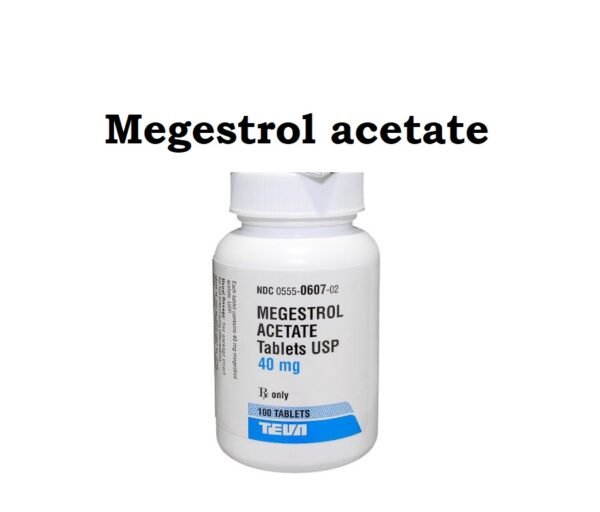
Megestrol acetate is an antiestrogenic progestin that is used in the treatment of anorexia and cachexia caused by HIV infection, cancers, endocrine, and psychiatric disorders.
Megestrol acetate Uses:
-
Anorexia or cachexia:
- Suspension:
- It is used in the treatment of cachexia, anorexia, or unexplained significant weight loss in patients with AIDS.
- Limitations of use:
- It is not intended to prevent weight loss.
- Treatment of the primary disorder is essential and treatment with megestrol should only be initiated once the primary disorder causing anorexia (such as cancer, infection, malabsorption, endocrine disease, kidney disease, or psychiatric disorder) is corrected.
- Suspension:
-
Breast cancer:
- The tablet formulation is indicated for the palliative treatment of advanced breast cancer
-
Endometrial cancer:
- It is indicated for the palliative treatment of advanced endometrial carcinoma.
-
Off Label Use of Megestrol acetate in Adults:
- It is used in the treatment of cancer-related cachexia
Megestrol acetate Dose in Adults:
Note:
- On a mg to mg basis, "Megace ES" suspension is not equivalent to other formulations.
Megestrol acetate Dose in the treatment of Anorexia or cachexia associated with AIDS: Oral:
- Suspension:
- 625 mg daily initially (of the 125 mg/mL suspension) or
- 800 mg daily (of the 40 mg/mL suspension)
- Doses in the range of 400 mg to 800 mg per day have been found to be effective
Megestrol acetate Dose in the treatment of advanced Breast cancer:
- Oral: Tablet:
- 160 mg per day in four equally divided doses (of 40 mg) for at least two months.
Megestrol acetate Dose in the treatment of advanced Endometrial cancer:
- Oral: Tablet:
- 40 to 320 mg per day in divided doses for a minimum of two months
Megestrol acetate Dose in the treatment of Cancer-related cachexia (off-label):
- The optimal dose has not been defined, however, doses ranging from 160 to 800 mg daily were effective in achieving weight gain with higher doses exceeding 160 mg were associated with more weight gain.
Megestrol acetate Dose in Childrens:
Note:
- Megace ES is not equivalent on a mg per mg basis with other megestrol formulations.
Megestrol acetate Dose in the treatment of Appetite stimulant and anorexia associated with chronic illness such as cancer, cystic fibrosis, and HIV):
-
Infants ≥8 months, Children, and Adolescents:
- Oral:
- Tablets or 40 mg/mL suspension:
- The initial dose is 7.5 to 10 mg/kg/day in one or two divided doses per day.
- The dose should be titrated to achieve an optimal response.
- If weight gain is excessive, the dose may be decreased.
- The usual duration of treatment is 3 - 11 months.
- The maximum daily dose is 800 mg/day or 15 mg/kg/day.
- Tablets or 40 mg/mL suspension:
- Oral:
Megestrol acetate Pregnancy Risk Category: X
- It is not recommended for pregnant women with anorexia and cachexia due to HIV infection.
- It can cause harm to the fetus if administered during pregnancy.
- Before starting treatment for females with reproductive potential, it is important to evaluate your pregnancy status.
- Effective contraception should be used to treat anorexia and cachexia due to HIV infection in females with reproductive potential.
- Breakthrough vaginal bleeding can occur during treatment, which should be distinguished from menstrual bleeding.
Megestrol acetate use during breastfeeding:
- It is eliminated from breastmilk.
- Clinical studies showed that milk with higher concentrations of megestrol was found when it was given three hours before sampling.
- The manufacturer suggests that breastfeeding and maternal drug intake be stopped due to the potential for serious adverse drug reactions.
- Breastfeeding is also not recommended due to the possibility of HIV infection.
Megestrol acetate Dose in Kidney Disease:
- In the manufacturer's labeling, adjustments in the dose have not been provided for patients with liver disease.
- However, it should be used with caution because the urinary excretion of the drug is substantial.
Megestrol acetate Dose in Liver disease:
In the manufacturer's labeling, adjustments in the dose have not been provided for patients with liver disease.
Side effects of Megestrol acetate:
-
Cardiovascular:
- Hypertension
- Cardiomyopathy
- Chest Pain
- Edema
- Palpitations
- Peripheral Edema
- Cardiac Failure
-
Central Nervous System:
- Headache
- Pain
- Insomnia
- Abnormality In Thinking
- Confusion
- Convulsions
- Depression
- Hypoesthesia
- Neuropathy
- Paresthesia
- Carpal Tunnel Syndrome
- Lethargy
- Malaise
- Mood Changes
-
Dermatologic:
- Skin Rash
- Alopecia
- Dermatological Disease
- Diaphoresis
- Pruritus
- Vesicobullous Dermatitis
-
Endocrine & Metabolic:
- Hyperglycemia
- Decreased Libido
- Albuminuria
- Gynecomastia
- Increased Lactate Dehydrogenase
- Adrenocortical Insufficiency
- Amenorrhea
- Cushing's Syndrome
- Diabetes Mellitus
- Hot Flash
- HPA-Axis Suppression
- Hypercalcemia
- Weight Gain
-
Gastrointestinal:
- Diarrhea
- Flatulence
- Vomiting
- Nausea
- Dyspepsia
- Abdominal Pain
- Constipation
- Oral Moniliasis
- Sialorrhea
- Xerostomia
-
Genitourinary:
- Impotence
- Urinary Incontinence
- Urinary Tract Infection
- Urinary Frequency
- Breakthrough Bleeding
-
Hematologic & Oncologic:
- Leukopenia
- Sarcoma
- Tumor Flare
-
Hepatic:
- Hepatomegaly
-
Infection:
- Candidiasis
- Herpes Virus Infection
- Infection
-
Neuromuscular & Skeletal:
- Weakness
-
Ophthalmic:
- Amblyopia
-
Respiratory:
- Cough
- Dyspnea
- Pharyngitis
- Pulmonary Disorder
- Pneumonia
- Hyperventilation
-
Miscellaneous:
- Fever
Contraindications to Megestrol acetate:
- Allergy to any drug or component of the formulation
- Pregnancy
Notice:
- Although cross-reactivity is not documented for other progestins, it may exist due to structural, chemical and functional similarities.
Warnings and precautions
-
Suppression of the adrenals:
- Long term use may be associated with hypothalamic-pituitary-adrenal axis suppression.
- Hypoadrenalism is a condition in which patients stop taking long-term megestrol and discontinue treatment. This can be especially true during stressful times.
- Hypoadrenalism should be checked and replacement doses of rapid-acting, stress-reducing glucocorticoids administered to patients.
-
Cushing syndrome
- Cushing's syndrome has been linked to long-term use.
-
AIDS-related cachexia
- It is unknown if it has any effect on viral replication when used to treat HIV-related cachexia. Monitoring via PCR is essential.
-
Diabetes:
- The drug can cause impaired glycemic control over long periods and new-onset diabetes mellitus.
-
Thromboembolism
- Patients who have a history of thromboembolic conditions should be cautious when taking the drug.
Megestrol acetate: Drug Interaction
|
Antidiabetic Agents |
Hyperglycemia-Associated Agents may diminish the therapeutic effect of Antidiabetic Agents. |
|
C1 inhibitors |
Progestins may enhance the thrombogenic effect of C1 inhibitors. |
|
Choline C 11 |
Antiandrogens may diminish the therapeutic effect of Choline C 11. |
|
Herbs (Progestogenic Properties) (eg, Bloodroot, Yucca) |
|
|
Risk Factor D (Consider therapy modification) |
|
|
Anticoagulants |
Progestins may diminish the therapeutic effect of Anticoagulants. More specifically, the potential prothrombotic effects of some progestins and progestin-estrogen combinations may counteract anticoagulant effects. Management: Carefully weigh the prospective benefits of progestins against the potential increased risk of procoagulant effects and thromboembolism. Use is considered contraindicated under some circumstances. Refer to related guidelines for specific recommendations. |
|
Pomalidomide |
|
|
Risk Factor X (Avoid combination) |
|
|
Dofetilide |
Megestrol may increase the serum concentration of Dofetilide. |
|
Indium 111 Capromab Pendetide |
Antiandrogens may diminish the diagnostic effect of Indium 111 Capromab Pendetide. |
|
Ulipristal |
Progestins may diminish the therapeutic effect of Ulipristal. Ulipristal may diminish the therapeutic effect of Progestins. Management: Ulipristal for uterine fibroids (Canadian indication): avoid progestins within 12 days of stopping ulipristal; as emergency contraceptive (U.S. indication): avoid progestins within 5 days of stopping ulipristal. |
Monitoring parameters:
- Observe for the clinical features of thromboembolic events
- Monitor blood pressure
- Weight
- Plasma glucose
How to administer Megestrol acetate?
- It is administered orally.
- The suspension is shaken well before use.
- The 625 mg/5 mL suspension may be administered without regard to meals.
Mechanism of action of Megestrol acetate:
- It is a synthetic estrogen with antiestrogenic properties, which disrupts the estrogen receptor system.
- Megestrol decreases LH titers because it interferes with the normal estrogen cycles.
- It can also affect the endometrium.
- Megestrol, a progestin that has antineoplastic properties, is known.
- It is thought to inhibit the effects of the luteinizing hormone, which is mediated by the pituitary.
- It can stimulate appetite by antagonizing metabolic effects of catabolic Cytokines.
The onset of action:
- Breast or endometrial cancer: At least two months of continuous treatment;
- For weight gain: 2 - 4 weeks
Absorption:
- Well absorbed
Metabolism:
- Hepatic (to free steroids and glucuronide conjugates)
Half-life elimination:
- Suspension: 20 to 50 hours;
- Tablet: 34.2 hours (range: 13 to 105 hours)
Time to peak serum concentration:
- Suspension: 5 hours;
- Tablet: 2.2 hours (range: 1 to 3 hours)
Excretion:
- Urine (57% to 78%; 5% to 8% as metabolites);
- feces (8% to 30%) within ten days
International Brands of Megestrol acetate:
- Megace ES
- Megace Oral
- Apegestrol
- Apetrol
- Endace
- Maygace
- Megace
- Megace ES
- Megace Oral
- Megaplex
- Megase
- Megastrol
- Megatus
- Megejohn
- Megesia
- Megesin
- Megestat
- Megex-I
- Megostat
- Mestrel
- Mestrol
- Norea
- Onistrol
- Tracetate
Megestrol acetate Brand Names in Pakistan:
Megestrol Acetate Tablets 40 mg |
|
| Medestrol | Pharmedic (Pvt) Ltd. |
| Megace | Glaxosmithkline |
| Progace | Medinet Pharmaceuticals |
Megestrol Acetate 160 mg Tablets |
|
| Megace | Glaxosmithkline |
| Megestil | Scharper Pharmaceuticals (Pvt) Ltd. |
| Progace | Medinet Pharmaceuticals |
.png)