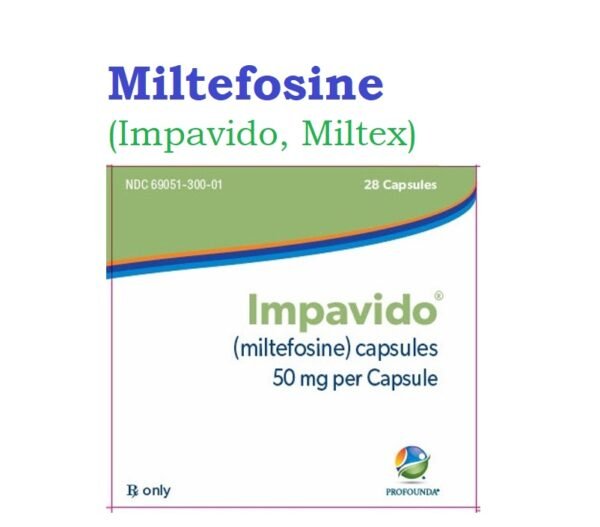
Miltefosine (Impavido, Miltex) is currently the only available oral medicine for the treatment of leishmaniasis including cutaneous, mucosal, and visceral forms.
Miltefosine (Impavido, Miltex) Uses:
-
Leishmaniasis:
- It is indicated for the treatment of visceral leishmaniasis caused by Leishmania donovani, cutaneous leishmaniasis caused by L. braziliensis, L. guyanensis, and L. panamensis), and mucosal leishmaniasis caused by L. braziliensis in adults and adolescents older than 12 years and weighing at least 30 kgs.
- Limitations of use:
- Efficacy of miltefosine treatment in infections caused by other species such as Leishmania infantum has not been evaluated
-
Off Label Use of Miltefosine in Adults:
- Free-living amebae (FLA) infections
Miltefosine Dose in Adults:
Miltefosine (Impavido, Miltex) Dose in the treatment of Leishmaniasis:
-
For the treatment of cutaneous, mucosal, and visceral leishmaniasis in Non-HIV positive patients:
- 30 to 44 kg:
- 50 mg orally two times a day for 28 days
- ≥45 kg:
- 50 mg orally three times a day for 28 days
- 30 to 44 kg:
-
For the treatment of initial acute visceral leishmaniasis in HIV-Positive patients:
- 100 mg orally daily for 28 days.
Miltefosine (Impavido, Miltex) Dose in the treatment of Free-living amebae (FLA) infections (off-label):
- <45 kg:
- 50 mg orally two times a day.
- ≥45 kg:
- 50 mg orally three times a day.
Miltefosine Dose in Childrens:
Miltefosine (Impavido, Miltex) Dose in the treatment of Leishmaniasis:
-
Non-HIV positive/-exposed patients:
- Children ≥12 years and Adolescents weighing 30 kgs or more:
- 30 to 44 kg:
- 50 mg orally two times a day for 28 days
- ≥45 kg:
- 50 mg orally three times a day for 28 days
-
HIV positive/-exposed patients:
- Adolescents: Visceral, initial acute infection:
- 100 mg orally daily for 28 days.
- Adolescents: Visceral, initial acute infection:
Miltefosine (Impavido, Miltex) Dose in the treatment of infections caused by Free-living amebas (Naegleria fowleri):
-
Children and Adolescents:
- <45 kg:
- 50 mg orally two times a day for 28 days.
- The dose should not exceed 2.5 mg/kg/dose.
- ≥45 kg:
- 50 mg orally three times a day for 28 days.
- <45 kg:
Pregnancy Risk Factor D
- It should not be used by pregnant women.
- [US Boxed Warning]
- The drug could have adverse effects on the fetus.
- The drug may cause fetal death or teratogenicity in animal reproduction studies.
- Pregnant women should not receive Miltefosine.
- Untreated leishmaniasis can also lead to maternal mortality, adverse pregnancy outcomes, such as spontaneous abortion, congenital diseases, small for gestational birth weight, severe anemia, and congenital disease.
- Patients with cutaneous leishmaniasis may develop larger and more unusual looking lesions during pregnancy.
- This can lead to adverse fetal outcomes, including stillbirths and preterm births.
- [US Boxed Warning]
- Perform a pregnancy test in the urine or serum of females with reproductive potential before prescribing the drug.
- Effective contraception should always be recommended to all females with reproductive potential during treatment and for the five months following treatment.
- Patients who experience nausea or vomiting while taking oral contraceptives can be switched to non-hormonal options.
- Testicular pain in male patients has been reported as reduced or absent ejaculation.
Miltefosine use during breastfeeding:
- It is unknown if the drug will be excreted into breastmilk.
- The manufacturer suggests that you stop breastfeeding while receiving treatment, and continue to breastfeed for at least five months after stopping.
Miltefosine Dose in Kidney Disease:
In the manufacturer’s labeling, adjustments in the dose has not been recommended in patients with kidney disease.
Miltefosine Dose in Liver disease:
In the manufacturer’s labeling, adjustments in the dose has not been recommended in patients with liver disease.
Common Side Effects of Miltefosine (Impavido, Miltex):
-
Central nervous system:
- Headache
- Dizziness
-
Gastrointestinal:
- Nausea
- Vomiting
- Motion sickness
- Decreased appetite
- Diarrhea
- Abdominal pain
-
Hematologic & oncologic:
- Decreased platelet count
-
Hepatic:
- Increased serum transaminases
-
Renal:
- Increased serum creatinine
Less Common Side Effects of Miltefosine (Impavido, Miltex):
-
Central Nervous System:
- Drowsiness
- Malaise
- Fatigue
- Paresthesia
-
Dermatologic:
- Pruritus
- Cellulitis
- Pyoderma
- Skin Rash
- Stevens-Johnson Syndrome
- Urticaria
-
Gastrointestinal:
- Abdominal Distention
- Constipation
- Dysphagia
- Flatulence
-
Genitourinary:
- Testicular Pain
- Testicular Swelling
-
Hematologic & Oncologic:
- Lymphangitis
- Anemia
- Lymphadenopathy
-
Infection:
- Abscess
- Ecthyma
-
Neuromuscular & Skeletal:
- Weakness
-
Miscellaneous:
- Fever
Contraindications to Miltefosine (Impavido, Miltex):
- Allergy to miltefosine and any component of this formulation
- Sjogren-Larsson Syndrome (characterized by eye and CNS symptoms, ichthyosis, and eye problems)
- Pregnancy
Warnings and precautions
-
Dermatologic toxicities:
- Stevens-Johnson syndrome is a skin-related toxicology. If an exfoliative, bullous rash develops, treatment should be stopped immediately.
-
Fertility effects
- It has been shown to cause impaired fertility in both male and females when used in animal research.
- This effect was not observed in humans.
- During therapy, patients may experience scrotal pain and ejaculation problems.
-
Gastrointestinal effects:
- To reduce side effects, you should take the medication with food.
- It is possible for patients to experience nausea, vomiting, or diarrhea. To prevent dehydration, ensure adequate fluid intake.
-
Hematologic toxicities:
- Low platelet counts are a reason to monitor platelet count when treating patients suffering from visceral Leishmaniasis.
-
Hepatic effects
- During treatment for visceral Leishmaniasis, it is important to monitor the liver function.
- During treatment, elevated liver enzymes and bilirubin were reported.
-
Toxicity in the renal system:
- It is important to monitor kidney function every week and after treatment ends, because it could cause an increase of serum creatinine.
Monitoring parameters:
Monitor liver function tests (AST, ALT, alkaline phosphatase, and bilirubin), Renal functions (BUN and serum creatinine), and platelet counts at baseline and as clinically indicated.
How to administer Miltefosine (Impavido, Miltex)?
- It is administered orally with meals to reduce the gastrointestinal side effects.
- When administered twice daily, it may be taken with breakfast and dinner.
- Thrice daily dosing should be similarly equally divided and given with each meal.
Mechanism of action of Miltefosine (Impavido, Miltex):
- It is unknown what the drug does.
- It interacts with steroids and phospholipids within parasitic cell membranes, interfering with mitochondrial function and inhibiting cytochrome C oxidase.
- This causes cell death that is apoptosis-like.
Protein binding:
- 98%
Metabolism:
- It is metabolized in the liver. Phospholipase D-like cleavage of miltefosine releases choline.
- Fatty alcohol-containing fragments are oxidized to palmitic acid and undergo fatty acid metabolism.
Half-life elimination:
- 6 - 31 days.
Time to peak serum concentration:
- 4 to 7 hours
Excretion:
- Urine (<0.2% as unchanged drug)
International Brands of Miltefosine:
- Impavido
- Miltex
Miltefosine Brand Names in Pakistan:
Miltefosine Capsules 50 mg |
|
| Fosine | Nimrall Laboratories |
.png)