The bladder muscles relax as a result of mirabegron (Myrbetriq) activating the Beta-3 receptors in the bladder.
Mirabegron (Myrbetriq) Uses:
-
Overactive bladder:
- It can be used alone or in conjunction with solifenacin to treat overactive bladder, which shows up as increased frequency, urgency, or urges incontinence.
Mirabegron Dose in Adults:
Mirabegron Dose in the treatment of Overactive bladder (OAB):
- 25 mg orally once a day initially.
- Depending on the effectiveness and acceptability of each patient, the dose may be raised to 50 mg once a day.
- For a dose of 25 mg, the drug's impact can be seen after 8 weeks.
-
Concomitant use with solifenacin:
- 25 mg taken orally once a day at first, followed by 5 mg of solifenacin once daily.
- The dose of mirabegron may be increased to 50 mg once a day after 4 to 8 weeks.
Use in Children:
The drug's effectiveness and safety in youngsters have not been shown.
Pregnancy Risk Category: C/D
- Animal studies have shown adverse outcomes for fetal health.
- According to Canadian labeling, it is best not to use it during pregnancy.
Mirabegron use during breastfeeding:
- It is unknown if the drug will be excreted into breast milk.
- When deciding how to treat the newborn, the company advises assessing the risks and advantages to the mother.
Mirabegron Dose in Kidney Disease:
-
CrCl <15 mL/minute or eGFR <15 mL/minute/1.73 m²:
- It has not been studied in these patients and is not recommended.
-
CrCl 30 to 89 mL/minute or eGFR 30 to 89 mL/minute/1.73 m²:
- Adjustment in the dose is not necessary.
-
CrCl 15 to 29 mL/minute or eGFR 15 to 29 mL/minute/1.73 m²:
- The maximum dose should be 25 mg & not more.
-
Hemodialysis:
- Avoid its use in patients on hemodialysis (not studied in these patients).
Mirabegron Dose in Liver disease:
-
Severe impairment (Child-Pugh class C):
- No study has been done on hepatic disease patients and is not suggested for such patients.
-
Mild impairment (Child-Pugh class A):
- Adjustment in the dose is not necessary.
-
Moderate impairment (Child-Pugh class B):
- The maximum dose should be 25 mg & not more.
Side Effects of Mirabegron (Myrbetriq):
-
Cardiovascular:
- Hypertension
- Tachycardia
-
Central nervous system:
- Headache
- Dizziness
-
Gastrointestinal:
- Diarrhea
- Abdominal pain
- Constipation
- Xerostomia
-
Infection:
- Influenza
-
Genitourinary:
- Urinary tract infection
- Cystitis
-
Respiratory:
- Nasopharyngitis
- Sinusitis
-
Neuromuscular & skeletal:
- Back pain
- Arthralgia
Contraindications to Mirabegron (Myrbetriq):
- Allergy to mirabegron, or any component of this formulation.
- Pregnancy
- Blood pressure must be equal to or greater than a systolic (180 mm Hg) and/or diastolic (110 mmHg) blood pressure.
Cautions and alerts
-
Angioedema
- It has been claimed that it can lead to angioedema, which is facial, lip, tongue, and lip swelling.
Angioedema may result in death. - It is imperative to start treating the patient very away, especially if the tongue, hypopharynx, or larynx are affected.
Blood pressure effects:
- It has been reported that it can cause an increase in blood pressure. Dose-related effects on blood pressure are reported.
- Patients with blood pressures of 180/110mmHg or higher should not receive treatment.
- It is important to monitor your blood pressure regularly. It should not be used by people with mild hypertension as it can cause hypertension to worsen.
- It has been claimed that it can lead to angioedema, which is facial, lip, tongue, and lip swelling.
-
Bladder flow obstruction
- Patients with a blocked bladder outlet and those on muscarinic antagonist medications (like atropine) should use it with caution due to the increased risk of urine retention.
-
Hepatic impairment
- Use it with caution if you have liver illness. Those who have hepatic impairment might need to change their dose.
- It is not recommended for severe hepatic impairment.
-
Extension of QT
- Patients who have a history or concomitant medication that prolongs the QT interval should be cautious.
- It has a low chance of prolonging the QT interval when taken in the recommended dosages.
-
Renal impairment
- Renal disease patients should take precautions while using it
- It is not recommended for use in ESRD.
- Patients with severe renal impairment may require dosage adjustment.
Mirabegron: Drug Interaction
Note: Drug Interaction Categories:
- Risk Factor C: Monitor When Using Combination
- Risk Factor D: Consider Treatment Modification
- Risk Factor X: Avoid Concomitant Use
Risk Factor C (Monitor therapy) |
|
| Ajmaline | Ajmaline's serum levels may rise after using CYP2D6 Inhibitors (Moderate). |
| Amphetamines | The serum levels of amphetamines may rise in response to CYP2D6 Inhibitors (Moderate). |
| Anticholinergic Agents | might make Mirabegron's harmful or hazardous effects worse. |
| ARIPiprazole | The blood concentration of ARIPiprazole may rise in response to moderately potent CYP2D6 inhibitors. Management: Keep an eye out for enhanced pharmacologic effects of aripiprazole. Depending on the concurrent therapy and/or the indication, aripiprazole dosage modifications may or may not be necessary. For detailed advice, refer to the whole interaction monograph. |
| Brexpiprazole | Brexpiprazole's serum levels may rise in the presence of moderate CYP2D6 inhibitors. Treatment: The dose of brexpiprazole should be halved if it is to be used with a strong or moderate CYP3A4 inhibitor and both a moderate or strong CYP2D6 inhibitor. |
| CloZAPine | The blood levels of CloZAPine may rise after using CYP2D6 Inhibitors (Moderate). |
| Codeine | The therapeutic benefit of codeine may be diminished by moderate CYP2D6 inhibitors. These CYP2D6 inhibitors could stop codeine from being metabolically converted to its active metabolite, morphine. |
| CYP2D6 Substrates (High risk with Inhibitors) | The metabolism of CYP2D6 Substrates may be decreased by moderate CYP2D6 Inhibitors (High risk with Inhibitors). Tamoxifen is an exception. |
| Desipramine | Desipramine's serum levels may rise in response to mirabegron. |
| Fesoterodine | The active metabolite(s) of fesoterodine may be present at higher blood quantities while using CYP2D6 inhibitors. |
| Flecainide | Flecainide's serum levels may rise in response to mirabegron. Management: Keep a watchful eye on the clinical outcome of flecainide. A dose change could be required. In individuals using flecainide, the maximum adult mirabegron dose should be limited to 25 mg/day, according to Canadian mirabegron labeling. |
| Indoramin | The serum levels of Indoramin may rise after using CYP2D6 Inhibitors (Moderate). |
| Ketoconazole (Systemic) | might raise the serum level of mirabegron. |
| Metoprolol | Metoprolol's ability to lower blood pressure may be decreased by mirabegron. Metoprolol serum levels may rise as a result of mirabegron. |
| Nebivolol | Nebivolol's serum levels may rise in response to moderate CYP2D6 inhibitors. |
| Pitolisant | Pitolisant's serum levels may rise in response to CYP2D6 Inhibitors (Moderate). |
| Propafenone | Propafenone's serum levels may rise in response to mirabegron. Management: Pay close attention to how propafenone is responding clinically. A dose change could be required. In patients using propafenone, the maximum adult mirabegron dose should be limited to 25 mg/day, according to Canadian mirabegron labeling. |
| RifAMPin | may lower the level of mirabegron in the serum. |
| Solifenacin | Mirabegron may intensify Solifenacin's negative or hazardous effects. Particularly, there may be an increased risk of acute urine retention. |
| Tamsulosin | Tamsulosin's serum levels may rise in response to moderately potent CYP2D6 inhibitors. |
| TraMADol | CYP2D6 Inhibitors (Moderate) may lessen TraMADol's therapeutic impact. The metabolic conversion of tramadol to its active metabolite, which is largely responsible for its opioid-like effects, may be inhibited by these CYP2D6 inhibitors. |
Risk Factor D (Consider therapy modification) |
|
| Digoxin | The blood level of Digoxin may rise when Mirabegron is used. Management: When starting concurrent mirabegron, take into account utilizing the lowest digoxin dosage possible. Digoxin dosage should be determined by constantly monitoring serum digoxin concentrations. Risk |
| DOXOrubicin (Conventional) | The serum levels of DOXOrubicin may rise after using moderate doses of CYP2D6 inhibitors (Conventional). Treatment: Whenever feasible, avoid using mild CYP2D6 inhibitors in patients receiving doxorubicin. Pfizer Inc., a U.S. company, advises against using certain mixtures. Risk |
| Eliglustat | Eliglustat's serum levels may rise when used with CYP2D6 Inhibitors (Moderate). Management: Lower the daily dose of eliglustat to 84 mg. Eliglustat shouldn't be used in conjunction with a strong or moderate CYP3A4 inhibitor and a moderate or strong CYP2D6 inhibitor. Risk |
| Perhexiline | The quantity of perhexiline in the serum may rise after using CYP2D6 inhibitors. Management: If feasible, look for alternatives to this pairing. If coupled, keep an eye out for toxicities and higher blood concentrations of perhexiline (eg, hypoglycemia, neuropathy, liver dysfunction). There will probably be a need to lower the dose of perhexiline. Risk |
| Tamoxifen | The active metabolite(s) of tamoxifen may be present at lower serum concentrations while using CYP2D6 Inhibitors (Moderate). In particular, CYP2D6 inhibitors may reduce the metabolic production of extremely powerful active metabolites. Management: Whenever feasible, look at options that have less of an inhibitory impact on CYP2D6 activity. Risk |
Risk Factor X (Avoid combination) |
|
| Thioridazine | Thioridazine's serum levels may rise in response to CYP2D6 inhibitors. |
Monitoring parameters:
- Prior to starting a course of therapy, check your blood pressure.
- Observe for urinary retention.
How to administer Mirabegron (Myrbetriq)?
Give the pills to the patient whole, with or without meals. It shouldn't be broken, chewed, or crushed.
Mode of action of Mirabegron (Myrbetriq):
- It activates the beta-3 adrenergic agonist receptors in your bladder.
- Beta-3 receptor activation causes relaxation of the bladder's smooth and detrusor muscles.
- This causes an increase in bladder storage.
- It has no effect on the other beta receptors (beta-1, beta-2), which are found in the myocardium, vessels, and bronchi at the recommended doses.
Time to peak:
- About 3.5 hours
The onset of action:
- The effect of the drug is seen within 8 weeks, however, the steady-state of the drug reach within 7 days.
Protein binding:
- About 71% (mainly to albumin and alpha-acid glycoprotein)
Bioavailability:
- 29% to 35% (following oral administration of 25 mg and 50 mg respectively);
- bioavailability is dependent on the dose.
Metabolism:
- It undergoes extensive metabolism with two primary pharmacologically inactive metabolites through a variety of routes (such as dealkylation, oxidation, glucuronidation, and amide hydrolysis) and enzymes (such as UGT, esterase, CYP3A4, and CYP2D6).
Half-life elimination:
- About 50 hours
Excretion:
- Excreta (radiolabeled drug: 34%; unaffected drug: 0%)
- Urine (radiolabeled drug: 55%; unaffected drug: ~25%)
International Brands of Mirabegron:
- Myrbetriq
- Betanis
- Betmiga
- Betmiga PR
- Globetric
- Mirabeg
- Mirablad
- Myrbetric
Mirabegron Brand Names in Pakistan:
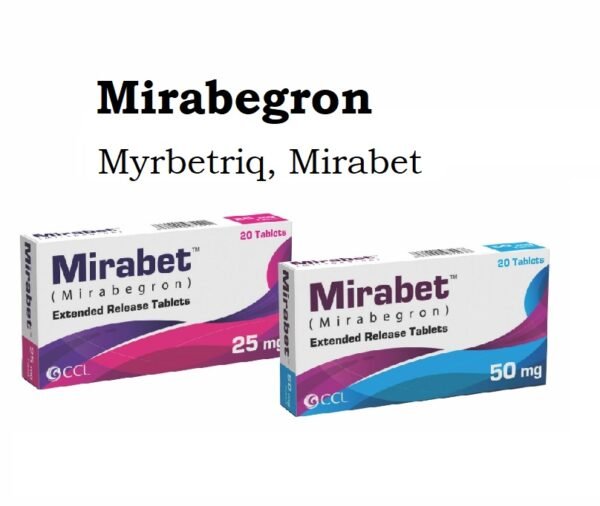
- Mrabet 25 mg and 50 mg - CCL Pharma
- Mibega 25 mg and 50 mg - Getz Pharma
.png)


