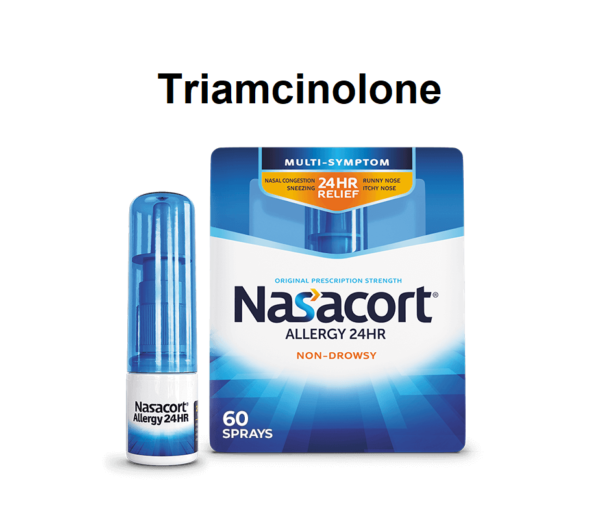
Triamcinolone Nasal Spray (Nasacort) is a medium potency glucocorticoid. It is used in the treatment of allergic and inflammatory diseases such as allergic rhinitis. On an mg to mg basis, 4 mg of triamcinolone is equivalent to 5 mg of prednisolone.
Triamcinolone (Nasacort) Uses:
- Allergic rhinitis (Rx products):
- Management of seasonal and perennial allergic rhinitis in adults and children 2 years and older
- Upper respiratory allergies (OTC products):
- Relief of hay fever and other upper respiratory allergies (e.g. nasal congestion, runny nose, sneezing, itchy nose) in adults and children of about 2 years and older
- Off Label Use of Triamcinolone in Adults:
- Acute bacterial rhinosinusitis as an adjunct to antibiotics (empiric treatment)
- Chronic rhinosinusitis
Triamcinolone Nasal Spray (Nasacort) Dose in Adults
Triamcinolone Nasal Spray (Nasacort) Dose in the treatment of Allergic rhinitis and upper respiratory symptoms:
- Intranasal: Two sprays (110 mcg) in each nostril once daily;
- Once symptoms controlled reduce to 1 spray (55 mcg) in each nostril once daily (maximum: 2 sprays [110 mcg] in each nostril once daily).
- Discontinue its therapy if adequate symptomatic relief is not observed within 3 weeks (1 week for OTC use).
Triamcinolone Nasal Spray (Nasacort) Dose in Childrens
Triamcinolone Nasal Spray (Nasacort) Dose in the treatment of seasonal and perennial allergic rhinitis:
If adequate control of symptoms has not occurred after 3 weeks of use (1 week if OTC use), discontinue the treatment and contact health care provider. Intranasal: 55 mcg/spray:
- Children 2 to <6 years:
- One spray per nostril once on a daily basis (Total daily dose is 110 mcg/day).
- The maximum daily dose: 1 spray per nostril/day (110 mcg/day)
- Children 6 to <12 years:
- Initial: One spray per nostril once daily (Total daily dose: 110 mcg/day);
- It may increase to 2 sprays per nostril once daily if the response is not adequate (Total daily dose 220 mcg/day);
- Once symptoms are controlled, reduce to 1 spray per nostril once daily (Total daily dose of 110 mcg/day).
- However, the maximum daily dose is: 2 sprays per nostril/day (220 mcg/day)
- Children ≥12 years and Adolescents:
- Initial: Two sprays per nostril once daily (Total daily dose: 220 mcg/day);
- once symptoms are controlled, reduce its dose to 1 spray per nostril once daily (total daily dose: 110 mcg/day).
- The maximum daily dose: 2 sprays per nostril/day (220 mcg/day)
Triamcinolone (Nasacort) Pregnancy Risk Category: C
- Limited information is available on the use of intra-asal triamcinolone during pregnancy.
- When used in the recommended dosages, intravenous corticosteroids (underpinning triamcinolone) may be acceptable to treat rhinitis.
- Triamcinolone can be continued by pregnant women who are well controlled. If treatment is initiated during pregnancy, an agent that has more data may be recommended.
Triamcinolone use during breastfeeding:
- It is not known if enough triamcinolone is absorbed after inhalation to make detectable amounts of breast milk.
- Human milk systemic corticosteroids exist.
Dose in Kidney disease:
No dosage adjustments are provided in the manufacturer’s labeling (has not been studied).
Dose in Liver disease:
No dosage adjustments are provided in the manufacturer’s labeling (has not been studied).
Side Effects of Triamcinolone Nasal Spray (Nasacort):
- Central nervous system:
- Headache
- Respiratory:
- Pharyngitis
Less Common Side Effects of Triamcinolone (Nasacort):
- Cardiovascular:
- Facial Edema
- Central Nervous System:
- Pain
- Voice Disorder
- Dermatologic:
- Skin Photosensitivity
- Skin Rash
- Burning Sensation Of The Nose
- Endocrine & Metabolic:
- Weight Gain
- Dysmenorrhea
- Gastrointestinal:
- Dysgeusia
- Dyspepsia
- Abdominal Pain
- Nausea
- Diarrhea
- Oral Candidiasis
- Toothache
- Vomiting
- Xerostomia
- Genitourinary:
- Cystitis
- Urinary Tract Infection
- Vulvovaginal Candidiasis
- Hypersensitivity:
- Hypersensitivity Reaction
- Infection:
- Infection
- Neuromuscular & Skeletal:
- Back Pain
- Bursitis
- Myalgia
- Tenosynovitis
- Ophthalmic:
- Conjunctivitis
- Otic:
- Otitis Media
- Respiratory:
- Flu-Like Symptoms
- Sinusitis
- Cough
- Epistaxis
- Bronchitis
- Chest Congestion
- Asthma
- Rhinitis
- Stinging Sensation Of The Nose
Contraindications to Triamcinolone (Nasacort):
- Hypersensitivity to triamcinolone and any component of the formulation
OTC labelling
- If you are using it for self-medication, don't give it to children under 2 years old.
- There is not much evidence of cross-reactivity between corticosteroids and allergenic corticosteroids.
- Cross-sensitivity is possible due to similarities in chemical structure or pharmacologic effects.
- Canadian labeling: Additional contraindications not in US labeling
- Active and quiescent tuberculosis or untreated fungal or bacterial infection.
Warnings and precautions
- Suppression of the adrenals:
- When used at excessive doses, it may cause hypercortisolism or suppression of the hypothalamic-pituitary-adrenal (HPA) axis, specifically in younger children or in patients receiving high doses for prolonged periods.
- An adrenal crisis may result from HPA axis suppression.
- It is important to withdraw and stop using a corticosteroid slowly and carefully.
- Patients who are being transferred from systemic to inhaled corticosteroids must be careful.
- This is because of possible adrenal insufficiency, withdrawal from steroids, and can also cause an increase in allergy symptoms.
- Delay in wound healing
- It should not be used on patients suffering from recent nasal septal injuries, nasal surgery, or trauma.
- Immunosuppression:
- Corticosteroids can increase the risk of secondary infections, mask acute infections (including fungal infections), prolong and exacerbate viral infections, and limit the effectiveness of vaccines. It is important to avoid exposure to chickenpox/measles.
- Local nasal effects:
- There may be nasal septal perforation, epistaxis, nasal ulceration, and localized Candida albicans infections in the nose and/or throat.
- Patients should be monitored for any adverse effects to their nasal passages.
- Infections
- Patients with ocular herpes, latent tuberculosis and/or TB reaction, as well as patients with untreated fungal or viral infections, should be careful to avoid using this product.
- Ocular disease:
- Patients with cataracts or glaucoma should be cautious.
- It has been linked to increased intraocular pressure, open angle glaucoma and cataracts.
- Routine eye exams are recommended for chronic users.
Triamcinolone (nasal): Drug Interaction
|
Ritodrine |
Corticosteroids may enhance the adverse/toxic effect of Ritodrine. |
|
Esketamine |
Corticosteroids (Nasal) may diminish the therapeutic effect of Esketamine. Management: Patients who require a nasal corticosteroid on an esketamine dosing day should administer the nasal corticosteroid at least 1 hour before esketamine. |
|
Desmopressin |
Corticosteroids (Nasal) may enhance the hyponatremic effect of Desmopressin. |
Monitoring parameters:
- Growth (adolescents and children);
- Signs/symptoms of HPA axis suppression/adrenal insufficiency;
- Ocular changes;
- Signs/symptoms of Candida infection (long-term therapy)
How to administer Triamcinolone Nasal Spray (Nasacort)?
- Shake well before using it.
- Gently blow nose to clear nostrils.
- Avoid spraying it into mouth or eyes and do not blow nose for 15 minutes after use.
- Prime prior to first use by shaking contents well and releasing 5 sprays into the air.
- If the product is not used for more than 2 weeks, reprime with 1 spray.
- Consider its use of a nasal vasoconstrictor for 2 to 3 days before initiating therapy in patients with excessive nasal mucous secretion or nasal mucosa edema.
Mechanism of action of Triamcinolone (Nasacort):
- This controls the rate of protein production, slows down the migration of polymorphonuclear lymphocytes and fibroblasts, reverses capillary permeability, and stabilizes lysosomal cells at the cellular level to control or prevent inflammation.
Absorption:
- Systemic absorption may occur following intranasal administration.
Half-life elimination:
- Biologic: 18-36 hours;
- Terminal (intranasal): 3.1 hours
Excretion:
- Urine (~40%);
- feces (~60%)
International Brand Names of Triamcinolone:
- GoodSense Nasal Allergy Spray
- Nasacort Allergy 24HR Children
- Nasacort Allergy 24HR
- Nasal Allergy 24 Hou
- APO-Triamcinolone AQ
- Nasacort AQ
- Actonace
- Cenolon
- Cortefin
- Nasacor
- Nasacort
- Nasacort Allergy
- Nasacort AQ
- Nasarin
- Nasonide
- Nosolone Aq
- Nosolone-aq
- Rinex
- T-Coat
- Tilon NS
- Trispray (BD
Triamcinolone Brand Names in Pakistan:
Triamcinolone Oint 0.1 % W/W |
|
|
Kenalog In Orabase |
Glaxosmithkline |
|
Lonacort 0.1% |
Zafa Pharmaceutical Laboratories (Pvt) Ltd. |
Triamcinolone Cream 1 mg/gm |
|
|
K-Kort |
Ophth-Pharma (Pvt) Ltd. |
Triamcinolone Nasal Spray 15 mg/actu |
|
|
Hinase |
Hilton Pharma (Pvt) Limited |
Triamcinolone Nasal Spray 55 mcg/actu |
|
|
Nasacort-Aq |
Sanofi Aventis (Pakistan) Ltd. |
|
Nasarin |
Schazoo Zaka |
.png)


