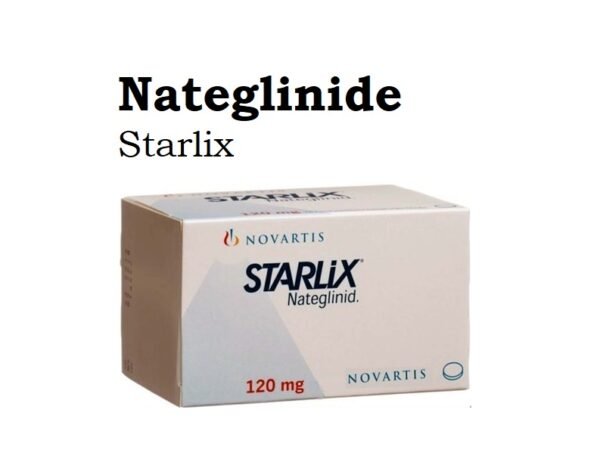
Nateglinide is a short-acting oral anti-diabetic drug that belongs to the meglitinide class. It acts on the beta cells to stimulate insulin release. Another drug in the same class is repaglinide.
Nateglinide Uses:
-
Diabetes mellitus, type 2:
- Treatment of adults with type 2 diabetes mellitus as an adjunct to diet and exercise to improve and optimize glycemic control
Nateglinide dose in Adults
Nateglinide dose in the treatment of Type 2 Diabetes mellitus:
- Initial and maintenance dose:
- 120 mg 3 times per day before meals.
- Patients close to targeted HbA1C goal at starting of therapy may be started at 60 mg 3 times daily
Nateglinide dose in Childrens
Not recommended for use in children.
Pregnancy Risk Factor C
- Limited data are available on the effects of nateglinide in pregnancy outcomes.
- Poorly managed diabetes can lead to adverse maternal and fetal outcomes. This could include preeclampsia and preterm deliveries, preterm birth, complications and major birth defects.
- Preventing adverse outcomes by keeping maternal blood glucose and HbA1C as close as possible to the target levels, both before conception and during pregnancy. However, it is important to avoid significant low blood sugar.
- For the treatment of diabetes mellitus during pregnancy, agents other than nateglinide should be considered.
Use of nateglinide during breastfeeding
- It is unknown if breast milk contains nateglinide.
- The manufacturer suggests that the mother decide whether to stop breastfeeding or discontinue using the drug because of the possibility of hypoglycemia. This decision should be taken in consideration of the mother's importance.
Nateglinide Dose in Kidney Disease:
-
Mild to moderate impairment
- There is no need to adjust the dosage.
-
Severe impairment
- Start conservatively with 60 mg three times daily, along with meals, if your eGFR is 30mL/minute/1.73m2.
- Take care (especially if your eGFR is 15mL/minute/1.73m2) as there may be an accumulation of metabolites with hypoglycemic properties.
Nateglinide dose in Liver disease:
-
Mild impairment (Child Puugh class A)
- There is no need to adjust the dosage.
-
Moderate to severe impairment (Child Puugh class B orC):
- The manufacturer's labeling does not contain any dosage adjustments (hasn't been studied).
- Use with caution because of the possibility for hypoglycemia.
Common Side Effects of Nateglinide:
-
Respiratory:
- Upper respiratory infection
Less Common Side Effects of Nateglinide:
-
Central Nervous System:
- Dizziness
-
Endocrine & Metabolic:
- Hypoglycemia
- Increased Uric Acid
- Weight Gain
-
Neuromuscular & Skeletal:
- Arthropathy
-
Respiratory:
- Flu-Like Symptoms
-
Miscellaneous:
- Accidental Injury
Contraindication to Nateglinide Include:
- Hypersensitivity to nateglinide and any component of the formulation
Warnings and precautions
-
Hypoglycemia
- Hypoglycemia may occur
- Risk factors include poor nutrition, changes in physical activity, concomitant use of anti-antidiabetic therapies, ethanol, renal impairment, and liver impairment.
- To avoid hypoglycemic episodes, it is important to choose the right patient, dose, and educate the patient.
-
Pituitary or adrenal impairment
- Patients with pituitary and adrenal impairment should be cautious; they may be more vulnerable to glucose-lowering effects.
-
Bariatric surgery
-
Absorption altered:
- Gastric bypass and Sleeve Gastrectomy can cause changes in absorption.
-
Hypoglycemia:
- Hypoglycemia may increase after gastric bypass, sleeve gastrectomy and gastric band (Mechanick 2013, 2013).
- These procedures may partially or fully restore insulin secretion and sensitivity (gastric bypass is the most effective, followed closely by the sleeve and then finally the band).
- In the days following gastric bypass or sleeve-gastrectomy, first-phase insulin secretion as well as hepatic insulin sensitive were significantly increased.
- These procedures may have a longer-lasting effect on peripheral insulin sensitivity. This could happen in the 3 to 12 months following surgery.
- It is recommended to select antidiabetic drugs that are not hypoglycemic.
-
-
Hepatic impairment
- Patients with severe hepatic impairment (moderate-to-severe) should be cautious.
-
Renal impairment
- Patients with severe renal impairment should be cautious; prolonged hypoglycemia may occur due to the accumulation a metabolite that has hypoglycemic activities (Inoue 2003).
-
Stress-related disorders:
- If the patient is experiencing stress, such as fever, trauma, infection or surgery, it may be necessary for them to stop taking nateglinide.
Nateglinide: Drug Interaction
Note: Drug Interaction Categories:
- Risk Factor C: Monitor When Using Combination
- Risk Factor D: Consider Treatment Modification
- Risk Factor X: Avoid Concomitant Use
Risk Factor C (Monitor therapy) |
|
| Alpelisib | May decrease the serum concentration of CYP2C9 Substrates (High risk with Inducers). |
| Alpha-Lipoic Acid | May enhance the hypoglycemic effect of Antidiabetic Agents. |
| Androgens | May enhance the hypoglycemic effect of Blood Glucose Lowering Agents. Exceptions: Danazol. |
| Antidiabetic Agents | May enhance the hypoglycemic effect of Hypoglycemia-Associated Agents. |
| CYP2C9 Inhibitors (Moderate) | May increase the serum concentration of Nateglinide. |
| Direct Acting Antiviral Agents (HCV) | May enhance the hypoglycemic effect of Antidiabetic Agents. |
| Eltrombopag | May increase the serum concentration of OATP1B1/1B3 (SLCO1B1/1B3) Substrates. |
| Gemfibrozil | May increase the serum concentration of OATP1B1/1B3 (SLCO1B1/1B3) Substrates. See separate drug interaction monographs for agents listed as exceptions. |
| Guanethidine | May enhance the hypoglycemic effect of Antidiabetic Agents. |
| Herbs (Hypoglycemic Properties) | May enhance the hypoglycemic effect of HypoglycemiaAssociated Agents. |
| Hyperglycemia-Associated Agents | May diminish the therapeutic effect of Antidiabetic Agents. |
| Hypoglycemia-Associated Agents | May enhance the hypoglycemic effect of other HypoglycemiaAssociated Agents. |
| Hypoglycemia-Associated Agents | Antidiabetic Agents may enhance the hypoglycemic effect of Hypoglycemia-Associated Agents. |
| Lumacaftor | May decrease the serum concentration of CYP2C9 Substrates (High Risk with Inhibitors or Inducers). Lumacaftor may increase the serum concentration of CYP2C9 Substrates (High Risk with Inhibitors or Inducers). |
| Maitake | May enhance the hypoglycemic effect of Blood Glucose Lowering Agents. |
| Monoamine Oxidase Inhibitors | May enhance the hypoglycemic effect of Blood Glucose Lowering Agents. |
| Pegvisomant | May enhance the hypoglycemic effect of Blood Glucose Lowering Agents. |
| Prothionamide | May enhance the hypoglycemic effect of Blood Glucose Lowering Agents. |
| Quinolones | May enhance the hypoglycemic effect of Blood Glucose Lowering Agents. Quinolones may diminish the therapeutic effect of Blood Glucose Lowering Agents. Specifically, if an agent is being used to treat diabetes, loss of blood sugar control may occur with quinolone use. |
| Rifapentine | May decrease the serum concentration of CYP2C9 Substrates (High risk with Inducers). |
| Ritodrine | May diminish the therapeutic effect of Antidiabetic Agents. |
| Salicylates | May enhance the hypoglycemic effect of Blood Glucose Lowering Agents. |
| Selective Serotonin Reuptake Inhibitors | May enhance the hypoglycemic effect of Blood Glucose Lowering Agents. |
| Teriflunomide | May increase the serum concentration of OATP1B1/1B3 (SLCO1B1/1B3) Substrates. |
| Thiazide and Thiazide-Like Diuretics | May diminish the therapeutic effect of Antidiabetic Agents. |
Risk Factor D (Consider therapy modification) |
|
| Dabrafenib | May decrease the serum concentration of CYP2C9 Substrates (High risk with Inducers). Management: Seek alternatives to the CYP2C9 substrate when possible. If concomitant therapy cannot be avoided, monitor clinical effects of the substrate closely (particularly therapeutic effects). |
| Enzalutamide | May decrease the serum concentration of CYP2C9 Substrates (High risk with Inducers). Management: Concurrent use of enzalutamide with CYP2C9 substrates that have a narrow therapeutic index should be avoided. Use of enzalutamide and any other CYP2C9 substrate should be performed with caution and close monitoring. |
| MiFEPRIStone | May increase the serum concentration of CYP2C9 Substrates (High risk with Inhibitors). Management: Use CYP2C9 substrates at the lowest recommended dose, and monitor closely for adverse effects, during and in the 2 weeks following mifepristone treatment. |
| Tolvaptan | May increase the serum concentration of OATP1B1/1B3 (SLCO1B1/1B3) Substrates. |
Monitoring parameters:
- Weighing
- Lipid profile
- Fasting blood glucose (periodically or during dosage titration)
- HbA1C: At least twice annually in patients with stable glycemic control who are meeting their treatment goals. Quarterly in patients not meeting treatment objectives or with therapy changes.
How to administer Nateglinide?
- Oral: Take 1-30 minutes before you eat.
- To avoid hypoglycemia, the scheduled dose should not have to be administered if a meal has been missed.
Mechanism of action of Nateglinide:
- It is a nonsulfonylurea hypoglycemic drug that blocks ATP-dependent potassium channel, depolarizes the membrane and facilitates calcium entry through calcium channels.
- Insulin release from pancreatic beta cells is stimulated by intracellular calcium.
- Nateglinide-induced Insulin Release is Glyce-dependent
The onset of action:
- Insulin secretion: ~20 minutes
Peak effect:
- 1 hour
Duration:
- 4 hours
Absorption:
- Rapid
Protein binding:
- 98%, primarily to albumin
Metabolism:
- Hepatic via hydroxylation followed by glucuronide conjugation via CYP2C9 (70%) and CYP3A4 (30%) to metabolites, including M1 (a major metabolite)
Bioavailability:
- 73%
Half-life elimination:
- 1.5 hours
Time to peak:
- ≤1 hour
Excretion:
- Urine (83%, 16% as unchanged drug);
- feces (10%)
International Brands of Nateglinide:
- Starlix
- Antangping
- Diabex
- Fastic
- Glinade
- Glinate
- Glunat
- Glytan
- Luoyu
- Nopik
- Novirep
- Starlidine
Nateglinide Brand Names in Pakistan:
Nateglinide 60 mg Tablets |
|
| Glytan | Wilshire Laboratories (Pvt) Ltd. |
Nateglinide 120 mg Tablets |
|
| Glytan | Wilshire Laboratories (Pvt) Ltd. |
.png)


