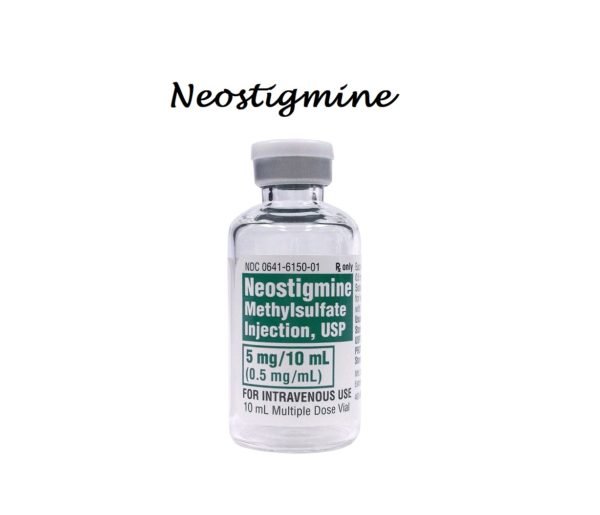
Neostigmine is a carbamate inhibitor of the enzyme acetylcholinesterase, which hydrolyzes the neurotransmitter acetylcholine at synapses in the nervous system and the neuromuscular junction to terminate cholinergic signaling.
Neostigmine Uses:
-
US labeling:
-
Reversal of nondepolarizing muscle relaxants:
- It is effective in reversing the nondepolarizing neuromuscular blocking agents relaxing effect after surgery.
-
-
Canadian labeling:
-
Myasthenia gravis:
- It is helpful in controlling symptoms of myasthenia gravis.
- Limitations of use: Other agents may be preferred for the symptomatic treatment or acute exacerbations.
-
Postoperative bladder distention, Urinary retention:
- It is indicated for the prevention and treatment of bladder distention/urinary retention usually after surgery after ruling out mechanical obstruction.
-
Reversal of nondepolarizing muscle relaxants:
- Reversal of effects of nondepolarizing neuromuscular blocking agents after surgery.
-
-
Off Label Use of Neostigmine in Adults:
- Acute colonic pseudo-obstruction (Ogilvie’s syndrome)
Neostigmine dose in adults:
Neostigmine for the treatment of Myasthenia gravis:
Diagnosis:
Canadian labeling: Note: Pretreatment is advised with atropine, and atropine should be used in case of a cholinergic reaction.
- 0.022 mg/kg intramuscular as a single dose.
- If the test is inconclusive, retesting can be done on a different day with a single dose of 0.031 mg/kg.
Treatment:
Canadian labeling:
- An initial dose of 15 mg per oral thrice daily.
- Usual dose: 150 mg in divided doses, administered over a 24-hour period
- Larger doses provided at times of extreme fatigue.
- Dosage range: 15 to 375 mg daily in divided doses.
- Subcutaneous, Intramuscular or Intravenous dose of 0.5 to 2.5 mg may be administered depending on individual patient response.
Neostigmine dose for the treatment of Reversal of nondepolarizing neuromuscular blockade after surgery:
- US labeling:
- Intravenous Bloxiverz:
Note: The anticholinergic agent such as atropine should be given before administering neostigmine if the patient has bradycardia. Before starting neostigmine therapy and need for additional doses should be evaluated by peripheral nerve stimulation delivering train-of-four (TOF) stimulus showing a twitch response to the first stimulus in the TOF of at least 10% of baseline.
- Usual dose: 0.03 to 0.07 mg/kg generally achieves a train of four twitch ratio of 90% within 10 to 20 minutes of administration
- maximum total dose: 0.07 mg/kg or 5 mg (whichever is less)
-
Dose selection guide:
- Agents with short half-life such as rocuronium need a dose of 0.03 mg/kg while those having longer half-lives (eg, vecuronium, pancuronium) are treated with 0.07mg/kg.
-
Canadian labeling:
- 0.5 to 2.5 mg intravenous repeated as required. Only in exceptional cases should the total dose exceed 5 mg.
- Note: Premedicate with atropine 0.6 to 1.2 mg intravenously in a separate syringe.
Neostigmine dose for the treatment of Postoperative bladder distention/ urinary retention:
-
Prevention:
- 25 mg intramuscular or subcutaneous immediately after the operation, repeat every 4 to 6 hours for 2 to 3 days.
-
Treatment:
- 5 to 1 mg subcutaneous or IM, the patient should be catheterized if urine fails to occur in 60 minutes.
- After the bladder has emptied or the patient has voided, doses may be repeated every 3 hours for 5 doses.
Neostigmine dose for the treatment of acute colonic pseudo-obstruction (Ogilvie syndrome):
- 2 mg intravenous over 3 to 5 minutes,
Note: The risk of bradycardia can be reduced by the administration over one hour however, efficacy may be reduced.
Neostigmine dose in children:
Neostigmine Dose for the Treatment of Myasthenia gravis:
For the Diagnosis of Myasthenia Gravis:
Note: Pretreatment with atropine and intravenous fluids is necessary.
-
Children less than 2 years of age:
- 0.04 mg/kg intramuscular as a single dose, may be repeated once in 4 hours if the desired response is not achieved.
- The typical dose is 0.5 to 1.5 mg.
Neostigmine for the treatment of myasthenia gravis:
Note: Dosage requirements are variable.
-
Children and Adolescents:
- 0.3 to 2 mg/kg per oral per day in divided doses.
- Intramuscular, intravenous or subcutaneous dose of 0.01 to 0.04 mg/kg every 2 to 6 hours.
Neostigmine for the reversal of nondepolarizing neuromuscular blockade after surgery:
-
Intravenous neostigmine:
-
Manufacturer labeling:
- similar dosing as for adults.
-
Alternate dosing: Generic injectable products.
- Infants and Children: 025 to 0.1 mg/kg/dose
-
Pregnancy Risk Factor C
- Studies on animal reproduction did not show any adverse outcomes.
- If given intravenously in the first trimester of pregnancy, anticholinesterases may cause uterine irritation and prematurity.
- Negative effects depending on the dose/can occur if Neostigmine is used alongside labor pain relief. Consider using other agents during pregnancy.
Use of neostigmine during lactation
- Breastfeeding women should exercise caution as the secretion of Neostigmine in breastmilk is not known.
- Transient myasthenia gravis can cause feeding difficulties in newborns.
Neostigmine Dose adjustment in renal disease:
- These adjustments were recommended by Aronoff 2007,
-
Creatine clearance >50mL/minute
- There is no need to adjust the dosage
-
Creatinine clearance 10-50 mL/minute
- Take half the normal dose.
-
Creatinine clearance: 10mL/minute
- 25 percent of the usual dose should be taken.
-
Hemodialysis
- There is no need to adjust the dosage
-
Peritoneal dialysis
- There is no need to adjust the dosage
-
Continuous renal replacement therapy (CRRT),:
- Half the normal dose should be taken
-
Dose adjustment in liver disease:
There are no dosage adjustments provided in manufacturer's labeling.
Side effects of neostigmine:
-
Cardiovascular:
- Atrioventricular Block
- Cardiac Arrhythmia (Especially Bradycardia)
- ECG Changes (Nonspecific)
- Flushing
- Hypotension
- Nodal Arrhythmia
- Syncope
- Tachycardia
- Thrombophlebitis
-
Central Nervous System:
- Dizziness
- Drowsiness
- Dysarthria
- Headache
- Loss Of Consciousness
- Seizure
- Voice Disorder
-
Dermatologic:
- Diaphoresis
- Skin Rash
- Urticaria
-
Gastrointestinal:
- Diarrhea
- Dysphagia
- Flatulence
- Increased Peristalsis
- Nausea
- Salivation
- Stomach Cramps
- Vomiting
-
Genitourinary:
- Urinary Urgency
-
Hypersensitivity:
- Anaphylaxis
- Hypersensitivity Reaction
-
Neuromuscular & Skeletal:
- Arthralgia
- Fasciculations
- Laryngospasm
- Muscle Cramps
- Muscle Spasm
- Weakness
-
Ophthalmic:
- Lacrimation
- Miosis
-
Respiratory:
- Bronchospasm
- Dyspnea
- Exacerbation Of Asthma
- Increased Bronchial Secretions
- Respiratory Depression
- Respiratory Paralysis
Contraindication to Neostigmine:
These include:
- Hypersensitivity to neostigmine and any component of this formulation
- Peritonitis
- Mechanical obstruction of the urinary or intestinal tract
- Hypersensitivity to bromides (tablets only).
- Although cross-reactivity between cholinesterase inhibitors and allergens has been documented in a limited amount of cases, cross-sensitivity can still be suspected due to similar structures.
Warnings and precautions
-
Cardiovascular effects
- Patients with certain cardiovascular conditions, such as heart disease, cardiac arrhythmias and recent acute coronary syndrome, may be at greater risk for bradycardia, hypotension and dysrhythmia.
-
Cholinergic crisis
- An overdose can cause cholinergic crises, which can be fatal and can result in extreme muscle weakness or respiratory paralysis.
-
Hypersensitivity reactions
- These include anaphylaxis and angioedema, fever, rash, anaphylaxis and urticaria. These conditions can be managed with epinephrine and atropine.
-
Neuromuscular effects
- If intravenous neostigmine is administered for the reverse of nondepolarizing neuromuscular blockers agents, it can cause neuromuscular dysfunction.
-
Asthma
- Patients with asthma should be cautious.
-
Cardiovascular disease
- Patients with bradycardia or cardiac arrhythmias, recent acute coronary syndrome, and coronary artery disease should be supervised.
-
Hyperthyroidism
- Patients with hyperthyroidism should be cautious.
-
Megacolon/ GI dysfunction
- Megacolon and decreased gastrointestinal motility should be avoided by taking oral doses (larger amounts).
-
Myasthenia gravis
- When testing for myasthenia Gravis and adjusting the dosage, it is important to have CPR.
-
Peptic ulcer disease:
- Patients with peptic ulcer disease should be cautious.
-
Seizure disorder
- Patients with epilepsy should be cautious.
-
Vagotonia
- Patients with vagotonia should be treated with caution.
Neostigmine: Drug Interaction
|
Risk Factor C (Monitor therapy) |
|
|
Amifampridine |
Acetylcholinesterase Inhibitors may enhance the therapeutic effect of Amifampridine. Amifampridine side effects may also be increased. Amifampridine may enhance the therapeutic effect of Acetylcholinesterase Inhibitors. Acetylcholinesterase inhibitor side effects may also be increased. |
|
Anticholinergic Agents |
Acetylcholinesterase Inhibitors may diminish the therapeutic effect of Anticholinergic Agents. Anticholinergic Agents may diminish the therapeutic effect of Acetylcholinesterase Inhibitors. |
|
Benoxinate |
Acetylcholinesterase Inhibitors may enhance the therapeutic effect of Benoxinate. Specifically, the effects of benoxinate may be prolonged. |
|
Beta-Blockers |
Acetylcholinesterase Inhibitors may enhance the bradycardic effect of BetaBlockers. Exceptions: Levobunolol; Metipranolol. |
|
Cholinergic Agonists |
Acetylcholinesterase Inhibitors may enhance the adverse/toxic effect of Cholinergic Agonists. |
|
Corticosteroids (Systemic) |
May enhance the adverse/toxic effect of Acetylcholinesterase Inhibitors. Increased muscular weakness may occur. |
|
Dipyridamole |
May diminish the therapeutic effect of Acetylcholinesterase Inhibitors. |
|
Neuromuscular-Blocking Agents (Nondepolarizing) |
Acetylcholinesterase Inhibitors may diminish the neuromuscular-blocking effect of Neuromuscular-Blocking Agents (Nondepolarizing). |
|
Risk Factor D (Consider therapy modification) |
|
|
Succinylcholine |
Acetylcholinesterase Inhibitors may increase the serum concentration of Succinylcholine. Management: Consider alternatives to this combination due to a risk of prolonged neuromuscular blockade. |
Monitoring parameters:
These include:
- Pulse
- BP
- ECG
- Acute colonic pseudoobstruction (off label use)
- After administration, patient should remain supine and be continuously monitored for ECG. This will include regular clinical monitoring of the patient for 30 minutes.
How to administer Neostigmine?
Tablets (neostigmine bromide),: Prostigmin [Canadian Product]:
- Combining the medication with food or milk can reduce muscarinic effect. Extreme fatigue may require a higher dose.
Injectable (neostigmine-methylsulfate).
-
Neostigmine Omega and Prostigmin [Canadian Products]:
- You can give it subcutaneously, intramuscularly or intravenous.
-
Bloxiverz
- Give a slow IV injection for at least one minute.
-
Acute colonic pseudoobstruction (off label use)
- Give intravenous medication for 3 to 5 minutes.
Mechanism of action of Neostigmine:
- It inhibits acetylcholine degrading by acetylcholinesterase, which allows for impulse transmission across the myoneural junction.
- It may have a direct cholinomimetic impact on skeletal muscle, as well as on the autonomic ganglion cells of the central nervous system and on neurons.
The onset of action: Peristaltic activity:
- Oral: 2 to 4 hours
- Parenteral: 10 to 30 minutes
Duration:
- Intramuscular 2.5 to 4 hours
Absorption:
- Oral: Poor (1% to 2%)
Protein binding:
- 15% to 25% to albumin
Metabolism:
- Occurs in liver
Half-life elimination:
-
Intramuscular:
- Adults: 51 to 90 minutes
-
Intravenous: Range: 24 to 113 minutes
- Infants 2 to 10 months:
- Mean: 39 ± 5 minutes
- Children 1 to 6 years:
- Mean: 48 ± 16 minutes
- Adults 29 to 48 years:
- 67 ± 8 minutes
- Anephric patients:
- 181 ± 54 minutes
- Renal transplant patients:
- 104.7 ± 64 minutes
- Oral: Adults:
- 42 to 60 minutes
- Infants 2 to 10 months:
Time to peak serum concentration:
- Oral: 1 to 2 hours.
Excretion:
- Urine (50% as unchanged drug; remainder as metabolites)
Neostigmine Brand Names (International):
- Bloxiverz
- Neostigmine Omega
- PMS-Neostigmine Methylsulfate
- Prostigmin
- Amostigmine
- Bloxiverz
- Episitgmin
- Epistigmin
- Fadastigmina
- Flextig
- Intrastigmina
- Metastigmin[inj.]
- Miostin
- Myostigmin
- Neostigmin
- Neotalis
- Normastigmin
- Polstigminum
- Prostig
- Prostigmin
- Prostigmin INJ
- Prostigmina
- Prostigmine
- Prostigmin[inj.]
- Setisin
- Stigmin
- Stigmosan
- Stignal
- Stigvita
- Syntostigmin
- Tilstigmin
- Vagostin
- Versia
Neostigmine Brand Names in Pakistan:
Neostigmine Injection 0.5 mg/ml |
|
| Stigen | Fassgen Pharmaceuticals |
Neostigmine Injection 0.5 mg/ml |
|
| Colinot | Mass Pharma (Private) Limited |
| Instigmine | Indus Pharma (Pvt) Ltd. |
| Neo-Choline | Brookes Pharmaceutical Laboratories (Pak.) Ltd. |
| Neostigmine | Haji Medicine Co. |
| Neostigmine | Siza International (Pvt) Ltd. |
| Nestigin | Elite Pharma |
| Netigmine | Neutro Pharma (Pvt) Ltd. |
| Stig | Global Pharmaceuticals |
| Stigma | Akhai Pharmaceuticals. |
Neostigmine Injection 2.5 mg/ml |
|
| Instigmine | Indus Pharma (Pvt) Ltd. |
| Neostig | Siza International (Pvt) Ltd. |
| Neostigmine | Siza International (Pvt) Ltd. |
| Neostigmine | Haji Medicine Co. |
| Neostigmine | Goodman International, |
| Stig | Global Pharmaceuticals |
| Stigma | Akhai Pharmaceuticals. |
.png)


