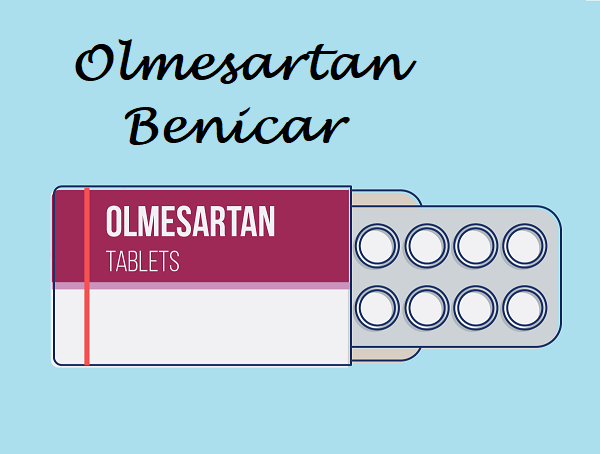
Olmesartan medoxomil is a selective and competitive reversible Angiotensin receptor blocker. It inhibits angiotensin receptors and has little effect on the angiotensin-converting enzyme. It is used to treat the following conditions:
-
For the management of hypertension as monotherapy or in combination with other medications especially in patients with high-risk atherosclerotic cardiovascular disease.
-
Off Label Uses of Olmesartan include:
-
For the secondary prevention of cardiovascular events in patients with acute coronary syndrome.
-
Patients with stable coronary artery Disease
-
Olmesartan Dose in Adults
Dose in the treatment of Hypertension in adults:
- 20 mg orally once a day.
- The dose should be titrated up to 40 mg once a day after 2 weeks.
Olmesartan Dose in Childrens
Dose for the treatment of Hypertension:
- Children 6 - 16 years:
-
20 kg to less than 35 kg:
- 10 mg orally once a day
- If the initial response is inadequate after 2 weeks, the dose may be increased to a maximum dose of 20 mg once a day.
-
More than 35 kg:
- 20 mg orally once a day.
- If the initial response is inadequate after 2 weeks, the dose may be increased to a maximum dose of 40 mg once a day.
-
Pregnancy Risk Factor D/ X
- [US Boxed Warning]
- Olmesartan can, along with other drugs that act on the RAAS, cause injury or death for the developing fetus.
- Once pregnancy is confirmed, it should be stopped immediately.
- Olmesartan crosses a placental barrier and is used in pregnancy. It can cause oligohydramnios, which can lead to fetal lung hypoplasia or skeletal malformations.
- Additionally, oligohydramnios might not be present until irreversible fetal injuries have occurred.
- It can also lead to hypotension, anuria and skull hypoplasia in infants and neonates.
- Hypertensive patients who are pregnant should avoid ARBs and ACE-Inhibitors.
- Alternative therapies should be considered if necessary.
Olmesartan use during breastfeeding:
- Breastmilk does not contain candesartan.
- Manufacturers recommend that you stop using the drug, or breastfeed, after weighing the benefits and risks
Olmesartan dose in patients with Kidney disease:
-
CrCl of more than 40 mL/minute:
- Adjustment in the dose is not necessary.
-
CrCl of less than 40 mL/minute:
- Adjustment in the initial dose is not necessary.
- AUC is increased by three times in patients with a CrCl of less than 20 mL/minute.
- A maximum dose of 20 mg/day has been recommended for these patients
Olmesartan Dose in Liver Disease:
-
Mild hepatic impairment:
- Adjustment in the dose is not necessary.
-
Moderate to severe hepatic impairment:
- Initial dosage adjustment is not necessary.
- In moderate hepatic impairment, the total drug exposure is increased by about 60%.
Common Side Effects of Olmesartan Include:
-
Central nervous system:
- Dizziness
- Headache
-
Endocrine & metabolic:
- Hyperglycemia
- Hypertriglyceridemia
-
Gastrointestinal:
- Diarrhea
-
Genitourinary:
- Hematuria
-
Neuromuscular & skeletal:
- Back pain
- Increased Creatine Phosphokinase
-
Respiratory:
- Bronchitis
- Flu-Like Symptoms
- Pharyngitis
- Rhinitis
- Sinusitis
Rare side effects of olmesartan:
-
Hematologic & oncologic:
- Decreased hematocrit
- Decreased hemoglobin
Contraindication to Olmesartan medoxomil Include:
- Severe allergic reactions, whether to olmesartan and any other component of the formulation
- Concomitant use of direct renin inhibitors - Aliskiren
- Pregnancy
- Breastfeeding
Warnings and Precautions
- Angioedema
- Angioedema can occur at any stage of treatment.
- Patients who have angioedema that is associated with ACE inhibitors, idiopathic or hereditary may be at greater risk.
- If patients experience swelling in the larynx, glottis or face, it is important to monitor them.
- The drug should be stopped immediately and not restarted. Aggressive management of the airway and Intramuscular epinephrine should be part of the resuscitation.
- Gastrointestinal effects:
- Olmesartan-treated patients may experience severe, persistent diarrhea and significant weight loss.
- It is possible for symptoms to develop over several years. Intestinal biopsy may be necessary in order to detect villous atrophy.
- Patients should be referred to antihypertensive medication alternatives once all other causes are ruled out.
- There has been an improvement in symptoms and biopsies after stopping the drug.
- Hyperkalemia:
- Hyperkalemia is a risk for the following:
- Patients with impaired renal function
- Diabetes mellitus
- Use potassium-sparing diuretics in conjunction
- Patients taking potassium supplements or potassium-containing sodium.
- Hyperkalemia is a risk for the following:
- Hypotension
- Hypotension is a risk factor for patients who are salt- and volume-depleted (e.g. Patients taking high-dose diuretics.
- The patient must be well hydrated before initiating treatment.
- Renal function deterioration:
- Patients suffering from low renal blood flow (e.g. Acute renal impairment may occur in patients with heart disease and renal artery narrowing.
- If there is a marked decline in renal function, therapy should be stopped.
- Mitral and aortic stenosis:
- Patients with significant mitral or aortic valve stenosis or aortic stenosis need to be cautious about taking the drug.
- Ascites:
- Patients with cirrhosis should not be given olmesartan.
- Rapid deterioration of renal function can occur after treatment.
- Renal artery stenosis
- Patients with bilateral renal arterial stenosis should not be used.
- Patients with unilateral renal arterial stenosis may need to be cautious.
Monitoring Parameters:
- Blood pressure
- Serum electrolytes
- BUN and serum creatinine
- Urinalysis
The dose should be adjusted to achieve the target blood pressure of:
- Hypertensive patients with known heart disease, or those at greater risk for ASCVD in the next 10 years will have blood pressures of less than 130/80 mmHg
- In hypertensive patients, a lower than 130/80mmHg is possible without ASCVD risk markers.
Blood Pressure Targets in Diabetes patients (ADA 2018 recommendations):
- Patients with co-morbid hypertension and diabetes, and patients who are less than 65 years old, have less than 140/90
- Patients less than 65 years old with diabetes or at high risk for cardiovascular disease have a lower rate of 130/80.
- Patients over 65 years old with Diabetes have a lower blood pressure of less than 140/90 mmHg.
- Patients over 65 years old with Diabetes or poor health have a lower reading of 150/90 mmHg.
How to take Olmesartan?
- It may be administered orally with or without food.
Mechanism of action of Olmesartan:
- Olmesartan is an inhibitor of the selective and competitive nonpeptide Angiotensin II receptor. It blocks the vasoconstrictor and aldosterone-secreting effects of angiotensin II.
- It reacts reversibly with many tissues' Angiotensin I and Angiotensin II receptors.
- Its affinity for angiotensin I receptors is 12,500x greater than that of angiotensin 2.
- Angiotensin II receptor inhibition causes a greater inhibition of the RAAS than the ACE inhibitors.
- They do not affect the bradykinin systems and are therefore less likely to cause angioedema or cough.
- Olmesartan can increase the rate of urinary flow. It can cause natriuresis and kaliuresis.
- It also increases the excretion of calcium, magnesium, uric acids, calcium, as well as phosphate.
It doesn't cross the blood-brain boundary and is 99 percent safe protein-bound.It is then hydrolyzed in your gastrointestinal tract to make the active compound. It has been abioavailability26% with a 13-hour half-life. When plasma concentration reaches its peakIt takes between 1 and 2 hours. 50% of the drug isexcretedIn the feces, as an unchanged drug, while 35-45% isexcretedIn the urine.
International Brands of Olmesartan:
- Abetis
- Almetec
- Alteis
- Alzor
- Angiosartan
- Ao Tan
- Arb-S
- Belsar
- Benetor
- Benicar
- Cardioplus
- Cresart
- Dolezine
- Erastapex
- Esatec
- Eukene
- Ixia
- Kaportan
- Lezberg
- Macolme
- Mesar
- Normesar
- Olartan
- Oldesar
- Olesta
- Olimestra
- Olme
- Olmec
- Olmecor
- Olmepas
- Olmes
- Olmesan
- Olmesta
- Olmetec
- Olmetel
- Olmezar
- Olsart
- Omecor
- Openvas
- Orion
- Osaver
- Presulock
- Tenzar
- Vivactra
- Votum
Olmesartan Brands in Pakistan:
|
Olmesartan Medoxomil [Tabs 5 Mg] |
|
| Bensar | Pharmevo (Pvt) Ltd. |
| Negatin | Wilsons Pharmaceuticals |
| Oscord | Hilton Pharma (Pvt) Limited |
|
Olmesartan Medoxomil [Tabs 10 Mg] |
|
| Malisartan | Alied Medical |
| Omsana | Hilton Pharma (Pvt) Limited |
| Orion | Ferozsons Laboratoies Ltd. |
| Oscord | Hilton Pharma (Pvt) Limited |
|
Olmesartan Medoxomil [Tabs 20 Mg] |
|
| Baritec | Barrett Hodgson Pakistan (Pvt) Ltd. |
| Bensar | Pharmevo (Pvt) Ltd. |
| Malisartan | Alied Medical |
| Negatin | Wilsons Pharmaceuticals |
| Olesta | Searle Pakistan (Pvt.) Ltd. |
| Olmicar | Rasco Pharma |
| Olmipress | Remington Pharmaceutical Industries (Pvt) Ltd. |
| Omsana | Hilton Pharma (Pvt) Limited |
| Orion | Ferozsons Laboratoies Ltd. |
| Oscord | Hilton Pharma (Pvt) Limited |
|
Olmesartan Medoxomil [Tabs 40 Mg] |
|
| Baritec | Barrett Hodgson Pakistan (Pvt) Ltd. |
| Bensar | Pharmevo (Pvt) Ltd. |
| Bensar | Pharmevo (Pvt) Ltd. |
| Malisartan | Allied Medical |
| Negatin | Wilsons Pharmaceuticals |
| Negatin | Wilsons Pharmaceuticals |
| Olesta | Searle Pakistan (Pvt.) Ltd. |
| Olmicar | Rasco Pharma |
| Olmipress | Remington Pharmaceutical Industries (Pvt) Ltd. |
| Omsana | Hilton Pharma (Pvt) Limited |
| Orion | Ferozsons Laboratoies Ltd. |
| Oscord | Hilton Pharma (Pvt) Limited |
.png)