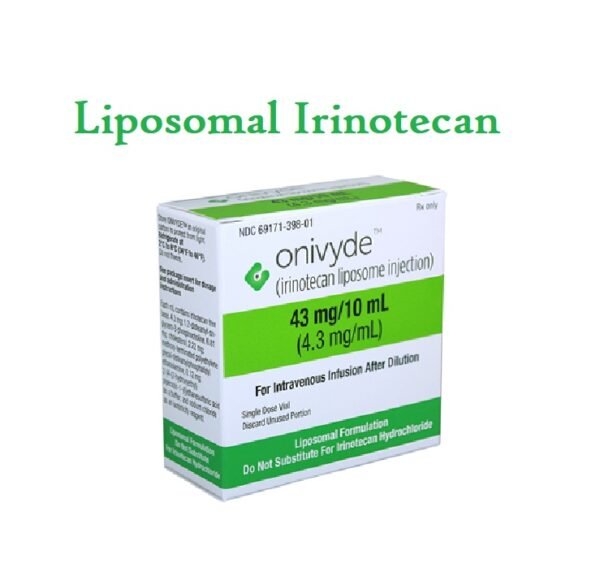
Onivyde is a liposomal formulation of irinotecan that is used after gemcitabine, fluorouracil, and leucovorin for the treatment of metastatic pancreatic adenocarcinoma.
Liposomal Irinotecan Uses:
-
Metastatic pancreatic adenocarcinoma:
- Used in the management of metastatic adenocarcinoma of the pancreas.
- It should not be used as monotherapy. Utilized after gemcitabine therapy, along with fluorouracil and leucovorin.
Liposomal Irinotecan (Onivyde) Dose in Adults:
Note:
- Irinotecan (liposomal) is associated with a moderate emetic potential. Premedicate with a corticosteroid and an antiemetic half an hour before infusion.
- Irinotecan (liposomal) and irinotecan (conventional) are NOT interchangeable. Dosing differs between formulations; confirm planned product and dose before preparation and administration.
Liposomal Irinotecan (Onivyde) Dose in the treatment of metastatic pancreatic adenocarcinoma:
- IV: 70 mg/m² once every 14 days ( with fluorouracil and leucovorin).
Note: Reduce initial dose to 50 mg/m² in patients proven to be homozygous for the UGT1A1*28 allele; the dose may be increased to 70 mg/m as tolerated in successive cycles.
Use in Children:
Not indicated.
Pregnancy Risk Category: D
- If given during pregnancy, liposomal Irinotecan can cause fetal impairment.
- Effective contraception should be used by women with childbearing potential. Pregnancy should not occur for at least one month after treatment.
- Contraception should be used by males who have female partners with reproductive potential during treatment, and for at least 4 months after the last dose..
Use while breastfeeding
- It isn't known if breast milk contains irinotecan (liposomal).
- The manufacturer doesn't recommend breastfeeding while receiving treatment, or for the first month after the last dose.
Dose in Kidney Disease:
- CrCl 30 to 89 mL/minute:
- Dosage modifications are not given in the manufacturer's labeling; however, a population pharmacokinetic analysis showed no effect on total SN-38 exposure in patients with mild to moderate renal damage.
- CrCl <30 mL/minute:
- Dosage modifications are not given in the manufacturer's labeling (insufficient data).
Dose in Liver disease:
- Bilirubin >ULN:
- Dosage modifications are not given in the manufacturer's labeling (there is no recommended dose); use carefully. No data present concerning utilization in patients with bilirubin >2 mg/dL.
Common Side Effects of Liposomal Irinotecan (Onivyde):
Frequency not always defined. Percentages reported as part of combination chemotherapy regimens.
-
Cardiovascular:
- Septic shock
-
Central nervous system:
- Fatigue
-
Dermatologic:
- Alopecia
-
Endocrine & Metabolic:
- Hypoalbuminemia
- Hypomagnesemia
- Hypocalcemia
- Hypokalemia
- Hypophosphatemia
- Hyponatremia
- Weight Loss
- Dehydration
-
Gastrointestinal:
- Diarrhea
- Vomiting
- Nausea
- Decreased Appetite
- Stomatitis
- Gastroenteritis
-
Hematologic & Oncologic:
- Anemia
- Lymphocytopenia
- Neutropenia
- Thrombocytopenia
- Febrile Neutropenia
-
Hepatic:
- Increased Serum ALT
-
Hypersensitivity:
- Severe Hypersensitivity
-
Infection:
- Sepsis
- Neutropenic Sepsis
-
Local:
- Catheter Infection
-
Neuromuscular & Skeletal:
- Weakness
-
Renal:
- Increased Creatinine Clearance
- Acute Renal Failure
-
Respiratory:
- Pneumonia
- Interstitial Pulmonary Disease
-
Miscellaneous:
- Fever
Contraindications to Liposomal Irinotecan (Onivyde):
- A severe allergic reaction to irinotecan liposomal, irinotecan hydrchloride or any other element of the formulation.
- Canadian labeling (additional contraindications that are not in the US labeling).
- It is not advised to breastfeed
Warnings and precautions
-
Suppression of bone marrow: [US Boxed Warning]
- Nearly 1% of patients who received irinotecan (liposomal) suffered from lethal neutropenic seizures.
- Severe or life-threatening neutropenic fever or sepsis was reported in 3% of patients. In 20% of cases, severe or life-threatening neutropenia was observed in patients receiving irinotecan (liposomal), in combination with fluorouracil or leucovorin.
- For absolute neutrophil count less than 1,500/mm, or for neutropenic fever, you should not use liposomal irinotecan.
- During treatment, it is important to regularly check the blood cell countDay 1 through 8 of each cycle, and more frequently if clinically necessary.
- You may need to stop treatment, reduce doses, or terminate the treatment.
- Anemia, lymphopenia and thrombocytopenia are all common.
- In Asian patients, neutropenia was more common than in white patients.
-
Gastrointestinal toxicities: [US Boxed Warning]
- One third of patients who took irinotecan (liposomal), with fluorouracil, and leucovorin developed severe diarrhea.
- Patients with bowel obstruction should not be given irinotecan (liposomal).
- For diarrhea of grade 2 or 4, withhold irinotecan.
- For late diarrhea, take loperamide.
- If you are not allergic to atropine, take it if you have severe diarrhea.
- Early diarrhea can occur within the first days of chemotherapy.
- Late diarrhea can occur more than one day after chemotherapy.
- Diarrhea can require medication interruption, dosage reduction and/or discontinuation.
- Irinotecan (liposomal), is associated with mild emetic perspectives; antiemetics can be used to prevent nausea or vomiting.
- Stomatitis is also a common condition.
-
Hypersensitivity reactions
- Irinotecan (conventional) has been linked to serious allergic reactions, including anaphylaxis.
- If severe hypersensitivity develops, monitor closely and stop using irinotecan (liposomal).
-
Toxicity in the lungs:
- Irinotecan (conventional), can cause serious and severe interstitial lung disease.
- If you experience new or progressive dyspnea or cough during diagnostic evaluation, stop using irinotecan liposomal.
- If ILD diagnosis is confirmed, stop treatment.
-
Bowel obstruction
- Patients suffering from bowel obstruction should avoid taking.
-
Hepatic impairment
- Patients with hepatic disease have not been able to evaluate the pharmacokinetics and safety of irinotecan (liposomal).
- Patients with hepatic issues receiving irinotecan (conventional) may have an increased risk of being exposed to the active metabolite (SN38). Toxicities could be higher.
Liposomal irinotecan: Drug Interaction
|
Aprepitant |
May increase the serum concentration of CYP3A4 Substrates (High risk with Inhibitors). |
|
Bosentan |
May decrease the serum concentration of CYP3A4 Substrates (High risk with Inducers). |
|
Chloramphenicol (Ophthalmic) |
May enhance the adverse/toxic effect of Myelosuppressive Agents. |
|
Clofazimine |
May increase the serum concentration of CYP3A4 Substrates (High risk with Inhibitors). |
|
CloZAPine |
Myelosuppressive Agents may enhance the adverse/toxic effect of CloZAPine. Specifically, the risk for neutropenia may be increased. |
|
Coccidioides immitis Skin Test |
Immunosuppressants may diminish the diagnostic effect of Coccidioides immitis Skin Test. |
|
CYP3A4 Inducers (Moderate) |
May decrease the serum concentration of CYP3A4 Substrates (High risk with Inducers). |
|
CYP3A4 Inhibitors (Moderate) |
May decrease the metabolism of CYP3A4 Substrates (High risk with Inhibitors). |
|
Deferasirox |
May decrease the serum concentration of CYP3A4 Substrates (High risk with Inducers). |
|
Denosumab |
May enhance the adverse/toxic effect of Immunosuppressants. Specifically, the risk for serious infections may be increased. |
|
Duvelisib |
May increase the serum concentration of CYP3A4 Substrates (High risk with Inhibitors). |
|
Eltrombopag |
May increase the serum concentration of OATP1B1/1B3 (SLCO1B1/1B3) Substrates. |
|
Erdafitinib |
May decrease the serum concentration of CYP3A4 Substrates (High risk with Inducers). |
|
Erdafitinib |
May increase the serum concentration of CYP3A4 Substrates (High risk with Inhibitors). |
|
Erdafitinib |
May increase the serum concentration of P-glycoprotein/ABCB1 Substrates. |
|
Fosaprepitant |
May increase the serum concentration of CYP3A4 Substrates (High risk with Inhibitors). |
|
Fosnetupitant |
May increase the serum concentration of CYP3A4 Substrates (High risk with Inhibitors). |
|
Gemfibrozil |
May increase the serum concentration of OATP1B1/1B3 (SLCO1B1/1B3) Substrates. See separate drug interaction monographs for agents listed as exceptions. |
|
Ivosidenib |
May decrease the serum concentration of CYP3A4 Substrates (High risk with Inducers). |
|
Larotrectinib |
May increase the serum concentration of CYP3A4 Substrates (High risk with Inhibitors). |
|
Mesalamine |
May enhance the myelosuppressive effect of Myelosuppressive Agents. |
|
Netupitant |
May increase the serum concentration of CYP3A4 Substrates (High risk with Inhibitors). |
|
Ocrelizumab |
May enhance the immunosuppressive effect of Immunosuppressants. |
|
Palbociclib |
May increase the serum concentration of CYP3A4 Substrates (High risk with Inhibitors). |
|
P-glycoprotein/ABCB1 Inhibitors |
May increase the serum concentration of P-glycoprotein/ABCB1 Substrates. P-glycoprotein inhibitors may also enhance the distribution of p-glycoprotein substrates to specific cells/tissues/organs where p-glycoprotein is present in large amounts (e.g., brain, T-lymphocytes, testes, etc.). |
|
Pidotimod |
Immunosuppressants may diminish the therapeutic effect of Pidotimod. |
|
Promazine |
May enhance the myelosuppressive effect of Myelosuppressive Agents. |
|
Ranolazine |
May increase the serum concentration of P-glycoprotein/ABCB1 Substrates. |
|
Rifabutin |
May decrease serum concentrations of the active metabolite(s) of Irinotecan Products. Specifically, serum concentrations of SN-38 may be reduced. Rifabutin may decrease the serum concentration of Irinotecan Products. |
|
Rifapentine |
May decrease serum concentrations of the active metabolite(s) of Irinotecan Products. Specifically, serum concentrations of SN-38 may be reduced. Rifapentine may decrease the serum concentration of Irinotecan Products. |
|
Sarilumab |
May decrease the serum concentration of CYP3A4 Substrates (High risk with Inducers). |
|
Siltuximab |
May decrease the serum concentration of CYP3A4 Substrates (High risk with Inducers). |
|
Simeprevir |
May increase the serum concentration of CYP3A4 Substrates (High risk with Inhibitors). |
|
Siponimod |
Immunosuppressants may enhance the immunosuppressive effect of Siponimod. |
|
Smallpox and Monkeypox Vaccine (Live) |
Immunosuppressants may diminish the therapeutic effect of Smallpox and Monkeypox Vaccine (Live). |
|
Teriflunomide |
May increase the serum concentration of OATP1B1/1B3 (SLCO1B1/1B3) Substrates. |
|
Tertomotide |
Immunosuppressants may diminish the therapeutic effect of Tertomotide. |
|
Tobacco (Smoked) |
May decrease serum concentrations of the active metabolite(s) of Irinotecan Products. |
|
Tocilizumab |
May decrease the serum concentration of CYP3A4 Substrates (High risk with Inducers). |
|
Trastuzumab |
May enhance the neutropenic effect of Immunosuppressants. |
|
Risk Factor D (Consider therapy modification) |
|
|
Baricitinib |
Immunosuppressants may enhance the immunosuppressive effect of Baricitinib. Management: Use of baricitinib in combination with potent immunosuppressants such as azathioprine or cyclosporine is not recommended. Concurrent use with antirheumatic doses of methotrexate or nonbiologic disease modifying antirheumatic drugs (DMARDs) is permitted. |
|
Dabrafenib |
|
|
Deferiprone |
Myelosuppressive Agents may enhance the neutropenic effect of Deferiprone. Management: Avoid the concomitant use of deferiprone and myelosuppressive agents whenever possible. If this combination cannot be avoided, monitor the absolute neutrophil count more closely. |
|
Echinacea |
May diminish the therapeutic effect of Immunosuppressants. |
|
Fingolimod |
Immunosuppressants may enhance the immunosuppressive effect of Fingolimod. Management: Avoid the concomitant use of fingolimod and other immunosuppressants when possible. If combined, monitor patients closely for additive immunosuppressant effects (eg, infections). |
|
Leflunomide |
Immunosuppressants may enhance the adverse/toxic effect of Leflunomide. Specifically, the risk for hematologic toxicity such as pancytopenia, agranulocytosis, and/or thrombocytopenia may be increased. Management: Consider not using a leflunomide loading dose in patients receiving other immunosuppressants. Patients receiving both leflunomide and another immunosuppressant should be monitored for bone marrow suppression at least monthly. |
|
Lenograstim |
Antineoplastic Agents may diminish the therapeutic effect of Lenograstim. Management: Avoid the use of lenograstim 24 hours before until 24 hours after the completion of myelosuppressive cytotoxic chemotherapy. |
|
Lipegfilgrastim |
Antineoplastic Agents may diminish the therapeutic effect of Lipegfilgrastim. Management: Avoid concomitant use of lipegfilgrastim and myelosuppressive cytotoxic chemotherapy. Lipegfilgrastim should be administered at least 24 hours after the completion of myelosuppressive cytotoxic chemotherapy. |
|
Lorlatinib |
May decrease the serum concentration of CYP3A4 Substrates (High risk with Inducers). Management: Avoid concurrent use of lorlatinib with any CYP3A4 substrates for which a minimal decrease in serum concentrations of the CYP3A4 substrate could lead to therapeutic failure and serious clinical consequences. |
|
Nivolumab |
Immunosuppressants may diminish the therapeutic effect of Nivolumab. |
|
Palifermin |
May enhance the adverse/toxic effect of Antineoplastic Agents. Specifically, the duration and severity of oral mucositis may be increased. Management: Do not administer palifermin within 24 hours before, during infusion of, or within 24 hours after administration of myelotoxic chemotherapy. |
|
Roflumilast |
May enhance the immunosuppressive effect of Immunosuppressants. |
|
Sipuleucel-T |
Immunosuppressants may diminish the therapeutic effect of Sipuleucel-T. Management: Evaluate patients to see if it is medically appropriate to reduce or discontinue therapy with immunosuppressants prior to initiating sipuleucel-T therapy. |
|
Stiripentol |
May increase the serum concentration of CYP3A4 Substrates (High risk with Inhibitors). Management: Use of stiripentol with CYP3A4 substrates that are considered to have a narrow therapeutic index should be avoided due to the increased risk for adverse effects and toxicity. Any CYP3A4 substrate used with stiripentol requires closer monitoring. |
|
Tofacitinib |
Immunosuppressants may enhance the immunosuppressive effect of Tofacitinib. Management: Concurrent use with antirheumatic doses of methotrexate or nonbiologic disease modifying antirheumatic drugs (DMARDs) is permitted, and this warning seems particularly focused on more potent immunosuppressants. |
|
Tolvaptan |
May increase the serum concentration of OATP1B1/1B3 (SLCO1B1/1B3) Substrates. |
|
Vaccines (Inactivated) |
Immunosuppressants may diminish the therapeutic effect of Vaccines (Inactivated). Management: Vaccine efficacy may be reduced. Complete all age-appropriate vaccinations at least 2 weeks prior to starting an immunosuppressant. If vaccinated during immunosuppressant therapy, revaccinate at least 3 months after immunosuppressant discontinuation. |
|
Risk Factor X (Avoid combination) |
|
|
BCG (Intravesical) |
Immunosuppressants may diminish the therapeutic effect of BCG (Intravesical). |
|
BCG (Intravesical) |
Myelosuppressive Agents may diminish the therapeutic effect of BCG (Intravesical). |
|
Cladribine |
May enhance the immunosuppressive effect of Immunosuppressants. |
|
Cladribine |
May enhance the myelosuppressive effect of Myelosuppressive Agents. |
|
Conivaptan |
May increase the serum concentration of CYP3A4 Substrates (High risk with Inhibitors). |
|
CYP3A4 Inducers (Strong) |
May decrease serum concentrations of the active metabolite(s) of Irinotecan Products. Specifically, serum concentrations of SN-38 may be reduced. CYP3A4 Inducers (Strong) may decrease the serum concentration of Irinotecan Products. |
|
CYP3A4 Inhibitors (Strong) |
May increase serum concentrations of the active metabolite(s) of Irinotecan Products. Specifically, serum concentrations of SN-38 may be increased. CYP3A4 Inhibitors (Strong) may increase the serum concentration of Irinotecan Products. |
|
Dipyrone |
May enhance the adverse/toxic effect of Myelosuppressive Agents. Specifically, the risk for agranulocytosis and pancytopenia may be increased |
|
Fusidic Acid (Systemic) |
May increase the serum concentration of CYP3A4 Substrates (High risk with Inhibitors). |
|
Idelalisib |
May increase the serum concentration of CYP3A4 Substrates (High risk with Inhibitors). |
|
Lasmiditan |
May increase the serum concentration of P-glycoprotein/ABCB1 Substrates. |
|
Natalizumab |
Immunosuppressants may enhance the adverse/toxic effect of Natalizumab. Specifically, the risk of concurrent infection may be increased. |
|
Pimecrolimus |
May enhance the adverse/toxic effect of Immunosuppressants. |
|
St John's Wort |
May decrease serum concentrations of the active metabolite(s) of Irinotecan Products. Specifically, concentrations of SN-38 may be reduced. St John's Wort may decrease the serum concentration of Irinotecan Products. |
|
Tacrolimus (Topical) |
May enhance the adverse/toxic effect of Immunosuppressants. |
|
UGT1A1 Inhibitors |
May increase serum concentrations of the active metabolite(s) of Irinotecan Products. Specifically, concentrations of SN-38 may be increased. UGT1A1 Inhibitors may increase the serum concentration of Irinotecan Products. Exceptions: Atazanavir; Ombitasvir, Paritaprevir, and Ritonavir; Ombitasvir, Paritaprevir, Ritonavir, and Dasabuvir. |
|
Upadacitinib |
Immunosuppressants may enhance the immunosuppressive effect of Upadacitinib. |
|
Vaccines (Live) |
Immunosuppressants may enhance the adverse/toxic effect of Vaccines (Live). Immunosuppressants may diminish the therapeutic effect of Vaccines (Live). Management: Avoid use of live organism vaccines with immunosuppressants; live-attenuated vaccines should not be given for at least 3 months after immunosuppressants. Exceptions: Smallpox and Monkeypox Vaccine (Live). |
Monitoring parameters:
- Complete blood counts on days 1 and 8 of every cycle and as clinically indicated;
- Bilirubin,
- electrolytes (with severe diarrhea);
- bowel movements (diarrhea episodes) and hydration status;
- signs and symptoms of pulmonary toxicity or allergic reactions
How to administer Liposomal Irinotecan (Onivyde)?
- Liposomal Irinotecan (liposomal), has moderate emetic properties; antiemetics should be used to prevent nausea or vomiting.
IV: Give IV infusion for at least an hour. Before infusion, premedicate with a corticosteroid or an antiemetic.
- Before fluorouracil or leucovorin, administer irinotecan (liposomal).
- For administration, do not use in-line filtering.
- For early diarrhea, use IV or SubQ atropine 0.25-1 mg (unless medically contraindicated). Start loperamide to treat late diarrhea.
Mechanism of action of Liposomal Irinotecan (Onivyde):
- Irinotecan (liposomal), is a topoisomerase-1 inhibitor that is enclosed in a lipid bilayer. (liposome).
- Irinotecan (liposomal) and its active metabolite, SN-38, bind reversibly with topoisomerase I DNA complex preventing religation of the cleaved DNA strand.
- This causes the accumulation of cleavable compounds and double-strand DNA breakages.
- These breaks are not easily repaired by mammalian cells, which results in cell death that is consistent with the S-phase cell cycle particularity, and termination of cell replication.
Distribution:
- 95% of irinotecan remains liposome-encapsulated
Protein binding:
- <1%
Metabolism:
- Irinotecan hydrochloride: Primarily hepatic to SN-38 (active metabolite) by carboxylesterase enzymes; may also undergo CYP3A4-mediated metabolism to inactive metabolites (one of which may be hydrolyzed to release SN-38).
- SN-38 undergoes conjugation by UDP-glucuronosyl transferase 1A1 (UGT1A1) to form a glucuronide metabolite.
- SN-38 is increased by UGT1A1*28 polymorphism (10% of North Americans are homozygous for UGT1A1*28 allele).
Half-life elimination:
- Total irinotecan: ~26 hours;
- SN-38: ~68 hours
Excretion:
- Urine: Irinotecan hydrochloride (11% to 20%), metabolites (SN-38 <1%, SN-38 glucuronide, 3%)
International Brands of Liposomal irinotecan:
- Onivyde
Liposomal Irinotecan Brand Names in Pakistan:
No Brands Available in Pakistan.
.png)


