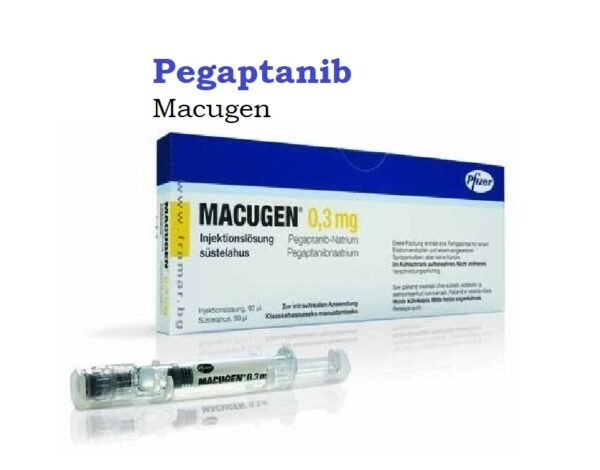
Pegaptanib (Macugen) is a VEGF (vascular endothelial growth factor) receptor inhibitor that is used in the treatment of age-related macular degeneration and neovascularization.
Pegaptanib (Macugen) Uses:
-
Macular degeneration (neovascular age-related):
- It is indicated for the treatment of neovascular (wet) age-related macular degeneration (AMD)
Pegaptanib (Macugen) Dose in Adults
Pegaptanib (Macugen) Dose in the treatment of Macular degeneration (neovascular age-related):
- As an intravitreous injection:
- 0.3 mg injection into the affected eye once every six weeks.
Pegaptanib (Macugen) dose in Children:
Not indicated.
Pegaptanib (Macugen) Pregnancy Risk Factor B
- Pegaptanib is an inhibitor of vascular endothelial growth factor receptors. For the maintenance of a normal pregnancy, VEGF is required.
- Data regarding the use of intravitreal VEGF inhibitors in pregnancy is limited.
- However, most experts recommend avoiding its use during the first trimester when most of the organogenesis occurs. In the second and the third trimesters, the risks and the benefits should be weighed.
- Before administering the drug, a pregnancy test should be done. Effective contraception should be advised before initiating the treatment, during, and at least three months after the injection.
Pegaptanib use during breastfeeding:
- The excretion of the drug into breastmilk is not known.
- The manufacturer recommends administering the drug with caution in breastfeeding women.
Pegaptanib (Macugen) Dose in Kidney Disease:
The manufacturer has not recommended any adjustment in the dose in patients with kidney disease.
Pegaptanib (Macugen) Dose in Liver Disease:
The manufacturer has not recommended any dose adjustment in patients with liver disease.
Common Side Effects of Pegaptanib (Macugen):
-
Cardiovascular:
- Hypertension
-
Ophthalmic:
- Anterior Chamber Inflammation
- Blurred Vision
- Cataract
- Conjunctival Hemorrhage
- Corneal Edema
- Decreased Visual Acuity
- Eye Discharge
- Eye Discomfort
- Eye Irritation
- Eye Pain
- Increased Intraocular Pressure
- Punctate Keratitis
- Visual Disturbance
- Vitreous Opacity
Less Common Side Effects Of Pegaptanib (Macugen):
-
Cardiovascular:
- Cerebrovascular Accident
- Chest Pain
- Occlusive Arterial Disease
- Transient Ischemic Attacks
-
Central Nervous System:
- Dizziness
- Headache
- Vertigo
-
Dermatologic:
- Contact Dermatitis
-
Endocrine & Metabolic:
- Diabetes Mellitus
-
Gastrointestinal:
- Diarrhea
- Nausea
- Dyspepsia
- Vomiting
-
Genitourinary:
- Urinary Tract Infection
- Urinary Retention
-
Hematologic & Oncologic:
- Bruise
- Periorbital Hematoma
- Vitreous Hemorrhage
-
Local:
- Local Inflammation
- Local Irritation
-
Neuromuscular & Skeletal:
- Arthritis
- Bone Spur
-
Ophthalmic:
- Blepharitis
- Conjunctivitis
- Photopsia
- Vitreous Disorder
- Allergic Conjunctivitis
- Conjunctival Edema
- Corneal Abrasion
- Corneal Deposits
- Epithelial Keratopathy
- Endophthalmitis
- Meibomianitis
- Mydriasis
- Retinal Edema
- Swelling Of Eye
-
Otic:
- Auditory Impairment
-
Respiratory:
- Bronchitis
- Pleural Effusion
Contraindications to Pegaptanib (Macugen):
- Known allergy to pegaptanib or any component of the formulation.
- ocular or periocular infections
Warnings and Precautions
-
Endophthalmitis and retinal detachment:
- The injection should be administered under aseptic measures and the patients should be asked to report any clinical signs of inflammation or infection (such as eye pain, redness, blurring, or discharge).
- Following the intravitreal injections, endophthalmitis has been reported. Other serious adverse reactions include retinal detachment and iatrogenic traumatic cataract.
-
Hypersensitivity:
- Hypersensitivity reactions including anaphylaxis, anaphylactoid reactions, and angioedema have occurred within several hours of the drug administration.
- Patients should be monitored carefully and appropriate medications and equipment should be available to manage such reactions.
-
Increased intraocular pressure:
- Following the intravitreal injection, the intraocular pressure may increase within 30 minutes of the injection.
- Optic nerve perfusion and the intraocular pressure should be monitored following the injection.
-
Thromboembolic events:
- Following intravitreal injection of VEGF inhibitors, thromboembolic events including nonfatal store, MI, and vascular deaths have been reported.
Pegaptanib: Drug Interaction
Note: Drug Interaction Categories:
- Risk Factor C: Monitor When Using Combination
- Risk Factor D: Consider Treatment Modification
- Risk Factor X: Avoid Concomitant Use
Risk Factor C (Monitor therapy) |
|
| Pegloticase | May diminish the therapeutic effect of PEGylated Drug Products. |
| Pegvaliase | PEGylated Drug Products may enhance the adverse/toxic effect of Pegvaliase. Specifically, the risk of anaphylaxis or hypersensitivity reactions may be increased. |
Monitoring Parameters:
- Monitor optic nerve head perfusion immediately after the injection.
- Monitor intraocular pressure within 30 minutes after the injection and during the week after the injection.
- Monitor for the clinical signs of inflammation and infection for one week after the injection.
- Hypersensitivity reactions, retinal perfusion, endophthalmitis, and visual acuity.
How to administer Pegaptanib (Macugen)?
- It is intended for ophthalmic use only as an intravitreal injection.
- Before administering the drug, administer adequate anesthesia and broad-spectrum topical antibiotics.
- The medication syringe should be attached to a 30 gauge needle.
- The plunger should be slowly depressed to expel the medication and the excess air. (Refer to product prescribing information leaflet).
Mechanism of action of Pegaptanib (Macugen):
It is an aptamer that is bound to polyethylene glycol. It slows visual loss and suppresses neovascularization by selectively binding and inhibiting the extracellular VEGF (vascular endothelial growth factor) to its receptors. Pegaptanib binds to VEGF after adopting a three-dimensional shape .
Systemic absorption is very slow when administered intravitreally. It is metabolized by endo and exonucleases and has a half-life of 10 +/- 4 days.
International Brands of Pegaptanib:
- Macugen
Pegaptanib Brand Names in Pakistan:
No Brands Available in Pakistan.
.png)


