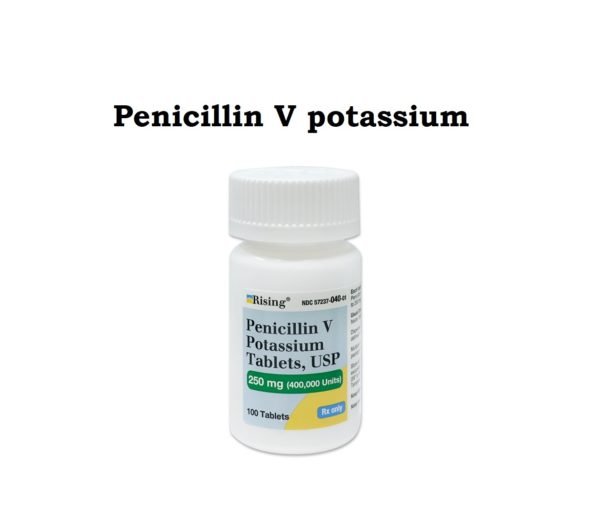
Penicillin V potassium is an orally available antibiotic. It has a very narrow spectrum of antibacterial properties and is used to treat mild to moderate infections.
Indications of Penicillin V potassium
-
Fusospirochetosis (Vincent gingivitis and pharyngitis):
- It used for treating fusospirochetosis (Vincent gingivitis and pharyngitis) in addition to dental hygiene.
-
Pneumococcal infections:
- Mild to moderately severe pneumococcal respiratory tract infections, including otitis media can be treated with penicillin V potassium.
-
Rheumatic fever and/or chorea prophylaxis:
- It is used for prophylaxis (chronic, secondary) of rheumatic fever and/or chorea.
-
Penicillin G-sensitive Staphylococcal infections:
- It is prescribed for the treatment of mild infections of the skin and soft tissues.
-
Streptococcal infections without bacteremia:
- Management of mild to moderate streptococcal infections of the upper respiratory tract, scarlet fever, and mild erysipelas is done by penicillin V potassium.
-
Off Label Use of Penicillin V potassium in Adults:
- Actinomycosis;
- Bite wounds (animal);
- Chronic antimicrobial suppression of prosthetic joint infection;
- Cutaneous anthrax;
- Cutaneous erysipeloid;
- Pneumococcal prophylaxis in hematopoietic cell transplant;
- Chronic Streptococcus group A carrier
Penicillin V dosage in adults:
Usual dosage range:
- 125 to 500 mg per oral every 6 to 8 hours.
Penicillin V Dose in the treatment of Actinomycosis:
Note:
The duration depends on the disease location and patient-specific factors.
- 2 to 4 g/day in per-oral in divided doses (every 6 hours).
Penicillin V dose in the treatment of Animal Bite Wounds:
- 500 mg per oral q.i.d daily in combination with dicloxacillin.
Penicillin V dose in the treatment of community-acquired Cutaneous anthrax:
- 500 mg per oral q.i.d daily for 7 to 10 days.
Dose in the treatment of Cutaneous erysipeloid:
- 500 mg per oral q.i.d daily for 7 to 10 days.
Penicillin V dose in the treatment of Erysipelas:
- 500 mg per oral q.i.d daily.
-
Manufacturer's labeling:
- Dosing in the prescribing information may not reflect current clinical practice.
- 125 to 250 mg every 6 to 8 hours.
Dose in the treatment of Fusospirochetosis (Vincent infection):
- 250 to 500 mg per oral every 6 to 8 hours.
Dose for Pneumococcal prophylaxis in hematopoietic cell transplant:
- 250 to 500 mg per oral b.i.d daily.
- Note: Use only in areas where the incidence of penicillin-resistant S. pneumoniae is low.
Penicillin V dose in the treatment dose of Prosthetic joint infection:
-
Chronic oral antimicrobial suppression (Enterococcus spp [penicillin-susceptible], streptococci [beta-hemolytic], Cutibacterium spp):
- 500 mg per oral b.i.d or q.i.d daily.
Penicillin V dose in the treatment of Streptococcal skin infection:
- 250 to 500 mg per oral every 6 hours.
Penicillin V dose in the treatment of Group A Streptococcal infections:
-
Acute treatment of Pharyngitis:
- 500 mg per oral b.i.d or ti.d daily for 10 days or 250 mg 4 times daily or 500 mg twice daily for 10 days.
-
Secondary prophylaxis for rheumatic fever (prevention of recurrent attacks):
- 250 mg per oral b.i.d daily. Duration depends on risk factors and the presence of valvular disease.
-
Chronic carriage:
- 500 mg per oral q.i.d daily for 10 days in combination with oral rifampin.
- Note: Most individuals with chronic carriage do not require antibiotics.
Penicillin V potassium dose in children:
Penicillin V General dosing in susceptible infections:
-
Infants and Children <12 years:
-
Mild to moderate infection:
- 25 to 75 mg/kg/day per oral in divided doses every 6 to 8 hours.
- The maximum daily dose is 2,000 mg/day.
-
-
Children ≥12 years and Adolescents:
-
Manufacturer's labeling (fixed dosing):
- 125 to 500 mg per oral every 6 to 8 hours.
-
Alternate dosing (weight-based):
- Mild to moderate infection: 25 to 75 mg/kg/day per oral in divided doses every 6 to 8 hours.
- maximum daily dose: 2,000 mg/day.
-
Penicillin V dose for the treatment of community-acquired cutaneous Anthrax:
-
Infants, Children, and Adolescents:
- 25 to 50 mg/kg/day per oral in divided doses 2 or 4 times daily.
- The maximum single dose: 500 mg.
Penicillin V dose in the treatment of mild to moderately severe Fusospirochetosis infections (Vincent infection):
-
Children ≥12 years and Adolescents:
- 250 to 500 mg per oral every 6 to 8 hours.
Penicillin V dose in the treatment of Tonsillopharyngitis caused by Group A streptococcal infection and for the treatment and primary prevention of Rheumatic fever:
-
Acute treatment :
-
Children ≤27 kg:
- 250 mg per oral twice or thrice daily for 10 days.
- Children >27 kg and Adolescents:
- 500 mg per oral 2 to 3 times daily for 10 days; in adolescents, 250 mg 4 times daily has also been suggested.
-
-
Chronic carrier treatment (Group A streptococci):
-
Children and Adolescents:
- 50 mg/kg/day per oral in 4 divided doses for 10 days in combination with oral rifampin.
- maximum daily dose: 2,000 mg/day.
-
Penicillin V dose for the prophylaxis of Recurrent rheumatic fever:
-
Children and Adolescents:
- 250 mg per oral b.i.d daily.
Penicillin V dose for the prophylaxis of Pneumococcal infection in patients with anatomic or functional asplenia (such as sickle cell disease):
-
Infants (as soon as SCD diagnosed or asplenic) and Children <3 years:
- 125 mg per oral b.i.d daily.
-
Children ≥3 years:
- 250 mg per oral b.i.d daily; the decision to discontinue penicillin prophylaxis after 5 years of age in children who have not experienced invasive pneumococcal infection and have received recommended pneumococcal immunizations is patient and clinician dependent
Penicillin V dose for the treatment of mild community-acquired Pneumonia or as a stepdown therapy caused by Group A Streptococcus
-
Infants ≥3 months, Children, and Adolescents:
- 50 to 75 mg/kg/day per oral in 3 to 4 divided doses.
- The maximum daily dose is 2,000 mg/day.
Pregnancy Risk Category: B
- Penicillin can cross the placenta.
- There has not been any increase in the risk of adverse fetal consequences due to maternal use.
- For the treatment of Bacillus Anthracis in pregnant women, alternate agents should be used.
Penicillin V potassium use during breastfeeding:
- Breast milk is where the drug is excreted.
- The relative infant dose (RID), is 0.6%. It is calculated by using the highest concentration of breast milk and compared with a weight-adjusted maternal daily dosage of 2,640m.
- When the RID is less than 10, breastfeeding is acceptable.
- Breast milk has a daily intake of 0.23 mg/kg/day. This is assuming that the highest concentration of milk (1.55mg/l) is used.
- The peak milk concentration reached at 2-8 hours after receiving a 1,320mg dose. Breast milk half-life ranged between 1 and 3.8 hours for women with mastitis.
- Some infants who breastfeed may have it in their urine.
- Breastfeeding infants can experience rash and diarrhea after being exposed to the drug.
- Monitoring for GI disturbances is therefore essential.
- Breastfeeding is possible for mothers who are undergoing treatment.
Dose adjustment in renal disease:
There are no dosage adjustments provided in manufacturer’s labeling. Use with caution as excretion is prolonged in patients with renal impairment.
Dose adjustment in liver disease:
There are no dosage adjustments provided in manufacturer’s labeling.
Side Effects of Penicillin V potassium:
-
Gastrointestinal:
- Melanoglossia
- Mild Diarrhea
- Nausea
- Oral Candidiasis
- Vomiting
Contraindication to Penicillin V potassium:
- Hypersensitivity to penicillin and any component of the formulation
Warnings and precautions
-
Anaphylactic and hypersensitivity reactions
- Hypersensitivity reactions that can lead to severe and fatal hypersensitivity reactions are more common in those who have a history either of beta-lactam hypersensitivity, or multiple allergen sensitivity.
- Asthmatic patients should not use it.
- Anaphylaxis requires immediate airway protection and supportive management.
-
Superinfection
- Long-term therapy can be used to treat fungal or bacterial superinfections, such as pseudomembranous and C. difficile-associated diarrhea.
-
Renal impairment
- Patients with severe renal impairment should be cautious.
-
Seizure disorders:
- Higher doses of treatment are more likely to cause seizures in patients with renal impairment.
Penicillin V potassium (oral): Drug Interaction
|
Acemetacin |
May increase the serum concentration of Penicillins. |
|
BCG Vaccine (Immunization) |
Antibiotics may diminish the therapeutic effect of BCG Vaccine (Immunization). |
|
Lactobacillus and Estriol |
Antibiotics may diminish the therapeutic effect of Lactobacillus and Estriol. |
|
Methotrexate |
Penicillins may increase the serum concentration of Methotrexate. |
|
Mycophenolate |
Penicillins may decrease serum concentrations of the active metabolite(s) of Mycophenolate. This effect appears to be the result of impaired enterohepatic recirculation. |
|
Nitisinone |
May increase the serum concentration of OAT1/3 Substrates. |
|
Pretomanid |
May increase the serum concentration of OAT1/3 Substrates. |
|
Probenecid |
May increase the serum concentration of Penicillins. |
|
Teriflunomide |
May increase the serum concentration of OAT1/3 Substrates. |
|
Vitamin K Antagonists (eg, warfarin) |
Penicillins may enhance the anticoagulant effect of Vitamin K Antagonists. |
|
Sodium Picosulfate |
Antibiotics may diminish the therapeutic effect of Sodium Picosulfate. Management: Consider using an alternative product for bowel cleansing prior to a colonoscopy in patients who have recently used or are concurrently using an antibiotic. |
|
Tetracyclines |
May diminish the therapeutic effect of Penicillins. |
|
Tolvaptan |
May increase the serum concentration of OAT1/3 Substrates. Management: Patients being treated with the Jynarque brand of tolvaptan should avoid concomitant use of OAT1/3 substrates. Concentrations and effects of the OAT1/3 substrate would be expected to increase with any combined use. |
|
Typhoid Vaccine |
Antibiotics may diminish the therapeutic effect of Typhoid Vaccine. Only the live attenuated Ty21a strain is affected. Management: Vaccination with live attenuated typhoid vaccine (Ty21a) should be avoided in patients being treated with systemic antibacterial agents. Use of this vaccine should be postponed until at least 3 days after cessation of antibacterial agents. |
|
BCG (Intravesical) |
Antibiotics may diminish the therapeutic effect of BCG (Intravesical). |
|
Cholera Vaccine |
Antibiotics may diminish the therapeutic effect of Cholera Vaccine. Management: Avoid cholera vaccine in patients receiving systemic antibiotics, and within 14 days following the use of oral or parenteral antibiotics. |
Monitoring Parameters:
Hematologic function tests Renal function tests Monitor for signs of anaphylaxis during first dose
How to administer Penicillin V potassium?
It is given orally around-the-clock to promote less variation in peak and trough serum levels on an empty stomach 1 hour before or 2 hours after meals, to enhance absorption.
Mechanism of action of Penicillin V potassium:
- Penicillin V potassium is a penicillin-binding protein (PBP) that inhibits the final transpeptidation step in peptidoglycan synthesis in bacterial cell walls. This causes inhibition of cell wall biosynthesis.
- It also reduces cell wall assembly and bacterial lysis due to the activity of cell-wall autolytic enzymes (autolysins or murein hydrolases).
Protein binding in the plasma is 80%
Excretion: Urine (as unchanged drug and metabolites)
International Brands of Penicillin V potassium:
- APO-Pen VK
- NOVO-Pen-VK [DSC]
- Pen-VK
- Anapenil
- Apocillin
- Beapen VK
- Cilicaine VK
- Fenocin
- Kaypen
- P.V.
- Len V.K.
- Megacilina Oral
- Milcopen
- Oracillin VK
- Orapen
- Orvek
- Ospa-V
- Ospen
- P.V.
- Pen V
- Pen Ve Oral
- Pen-Vi-K
- Penilevel
- Penoxil
- Pota-Vi-Kin
- Prevecilina
- Robicillin VK
- Semicillin
- Sumapen
- V-Cil-K
- V-Cillin K
- Vikadar
- Weifapenin
Penicillin V potassium Brands in Pakistan:
Phenoxymethylpenicillin Syrup 125 mg/5ml |
|
| Penicillin V | Lisko Pakistan (Pvt) Ltd |
| Penicillin V | Hizat Pharmaceutical Industries (Pvt) Ltd. |
Phenoxymethylpenicillin Suspension 125 mg/5ml |
|
| Penisol V.K. | Lisko Pakistan (Pvt) Ltd |
| Penvee | Polyfine Chempharma (Pvt) Ltd. |
Phenoxymethylpenicillin Suspension 250 mg/5ml |
|
| Penvee | Polyfine Chempharma (Pvt) Ltd. |
Phenoxymethylpenicillin 125 mg Tablets |
|
| Penicillin V | Lisko Pakistan (Pvt) Ltd |
Phenoxymethylpenicillin 250 mg Tablets |
|
| Penicillin V | Lisko Pakistan (Pvt) Ltd |
.png)