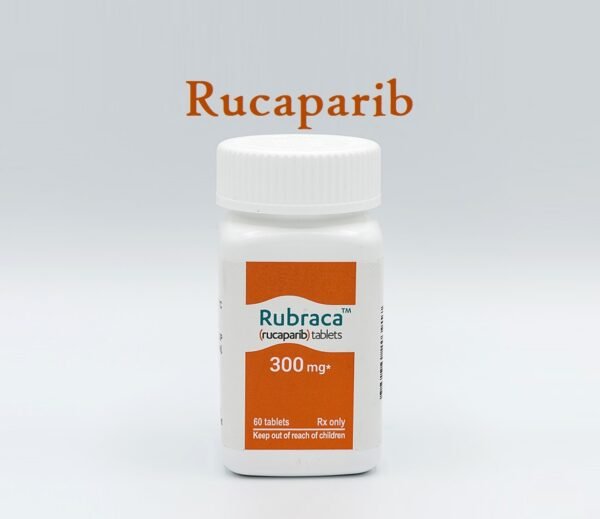
Rucaparib (Rubraca) inhibits PARP enzymes (poly ADP-ribose polymerase) that play an essential role in cell replication. It is used in the treatment of advanced or recurrent ovarian cancer.
Rucaparib Uses:
-
Advanced Ovarian cancer:
- It is used in the treatment of deleterious germline and/or somatic BRCA mutations associated ovarian cancer (epithelial, fallopian tube, or primary peritoneal) in patients who have been treated with two or more chemotherapy regimens before.
- Note: The mutations should be detected by approved labs
-
Maintenance treatment of recurrent ovarian cancer:
- It is used in the maintenance treatment of recurrent ovarian cancer (epithelial, fallopian tube, or primary peritoneal) in patients who have a complete or partial response to platinum-based chemotherapy.
Rucaparib (Rubraca) Dose in Adults
Note:
- It should be administered only to patients with deleterious germline and/or somatic BRCA mutation, as detected by an approved test.
- Premedication with an antiemetic drug may be advised to prevent nausea and vomiting associated with the drug.
Rucaparib (Rubraca) Dose in the treatment of advanced ovarian cancer:
- Oral: 600 mg twice daily until disease either disease progression or unacceptable toxicity.
Rucaparib (Rubraca) Dose in the maintenance treatment of recurrent ovarian cancer:
- Oral: 600 mg twice daily until either disease progression or unacceptable toxicity.
-
Missed doses:
- In case a dose is missed, the next dose should be administered at the scheduled time. if the dose is followed by vomiting, it should not be repeated.
Use in Children:
Not indicated.
Pregnancy Risk Category: D
- Pregnancy may be a time when the drug can cause harm to the fetus.
- Before treatment is initiated, it is important to perform a pregnancy test on any females with reproductive potential.
- Effective contraception should be used for the duration of therapy and at least six months thereafter to prevent any potential pregnancy.
Use while breastfeeding
- It is unknown if the drug will be excreted into breastmilk.
- Because of possible adverse effects on the infant's health, the manufacturer suggests that you stop breastfeeding during treatment and for at least two weeks thereafter.
Dose in Kidney Disease:
- CrCl ≥30 mL/minute at baseline:
- No dosage adjustment is necessary
- CrCl <30 mL/minute:
- There are no dosage adjustments provided in the manufacturer’s labeling (it has not been studied).
- Hemodialysis:
- There are no dosage adjustments provided in the manufacturer’s labeling (it has not been studied).
Dose in Liver disease:
- Mild impairment (total bilirubin ≤ ULN and AST > ULN or total bilirubin 1 to 1.5 times ULN and any AST):
- No dosage adjustment is necessary.
- Moderate to severe impairment (total bilirubin > 1.5 times ULN):
- There are no dosage adjustments provided in the manufacturer’s labeling (it has not been studied).
Common Side Effects of Rucaparib (Rubraca):
-
Cardiovascular:
- Peripheral Edema
-
Central Nervous System:
- Fatigue
- Dizziness Headache
- Insomnia
- Depression
-
Dermatologic:
- Skin Rash
-
Endocrine & Metabolic:
- Increased Serum Cholesterol
-
Gastrointestinal:
- Nausea
- Abdominal Distention
- Abdominal Pain
- Dysgeusia
- Constipation
- Vomiting
- Diarrhea
- Stomatitis
- Decreased Appetite
- Dyspepsia
-
Hematologic & Oncologic:
- Decreased White Blood Cell Count
- Anemia
- Decreased Absolute Lymphocyte Count
- Thrombocytopenia
- Neutropenia
-
Hepatic:
- Increased Serum ALT
- Increased Serum AST
- Increased Serum Alkaline Phosphatase
-
Neuromuscular & Skeletal:
- Weakness
-
Renal:
- Increased Serum Creatinine
-
Respiratory:
- Nasopharyngitis
- Upper Respiratory Tract Infection
- Dyspnea
-
Miscellaneous:
- Fever
Contraindication to Rucaparib (Rubraca):
The manufacturer's labeling does not list any contraindications.
Warnings and precautions
- Suppression of bone marrow
- Cytopenias are a risk for patients (Anemia and neutropenia as well as lymphocytopenia and thrombocytopenia).
- The treatment should be stopped until the blood counts improve.
- Patients with prolonged hematologic toxicities (exceeding 4 week) should have their treatment stopped or reduced. Until recovery, blood counts must be monitored regularly.
- Toxicity to the gastrointestinal tract:
- The moderate risk of vomiting is associated with treatment. Patients may need antiemetics to prevent nausea or vomiting.
- Secondary malignancy
- Rarely, secondary hematological malignancies like MDS or acute myeloid leukemia have been reported in patients receiving rucaparib therapy. These conditions could prove fatal.
- Sometimes, secondary malignancies can develop within the first 28 days after treatment. Secondary malignancies can develop in as little as one month, up to as long at 28 months.
- Patients who had developed secondary malignancies reported that they had received chemotherapy with DNA-damaging drugs and platinum-based chemotherapy. These patients displayed classic features of secondary malignancies.
- Monitoring blood counts is crucial at baseline, and again periodically or as indicated by a physician.
- The patient should stop receiving treatment if they experience blood-related side effects. This should continue for at least four weeks until their hematologic toxicities improve to baseline.
- The blood counts should also be checked frequently during this period.
- If the patient's hematologic toxicity persists for more than 4 weeks, or if there is suspicion of MDS or AML, a thorough hematologic evaluation including bone marrow biopsy or cytogenetics may help. If MDS or AML are suspected, treatment should be stopped immediately.
Rucaparib: Drug Interaction
|
Agomelatine |
CYP1A2 Inhibitors (Moderate) may increase the serum concentration of Agomelatine. |
|
ARIPiprazole |
CYP3A4 Inhibitors (Weak) may increase the serum concentration of ARIPiprazole. Management: Monitor for increased aripiprazole pharmacologic effects. Aripiprazole dose adjustments may or may not be required based on concomitant therapy and/or indication. Consult full interaction monograph for specific recommendations. |
|
Chloramphenicol (Ophthalmic) |
May enhance the adverse/toxic effect of Myelosuppressive Agents. |
|
CloZAPine |
Myelosuppressive Agents may enhance the adverse/toxic effect of CloZAPine. Specifically, the risk for neutropenia may be increased. |
|
CloZAPine |
CYP1A2 Inhibitors (Moderate) may increase the serum concentration of CloZAPine. |
|
CYP1A2 Substrates (High risk with Inhibitors) |
CYP1A2 Inhibitors (Moderate) may decrease the metabolism of CYP1A2 Substrates (High risk with Inhibitors). |
|
Dofetilide |
CYP3A4 Inhibitors (Weak) may increase the serum concentration of Dofetilide. |
|
Flibanserin |
CYP3A4 Inhibitors (Weak) may increase the serum concentration of Flibanserin. |
|
Mesalamine |
May enhance the myelosuppressive effect of Myelosuppressive Agents. |
|
NiMODipine |
CYP3A4 Inhibitors (Weak) may increase the serum concentration of NiMODipine. |
|
Promazine |
May enhance the myelosuppressive effect of Myelosuppressive Agents. |
|
Warfarin |
Rucaparib may increase the serum concentration of Warfarin. |
|
Cilostazol |
CYP2C19 Inhibitors may increase the serum concentration of Cilostazol. Management: Consider reducing the cilostazol dose to 50 mg twice daily in patients who are also receiving inhibitors of CYP2C19. |
|
Deferiprone |
Myelosuppressive Agents may enhance the neutropenic effect of Deferiprone. Management: Avoid the concomitant use of deferiprone and myelosuppressive agents whenever possible. If this combination cannot be avoided, monitor the absolute neutrophil count more closely. |
|
Lomitapide |
CYP3A4 Inhibitors (Weak) may increase the serum concentration of Lomitapide. Management: Patients on lomitapide 5 mg/day may continue that dose. Patients taking lomitapide 10 mg/day or more should decrease the lomitapide dose by half. The lomitapide dose may then be titrated up to a max adult dose of 30 mg/day. |
|
Pirfenidone |
CYP1A2 Inhibitors (Moderate) may increase the serum concentration of Pirfenidone. Management: Use any such combination with caution and close monitoring for pirfenidone toxicity. Avoid the use of pirfenidone with moderate CYP1A2 inhibitors whenever CYP2C9, 2C19, 2C6, or 2E1 is also inhibited (either by the CYP1A2 inhibitor or by a third drug). |
|
Rasagiline |
CYP1A2 Inhibitors (Moderate) may increase the serum concentration of Rasagiline. Management: Limit rasagiline dose to 0.5 mg once daily in patients taking moderate CYP1A2 inhibitors. |
|
TiZANidine |
CYP1A2 Inhibitors (Moderate) may increase the serum concentration of TiZANidine. Management: If combined use cannot be avoided, initiate tizanidine in adults at 2 mg and increase in 2 to 4 mg increments based on patient response. Monitor for increased effects of tizanidine, including adverse reactions. |
|
Alosetron |
CYP1A2 Inhibitors (Moderate) may increase the serum concentration of Alosetron. |
|
BCG (Intravesical) |
Myelosuppressive Agents may diminish the therapeutic effect of BCG (Intravesical). |
|
Cladribine |
May enhance the myelosuppressive effect of Myelosuppressive Agents. |
|
Dipyrone |
May enhance the adverse/toxic effect of Myelosuppressive Agents. Specifically, the risk for agranulocytosis and pancytopenia may be increased |
|
Pimozide |
CYP3A4 Inhibitors (Weak) may increase the serum concentration of Pimozide. |
Monitoring parameters:
- BRCA mutation testing is recommended to treat advanced ovarian carcinoma (not for maintenance therapy).
- Complete blood count prior to treatment, and every month thereafter, unless otherwise indicated clinically.
- CBC should always be checked weekly after prolonged hematologic toxicity.
- Before treatment is initiated in females with reproductive potential, a pregnancy test should be done
- Monitor for symptoms and signs of MDS/AML.
- Monitoring drug adherence.
How to administer Rucaparib?
- It is generally taken twice daily, with or without meals.
- It can cause mild vomiting. Premedication with antiemetic medications may be necessary to prevent nausea and vomiting.
- It is not recommended to repeat a dose if it is thrown out.
Mechanism of action of Rucaparib:
- Rucaparib is an ADP-ribose polymerase enzyme inhibitor (PARP enzyme inhibit), which includes PARP1, PARP2, PARP3, and PARP3.
- PARP enzymes play an important role in DNA transcription, cell cycle regulation and DNA repair. PARP-DNA complexes can be formed when PARP enzymes have been inhibited.
- This results in DNA damage, apoptosis and death of cancer cells. In tumor cells lacking BRCA1/2 or other DNA repair genes, increased cytotoxicity and antitumor activity were seen.
Absorption:
- The drug's C-max is increased 20% and AUC by 38% respectively. T-max is delayed 2.5 hours after eating a high-fat food (in comparison to fasting).
Protein binding:
- 70%
Metabolism:
- It is metabolized primarily in the liver via CYP2D6;
- minor pathways include CYP1A2 and CYP3A4
Bioavailability:
- 36% (range: 30% to 45%)
Half-life elimination:
- Terminal half-life elimination after a single oral dose of 600 mg dose is 17 to 19 hours.
Time to peak:
- 1.9 hours
International Brand names of Rucaparib:
- Rubraca
Rucaparib Brand Names in Pakistan:
No Brands Available in Pakistan.
.png)


