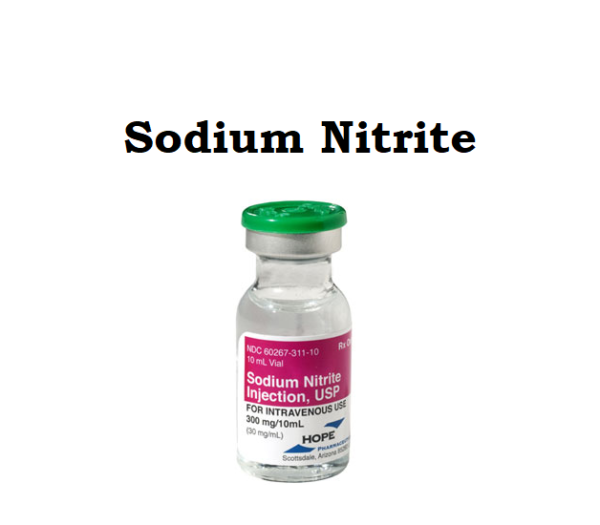
Sodium Nitrite promotes the formation of methemoglobin which then competes with cytochrome oxidase for the cyanide ion.
Sodium nitrite Uses:
-
Cyanide poisoning:
- Treatment of acute, life-threatening cyanide poisoning.
Note:
- The preferred antidote for the treatment of acute cyanide poisoning is hydroxocobalamin, especially in patients who have concurrent carbon monoxide poisoning (eg, smoke inhalation), significant anemia, or G6PD deficiency.
- Sodium nitrite in combination with sodium thiosulfate should be considered only if hydroxocobalamin is unavailable, there is a contraindication to the use of hydroxocobalamin, or if the patient has a known sensitivity to hydroxocobalamin or vitamin B analogs.
Sodium Nitrite Dose in Adults
Sodium Nitrite Dose in the treatment of Cyanide poisoning:
Note:
- Given in conjunction with sodium thiosulfate.
- Administer sodium nitrite first, followed immediately by the administration of sodium thiosulfate: 300 mg (10 mL of 3% solution)
- may repeat at one-half of the original dose if symptoms of cyanide toxicity return back.
- Sodium nitrite is generally discontinued for methemoglobin levels of >30%.
- Alternatively, in patients who are unable to tolerate significant methemoglobinemia (eg, patients with comorbidities that compromise oxygen delivery, such as heart disease, lung disease), dosing may be based on hemoglobin levels (when rapid bedside testing is available) in order to prevent fatal methemoglobinemia; see table:
| Hemoglobin Level (g/dL) | The dose of 3% Sodium Nitrite Solution (maximum dose: 10 mL) |
| 7 | 0.19 mL/kg |
| 8 | 0.22 mL/kg |
| 9 | 0.25 mL/kg |
| 10 | 0.27 mL/kg |
| 11 | 0.3 mL/kg |
| 12 | 0.33 mL/kg |
| 13 | 0.36 mL/kg |
| 14 | 0.39 mL/kg |
Note:
- Monitor the patient for 24 to 48 hours; if symptoms return, repeat sodium nitrite and sodium thiosulfate at one-half the original dose.
Sodium Nitrite Dose in Childrens
Sodium Nitrite Dose in the treatment of Cyanide poisoning:
- 6 mg/kg (0.2 mL/kg or 6-8 mL/m of a 3% solution);
- maximum dose: 300 mg (10 mL of a 3% solution);
- may repeat at one-half of the original dose if symptoms of cyanide toxicity return back.
Note:
- It is given in conjunction with sodium thiosulfate.
- Administer sodium nitrite first, followed by the administration of sodium thiosulfate immediately.
- Treatment is generally discontinued for methemoglobin levels of >30%.
- Alternatively, in patients who are unable to tolerate significant methemoglobinemia (eg, patients with comorbidities that compromise oxygen delivery, such as heart disease, lung disease): Refer to adult dosing.
Note:
- Monitor the patient for 24-48 hours; if symptoms return, repeat sodium nitrite, and sodium thiosulfate at one-half the original dose.
Pregnancy Risk Factor C
- Teratogenic effects have been observed following maternal exposure to high concentrations of the drug in drinking water.
- Teratogenic effects were not observed in animal reproduction studies.
- Embryotoxic and nonteratogenic effects were reported in animal reproduction studies.
- Methemoglobin reductase is lower in the fetus compared to adults and may result in adverse effects due to nitrite-induced prenatal hypoxia.
- In general, medications used as antidotes should take into consideration the health and prognosis of pregnant women;
- Antidotes should be administered to pregnant women if there is a clear indication for use and should not be withheld because of fears of teratogenicity.
Use during breastfeeding:
- It is not known if sodium nitrite is excreted in breast milk.
- The manufacturer recommends that caution be exercised when administering the drug to nursing women.
Sodium Nitrite Dose in Kidney Disease:
- No dosage adjustment provided in the drug manufacturer’s labeling; however, renal elimination of sodium nitrite is significant and the risk of adverse effects may be increased in patients with renal impairment.
Sodium Nitrite Dose in Liver disease:
- No dosage adjustment provided in the drug manufacturer’s labeling. (Has not been studed)
Side effects of Sodium Nitrite:
-
Cardiovascular:
- Cardiac Arrhythmia
- Flushing
- Hypotension
- Palpitations
- Syncope
- Tachycardia
-
Central Nervous System:
- Anxiety
- Coma
- Confusion
- Dizziness
- Fatigue
- Headache
- Numbness
- Paresthesia
- Seizure
- Tingling Sensation (At Injection Site)
-
Dermatologic:
- Diaphoresis
- Urticaria
-
Endocrine & Metabolic:
- Acidosis
-
Gastrointestinal:
- Abdominal Pain
- Nausea
- Vomiting
-
Hematologic & Oncologic:
- Methemoglobinemia
-
Neuromuscular & Skeletal:
- Weakness
-
Ophthalmic:
- Blurred Vision
-
Respiratory:
- Cyanosis
- Dyspnea
- Tachypnea
Contraindications to Sodium nitrite:
- There are no contraindications listed within the manufacturer's labeling.
Warnings and Precautions
-
Hypotension: [US Boxed Warning]:
- It may cause severe lowering of blood pressure resulting in diminished oxygen-carrying capacity;
- serious adverse effects may occur at doses less than twice the recommended therapeutic dose.
- Monitor for adequate perfusion and oxygenation;
- ensure the patient is euvolemic.
- Use with caution in patients where the diagnosis of cyanide poisoning is uncertain, patients with pre-existing diminished oxygen or cardiovascular reserve (eg, smoke inhalation victims, anemia, substantial blood loss, and cardiac or respiratory compromise), and in patients who may be susceptible to injury from vasodilation; the use of hydroxocobalamin is recommended in these patients.
-
Methemoglobinemia: [US Boxed Warning]:
- It may cause methemoglobin formation which is then resulting in diminished oxygen-carrying capacity;
- serious adverse effects may occur at doses less than twice the recommended therapeutic dose.
- Monitor for adequate perfusion and oxygenation.
- Use with caution in patients where the diagnosis of cyanide poisoning is uncertain, patients with pre-existing diminished oxygen or cardiovascular reserve (eg, smoke inhalation victims, anemia, substantial blood loss, and cardiac or respiratory compromise), and in patients who are at greater risk for developing methemoglobinemia (eg, congenital methemoglobin reductase deficiency); the use of hydroxocobalamin is recommended in such patients.
- Use with caution with medications known to cause methemoglobinemia (eg, nitroglycerin, phenazopyridine).
- Treatment is generally discontinued for methemoglobin levels of >30%.
- Intravenous methylene blue and exchange transfusion have been used to treat life-threatening methemoglobinemia.
-
Anemia:
- Use with caution; patients with anemia will form more methemoglobin.
- Dosage reduction in proportion to oxygen-carrying capacity is recommended.
-
Glucose-6-phosphate dehydrogenase deficiency:
- Patients with glucose-6-phosphate dehydrogenase (G6PD) deficiency are at an increased risk for a hemolytic crisis following sodium nitrite administration; consider alternative treatment options if possible.
- Monitor for an acute drop in hematocrit; exchange transfusion may be necessary.
-
Renal impairment:
- Use with caution; sodium nitrite undergoes substantial renal excretion.
- The risk of adverse events may be increased.
Sodium nitrite: Drug Interaction
Note: Drug Interaction Categories:
- Risk Factor C: Monitor When Using Combination
- Risk Factor D: Consider Treatment Modification
- Risk Factor X: Avoid Concomitant Use
Risk Factor C (Monitor therapy) |
|
| Alfuzosin | May enhance the hypotensive effect of Blood Pressure Lowering Agents. |
| Antipsychotic Agents (Second Generation [Atypical]) | Blood Pressure Lowering Agents may enhance the hypotensive effect of Antipsychotic Agents (Second Generation [Atypical]). |
| Barbiturates | May enhance the hypotensive effect of Blood Pressure Lowering Agents. |
| Benperidol | May enhance the hypotensive effect of Blood Pressure Lowering Agents. |
| Blood Pressure Lowering Agents | May enhance the hypotensive effect of HypotensionAssociated Agents. |
| Brimonidine (Topical) | May enhance the hypotensive effect of Blood Pressure Lowering Agents. |
| Dapsone (Topical) | May enhance the adverse/toxic effect of Methemoglobinemia Associated Agents. |
| Diazoxide | May enhance the hypotensive effect of Blood Pressure Lowering Agents. |
| DULoxetine | Blood Pressure Lowering Agents may enhance the hypotensive effect of DULoxetine. |
| Herbs (Hypotensive Properties) | May enhance the hypotensive effect of Blood Pressure Lowering Agents. |
| Hypotension-Associated Agents | Blood Pressure Lowering Agents may enhance the hypotensive effect of Hypotension-Associated Agents. |
| Levodopa-Containing Products | Blood Pressure Lowering Agents may enhance the hypotensive effect of Levodopa-Containing Products. |
| Local Anesthetics | Methemoglobinemia Associated Agents may enhance the adverse/toxic effect of Local Anesthetics. Specifically, the risk for methemoglobinemia may be increased. |
| Lormetazepam | May enhance the hypotensive effect of Blood Pressure Lowering Agents. |
| Methemoglobinemia Associated Agents | May enhance the adverse/toxic effect of Sodium Nitrite. Combinations of these agents may increase the likelihood of significant methemoglobinemia. |
| Molsidomine | May enhance the hypotensive effect of Blood Pressure Lowering Agents. |
| Naftopidil | May enhance the hypotensive effect of Blood Pressure Lowering Agents. |
| Nicergoline | May enhance the hypotensive effect of Blood Pressure Lowering Agents. |
| Nicorandil | May enhance the hypotensive effect of Blood Pressure Lowering Agents. |
| Nitric Oxide | May enhance the adverse/toxic effect of Methemoglobinemia Associated Agents. Combinations of these agents may increase the likelihood of significant methemoglobinemia. Management: Monitor patients for signs of methemoglobinemia (e.g., hypoxia, cyanosis) when nitric oxide is used in combination with other agents associated with development of methemoglobinemia. Avoid lidocaine/prilocaine. |
| Nitroprusside | Blood Pressure Lowering Agents may enhance the hypotensive effect of Nitroprusside. |
| Pentoxifylline | May enhance the hypotensive effect of Blood Pressure Lowering Agents. |
| Pholcodine | Blood Pressure Lowering Agents may enhance the hypotensive effect of Pholcodine. |
| Phosphodiesterase 5 Inhibitors | May enhance the hypotensive effect of Blood Pressure Lowering Agents. |
| Prilocaine | Methemoglobinemia Associated Agents may enhance the adverse/toxic effect of Prilocaine. Combinations of these agents may increase the likelihood of significant methemoglobinemia. Management: Monitor patients for signs of methemoglobinemia (e.g., hypoxia, cyanosis) when prilocaine is used in combination with other agents associated with development of methemoglobinemia. Avoid lidocaine/prilocaine in infants receiving such agents. |
| Prostacyclin Analogues | May enhance the hypotensive effect of Blood Pressure Lowering Agents. |
| Quinagolide | May enhance the hypotensive effect of Blood Pressure Lowering Agents. |
Risk Factor D (Consider therapy modification) |
|
| Amifostine | Blood Pressure Lowering Agents may enhance the hypotensive effect of Amifostine. Management: When amifostine is used at chemotherapy doses, blood pressure lowering medications should be withheld for 24 hours prior to amifostine administration. If blood pressure lowering therapy cannot be withheld, amifostine should not be administered. |
| Obinutuzumab | May enhance the hypotensive effect of Blood Pressure Lowering Agents. Management: Consider temporarily withholding blood pressure lowering medications beginning 12 hours prior to obinutuzumab infusion and continuing until 1 hour after the end of the infusion. |
Risk Factor X (Avoid combination) |
|
| Bromperidol | Blood Pressure Lowering Agents may enhance the hypotensive effect of Bromperidol. Bromperidol may diminish the hypotensive effect of Blood Pressure Lowering Agents. |
Monitoring parameters:
- Monitor for at least 24 to 48 hours after dose administration;
- blood pressure and heart rate during and after infusion;
- hemoglobin/hematocrit;
- co-oximetry;
- serum lactate levels;
- venous-arterial PO gradient;
- serum methemoglobin and oxyhemoglobin.
- Pretreatment cyanide levels may be useful diagnostically, but if the patient is acutely ill, sodium nitrite therapy should not be delayed while awaiting laboratory results.
How to administer Sodium nitrite?
- IV: Administer via slow IV injection (2.5 to 5 mL/minute) as soon as possible after the diagnosis of acute, life-threatening cyanide poisoning;
- follow immediately with the administration of sodium thiosulfate.
- Decrease the rate of infusion in the event of significant hypotension.
Mechanism of action of Sodium nitrite:
- It promotes the formation of methemoglobin which then competes with cytochrome oxidase for the cyanide ion.
- Cyanide combines with methemoglobin and forms cyano methemoglobin, hence freeing the cytochrome oxidase and allowing aerobic metabolism to continue.
Onset: Peak effect:
- Methemoglobinemia: 30 to 60 minutes
Duration of action:
- Methemoglobinemia: ~55 minutes
Metabolism:
- To ammonia and other metabolites
Excretion:
- Urine (~40% as unchanged drug)
International Brands of Sodium nitrite:
- Sodium Nitrite Injection
Sodium nitrite Brand Names in Pakistan:
No Brands Available in Pakistan.
.png)