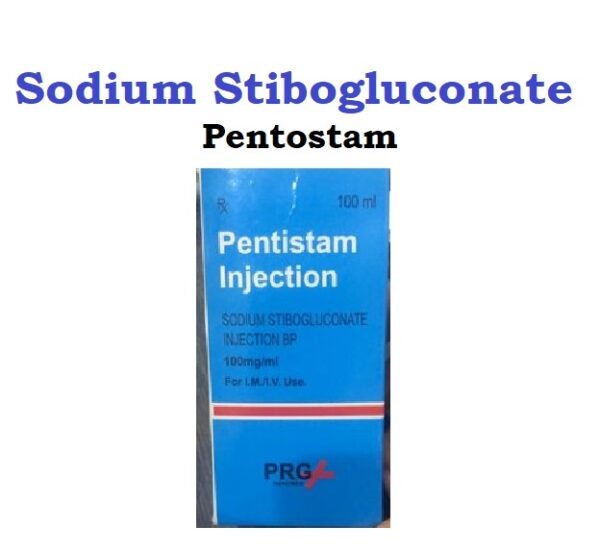
Sodium Stibogluconate (Pentostam) Injection is an anti-protozoal drug. It is a synthetic pentavalent antimonial agent that is indicated for the treatment of leishmaniasis.
Sodium Stibogluconate (Pentostam) Uses:
-
Leishmaniasis:
- Cutaneous, mucosal & visceral leishmaniasis treatment.
Sodium Stibogluconate (Pentostam) Dose in Adults
- Dosage is expressed as mg of pentavalent antimony.
Sodium Stibogluconate (Pentostam) Dose in the treatment of Leishmaniasis:
- IM/IV:
- 20 mg/kg/day.
- For cutaneous leishmaniasis, the duration of therapy is 20 days & 28 days for mucosal & visceral leishmaniasis.
Use in Children:
- Refer to adult dosing.
Sodium Stibogluconate (Pentostam) Pregnancy Risk Category: C
- The use of sodium stibogluconate in pregnancy has been documented.
- However, spontaneous abortions may be more likely than with other agents.
- Untreated leishmaniasis can also cause spontaneous abortion.
- Also, babies who are too small to be diagnosed with congenital leishmaniasis at gestational age 7 may experience spontaneous abortion.
- Pregnancy may activate an existing maternal infection.
- Maternal infection can be transmitted to the baby during delivery.
- Lesions in cutaneous Leishmaniasis can be more severe in pregnant women.
- Other agents may be recommended for pregnant women to treat visceral Leishmaniasis.
Sodium stibogluconate use during breastfeeding:
- Breast milk contains sodium stibogluconate.
Pentostam Dose in Kidney Disease:
- Avoid use in significant impairment.
Pentostam Dose in Liver disease:
- Avoid use.
Side Effects of Sodium Stibogluconate (Pentostam):
-
Gastrointestinal:
- Diarrhea
- Nausea
- Vomiting
- Abdominal pain
- Anorexia
- Increase serum lipase levels
-
Cardiovascular:
- Flattened T Wave On ECG
- Inversion T Wave On ECG
- Prolonged Q-T Interval On ECG
-
Central Nervous System:
- Headache
- Lethargy
- Malaise
-
Endocrine & Metabolic:
- Increased Amylase
-
Hematologic & Oncologic:
- Change In Platelet Count (Decreased; Transient)
- Decreased Hemoglobin (Transient)
- Decreased White Blood Cell Count (Transient)
-
Neuromuscular & Skeletal:
- Arthralgia
- Myalgia
-
Respiratory:
- Cough (Transient)
- Pneumonia
Contraindication to Sodium Stibogluconate (Pentostam):
Hypersensitivity reactions to any drug or component of the formulations should be avoided. Advanced liver and kidney disease.
Warnings and precautions
-
Modified cardiac conduction
- ECG changes such as T-wave inversions, extended QT intervals and arrhythmia can occur. They appear to be dose and duration dependent.
- Reports of sudden death and cardiotoxicity have been rare.
- Stop immediately if a QT interval corrected >0.5 seconds is prolonged or any other signs of cardiotoxicity, such as significant arrhythmia, concave segments ST segments, or prolongation.
-
Hematologic effects
- Anemia, leukopenia and thrombocytopenia can occur during treatment.
- Monitor CBC periodically.
- If possible, iron deficiency should first be corrected before therapy can begin.
-
Hepatotoxicity:
- Elevated liver enzymes can occur.
- It is important to monitor LFTs regularly.
- If hepatotoxicity develops, discontinue use.
-
Musculoskeletal effects
- Myalgias and arthralgias can occur. Sometimes, they are severe and last for several weeks.
-
Pancreatitis
- Common symptoms are pancreatic enzyme elevations.
- Although less common, pancreatitis can occur.
- Patients with preexisting pancreatic diseases should be avoided.
-
Cardiac disease
- Patients with pre-existing heart disease should be avoided.
-
Hepatic impairment
- Patients with preexisting liver disease should be avoided.
-
Renal impairment
- Patients with severe renal impairment should not use this medication.
Sodium stibogluconate (United States: Available via CDC drug service investigational drug [IND] protocol only)s: Drug Interaction
|
Chloroquine |
QT-prolonging Miscellaneous Agents (Moderate Risk) may enhance the QTcprolonging effect of Chloroquine. Management: Monitor for QTc interval prolongation and ventricular arrhythmias when these agents are combined. Patients with additional risk factors for QTc prolongation may be at even higher risk. |
|
Clofazimine |
QT-prolonging Miscellaneous Agents (Moderate Risk) may enhance the QTcprolonging effect of Clofazimine. Management: Monitor for QTc interval prolongation and ventricular arrhythmias when these agents are combined. Patients with additional risk factors for QTc prolongation may be at even higher risk. |
|
Gadobenate Dimeglumine |
QT-prolonging Miscellaneous Agents (Moderate Risk) may enhance the QTc-prolonging effect of Gadobenate Dimeglumine. Management: Monitor for QTc interval prolongation and ventricular arrhythmias when these agents are combined. Patients with additional risk factors for QTc prolongation may be at even higher risk. |
|
Halofantrine |
QT-prolonging Miscellaneous Agents (Moderate Risk) may enhance the QTcprolonging effect of Halofantrine. Management: Monitor for QTc interval prolongation and ventricular arrhythmias when these agents are combined. Patients with additional risk factors for QTc prolongation may be at even higher risk. |
|
Haloperidol |
QT-prolonging Miscellaneous Agents (Moderate Risk) may enhance the QTcprolonging effect of Haloperidol. Management: Monitor for QTc interval prolongation and ventricular arrhythmias when these agents are combined. Patients with additional risk factors for QTc prolongation may be at even higher risk. |
|
Lofexidine |
QT-prolonging Miscellaneous Agents (Moderate Risk) may enhance the QTcprolonging effect of Lofexidine. Management: Monitor for QTc interval prolongation and ventricular arrhythmias when these agents are combined. Patients with additional risk factors for QTc prolongation may be at even higher risk. |
|
Midostaurin |
QT-prolonging Miscellaneous Agents (Moderate Risk) may enhance the QTcprolonging effect of Midostaurin. Management: Monitor for QTc interval prolongation and ventricular arrhythmias when these agents are combined. Patients with additional risk factors for QTc prolongation may be at even higher risk. |
|
Ondansetron |
QT-prolonging Miscellaneous Agents (Moderate Risk) may enhance the QTcprolonging effect of Ondansetron. Management: Monitor for QTc interval prolongation and ventricular arrhythmias when these agents are combined. Patients with additional risk factors for QTc prolongation may be at even higher risk. |
|
Pentamidine (Systemic) |
QT-prolonging Miscellaneous Agents (Moderate Risk) may enhance the QTc-prolonging effect of Pentamidine (Systemic). Management: Monitor for QTc interval prolongation and ventricular arrhythmias when these agents are combined. Patients with additional risk factors for QTc prolongation may be at even higher risk. |
|
Piperaquine |
QT-prolonging Miscellaneous Agents (Moderate Risk) may enhance the QTcprolonging effect of Piperaquine. Management: Monitor for QTc interval prolongation and ventricular arrhythmias when these agents are combined. Patients with additional risk factors for QTc prolongation may be at even higher risk. |
|
Probucol |
QT-prolonging Miscellaneous Agents (Moderate Risk) may enhance the QTcprolonging effect of Probucol. Management: Monitor for QTc interval prolongation and ventricular arrhythmias when these agents are combined. Patients with additional risk factors for QTc prolongation may be at even higher risk. |
|
QT-prolonging Antidepressants (Moderate Risk) |
May enhance the QTc-prolonging effect of QTprolonging Miscellaneous Agents (Moderate Risk). Management: Monitor for QTc interval prolongation and ventricular arrhythmias when these agents are combined. Patients with additional risk factors for QTc prolongation may be at even higher risk. |
|
QT-prolonging Antipsychotics (Moderate Risk) |
QT-prolonging Miscellaneous Agents (Moderate Risk) may enhance the QTc-prolonging effect of QT-prolonging Antipsychotics (Moderate Risk). Management: Monitor for QTc interval prolongation and ventricular arrhythmias when these agents are combined. Patients with additional risk factors for QTc prolongation may be at even higher risk. Exceptions: Pimozide. |
|
QT-prolonging Class IC Antiarrhythmics (Moderate Risk) |
QT-prolonging Miscellaneous Agents (Moderate Risk) may enhance the QTc-prolonging effect of QT-prolonging Class IC Antiarrhythmics (Moderate Risk). Management: Monitor for QTc interval prolongation and ventricular arrhythmias when these agents are combined. Patients with additional risk factors for QTc prolongation may be at even higher risk. |
|
QT-prolonging Kinase Inhibitors (Moderate Risk) |
May enhance the QTc-prolonging effect of QTprolonging Miscellaneous Agents (Moderate Risk). Management: Monitor for QTc interval prolongation and ventricular arrhythmias when these agents are combined. Patients with additional risk factors for QTc prolongation may be at even higher risk. |
|
QT-prolonging Miscellaneous Agents (Moderate Risk) |
May enhance the QTc-prolonging effect of Sodium Stibogluconate. Management: Monitor for QTc interval prolongation and ventricular arrhythmias when these agents are combined. Patients with additional risk factors for QTc prolongation may be at even higher risk. Exceptions: Chloroquine; Clofazimine; Domperidone; Gadobenate Dimeglumine; Halofantrine; Lofexidine; Midostaurin; Piperaquine; Probucol. |
|
QT-prolonging Moderate CYP3A4 Inhibitors (Moderate Risk) |
May enhance the QTc-prolonging effect of QT-prolonging Miscellaneous Agents (Moderate Risk). QT-prolonging Moderate CYP3A4 Inhibitors (Moderate Risk) may increase the serum concentration of QT-prolonging Miscellaneous Agents (Moderate Risk). Management: Monitor for QTc interval prolongation and ventricular arrhythmias when these agents are combined. Patients with additional risk factors for QTc prolongation may be at even higher risk. |
|
QT-prolonging Quinolone Antibiotics (Moderate Risk) |
QT-prolonging Miscellaneous Agents (Moderate Risk) may enhance the QTc-prolonging effect of QT-prolonging Quinolone Antibiotics (Moderate Risk). Management: Monitor for QTc interval prolongation and ventricular arrhythmias when these agents are combined. Patients with additional risk factors for QTc prolongation may be at even higher risk. |
|
Amphotericin B |
May enhance the cardiotoxic effect of Sodium Stibogluconate. |
|
Amphotericin B (Conventional) |
May enhance the cardiotoxic effect of Sodium Stibogluconate. Specifically, arrhythmia and sudden cardiac death risks may be increased. |
|
Domperidone |
QT-prolonging Agents (Moderate Risk) may enhance the QTc-prolonging effect of Domperidone. Management: Consider alternatives to this drug combination. If combined, monitor for QTc interval prolongation and ventricular arrhythmias. Patients with additional risk factors for QTc prolongation may be at even higher risk. |
|
QT-prolonging Agents (Highest Risk) |
May enhance the QTc-prolonging effect of Sodium Stibogluconate. Management: Consider alternatives to this combination. If combined, monitor for QTc interval prolongation and ventricular arrhythmias. Patients with additional risk factors for QTc prolongation may be at even higher risk. |
|
Pimozide |
May enhance the QTc-prolonging effect of QT-prolonging Agents (Moderate Risk). |
|
QT-prolonging Strong CYP3A4 Inhibitors (Moderate Risk) |
May enhance the QTc-prolonging effect of QT-prolonging Miscellaneous Agents (Moderate Risk). QT-prolonging Strong CYP3A4 Inhibitors (Moderate Risk) may increase the serum concentration of QT-prolonging Miscellaneous Agents (Moderate Risk). |
Monitoring parameters:
- Baseline & weekly EKG, serum creatinine, liver function tests, serum amylase & CBC.
- During week 3 of therapy, patients requiring >20 days of treatment should begin twice-weekly EKG monitoring.
- In certain patients, twice-weekly or more frequent EKG monitoring may be indicated (eg, elderly, underlying cardiac, renal, or hepatic disease).
How to administer Sodium Stibogluconate (Pentostam)?
- IM/IV:
- Administer IM or IV (preferred) over 5-10 mins.
- IM injection may be painful because volume per dose may be large.
Mechanism of action of Sodium Stibogluconate (Pentostam):
- It is not known what the exact mechanism of action is.
- The proposed mechanisms include the conversion to a trivalent antimony form that affects glucose metabolism, fatty acids beta-oxidation, and adenosine triphosphate formation.
- It can cause the formation of a complex containing adenine nucleotides that acts as an inhibitor for Leishmania purine transporters, or interfere with purine salvage pathway.
- Activation and stimulation of the host immune system.
Absorption:
- IM:
- Well absorbed.
Half-life elimination:
- ~10 hours.
Excretion:
- Urine (80% as an unchanged drug over 6 hours)
International Brands of Sodium Stibogluconate:
- Pentostam
- Stibovita
Sodium Stibogluconate Brand Names in Pakistan:
Sodium Stibogluconate Injection 333 mg |
|
| Stibotim | Star Laboratories (Pvt) Ltd. |
.png)


