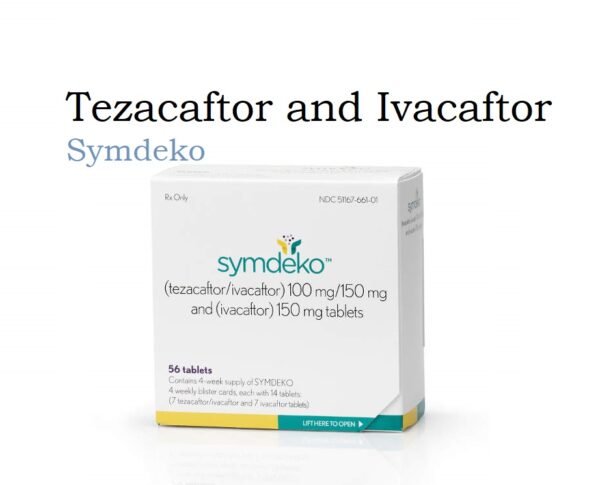
Symdeko is a combination of two drugs Tezacaftor and Ivacaftor approved for the treatment of patients with cystic fibrosis with at least two mutations as mentioned below.
Tezacaftor and ivacaftor Uses:
-
Cystic fibrosis:
- Treatment of patients with cystic fibrosis who are:
- ≥6 years of age
- homozygous for the F508del mutation or
- having at least one mutation in the cystic fibrosis transmembrane conductance regulator (CFTR) gene i.e responsive to tezacaftor/ivacaftor on the basis of in vitro data and/or clinical evidence.
- Treatment of patients with cystic fibrosis who are:
Note: CFTR gene mutations that produce CFTR protein and are responsive to tezacaftor/ivacaftor are listed below:
- A455E,
- A1067T,
- D110E,
- D110H,
- D579G,
- D1152H,
- D1270N,
- E56K,
- E193K,
- E831X,
- F1052V,
- F1074L,
- F508del (two copies of mutation or at least 1 copy of a responsive mutation),
- K1060T,
- L206W,
- P67L,
- R74W,
- R1070W,
- R117C,
- R347H,
- R352Q,
- 51070W,
- S945L,
- S977F,
- 711+3A→G,
- 2789+5G→A,
- 3272-26A→G,
- 3849+10kbC→T.
Tezacaftor and Ivacaftor (Symdeko) Dose in Adults
Note: Symdeko is supplied as co-packaged:
- Yellow tablets tezacaftor 100 mg/ivacaftor 150 mg fixed-dose combination and
- Light blue tablets ivacaftor 150 mg .
Tezacaftor and Ivacaftor (Symdeko) Dose in the treatment of Cystic fibrosis:
- Oral: Tezacaftor 100 mg/ivacaftor 150 mg in the morning and ivacaftor 150 mg in the evening, approximately 12 hours apart.
-
Missed dose:
- Take the dose as soon as possible, if a dose is missed ≤6 hours of the usual time it is taken.
- if >6 hours have passed since the missed dose, skip the missed dose and resume the normal dosing schedule.
-
Tezacaftor and Ivacaftor (Symdeko) Dosage adjustment with concomitant medications:
-
Coadministration with moderate CYP3A inhibitors (eg, erythromycin, fluconazole):
- On day 1, administer tezacaftor 100 mg/ivacaftor 150 mg once per day in the morning, and
- on day 2, administer ivacaftor 150 mg once per day in the morning; continue this regimen with tezacaftor 100 mg/ivacaftor 150 mg or ivacaftor 150 mg on alternate days in the morning; the dose of ivacaftor 150 mg at evening should not be given.
-
Coadministration with strong CYP3A inhibitors (eg, clarithromycin, itraconazole, ketoconazole, posaconazole, telithromycin, voriconazole):
- On day 1, administer tezacaftor 100 mg/ivacaftor 150 mg once per day in the morning.
- do not administer any tablets on days 2 and 3;
- on day 4, administer tezacaftor 100 mg/ivacaftor 150 mg once per day in the morning.
- Continue dosing with tezacaftor 100 mg/ivacaftor 150 tablets twice a week, administered almost 3 to 4 days apart;
- the dose of ivacaftor 150 mg in the evening should not be administered.
-
Tezacaftor and Ivacaftor (Symdeko) Dose in Childrens
Note: Symdeko is marketed as two separate products packaged together:
- tezacaftor/ivacaftor tablets in a fixed-dose combination and
- ivacaftor tablets;
- use caution when selecting dosage form;
- multiple strengths are available.
Tezacaftor and Ivacaftor (Symdeko) Dose in the treatment of Cystic fibrosis:
-
Children ≥6 years to <12 years weighing <30 kg:
- Oral: Tezacaftor 50 mg/ivacaftor 75 mg (1 tablet) in the morning and ivacaftor 75 mg in the evening, approximately 12 hours apart.
-
Children ≥6 years to <12 years weighing ≥30 kg, Children ≥12 years, and Adolescents:
- Oral: Tezacaftor 100 mg/ivacaftor 150 mg (1 tablet) in the morning and ivacaftor 150 mg in the evening, approximately 12 hours apart.
-
Missed dose:
- Take the dose as soon as possible, if a dose is missed ≤6 hours of the usual time it is taken;
- if >6 hours have passed since the missed dose, skip the missed dose and resume the normal dosing schedule.
-
Dosing adjustment with concomitant medications:
-
Coadministration with moderate CYP3A inhibitors (eg, erythromycin, fluconazole):
-
Children ≥6 years to <12 years weighing <30 kg:
- An alternating schedule is necessary;
- on day 1, administer tezacaftor 50 mg/ivacaftor 75 mg once daily in the morning, and
- on day 2, administer ivacaftor 75 mg only once daily in the morning;
- continue this dosing schedule with tezacaftor 50 mg/ivacaftor 75 mg or ivacaftor 75 mg on alternate days in the morning; no evening dose of ivacaftor 75 mg should be administered on any day.
-
Children ≥6 years to <12 years weighing ≥30 kg, Children ≥12 years, and Adolescents:
- An alternating schedule is necessary;
- on day 1, administer tezacaftor 100 mg/ivacaftor 150 mg once in a day in the morning, and
- on day 2, administer ivacaftor 150 mg only once daily in the morning;
- continue this dosing schedule with tezacaftor 100 mg/ivacaftor 150 mg or ivacaftor 150 mg on alternate days in the morning; no evening dose of ivacaftor 150 mg should be administered on any day.
-
-
Coadministration with strong CYP3A inhibitors (eg, clarithromycin, itraconazole, ketoconazole, posaconazole, telithromycin, voriconazole):
-
Children ≥6 years to <12 years weighing <30 kg:
- Twice-weekly schedule:
- On day 1, administer tezacaftor 50 mg/ivacaftor 75 mg once daily in the morning;
- do not administer any tablets on days 2 and 3;
- on day 4, administer tezacaftor 50 mg/ivacaftor 75 mg once daily in the morning.
- Continue dosing with tezacaftor 50 mg/ivacaftor 75 tablets twice a week, administered approximately 3 to 4 days apart;
- no evening dose of ivacaftor 75 mg should be administered on any day.
-
Children ≥6 years to <12 years weighing ≥ 30 kg, Children ≥12 years, and Adolescents:
- Twice-weekly schedule:
- On day 1, administer tezacaftor 100 mg/ivacaftor 150 mg once per day in the morning.
- do not administer any tablets on days 2 and 3;
- on day 4, administer tezacaftor 100 mg/ivacaftor 150 mg once per day in the morning.
- Continue dosing with tezacaftor 100 mg/ivacaftor 150 tablets twice a week, administered approximately 3 to 4 days apart;
- no evening dose of ivacaftor 150 mg should be administered on any day.
-
-
Pregnancy Risk Category: B3
- Ivacaftor passes the placental barrier
- For more information, refer to the ivacaftor Monograph.
Use of ivacaftor or zacaftor during lactation
- Ivacaftor can be found in breast milk (Trimble 2018, 2018); the excretion of Tezacaftor has not been determined.
- Consider these factors when deciding whether to breastfeed during therapy:
- The risk of infant exposure
- The benefits of breastfeeding your infant
- The mother can reap the benefits of treatment.
- For more information, refer to the ivacaftor Monograph.
Tezacaftor and Ivacaftor (Symdeko) Dose in Kidney Disease:
-
CrCl >30 mL/minute:
- No adjustment in dosage is necessary.
-
CrCl ≤30 mL/minute:
- There are no dosage adjustments provided in the manufacturer's labeling (has not been studied); use with caution.
-
ESRD:
- There are no dosage adjustments provided in the manufacturer's labeling (has not been studied); use with caution.
Tezacaftor and Ivacaftor (Symdeko) Dose in Liver disease:
-
Hepatic impairment prior to treatment initiation:
-
Mild impairment (Child-Pugh class A):
- No adjustment in dosage is necessary.
-
Moderate impairment (Child-Pugh class B):
- Tezacaftor 100 mg/ivacaftor 150 mg once per day in the morning.
- The dose of ivacaftor 150 mg in the evening should not be administered.
-
Severe impairment (Child-Pugh class C):
- Tezacaftor 100 mg/ivacaftor 150 mg once per day in the morning (or less frequently).
- The dose of ivacaftor 150 mg in the evening should not be administered.
-
-
Hepatotoxicity during treatment:
-
ALT or AST >5 × ULN without concomitant elevated bilirubin:
- Temporarily discontinue tezacaftor/ivacaftor;
- may resume if elevated transaminases resolved and
- after assessing benefits versus risks of continued treatment.
-
ALT or AST >3 × ULN with concomitant bilirubin >2 × ULN:
- Temporarily discontinue tezacaftor/ivacaftor;
- may resume if elevated transaminases resolved and
- after assessing benefits versus risks of continued treatment.
-
Common Side Effects of Tezacaftor and Ivacaftor (Symdeko):
-
Central nervous system:
- Headache
Less Common Side Effects of Tezacaftor and Ivacaftor (Symdeko):
-
Central nervous system:
- Dizziness
-
Gastrointestinal:
- Nausea
-
Respiratory:
- Paranasal sinus congestion
Contraindications to Tezacaftor and Ivacaftor (Symdeko):
Hypersensitivity to ivacaftor or tezacaftor or any other component of the formulation
Warnings and precautions
-
Cataracts
- Children who received treatment with ivacaftor/tezacaftor have reported noncongenital lenses opacities and cataracts.
- Other risk factors, such as corticosteroid use and radiation exposure, were also present in certain cases, but there is no way to rule out a potential risk from tezacaftor/ivacaftor.
- Patients with such conditions are advised to have follow-up and Baseline ophthalmological exams.
-
CNS effects
- Dizziness can cause dizziness which may lead to impairment of mental or physical abilities.
- Patients must be educated and counseled on how to perform tasks that require mental alertness (eg driving, operating machinery).
-
Hepatic effects
- May increase liver transaminases.
- Monitor ALT, AST and bilirubin at baseline every 3 months during the first year of therapy and annually thereafter.
- Patients with elevated liver transaminases may require increased monitoring.
- Temporarily stop treatment if ALT/AST >5x ULN, or ALT/AST >3x ULN with concomitant Bilirubin >2x ULN.
- Consider the risks and benefits of resuming treatment after transaminase elevations have been resolved.
-
Hepatic impairment
- Patients with hepatic impairment should be cautious; dose adjustment is recommended for patients with moderate to severe (Childugh class B orC) impairment.
-
Renal impairment
- Patients with severe impairment (CrCl =30mL/minute or ESRD) should be cautious.
Tezacaftor and ivacaftor: Drug Interaction
|
ARIPiprazole |
CYP3A4 Inhibitors (Weak) may increase the serum concentration of ARIPiprazole. Management: Monitor for increased aripiprazole pharmacologic effects. Aripiprazole dose adjustments may or may not be required based on concomitant therapy and/or indication. Consult full interaction monograph for specific recommendations. |
|
Bosentan |
May decrease the serum concentration of CYP3A4 Substrates (High risk with Inducers). |
|
Brentuximab Vedotin |
P-glycoprotein/ABCB1 Inhibitors may increase the serum concentration of Brentuximab Vedotin. Specifically, concentrations of the active monomethyl auristatin E (MMAE) component may be increased. |
|
Celiprolol |
P-glycoprotein/ABCB1 Inhibitors may increase the serum concentration of Celiprolol. |
|
Clofazimine |
May increase the serum concentration of CYP3A4 Substrates (High risk with Inhibitors). |
|
CYP3A4 Inducers (Moderate) |
May decrease the serum concentration of CYP3A4 Substrates (High risk with Inducers). |
|
Deferasirox |
May decrease the serum concentration of CYP3A4 Substrates (High risk with Inducers). |
|
Dofetilide |
CYP3A4 Inhibitors (Weak) may increase the serum concentration of Dofetilide. |
|
Erdafitinib |
May decrease the serum concentration of CYP3A4 Substrates (High risk with Inducers). |
|
Erdafitinib |
May increase the serum concentration of CYP3A4 Substrates (High risk with Inhibitors). |
|
Everolimus |
P-glycoprotein/ABCB1 Inhibitors may increase the serum concentration of Everolimus. |
|
Flibanserin |
CYP3A4 Inhibitors (Weak) may increase the serum concentration of Flibanserin. |
|
Fosaprepitant |
May increase the serum concentration of CYP3A4 Substrates (High risk with Inhibitors). |
|
Ivosidenib |
May decrease the serum concentration of CYP3A4 Substrates (High risk with Inducers). |
|
Larotrectinib |
May increase the serum concentration of CYP3A4 Substrates (High risk with Inhibitors). |
|
Larotrectinib |
P-glycoprotein/ABCB1 Inhibitors may increase the serum concentration of Larotrectinib. |
|
Naldemedine |
P-glycoprotein/ABCB1 Inhibitors may increase the serum concentration of Naldemedine. |
|
Naloxegol |
P-glycoprotein/ABCB1 Inhibitors may increase the serum concentration of Naloxegol. |
|
NiMODipine |
CYP3A4 Inhibitors (Weak) may increase the serum concentration of NiMODipine. |
|
Palbociclib |
May increase the serum concentration of CYP3A4 Substrates (High risk with Inhibitors). |
|
P-glycoprotein/ABCB1 Substrates |
P-glycoprotein/ABCB1 Inhibitors may increase the serum concentration of P-glycoprotein/ABCB1 Substrates. P-glycoprotein inhibitors may also enhance the distribution of p-glycoprotein substrates to specific cells/tissues/organs where p-glycoprotein is present in large amounts (e.g., brain, T-lymphocytes, testes, etc.). Exceptions: Loperamide. |
|
Prucalopride |
P-glycoprotein/ABCB1 Inhibitors may increase the serum concentration of Prucalopride. |
|
Ranolazine |
P-glycoprotein/ABCB1 Inhibitors may increase the serum concentration of Ranolazine. |
|
Rifabutin |
May decrease the serum concentration of Ivacaftor. |
|
RifAXIMin |
P-glycoprotein/ABCB1 Inhibitors may increase the serum concentration of RifAXIMin. |
|
Sarilumab |
May decrease the serum concentration of CYP3A4 Substrates (High risk with Inducers). |
|
Silodosin |
P-glycoprotein/ABCB1 Inhibitors may increase the serum concentration of Silodosin. |
|
Siltuximab |
May decrease the serum concentration of CYP3A4 Substrates (High risk with Inducers). |
|
Simeprevir |
May increase the serum concentration of CYP3A4 Substrates (High risk with Inhibitors). |
|
Talazoparib |
P-glycoprotein/ABCB1 Inhibitors may increase the serum concentration of Talazoparib. Management: These listed exceptions are discussed in detail in separate interaction monographs. |
|
Tegaserod |
P-glycoprotein/ABCB1 Inhibitors may increase the serum concentration of Tegaserod. |
|
Tocilizumab |
May decrease the serum concentration of CYP3A4 Substrates (High risk with Inducers). |
|
Risk Factor D (Consider therapy modification) |
|
|
Afatinib |
P-glycoprotein/ABCB1 Inhibitors may increase the serum concentration of Afatinib. Management: Reduce afatinib by 10 mg if not tolerated. Some non-US labeling recommends avoiding combination if possible. Iif used, administer the P-gp inhibitor simultaneously with or after the dose of afatinib. |
|
Betrixaban |
P-glycoprotein/ABCB1 Inhibitors may increase the serum concentration of Betrixaban. Management: Decrease the adult betrixaban dose to an initial single dose of 80 mg followed by 40 mg once daily if combined with a P-glycoprotein inhibitor. |
|
Bilastine |
P-glycoprotein/ABCB1 Inhibitors may increase the serum concentration of Bilastine. Management: Consider alternatives when possible; bilastine should be avoided in patients with moderate to severe renal insufficiency who are receiving p-glycoprotein inhibitors. |
|
Colchicine |
|
|
CYP3A4 Inhibitors (Moderate) |
May increase the serum concentration of Ivacaftor. Management: Ivacaftor dose reductions are required; consult full monograph content for specific age- and weight-based recommendations. No dose adjustment is needed when using ivacaftor/lumacaftor with a moderate CYP3A4 inhibitor. |
|
CYP3A4 Inhibitors (Moderate) |
May increase the serum concentration of Tezacaftor. Management: When combined with moderate CYP3A4 inhibitors, tezacaftor/ivacaftor should be given in the morning, every other day. Ivacaftor alone should be given in the morning, every other day on alternate days from tezacaftor/ivacaftor. |
|
CYP3A4 Inhibitors (Strong) |
May increase the serum concentration of Ivacaftor. Management: Ivacaftor dose reductions are required; consult full monograph content for specific age- and weight-based recommendations. |
|
CYP3A4 Inhibitors (Strong) |
May increase the serum concentration of Tezacaftor. Management: When combined with strong CYP3A4 inhibitors, tezacaftor/ivacaftor should be administered in the morning, twice a week, approximately 3 to 4 days apart. No evening doses of ivacaftor alone should be administered. |
|
Dabigatran Etexilate |
P-glycoprotein/ABCB1 Inhibitors may increase serum concentrations of the active metabolite(s) of Dabigatran Etexilate. Management: Dabigatran dose reductions may be needed. Specific recommendations vary considerably according to US vs Canadian labeling, specific P-gp inhibitor, renal function, and indication for dabigatran treatment. Refer to full monograph or dabigatran labeling. |
|
Dabrafenib |
May decrease the serum concentration of CYP3A4 Substrates (High risk with Inducers). Management: Seek alternatives to the CYP3A4 substrate when possible. If concomitant therapy cannot be avoided, monitor clinical effects of the substrate closely (particularly therapeutic effects). |
|
DOXOrubicin (Conventional) |
P-glycoprotein/ABCB1 Inhibitors may increase the serum concentration of DOXOrubicin (Conventional). Management: Seek alternatives to P-glycoprotein inhibitors in patients treated with doxorubicin whenever possible. One U.S. manufacturer (Pfizer Inc.) recommends that these combinations be avoided. |
|
Edoxaban |
P-glycoprotein/ABCB1 Inhibitors may increase the serum concentration of Edoxaban. Management: See full monograph for details. Reduced doses are recommended for patients receiving edoxaban for venous thromboembolism in combination with certain P-gp inhibitors. Similar dose adjustment is not recommended for edoxaban use in atrial fibrillation. |
|
Lefamulin |
P-glycoprotein/ABCB1 Inhibitors may increase the serum concentration of Lefamulin. Management: Avoid concomitant use of lefamulin tablets with P-glycoprotein/ABCB1 inhibitors. If concomitant use is required, monitor for lefamulin adverse effects. |
|
Lomitapide |
CYP3A4 Inhibitors (Weak) may increase the serum concentration of Lomitapide. Management: Patients on lomitapide 5 mg/day may continue that dose. Patients taking lomitapide 10 mg/day or more should decrease the lomitapide dose by half. The lomitapide dose may then be titrated up to a max adult dose of 30 mg/day. |
|
Lorlatinib |
May decrease the serum concentration of CYP3A4 Substrates (High risk with Inducers). Management: Avoid concurrent use of lorlatinib with any CYP3A4 substrates for which a minimal decrease in serum concentrations of the CYP3A4 substrate could lead to therapeutic failure and serious clinical consequences. |
|
MiFEPRIStone |
May increase the serum concentration of CYP3A4 Substrates (High risk with Inhibitors). Management: Minimize doses of CYP3A4 substrates, and monitor for increased concentrations/toxicity, during and 2 weeks following treatment with mifepristone. Avoid cyclosporine, dihydroergotamine, ergotamine, fentanyl, pimozide, quinidine, sirolimus, and tacrolimus. |
|
Stiripentol |
May increase the serum concentration of CYP3A4 Substrates (High risk with Inhibitors). Management: Use of stiripentol with CYP3A4 substrates that are considered to have a narrow therapeutic index should be avoided due to the increased risk for adverse effects and toxicity. Any CYP3A4 substrate used with stiripentol requires closer monitoring. |
|
Venetoclax |
P-glycoprotein/ABCB1 Inhibitors may increase the serum concentration of Venetoclax. Management: Consider a venetoclax dose reduction by at least 50% in patients requiring concomitant treatment with P-glycoprotein (P-gp) inhibitors. |
|
Risk Factor X (Avoid combination) |
|
|
Bitter Orange |
May increase the serum concentration of Ivacaftor. |
|
Conivaptan |
May increase the serum concentration of CYP3A4 Substrates (High risk with Inhibitors). |
|
CYP3A4 Inducers (Strong) |
May decrease the serum concentration of Ivacaftor. |
|
Fusidic Acid (Systemic) |
May increase the serum concentration of CYP3A4 Substrates (High risk with Inhibitors). |
|
Grapefruit Juice |
May increase the serum concentration of Ivacaftor. |
|
Idelalisib |
May increase the serum concentration of CYP3A4 Substrates (High risk with Inhibitors). |
|
PAZOPanib |
P-glycoprotein/ABCB1 Inhibitors may increase the serum concentration of PAZOPanib. |
|
Pimozide |
CYP3A4 Inhibitors (Weak) may increase the serum concentration of Pimozide. |
|
St John's Wort |
May decrease the serum concentration of Ivacaftor. |
|
Topotecan |
P-glycoprotein/ABCB1 Inhibitors may increase the serum concentration of Topotecan. |
|
VinCRIStine (Liposomal) |
P-glycoprotein/ABCB1 Inhibitors may increase the serum concentration of VinCRIStine (Liposomal). |
Monitoring parameters:
- CF mutation test (prior to therapy if the genotype is unknown);
- ophthalmological examinations (baseline and follow-up in pediatric patients);
- ALT and AST (baseline, every 3 months for the first year of therapy, and annually thereafter; increased monitoring may be necessary for patients with a history of elevated hepatic transaminases or bilirubin).
How to administer Tezacaftor and Ivacaftor (Symdeko)?
- Swallow the tablets whole.
- Administer with fat-containing food (eg, eggs, butter, oils, cheese, nuts, peanut butter, meats, whole-milk dairy products).
- Food or drink containing grapefruit or Seville oranges should be avoided.
Mechanism of action of Tezacaftor and Ivacaftor (Symdeko):
Tezacaftor
- It facilitates the cellular processing of select mutant and normal forms of CFTR (including F508delCFTR), to increase the amount of mature CFTR protein delivered directly to the cell's surface.
Ivacaftor:
- This is a CFTR Potentiator, which increases chloride transport by increasing the channel-open probability (or gating), of the CFTR protein at cell surface.
Absorption:
- Ivacaftor and tezacaftor: Variable; increased (by almost 3-fold) when administered with fatty foods.
Protein binding:
- Ivacaftor: ~99%; primarily to alpha -acid glycoprotein and albumin
- Tezacaftor: ~99%; primarily to albumin
Metabolism:
- Ivacaftor:
- Hepatic metabolism is extensive via CYP3A and CYP3A5; forming 2 major metabolites which are (M1 [active; 1/6 potency] and M6 [inactive])
- Tezacaftor:
- Hepatic metabolism is extensive via CYP3A and CYP3A5; forming 3 major metabolites which are (M1 and M2 active; M5 inactive)
Half-life elimination:
- Ivacaftor: 13.7 ± 6.06 hours
- Tezacaftor: 15 ± 3.44 hours
Time to peak:
- Ivacaftor: Median: approximately 6 hours (range: 3 to 10 hours)
- Tezacaftor: Median: approximately 4 hours (range: 2 to 6 hours)
Excretion:
- Ivacaftor: Feces (87.8%); urine (6.6%)
- Tezacaftor:
- Feces (72% as unchanged drug or in form of M2 metabolite);
- urine (14% [in form of M2 metabolite],
- <1% of administered dose as unchanged drug)
International Brands of Tezacaftor and ivacaftor:
- Symdeko
- Symkevi
Tezacaftor and ivacaftor Brands Names in Pakistan:
No Brands Available in Pakistan.
.png)


