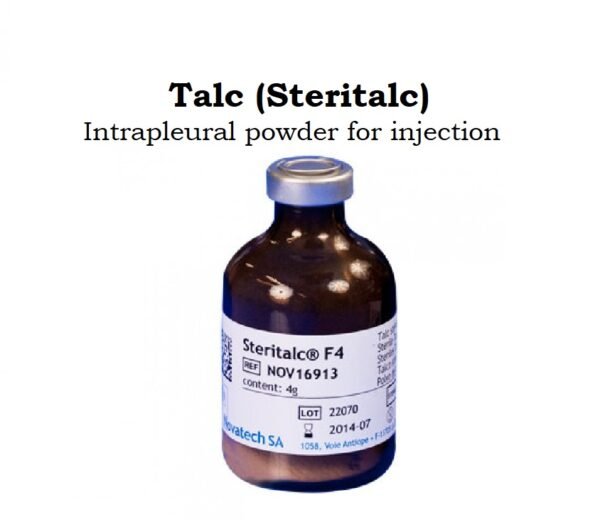
Talc (Steritalc) when injected inside the pleural cavity results in inflammation of the visceral and parietal pleura resulting in their dehiscence. Talc (Steritalc), thus inhibits the accumulation of air and fluid in the pleural cavity.
Indications of Talc (Steritalc) use:
-
Malignant Pleural effusion:
- It is effective in preventing the re-accumulation of malignant pleural effusion as a sclerosing agent in symptomatic patients after maximum drainage of the fluid via thoracocentesis.
-
Pneumothorax:
- It is used as a sclerosing agent to prevent the recurrence of pneumothorax.
Talc (Steritalc) dosage in adults:
Talc (Steritalc) dose in the treatment of malignant pleural effusion:
-
Intrapleural aerosol:
- 4 to 8 g (1 to 2 cans) as a single dose.
-
Intrapleural suspension:
- Sterile Talc Powder: 5 g.
- Steritalc: 2 to 5 g.
- The maximum cumulative dose is 10 gms.
Talc (Steritalc) dose in the treatment of Pneumothorax:
-
Intrapleural:
- Steritalc: 2 g.
- The maximum cumulative dose is 10 gms.
Talc (Steritalc) dosage in children:
Dose in children has not been defined.
Talc (Steritalc) pregnancy Risk Category: D
- Steritalc is not recommended for pregnant women because it contains lead impurities.
- Lead exposure in pregnant women can lead to premature birth, low birthweight, miscarriage and impaired mental development.
- After exposure, strict contraception should only be used for five consecutive months by women of child bearing age.
- Steritalc can cause impaired fertility in males.
Talc use during breastfeeding:
- It is not known if breast milk secretes Talc.
- If the mother has been exposed, breastfeeding should be avoided as it can cause severe adverse reactions in the infant.
Talc (Steritalc) Dose adjustment in renal disease:
The manufacturer has not provided any adjustments in the dose
Talc (Steritalc) Dose adjustment in liver disease:
The manufacturer has not provided any adjustments in the dose.
Side effects of Talc (Steritalc):
-
Cardiovascular:
- Cardiac Arrhythmia
- Hypotension
- Myocardial Infarction
- Pulmonary Embolism
- Tachycardia
-
Central Nervous System:
- Pain
-
Endocrine & Metabolic:
- Hypovolemia
-
Respiratory:
- Acute Respiratory Distress Syndrome
- Bronchopleural Fistula
- Dyspnea
- Empyema Of Pleura
- Hemoptysis
- Pneumonia
- Pneumonitis
-
Miscellaneous:
- Fever
Contraindications to Talc (Steritalc):
Pregnancy. The manufacturer did not list any contraindications for Sclerosol or Sterile Talc Powder.
Warnings and precautions
-
Effects on the pulmonary system:
- With doses exceeding 10gm administered via a chest tube, acute pneumonitis or acute respiratory distress syndrome (ARDS), can occur.
- The endothelial, visceral, and intestinal integrity are key factors in the absorption of talc.
- The distribution of talc particles is a predictor of toxic effects.
- If intravenously administered, pulmonary hypertension and lung parenchymal diseases can occur.
- Inhalation of talc may cause silicosis (or asbestosis-like) conditions (chronic Bronchogenic Cancer, Bronchogenic Bronchogenic Carcinom, and Pleural Plaques).
-
Sclerosol
- It must be packed as pressurized, and should be kept away form heat sources or open flames.
- The container must not be punctured.
-
Steritalc
- Lead exposure: Steritalc is a lead-containing impurity.
- Lead toxicity is most detrimental to the central nervous system, but it can also have an impact on blood pressure, kidney function, and male fertility.
- Humans have not yet established the threshold of minimal risk exposure.
- Children are more sensitive to lead poisoning than adults. However, there is no safe blood level for children.
- Lead toxicity can cause cognitive and neurobehavioral problems in children.
- Pregnancy can also be affected by lead exposure
Monitoring parameters:
- Oxygenation (SaO2 and SpO2)
- Respiratory rate
- Clinical features of infection
- Repeated chest radiographs as indicated
How to administer Talc (Steritalc)?
- It is only indicated for intrapleural (pleurodesis) administration.
- It should be given after maximum drainage of the fluid or air.
Sclerosol Intrapleural Aerosol:
- After shaking well, a delivery tube should be attached.
- The delivery tube should be inserted through the pleural trocar, the actuator button of the canister should be pressed manually to release pointing in several different directions to distribute to all pleural surfaces.
- The canister should be kept in an upright position for optimal distribution. The rate of delivery is 1.2 g per second.
Sterile Talc Powder:
- It should be given as a suspension and shaken well before use.
- After Vent, the 10 mL air headspace, contents of each syringe should be emptied into the chest cavity through the chest tube by gently applying pressure to the syringe plunger.
- The chest tube should be clamped for 1 to 2 hours after instillation and then the pleural fluid should be drained. The chest tube can be removed when drainage is <100 to 150 mL/24 hours.
Steritalc:
-
The slurry for tube thoracostomy:
- The syringe should be shaken well before use to redisperse talc and avoid settling.
- Vent the 10 mL air headspace from each syringe just before administration and administer talc suspension through the chest tube (follow standard procedures).
- The slurry should be injected through pleural drainage into the pleural cavity.
- Drainage should be clamped and negative pressure in the pleural cavity should be retained.
- With slurry in the cavity, the patient should be regularly repositioned to achieve even slurry distribution. The surry should be aspirated through pleural drainage.
-
Insufflation/ poudrage:
- The procedure should be done with a tube thoracoscopy. Follow device instructions for insufflation or poudrage.
- After use, some talc may remain in the vial (discard unused portion).
-
2 or 4 g vials:
- The cannula should be introduced into the trocar, talc should be distributed evenly in the pleural cavity by spraying several times and changing cannula direction every few sprays.
-
3 g vial:
- The product should be kept upright during use, contact between the cannula tip and tissue or body fluids (may result in blocked cannula) should be avoided.
- If a blockage occurs, the cannula should be shortened with a scalpel, cutting perpendicular to the cannula and ensuring the cut edge is straight and smooth).
- Intervention should be done by introducing the cannula into the trocar, distributing the talc evenly in the pleural cavity by pressing the insufflation bulb carefully and at regular intervals.
- The cannula direction should be changed after spraying a few times.
Mechanism of action of Talc (Steritalc):
- Sterile talc prevents fluid from accumulating in the pleural cavities by inducing an inflammation reaction when it is instilled in the cavity.
- This promotes the adhesion of the visceral pleura and parietal.
- Although the absorption of the drug is not known, it has been shown that the integrity of the visceral and endothelial tissues may influence its absorption.
International Brands of Talc:
- Sclerosol Intrapleural
- Sterile Talc Powder
- Steritalc
Talc Brand Names in Pakistan:
No Brands Available in Pakistan.
.png)


