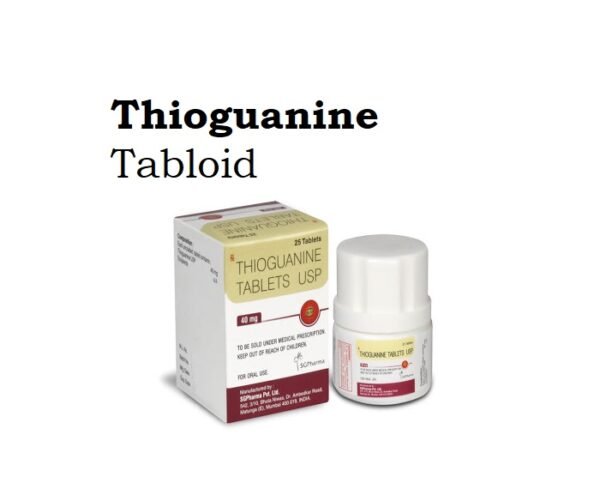
Thioguanine or 6-thioguanine is the generic name of Tabloid. It is an orally available anti-neoplastic antimetabolite drug that is used in various types of blood cancers.
Thioguanine (Tabloid) Uses:
-
Acute myeloid leukemia:
- Used in treatment (remission induction and consolidation) of acute myeloid (nonlymphocytic) leukemia (AML)
- Limitations of use:
- Thioguanine use for AML maintenance therapy or other similar longterm continuous treatments is not recommended because of the high risk of hepatotoxicity.
-
Off Label Use of Thioguanine in Adults:
- Acute lymphoblastic leukemia
Thioguanine Dose in Adults
Note:
- Consider testing for thiopurine S-methyltransferase (TPMT) deficiency and nudix hydrolase 15 (nucleotide diphosphatase [NUDT15]) deficiency
- Patients with TPMT or NUDT15 deficiency have an increased risk for severe toxicity at conventional thioguanine doses and generally need dose reduction.
Thioguanine Dose in the treatment of Acute myeloid leukemia (AML):
- P/O: 2 mg/kg OD for 4 weeks
- If no clinical improvement after 4 weeks and ANC and platelet counts are not depressed,
- The dose may be increased to 3 mg/kg OD with careful monitoring.
Thioguanine (Tabloid) Dose in the treatment of Acute lymphoblastic leukemia (ALL):
-
Late intensification treatment phase:
- 60 mg/m² once in a day on days 29 to 42 (in combination with doxorubicin, vincristine, dexamethasone, cyclophosphamide, and cytarabine).
-
Thioguanine (Tabloid) Dosage adjustment for TPMT and/or NUDT15 deficiency:
-
Heterozygous deficiency (intermediate activity):
- The dose should be reduced based on tolerability
- According to the manufacturer, most patients with heterozygous deficiency of TPMT or NUDT15 tolerate recommended doses
- Although some require dosage reduction.
- Patients who are heterozygous for both TPMT and NUDT15 may require more substantial dose reductions.
-
Clinical Pharmacogenetics Implementation Consortium (CPIC) guidelines for reduced TPMT activity:
- Initiate thioguanine with the dose reduced by 30% to 50% of the usual dose and adjust based on the extent of myelosuppression and condition being treated.
- Allow two to four weeks after each dosage adjustment to reach a steady state. For patients on combination therapy who experience severe myelosuppression, the focus should be on reducing the thioguanine dose over the rest of agents (depending on concomitant therapy).
-
Homozygous deficiency (low or deficient activity):
- Reduce the thioguanine dose to 10 percent of the usual dose or lower for homozygous deficiency in either TPMT or NUDT15.
-
CPIC guidelines for reduced TPMT activity:
- Initiate thioguanine with drastically reduced doses (reduce the daily dose by 10-fold and reduce the frequency from once in a day to 3 times a week).
- The dose should be adjusted based on the extent of myelosuppression and condition being treated.
- 4 to 6 weeks should be allowed after each dosage adjustment to reach a steady state.
- For patients on combination therapy who experience severe myelosuppression, the focus should be on reducing the thioguanine dose over the rest of agents (depending on concomitant therapy).
- When used for nonmalignant conditions, consider alternative (non-thiopurine) immunosuppressant therapy.
-
Homozygous wild type (normal activity):
- CPIC guidelines for reduced TPMT activity:
- Dose adjustment necessary.
- 2 weeks should be allowed after each dosage adjustment to reach a steady state.
- For patients on combination therapy, dosage adjustments (of all agents) should be made without any emphasis on thioguanine compared to rest of agents.
- CPIC guidelines for reduced TPMT activity:
-
Thioguanine Dose in Childrens
Note:
- Consider testing for thiopurine S-methyltransferase (TPMT) deficiency and nudix hydrolase 15 (nucleotide diphosphatase [NUDT15]) deficiency
- Patients with TPMT or NUDT15 deficiency are at increased risk for severe toxicity at conventional thioguanine doses and generally require dose reduction.
- Refer to individual protocols for dosing, and frequency;
- dosing presented as mg/m and mg/kg;
- use extra precautions.
Thioguanine (Tabloid) Dose in the treatment of Acute lymphoblastic leukemia (ALL):
-
Delayed intensification treatment phase:
-
Children ≥1 year and Adolescents:
- P/O: 60 mg/m /dose once in a day for 14 days (Lange 2002; Nachman 1998)
-
Thioguanine (Tabloid) Dose in the treatment of Acute myeloid leukemia (AML):
-
DCTER regimen: Limited data available (Lange 1998): Induction:
-
Infants and Children <3 years:
- P/O: 3.3 mg/kg/day divided once or twice daily for 4 days in combination with cytarabine and daunorubicin
-
Children ≥3 years and Adolescents:
- P/O: 100 mg/m /day divided once or twice daily for 4 days in combination with cytarabine and daunorubicin
-
-
Manufacturer's labeling:
-
Infants, Children, and Adolescents:
- 2 mg/kg orally once a day for 4 weeks;
- If no clinical improvement after 4 weeks & ANC & platelet counts are not depressed, may increase the dose to 3 mg/kg once a day with careful monitoring
-
Thioguanine (Tabloid) Dose in the treatment of Acute myeloid leukemia (AML)/myelodysplastic syndrome (MDS) with Down syndrome:
-
DCTER regimen: Induction:
-
Infants and Children <3 years:
- P/O: 3.3 mg/kg/day divided once or twice daily for 4 days in combination with cytarabine and daunorubicin.
-
Children ≥3 years and Adolescents:
- P/O: 100 mg/m /day divided once or twice daily for 4 days in combination with cytarabine and daunorubicin.
-
Thioguanine (Tabloid) Dose in the treatment of low-grade gliomas CNS Tumors:
TPCV regimen:
-
Children <10 years:
- P/O: 30 mg/m q6 hours x 11 doses (from hours 0 to 66) in a 42-day cycle for a total of 8 cycles (in combination with procarbazine, lomustine, and vincristine)
-
Thioguanine (Tabloid) Dose adjustment in TPMT and/or NUDT15 deficiency:
-
Heterozygous deficiency (intermediate activity):
- Dose reduction should be done based on tolerability.
- According to the manufacturer, most patients with heterozygous deficiency of TPMT or NUDT15 tolerate recommended doses, although some need dosage reduction.
- Patients who are heterozygous for both TPMT and NUDT15 may need more substantial dose reductions.
-
Clinical Pharmacogenetics Implementation Consortium (CPIC) guidelines for reduced TPMT activity:
- Initiate thioguanine with the dose decreased by 30% to 50% of the usual dose and adjust based on the extent of myelosuppression and condition being treated.
- 2 to 4 weeks should be allowed after each dosage adjustment to reach a steady state.
- For patients on combination therapy who experience severe myelosuppression, the focus should be on reducing the thioguanine dose over the rest of agents (depending on concomitant therapy).
-
Homozygous deficiency (low or deficient activity):
- Reduce the thioguanine dose to 10% of the usual dose or lower for homozygous deficiency in either TPMT or NUDT15.
-
CPIC guidelines for reduced TPMT activity:
- Initiate thioguanine with drastically reduced doses (reduce the daily dose by 10-fold and reduce the frequency from once daily to 3 times per week).
- Adjust doses based on the extent of myelosuppression and condition being treated.
- 4 to 6 weeks should be allowed after each dosage adjustment to reach a steady state.
- For patients on combination therapy who experience severe myelosuppression, the focus should be on reducing the thioguanine dose over the rest of agents (depending on concomitant therapy).
- When used for nonmalignant conditions, consider alternative (non-thiopurine) immunosuppressant therapy.
-
Homozygous wild type (normal activity):
- CPIC guidelines for reduced TPMT activity (Relling 2011; Relling 2013):
- Initial dosage adjustment not necessary.
- 2 weeks should be allowed after each dosage adjustment to reach a steady state.
- For patients receiving combination therapy, dosage adjustments (of all agents) should be made without any emphasis on thioguanine compared to rest of agents.
-
Pregnancy Risk Factor D
- Negative effects in animal reproduction have been documented.
- If given during pregnancy, may cause harm to the fetus.
- Treatment should not be used to induce pregnancy in females with reproductive potential.
Use of thioguanine during breastfeeding
- It is unknown if thioguanine can be found in breast milk.
- The manufacturer suggests that the mother decide whether to stop breastfeeding or discontinue taking thioguanine.
- This is in consideration of the risk of serious adverse reactions in breastfed babies.
Thioguanine (Tabloid) Dose in Kidney Disease:
- No dosage adjustments provided in the manufacturer’s labeling.
Tabloid Dose in Liver disease:
-
Hepatic impairment prior to treatment:
- No dosage adjustments provided in the manufacturer’s labeling.
-
Hepatotoxicity during treatment:
- Deterioration in transaminases, alkaline phosphatase or bilirubin, toxic hepatitis, biliary stasis, clinical jaundice, evidence of hepatic sinusoidal obstruction syndrome (veno-occlusive disease), or evidence of portal hypertension; treatment should be discontinued.
Side effects of Thioguanine (Tabloid):
-
Cardiovascular:
- Esophageal Varices
- Portal Hypertension
-
Endocrine & Metabolic:
- Fluid Retention
- Hyperuricemia (Common)
- Increased Gamma Glutamyl Transferase
- Weight Gain
-
Gastrointestinal:
- Anorexia
- Intestinal Necrosis
- Intestinal Perforation
- Nausea
- Stomatitis
- Vomiting
-
Hematologic & Oncologic:
- Anemia (May Be Delayed)
- Bone Marrow Depression
- Granulocytopenia
- Hemorrhage
- Leukopenia (Common; May Be Delayed)
- Pancytopenia
- Splenomegaly
- Thrombocytopenia (Common; May Be Delayed)
-
Hepatic:
- Ascites
- Hepatic Disease (Hepatoportal Sclerosis)
- Hepatic Focal Nodular Hyperplasia (Regenerative)
- Hepatic Necrosis (Centrilobular)
- Hepatic Sinusoidal Obstruction Syndrome
- Hepatomegaly (Tender)
- Hepatotoxicity
- Hyperbilirubinemia
- Increased Liver Enzymes
- Increased Serum Alkaline Phosphatase
- Jaundice
- Peliosis Hepatitis
- Periportal Fibrosis
-
Infection:
- Infection
-
Neuromuscular & Skeletal:
- Bone Hypoplasia
Contraindications to Thioguanine (Tabloid):
- Previous resistance to thioguanine or mercaptopurine
- Hypersensitivity to thioguanine and any component of the formulation
Warnings and precautions
-
Suppression of bone marrow
- Common dose-related toxicities include myelosuppression (anemia and/or leukopenia) and/or thrombocytopenia (may be delayed).
- Monitor for infection (due to leukopenia or bleeding) and withhold treatment if blood counts drop abnormally.
- Patients with a genetic enzyme deficiency in thiopurine-methyltransferase or nudixhydrlase 15 (nucleotide phosphatase [NUDT15]), or those who are taking drugs that inhibit this enzyme (mesalazine or olsalazine or sulfasalazine), may be very sensitive to myelosuppressive side effects and may need substantial dose reductions.
-
Hepatotoxicity
- A high risk of hepatotoxicity and hepatic sinusoidal obstruction syndrome (SOS) is associated with long-term continuous or maintenance therapy.
- Patients with liver toxicity should be monitored closely and LFTs stopped in those who have evidence of liver damage.
- Transaminase elevations can cause hepatotoxicity.
- Hepatotoxicity can be diagnosed by pathologic findings such as hepatoportal swelling, idiopathic portal hypertension (including nodular regeneration hyperplasia), periportal fibrisis and peliosis.
- Hepatotoxicity is more common in males.
- It is not recommended to use thioguanine for long-term or maintenance treatment.
- It is important to advise patients not to drink alcohol as it can increase the chance of hepatotoxicity.
-
Photosensitivity
- Photosensitivity can be caused by Thioguanine; protective clothing and sunscreen are recommended.
-
Secondary malignancies
- Thioguanine is carcinogenic.
-
Tumor lysis syndrome
- Hyperuricemia is a common side effect of treatment. Hydration should be adequate as well as prophylactic allopurinol.
-
Genetic variation NUDT15:
- Patients who have a germline mutation in nudixhydrlase (nucleoside-linked moiety-X-type motif 15, [NUDT15]), may require substantial dose reductions of thiopurine (eg thioguanine and mercaptopurine).
- Patients receiving treatment for acute lymphoblastic Leukemia (ALL) have a reduced NUDT15 activity that is strongly associated with mercaptopurine intolerance.
- Two prospective clinical childhood ALL trials were used to conduct a genome-wide association study. It was found that patients who were homozygous for the TT gene were very sensitive to mercaptopurine. The average dose intensity was 8.3%.
- Most common is the NUDT15 variant in East Asian and Hispanic patients.
- Patients who have suffered from severe bone marrow toxicities, repeated myelosuppressive episodes, or multiple bone marrow toxicities should be tested for NUDT15 (and TPMT) deficiency.
-
TPMT Deficiency
- Patients suffering from TPMT deficiency may be more sensitive to myelosuppressive effects. They may need substantial dose reductions.
- It is worth testing for a TPMT defect
- The Clinical Pharmacogenetics Implementation Consortium's (CPIC) guidelines for reducing TPMT activity recommend that patients with heterozygous or homozygous deficiencies take lower doses.
Thioguanine: Drug Interaction
|
5-Aminosalicylic Acid Derivatives |
May decrease the metabolism of Thiopurine Analogs. |
|
Anti-TNF Agents |
May enhance the adverse/toxic effect of Thiopurine Analogs. Specifically, the risk for T-cell non-Hodgkin's lymphoma (including hepatosplenic T-cell lymphoma) may be increased. Exceptions: Lenalidomide; Pomalidomide; Thalidomide. |
|
Chloramphenicol (Ophthalmic) |
May enhance the adverse/toxic effect of Myelosuppressive Agents. |
|
CloZAPine |
Myelosuppressive Agents may enhance the adverse/toxic effect of CloZAPine. Specifically, the risk for neutropenia may be increased. |
|
Coccidioides immitis Skin Test |
Immunosuppressants may diminish the diagnostic effect of Coccidioides immitis Skin Test. |
|
Denosumab |
May enhance the adverse/toxic effect of Immunosuppressants. Specifically, the risk for serious infections may be increased. |
|
Mesalamine |
May enhance the myelosuppressive effect of Myelosuppressive Agents. |
|
Ocrelizumab |
May enhance the immunosuppressive effect of Immunosuppressants. |
|
Pidotimod |
Immunosuppressants may diminish the therapeutic effect of Pidotimod. |
|
Promazine |
May enhance the myelosuppressive effect of Myelosuppressive Agents. |
|
Siponimod |
Immunosuppressants may enhance the immunosuppressive effect of Siponimod. |
|
Tertomotide |
Immunosuppressants may diminish the therapeutic effect of Tertomotide. |
|
Trastuzumab |
May enhance the neutropenic effect of Immunosuppressants. |
|
Risk Factor D (Consider therapy modification) |
|
|
Baricitinib |
Immunosuppressants may enhance the immunosuppressive effect of Baricitinib. Management: Use of baricitinib in combination with potent immunosuppressants such as azathioprine or cyclosporine is not recommended. Concurrent use with antirheumatic doses of methotrexate or nonbiologic disease modifying antirheumatic drugs (DMARDs) is permitted. |
|
Deferiprone |
|
|
Echinacea |
May diminish the therapeutic effect of Immunosuppressants. |
|
Fingolimod |
Immunosuppressants may enhance the immunosuppressive effect of Fingolimod. Management: Avoid the concomitant use of fingolimod and other immunosuppressants when possible. If combined, monitor patients closely for additive immunosuppressant effects (eg, infections). |
|
Leflunomide |
Immunosuppressants may enhance the adverse/toxic effect of Leflunomide. Specifically, the risk for hematologic toxicity such as pancytopenia, agranulocytosis, and/or thrombocytopenia may be increased. Management: Consider not using a leflunomide loading dose in patients receiving other immunosuppressants. Patients receiving both leflunomide and another immunosuppressant should be monitored for bone marrow suppression at least monthly. |
|
Lenograstim |
Antineoplastic Agents may diminish the therapeutic effect of Lenograstim. Management: Avoid the use of lenograstim 24 hours before until 24 hours after the completion of myelosuppressive cytotoxic chemotherapy. |
|
Lipegfilgrastim |
Antineoplastic Agents may diminish the therapeutic effect of Lipegfilgrastim. Management: Avoid concomitant use of lipegfilgrastim and myelosuppressive cytotoxic chemotherapy. Lipegfilgrastim should be administered at least 24 hours after the completion of myelosuppressive cytotoxic chemotherapy. |
|
Nivolumab |
Immunosuppressants may diminish the therapeutic effect of Nivolumab. |
|
Palifermin |
May enhance the adverse/toxic effect of Antineoplastic Agents. Specifically, the duration and severity of oral mucositis may be increased. Management: Do not administer palifermin within 24 hours before, during infusion of, or within 24 hours after administration of myelotoxic chemotherapy. |
|
Roflumilast |
May enhance the immunosuppressive effect of Immunosuppressants. |
|
Sipuleucel-T |
Immunosuppressants may diminish the therapeutic effect of Sipuleucel-T. Management: Evaluate patients to see if it is medically appropriate to reduce or discontinue therapy with immunosuppressants prior to initiating sipuleucel-T therapy. |
|
Tofacitinib |
Immunosuppressants may enhance the immunosuppressive effect of Tofacitinib. Management: Concurrent use with antirheumatic doses of methotrexate or nonbiologic disease modifying antirheumatic drugs (DMARDs) is permitted, and this warning seems particularly focused on more potent immunosuppressants. |
|
Vaccines (Inactivated) |
Immunosuppressants may diminish the therapeutic effect of Vaccines (Inactivated). Management: Vaccine efficacy may be reduced. Complete all age-appropriate vaccinations at least 2 weeks prior to starting an immunosuppressant. If vaccinated during immunosuppressant therapy, revaccinate at least 3 months after immunosuppressant discontinuation. |
|
Risk Factor X (Avoid combination) |
|
|
BCG (Intravesical |
Immunosuppressants may diminish the therapeutic effect of BCG (Intravesical). |
|
BCG (Intravesical) |
Myelosuppressive Agents may diminish the therapeutic effect of BCG (Intravesical). |
|
Cladribine |
May enhance the immunosuppressive effect of Immunosuppressants. |
|
Cladribine |
May enhance the myelosuppressive effect of Myelosuppressive Agents. |
|
Cladribine |
Agents that Undergo Intracellular Phosphorylation may diminish the therapeutic effect of Cladribine. |
|
Dipyrone |
May enhance the adverse/toxic effect of Myelosuppressive Agents. Specifically, the risk for agranulocytosis and pancytopenia may be increased |
|
Natalizumab |
Immunosuppressants may enhance the adverse/toxic effect of Natalizumab. Specifically, the risk of concurrent infection may be increased. |
|
Pimecrolimus |
May enhance the adverse/toxic effect of Immunosuppressants. |
|
Tacrolimus (Topical) |
May enhance the adverse/toxic effect of Immunosuppressants. |
|
Vaccines (Live) |
Immunosuppressants may enhance the adverse/toxic effect of Vaccines (Live). Immunosuppressants may diminish the therapeutic effect of Vaccines (Live). Management: Avoid use of live organism vaccines with immunosuppressants; live-attenuated vaccines should not be given for at least 3 months after immunosuppressants. |
Monitoring parameters:
- CBC with differential platelet count and CBC (monitor often)
- LFTs (weekly upon starting therapy, then monthly for patients with a liver disease or concurrently taking hepatotoxic drugs)
- Serum uric acid
- If severe hematologic toxicities or repeated episodes are present, it is important to genotype thiopurine-methyltransferase and nudixhydrlase 15 (nucleotide dimphosphatase [NUDT15]).
- You should monitor for symptoms such as hepatotoxicity, portal hypotension (splenomegaly and esophageal varices), or sinusoidal obstruction syndrome. (veno-occlusive diseases; fluid retention, tenderness, hyperbilirubinemia, hepatomegaly or hepatomegaly)
- Check for signs of tumor lysis syndrome
- You must ensure that you adhere to the rules.
How to administer Thioguanine (Tabloid)?
P/O:
- Give orally
- Conpletell daily dose can be given at one time.
Mechanism of action of Thioguanine (Tabloid):
- Thioguanine, a purine analog to guanine, is incorporated into DNA and the RN and results in the blocking of the synthesis and metabolism purine nucleotides.
Absorption:
- ~30% (range: 14% to 46%; highly variable)
Distribution:
- Does not reach therapeutic concentrations in the CSF
Metabolism:
- Hepatic; rapidly and extensively via thiopurine methyltransferase (TPMT) to 2amino-6-methylthioguanine (MTG; active) and inactive compounds
Half-life elimination:
- Terminal: 5 - 9 hrs
Time to peak, serum:
- Within 8 hours
- predominantly metabolite(s)
Excretion:
- Urine, primarily as metabolites
International Brands of Thioguanine:
- 6-TG
- Lanvis
- Tabloid
- Thioguanin Glaxo Wellcome
- Thioguanine Wellcome
Thioguanine Brand Names in Pakistan:
Thioguanine 40 mg Tablets |
|
| Thioguanine | Al-Habib Pharmaceuticals. |
.png)


