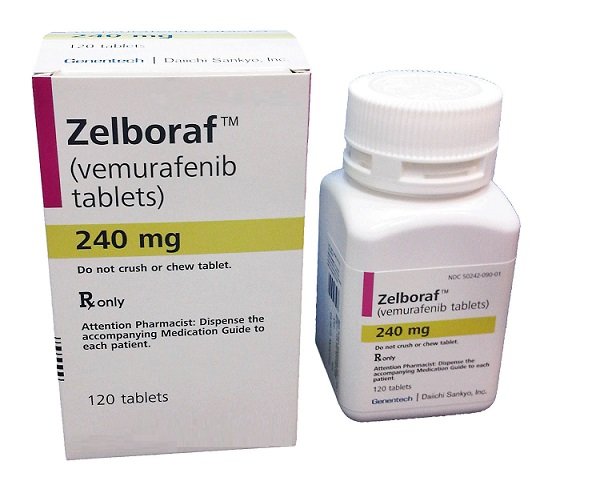
Vemurafenib (Zelboraf) stops the cellular proliferation in melanoma cells with mutation by inhibiting tumor growth in melanomas by inhibiting the kinase activity of certain mutated forms of BRAF, including BRAF with V600E mutation. It is a low molecular weight oral BRAF kinase inhibitor.
It is used to treat the following conditions:
-
Unresectable or metastatic melanoma in patients having BRAFV600E mutation. It is not used for the treatment of wild-type BRAF melanoma
-
Treatment of Erdheim-Chester disease (ECD) in patients having BRAF V600 mutation
-
Off Label Usage in Adults include:
-
as off label agent in Melanoma, metastatic (with BRAFV600K mutation)
-
as off label agent in non-small cell lung cancer, refractory (with BRAF V600 mutation)
-
Vemurafenib (Zelboraf) dose in Adults
Dosage in the treatment of metastatic or unresectable Melanoma, (with BRAF V600E mutation):
- It is given 960 mg orally twice a da
- It should be continued until disease progression or unacceptable toxicity.
Dosage in the treatment of Erdheim-Chester disease (with BRAF V600 mutation):
- It is given 960 mg orally twice a day.
- It should be continued until disease progression or unacceptable toxicity.
- Missed doses:
- A missed dose can be taken up to 4 hours before the next scheduled dose.
- If it is within 4 hours of the next dose, then administer the next dose at the regular schedule.
- If vomiting occurs after dose then do not take an additional dose & continue with the next scheduled dose.
Off label Dosage in the treatment of metastatic or unresectable Melanoma (with BRAF V600K mutation):
- It is given 960 mg orally twice a day
- It should be continued until disease progression or unacceptable toxicity.
Off label Dose in the treatment of metastatic or unresectable Melanoma, (with BRAF V600E or V600K mutations) :
- It is given 960 mg orally twice a day in combination with cobimetinib
- It should be continued until disease progression or unacceptable toxicity .
Off label Dose in the treatment of refractory Non-small cell lung cancer, (with BRAF V600 mutation):
- It is given 960 mg orally twice a day
- Dosage adjustment for concomitant strong CYP3A4 inducers:
- Avoid using strong CYP3A4 inducers.
- If the use of a strong CYP3A4 inducer (eg, rifampin, carbamazepine, phenytoin) cannot be avoided, then increase the vemurafenib dose by 240 mg as tolerated.
- After the strong CYP3A4 inducer has been stopped for 2 weeks then restart vemurafenib dose that was used before initiating the CYP3A4 inducer.
Vemurafenib (Zelboraf) dose in Childrens
Data not available. Efficacy & safety not established
Pregnancy Risk Factor: D
- Animal reproduction studies did not show any adverse effects.
- Vemurafenib can cause fetal harm if it is given to a pregnant woman or to a patient who becomes pregnant while receiving treatment.
- Effective contraceptives should be used during treatment, and at least 14 days following the last dose.
Use Vemurafenib (Zelboraf), during breastfeeding
- It is unknown if vemurafenib can be found in breast milk.
- The manufacturer does not recommend breastfeeding during treatment or for 14 days following the last dose.
Vemurafenib (Zelboraf) dose in Renal disease:
- Mild to moderate preexisting renal impairment:
- No dosage adjustment required.
- Severe preexisting renal impairment ():
- There are no dosage adjustments given in the manufacturer's labeling But caution should be taken.
- Nephrotoxicity/creatinine abnormalities during treatment:
- See dosage adjustment for toxicity and manage with dose reduction, discontinuation or treatment interruption.
Vemurafenib (Zelboraf) Dose in Liver disease:
- Mild to moderate preexisting hepatic impairment:
- No dosage adjustment required.
- Severe preexisting hepatic impairment:
- There are no dosage adjustments given in the manufacturer's labeling But use with caution.
- Hepatotoxicity and lab abnormalities during treatment:
- See dosage adjustment for toxicity and manage with dose reduction, discontinuation or treatment interruption.
Common Side Effects of Vemurafenib (Zelboraf) Include:
- Cardiovascular:
- Prolonged Q-T Interval On ECG
- Hypertension
- Peripheral Edema
- Central Nervous System:
- Fatigue
- Peripheral Sensory Neuropathy
- Headache
- Dermatologic:
- Maculopapular Rash
- Alopecia
- Skin Rash
- Hyperkeratosis
- Skin Photosensitivity
- Xeroderma
- Palmar-Plantar Erythrodysesthesia
- Pruritus
- Nevus
- Sunburn
- Papular Rash
- Erythema
- Gastrointestinal:
- Diarrhea
- Nausea
- Vomiting
- Decreased Appetite
- Constipation
- Dysgeusia
- Hematologic & Oncologic:
- Cutaneous Papilloma
- Keratoacanthoma
- Squamous Cell Carcinoma Of Skin
- Hepatic:
- Increased Gamma-Glutamyl Transferase
- Neuromuscular & Skeletal:
- Arthralgia
- Myalgia
- Limb Pain
- Back Pain
- Musculoskeletal Pain
- Weakness
- Renal:
- Increased Serum Creatinine
- Respiratory:
- Cough
- Miscellaneous:
- Fibrosis (Dupuytren Contracture)
- Fever
Less Common Side Effects of Vemurafenib Include:
- Cardiovascular:
- Atrial Fibrillation
- Hypotension
- Retinal Vein Occlusion
- Vasculitis
- Central Nervous System:
- Cranial Nerve Palsy (Facial)
- Dizziness
- Peripheral Neuropathy
- Dermatologic:
- Erythema Nodosum
- Folliculitis
- Stevens-Johnson Syndrome
- Toxic Epidermal Necrolysis
- Endocrine & Metabolic:
- Weight Loss
- Hematologic & Oncologic:
- Basal Cell Carcinoma
- Malignant Melanoma (New Primary)
- Squamous Cell Carcinoma (Oropharyngeal)
- Hepatic:
- Increased Serum ALT
- Increased Serum Alkaline Phosphatase
- Increased Serum Bilirubin
- Hypersensitivity:
- Anaphylaxis
- Hypersensitivity Reaction
- Neuromuscular & Skeletal:
- Arthritis
- Panniculitis
- Ophthalmic:
- Blurred Vision
- Iritis
- Photophobia
- Uveitis
Frequency not defined:
- Hematologic & oncologic:
- Secondary acute myelocytic leukemia
Contraindication to Vemurafenib (Zelboraf) Include:
- The US labeling of the manufacturer does not contain any contraindications.
- Hypersensitivity to vemurafenib and any part of its formulation
Warnings and precautions
- Dermatologic toxicities:
- There have been several dermatologic reactions, including Stevens-Johnson Syndrome and toxic epidermal necrolysis.
- If severe dermatologic toxicity is observed, stop taking the medication permanently
- Fibroproliferative Disease:
- Vemurafenib has been shown to cause Dupuytren contracture as well as plantar fascial fibromatosis.
- Hepatotoxicity
- It has been shown that liver injury can be caused by its use.
- Monitoring of transaminases and alkalinephosphatase at baseline and every month during therapy or as clinically required.
- This could lead to a reduction in dose, interruption or discontinuation.
- Hypersensitivity
- During treatment, severe hypersensitivity and anaphylaxis can occur.
- Severe reactions include erythema and hypotension, generalized rash, erythema and erythema, as well as drug rash with eosinophilia (DRESS syndrome).
- If you experience severe hypersensitivity reactions, stop abruptly.
- Malignancies
- There have been reports of cutaneous squamous cells carcinomas (cuSCC), and keratoacanthomas as well as melanoma.
- Cutaneous SCC usually occurs in the early stages of treatment.
- CuSCC is susceptible to risk factors such as being older than 65, having a history of skin cancer or prolonged sun exposure.
- Monitor skin lesions with dermatology evaluation at baseline and every two months during treatment. Then, consider continuing monitoring for six months after treatment.
- Patients treated with vemurafenib to treat melanoma have rarely experienced new primary malignant melanomas.
- Noncutaneous squamous cells carcinomas (noncuSCC) have been identified in the neck and head. Be sure to monitor for any signs and symptoms.
- Vemurafenib may promote malignancies that are correlated with RAS activation. Monitoring for signs and symptoms of other malignancies is recommended.
- ECD patients have had myeloid malignancies. Observe CBC in patients with ECD or co-existing myeloid malignancies.
- Nephrotoxicity
- There have been cases of acute kidney injury including interstitial Nephritis, acute tube necrosis and serum creatinine levels (grades 1 through 4)
- It is important to monitor serum creatinine.
- Ocular toxicities:
- It can lead to blurred vision, uveitis (including iritis), and photophobia.
- Corticosteroid eye drops and mydriatic drops are used to treat uveitis.
- Clinical trials have shown that retinal vein occlusion can be achieved.
- Pancreatitis
- Rarely has pancreatitis been reported.
- The usual time for the first symptoms to appear is two weeks. Exacerbation can also occur upon a reduction in dose.
- Clinically indicated evaluation of abdominal pain that is not explained by pancreatitis (eg serum lipase, amylase, abdominal CT).
- Photosensitivity
- There have been cases of photosensitivity that range from mild to severe.
- Patients should be advised to protect themselves from the sun and wear sunscreen
- When outdoors, use effective UVA/UVB sunscreen (SPF >=30).
- For photosensitivity that is beyond control, such as erythema that exceeds 10% to 30% of the body's surface area, dosage modifications may be necessary.
- Extension of QT
- QT prolongation has been observed (dose dependent).
- This can increase the risk of ventricular arrhythmia and torsade-de-pointes.
- Monitor electrolytes (magnesium and calcium) at baseline as well as with dosage adjustments.
- Monitor ECG at baseline 15 days after beginning, then monthly for 3 to 6 months, and then every 3 to 4 months. Also monitor dosage adjustments.
- If your baseline QTc is greater than 500 msec, do not begin treatment.
- If QTc is greater than 500 msec during treatment, discontinue treatment. Correct electrolytes and manage other risk factors that could cause QT prolongation.
- You may start the dose reduction again once QTc drops to 500msec.
- If after correcting risk factors, the QTc continues its upward trend of >500 msec or there is >60msec increase above baseline, then you should stop permanently
- Patients with electrolyte abnormalities that are not easily corrected, long QT syndrome or who are taking medication that prolongs the QT interval should not be treated.
- Radiation sensitization/recall
- Patients who received radiation before, during, and after treatment with Vemurafenib have shown radiosensitivity and recall.
- When vemurafenib has been administered concurrently or sequentially with radiation treatment, it is important to monitor the situation.
Vemurafenib: Drug Interaction
|
Aminolevulinic Acid (Topical) |
Photosensitizing Agents may enhance the photosensitizing effect of Aminolevulinic Acid (Topical). |
|
Aprepitant |
May increase the serum concentration of CYP3A4 Substrates (High risk with Inhibitors). |
|
ARIPiprazole |
CYP2D6 Inhibitors (Weak) may increase the serum concentration of ARIPiprazole. Management: Monitor for increased aripiprazole pharmacologic effects. Aripiprazole dose adjustments may or may not be required based on concomitant therapy and/or indication. Consult full interaction monograph for specific recommendations. |
|
Bosentan |
May decrease the serum concentration of CYP3A4 Substrates (High risk with Inducers). |
|
Brentuximab Vedotin |
P-glycoprotein/ABCB1 Inhibitors may increase the serum concentration of Brentuximab Vedotin. Specifically, concentrations of the active monomethyl auristatin E (MMAE) component may be increased. |
|
Celiprolol |
P-glycoprotein/ABCB1 Inhibitors may increase the serum concentration of Celiprolol. |
|
Clofazimine |
May increase the serum concentration of CYP3A4 Substrates (High risk with Inhibitors). |
|
CloZAPine |
CYP1A2 Inhibitors (Moderate) may increase the serum concentration of CloZAPine. |
|
CloZAPine |
CYP3A4 Inducers (Weak) may decrease the serum concentration of CloZAPine. |
|
CYP1A2 Substrates (High risk with Inhibitors) |
CYP1A2 Inhibitors (Moderate) may decrease the metabolism of CYP1A2 Substrates (High risk with Inhibitors). |
|
CYP3A4 Inducers (Moderate) |
May decrease the serum concentration of CYP3A4 Substrates (High risk with Inducers). |
|
CYP3A4 Inhibitors (Moderate) |
May decrease the metabolism of CYP3A4 Substrates (High risk with Inhibitors). |
|
Deferasirox |
May decrease the serum concentration of CYP3A4 Substrates (High risk with Inducers). |
|
Duvelisib |
May increase the serum concentration of CYP3A4 Substrates (High risk with Inhibitors). |
|
Erdafitinib |
May decrease the serum concentration of CYP3A4 Substrates (High risk with Inducers). |
|
Erdafitinib |
May increase the serum concentration of CYP3A4 Substrates (High risk with Inhibitors). |
|
Erdafitinib |
May increase the serum concentration of P-glycoprotein/ABCB1 Substrates. |
|
Everolimus |
P-glycoprotein/ABCB1 Inhibitors may increase the serum concentration of Everolimus. |
|
Fosaprepitant |
May increase the serum concentration of CYP3A4 Substrates (High risk with Inhibitors). |
|
Fosnetupitant |
May increase the serum concentration of CYP3A4 Substrates (High risk with Inhibitors). |
|
Haloperidol |
QT-prolonging Kinase Inhibitors (Moderate Risk) may enhance the QTc-prolonging effect of Haloperidol. Management: Monitor for QTc interval prolongation and ventricular arrhythmias when these agents are combined. Patients with additional risk factors for QTc prolongation may be at even higher risk. |
|
Larotrectinib |
May increase the serum concentration of CYP3A4 Substrates (High risk with Inhibitors). |
|
Larotrectinib |
P-glycoprotein/ABCB1 Inhibitors may increase the serum concentration of Larotrectinib. |
|
Naldemedine |
P-glycoprotein/ABCB1 Inhibitors may increase the serum concentration of Naldemedine. |
|
Naloxegol |
P-glycoprotein/ABCB1 Inhibitors may increase the serum concentration of Naloxegol. |
|
Netupitant |
May increase the serum concentration of CYP3A4 Substrates (High risk with Inhibitors). |
|
NiMODipine |
CYP3A4 Inducers (Weak) may decrease the serum concentration of NiMODipine. |
|
Ondansetron |
May enhance the QTc-prolonging effect of QT-prolonging Kinase Inhibitors (Moderate Risk). Management: Monitor for QTc interval prolongation and ventricular arrhythmias when these agents are combined. Patients with additional risk factors for QTc prolongation may be at even higher risk. |
|
Palbociclib |
May increase the serum concentration of CYP3A4 Substrates (High risk with Inhibitors). |
|
Pentamidine (Systemic) |
May enhance the QTc-prolonging effect of QT-prolonging Kinase Inhibitors (Moderate Risk). Management: Monitor for QTc interval prolongation and ventricular arrhythmias when these agents are combined. Patients with additional risk factors for QTc prolongation may be at even higher risk. |
|
Perhexiline |
CYP2D6 Inhibitors (Weak) may increase the serum concentration of Perhexiline. |
|
P-glycoprotein/ABCB1 Inhibitors |
May increase the serum concentration of Pglycoprotein/ABCB1 Substrates. P-glycoprotein inhibitors may also enhance the distribution of pglycoprotein substrates to specific cells/tissues/organs where p-glycoprotein is present in large amounts (e.g., brain, T-lymphocytes, testes, etc.). |
|
P-glycoprotein/ABCB1 Substrates: |
P-glycoprotein/ABCB1 Inhibitors may increase the serum concentration of P-glycoprotein/ABCB1 Substrates. P-glycoprotein inhibitors may also enhance the distribution of p-glycoprotein substrates to specific cells/tissues/organs where p-glycoprotein is present in large amounts (e.g., brain, T-lymphocytes, testes, etc.). Exceptions: Loperamide. |
|
Porfimer |
Photosensitizing Agents may enhance the photosensitizing effect of Porfimer. |
|
Prucalopride |
P-glycoprotein/ABCB1 Inhibitors may increase the serum concentration of Prucalopride. |
|
QT-prolonging Antidepressants (Moderate Risk) |
May enhance the QTc-prolonging effect of QTprolonging Kinase Inhibitors (Moderate Risk). Management: Monitor for QTc interval prolongation and ventricular arrhythmias when these agents are combined. Patients with additional risk factors for QTc prolongation may be at even higher risk. |
|
QT-prolonging Antipsychotics (Moderate Risk) |
May enhance the QTc-prolonging effect of QTprolonging Kinase Inhibitors (Moderate Risk). Management: Monitor for QTc interval prolongation and ventricular arrhythmias when these agents are combined. Patients with additional risk factors for QTc prolongation may be at even higher risk. Exceptions: Pimozide. |
|
QT-prolonging Class IC Antiarrhythmics (Moderate Risk) |
May enhance the QTc-prolonging effect of QT-prolonging Kinase Inhibitors (Moderate Risk). Management: Monitor for QTc interval prolongation and ventricular arrhythmias when these agents are combined. Patients with additional risk factors for QTc prolongation may be at even higher risk. |
|
QT-prolonging Kinase Inhibitors (Moderate Risk) |
May enhance the QTc-prolonging effect of other QT-prolonging Kinase Inhibitors (Moderate Risk). Management: Monitor for QTc interval prolongation and ventricular arrhythmias when these agents are combined. Patients with additional risk factors for QTc prolongation may be at even higher risk. |
|
QT-prolonging Miscellaneous Agents (Moderate Risk) |
QT-prolonging Kinase Inhibitors (Moderate Risk) may enhance the QTc-prolonging effect of QT-prolonging Miscellaneous Agents (Moderate Risk). Management: Monitor for QTc interval prolongation and ventricular arrhythmias when these agents are combined. Patients with additional risk factors for QTc prolongation may be at even higher risk. Exceptions: Domperidone. |
|
QT-prolonging Moderate CYP3A4 Inhibitors (Moderate Risk) |
May enhance the QTc-prolonging effect of QT-prolonging Kinase Inhibitors (Moderate Risk). QT-prolonging Moderate CYP3A4 Inhibitors (Moderate Risk) may increase the serum concentration of QT-prolonging Kinase Inhibitors (Moderate Risk). |
|
QT-prolonging Quinolone Antibiotics (Moderate Risk) |
May enhance the QTc-prolonging effect of QT-prolonging Kinase Inhibitors (Moderate Risk). Management: Monitor for QTc interval prolongation and ventricular arrhythmias when these agents are combined. Patients with additional risk factors for QTc prolongation may be at even higher risk. |
|
Ranolazine |
P-glycoprotein/ABCB1 Inhibitors may increase the serum concentration of Ranolazine. |
|
Ranolazine |
May increase the serum concentration of P-glycoprotein/ABCB1 Substrates. |
|
RifAXIMin |
P-glycoprotein/ABCB1 Inhibitors may increase the serum concentration of RifAXIMin. |
|
Sarilumab |
May decrease the serum concentration of CYP3A4 Substrates (High risk with Inducers). |
|
Silodosin |
P-glycoprotein/ABCB1 Inhibitors may increase the serum concentration of Silodosin. |
|
Siltuximab |
May decrease the serum concentration of CYP3A4 Substrates (High risk with Inducers). |
|
Simeprevir |
May increase the serum concentration of CYP3A4 Substrates (High risk with Inhibitors). |
|
Talazoparib |
P-glycoprotein/ABCB1 Inhibitors may increase the serum concentration of Talazoparib. Management: These listed exceptions are discussed in detail in separate interaction monographs. |
|
Tegaserod |
P-glycoprotein/ABCB1 Inhibitors may increase the serum concentration of Tegaserod. |
|
Tocilizumab |
May decrease the serum concentration of CYP3A4 Substrates (High risk with Inducers). |
|
Verteporfin |
Photosensitizing Agents may enhance the photosensitizing effect of Verteporfin. |
|
Warfarin |
Vemurafenib may increase the serum concentration of Warfarin. |
|
Risk Factor D (Consider therapy modification) |
|
|
Afatinib |
P-glycoprotein/ABCB1 Inhibitors may increase the serum concentration of Afatinib. Management: Per US labeling: reduce afatinib by 10mg if not tolerated. Per Canadian labeling: avoid combination if possible; if used, administer the P-gp inhibitor simultaneously with or after the dose of afatinib. |
|
Betrixaban |
|
|
Bilastine |
P-glycoprotein/ABCB1 Inhibitors may increase the serum concentration of Bilastine. Management: Consider alternatives when possible; bilastine should be avoided in patients with moderate to severe renal insufficiency who are receiving p-glycoprotein inhibitors. |
|
Colchicine |
P-glycoprotein/ABCB1 Inhibitors may increase the serum concentration of Colchicine. Colchicine distribution into certain tissues (e.g., brain) may also be increased. Management: Colchicine is contraindicated in patients with impaired renal or hepatic function who are also receiving a p-glycoprotein inhibitor. In those with normal renal and hepatic function, reduce colchicine dose as directed. See full monograph for details. |
|
CYP1A2 Substrates (High risk with Inhibitors) |
Vemurafenib may increase the serum concentration of CYP1A2 Substrates (High risk with Inhibitors). Management: Consider alternatives to such combinations whenever possible, particularly if the CYP1A2 substrate has a relatively narrow therapeutic index. Drugs listed as exceptions to this monograph are discussed in separate drug interaction monographs. Exceptions: CloZAPine; OLANZapine. |
|
CYP3A4 Inducers (Strong) |
May decrease the serum concentration of Vemurafenib. Management: Avoid concurrent use of vemurafenib with a strong CYP3A4 inducer and replace with another agent when possible. If a strong CYP3A4 inducer is indicated and unavoidable, the dose of vemurafenib may be increased by 240 mg (1 tablet) as tolerated. |
|
CYP3A4 Inhibitors (Strong) |
May increase the serum concentration of Vemurafenib. Management: Avoid concurrent use of vemurafenib with strong CYP3A4 inhibitors when possible. Consider use of an alternative that is not a strong inhibitor of CYP3A4 as clinically appropriate. Exceptions are discussed in separate monographs. Exceptions: Clarithromycin; Saquinavir; Voriconazole. |
|
Dabigatran Etexilate |
P-glycoprotein/ABCB1 Inhibitors may increase serum concentrations of the active metabolite(s) of Dabigatran Etexilate. Management: Dabigatran dose reductions may be needed. Specific recommendations vary considerably according to US vs Canadian labeling, specific P-gp inhibitor, renal function, and indication for dabigatran treatment. Refer to full monograph or dabigatran labeling. |
|
Dabrafenib |
May decrease the serum concentration of CYP3A4 Substrates (High risk with Inducers). Management: Seek alternatives to the CYP3A4 substrate when possible. If concomitant therapy cannot be avoided, monitor clinical effects of the substrate closely (particularly therapeutic effects). |
|
Digoxin |
Vemurafenib may increase the serum concentration of Digoxin. Management: Avoid coadministration of vemurafenib and digoxin when possible. If concomitant use cannot be avoided, consider digoxin dose reduction. |
|
Domperidone |
QT-prolonging Agents (Moderate Risk) may enhance the QTc-prolonging effect of Domperidone. Management: Consider alternatives to this drug combination. If combined, monitor for QTc interval prolongation and ventricular arrhythmias. Patients with additional risk factors for QTc prolongation may be at even higher risk. |
|
DOXOrubicin (Conventional) |
P-glycoprotein/ABCB1 Inhibitors may increase the serum concentration of DOXOrubicin (Conventional). Management: Seek alternatives to P-glycoprotein inhibitors in patients treated with doxorubicin whenever possible. One U.S. manufacturer (Pfizer Inc.) recommends that these combinations be avoided. |
|
Edoxaban |
P-glycoprotein/ABCB1 Inhibitors may increase the serum concentration of Edoxaban. Management: See full monograph for details. Reduced doses are recommended for patients receiving edoxaban for venous thromboembolism in combination with certain P-gp inhibitors. Similar dose adjustment is not recommended for edoxaban use in atrial fibrillation. |
|
Enzalutamide |
May decrease the serum concentration of CYP3A4 Substrates (High risk with Inducers). Management: Concurrent use of enzalutamide with CYP3A4 substrates that have a narrow therapeutic index should be avoided. Use of enzalutamide and any other CYP3A4 substrate should be performed with caution and close monitoring. |
|
Ipilimumab |
May enhance the hepatotoxic effect of Vemurafenib. Management: Consider alternatives to this combination when possible. Use of this combination should only be undertaken with extra close monitoring of liver function (hepatic transaminases and bilirubin) and signs/symptoms of hepatotoxicity. |
|
Lorlatinib |
May decrease the serum concentration of CYP3A4 Substrates (High risk with Inducers). Management: Avoid concurrent use of lorlatinib with any CYP3A4 substrates for which a minimal decrease in serum concentrations of the CYP3A4 substrate could lead to therapeutic failure and serious clinical consequences. |
|
MiFEPRIStone |
May increase the serum concentration of CYP3A4 Substrates (High risk with Inhibitors). Management: Minimize doses of CYP3A4 substrates, and monitor for increased concentrations/toxicity, during and 2 weeks following treatment with mifepristone. Avoid cyclosporine, dihydroergotamine, ergotamine, fentanyl, pimozide, quinidine, sirolimus, and tacrolimus. |
|
Mitotane |
May decrease the serum concentration of CYP3A4 Substrates (High risk with Inducers). Management: Doses of CYP3A4 substrates may need to be adjusted substantially when used in patients being treated with mitotane. |
|
Pirfenidone |
CYP1A2 Inhibitors (Moderate) may increase the serum concentration of Pirfenidone. Management: Use any such combination with caution and close monitoring for pirfenidone toxicity. Avoid the use of pirfenidone with moderate CYP1A2 inhibitors whenever CYP2C9, 2C19, 2C6, or 2E1 is also inhibited (either by the CYP1A2 inhibitor or by a third drug). |
|
Pitolisant |
May decrease the serum concentration of CYP3A4 Substrates (High risk with Inducers). Management: Combined use of pitolisant with a CYP3A4 substrate that has a narrow therapeutic index should be avoided. Other CYP3A4 substrates should be monitored more closely when used with pitolisant. |
|
QT-prolonging Agents (Highest Risk) |
May enhance the QTc-prolonging effect of Vemurafenib. Management: Consider alternatives to this combination. Patients with other risk factors (eg, older age, female sex, bradycardia, hypokalemia, hypomagnesemia, heart disease, and higher drug concentrations) are likely at greater risk for these toxicities. |
|
QT-prolonging Strong CYP3A4 Inhibitors (Moderate Risk) |
Vemurafenib may enhance the QTcprolonging effect of QT-prolonging Strong CYP3A4 Inhibitors (Moderate Risk). QT-prolonging Strong CYP3A4 Inhibitors (Moderate Risk) may increase the serum concentration of Vemurafenib. Management: Avoid concomitant use of vemurafenib and strong CYP3A4 inhibitors that prolong the QTc interval whenever possible. If combined monitor patients for vemurafenib toxicities including QTc prolongation and TdP. |
|
Rasagiline |
CYP1A2 Inhibitors (Moderate) may increase the serum concentration of Rasagiline. Management: Limit rasagiline dose to 0.5 mg once daily in patients taking moderate CYP1A2 inhibitors. |
|
St John's Wort |
May decrease the serum concentration of CYP3A4 Substrates (High risk with Inducers). Management: Consider an alternative for one of the interacting drugs. Some combinations may be specifically contraindicated. Consult appropriate manufacturer labeling. |
|
Stiripentol |
May increase the serum concentration of CYP3A4 Substrates (High risk with Inhibitors). Management: Use of stiripentol with CYP3A4 substrates that are considered to have a narrow therapeutic index should be avoided due to the increased risk for adverse effects and toxicity. Any CYP3A4 substrate used with stiripentol requires closer monitoring. |
|
TiZANidine |
CYP1A2 Inhibitors (Moderate) may increase the serum concentration of TiZANidine. Management: If combined use cannot be avoided, initiate tizanidine in adults at 2 mg and increase in 2 to 4 mg increments based on patient response. Monitor for increased effects of tizanidine, including adverse reactions. |
|
Venetoclax |
P-glycoprotein/ABCB1 Inhibitors may increase the serum concentration of Venetoclax. Management: Consider a venetoclax dose reduction by at least 50% in patients requiring concomitant treatment with P-glycoprotein (P-gp) inhibitors. |
|
Risk Factor X (Avoid combination) |
|
|
Alosetron |
CYP1A2 Inhibitors (Moderate) may increase the serum concentration of Alosetron. |
|
Aminolevulinic Acid (Systemic) |
Photosensitizing Agents may enhance the photosensitizing effect of Aminolevulinic Acid (Systemic). |
|
Conivaptan |
May increase the serum concentration of CYP3A4 Substrates (High risk with Inhibitors). |
|
Fusidic Acid (Systemic) |
May increase the serum concentration of CYP3A4 Substrates (High risk with Inhibitors). |
|
Idelalisib |
May increase the serum concentration of CYP3A4 Substrates (High risk with Inhibitors). |
|
PAZOPanib |
P-glycoprotein/ABCB1 Inhibitors may increase the serum concentration of PAZOPanib. |
|
Pimozide |
May enhance the QTc-prolonging effect of QT-prolonging Agents (Moderate Risk). |
|
Topotecan |
P-glycoprotein/ABCB1 Inhibitors may increase the serum concentration of Topotecan. |
|
VinCRIStine (Liposomal) |
P-glycoprotein/ABCB1 Inhibitors may increase the serum concentration of VinCRIStine (Liposomal). |
Monitor:
- Check for BRAF V600 mutation status in patients with melanoma
- Liver transaminases and alkalinephosphatase should be performed at baseline and every month during treatment.
- Serum creatinine measured at baseline and then sequentially during treatment.
- At baseline and after dosage adjustments, electrolytes (calcium and magnesium) are measured.
- ECG at baseline 15 days after beginning, then monthly for 3 to 6 months and then every 3 months with dosage adjustments.
- At baseline and every 2 weeks during treatment, dermatology examination (for any new skin lesions).
- Consider continuing monitoring for six months after treatment is completed.
- Here are some signs and symptoms of uveitis and hypersensitivity reactions.
- Radiation sensitization signs and recall.
- You must ensure that you adhere to the rules.
How to administer Vemurafenib (Zelboraf)?
- Doses should be given orally in the morning and evening, about 12 hours apart.
- Can be taken with or without a meal.
- Do not use an additional dose if vomiting takes place after a dose is taken, continue with the next scheduled dose.
- Swallow whole with a glass of water.
- Do not chew or crush.
Mechanism of action of Vemurafenib (Zelboraf):
- Vemurafenib (Zelboraf), stops the proliferation of melanoma cells that have mutations.
- It inhibits tumor growth in melanomas through inhibition of the kinase activity in certain mutant forms of BRAF. This includes BRAF with the V600E mutation.
- It is an oral BRAF kinase inhibitor with a low molecular mass.
- It is not effective against cells expressing wild-type BRAF.
- BRAF V600E activating mutations are found in approximately 50% of melanomas;
- The V600E mutation is the substitution of glutamic for valine at amino acids 600.
Protein binding: >99% to albumin and α -acid glycoprotein
The half-life elimination is 57 hours (ranging from 30 to 120 hours)
Time to peak serum concentration is about 3 hours
Excretion: Mostly via Feces (94%); urine (1%)
International Brands of Vemurafenib:
- Zelboraf
Vemurafenib (Zelboraf) is not Available in Pakistan.
No Brands Available in Pakistan.
.png)