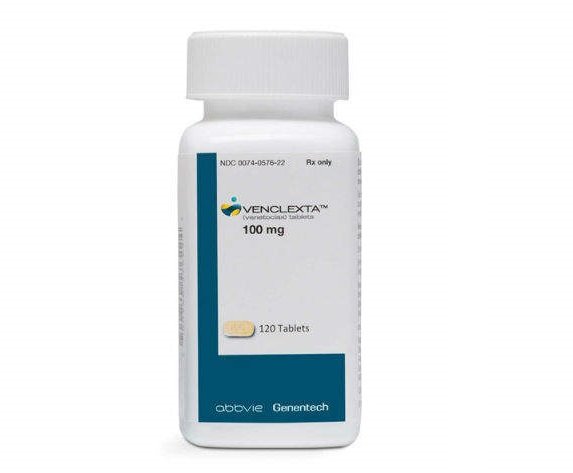
Venetoclax selectively inhibits the anti-apoptotic protein BCL-2, which is overexpressed in chronic lymphocytic leukemia (CLL) cells and acute myeloid leukemia (AML) cells. It is used to treat the following conditions:
- Acute myeloid leukemia:
- It is used in the treatment of newly-diagnosed acute myeloid leukemia (along with azacitidine, decitabine, or low-dose cytarabine) in patients more than 75 years of age, or in patients with comorbid conditions that necessitate the use of intensive induction chemotherapy.
- Chronic lymphocytic leukemia and small lymphocytic lymphoma:
- It is used in the treatment of chronic lymphocytic leukemia and small lymphocytic lymphoma in adults
- Off Label Usage of Venetoclax in Adults:
- It is used as off label agent in treating mantle cell lymphoma.
Venetoclax Dose in Adults
- Risk assessment for tumor lysis syndrome should be done
- Give prophylactic hydration and anti-hyperuricemic
Dose in the treatment of Newly diagnosed Acute myeloid leukemia: Adults ≥75 years of age or with comorbidities:
- Start azacitidine, decitabine, or low-dose cytarabine on the first day.
- The venetoclax dose usually depends upon the concomitant chemotherapy agent.
- WBC should be less than 25,000/mm before initiation of venetoclax.
- Cytoreduction prior to treatment may be required.
- Day 1: 100 mg orally once a day.
- Day 2: 200 mg orally once a day.
- Day 3: 400 mg orally once a day.
-
Venetoclax in combination with azacitidine or decitabine: Day 4 and afterward:
- 400 mg orally once a day until disease progression or toxicity occurs.
-
Venetoclax in combination with low-dose cytarabine: Day 4 and afterward:
- 600 mg orally once a day until disease progression or unacceptable toxicity occurs.
Dose in the treatment of Chronic lymphocytic leukemia/small lymphocytic lymphoma:
- Week 1: 20 mg orally once a day.
- Week 2: 50 mg orally once a day.
- Week 3: 100 mg orally once a day.
- Week 4: 200 mg orally once a day.
- Week 5: 400 mg orally once a day.
Venetoclax monotherapy: Week 5 and afterward:
- 400 mg orally once a day
- It is continued until disease progression or unacceptable toxicity occurs.
Venetoclax in combination with obinutuzumab:
- Obinutuzumab is started on day 1 of cycle 1
- Start venetoclax on day 22 of cycle 1 according to the 5-week schedule for chronic lymphocytic leukemia/small lymphocytic lymphoma above;
- Ramp-up is completed at the end of cycle 2.
- Cycle 3 (day 1 and beyond): 400 mg once a day until the end of cycle 12.
- Each cycle is 4 weeks.
Venclexta in combination with rituximab: Week 5 and thereafter:
- 400 mg orally once a day;
- Then continue venetoclax until disease progression or unacceptable toxicity occurs, for up to 2 years from day 1 (cycle 1) of rituximab;
- Start rituximab after receiving venetoclax at the 400 mg once daily dose for 1 week
- Premedicate with I/V fluids and anti-hyperuricemic therapy.
Dose in the treatment of Acute myeloid leukemia:
- WBC should be less than 25,000/mm before venetoclax initiation
- Pre-treatment cytoreduction could be required.
- Give adequate hydration and anti-hyperuricemic agents; continue during the ramp-up phase.
- Correct electrolyte abnormalities (potassium, calcium, phosphorus, and creatinine) before venetoclax initiation.
- For patients at high risk of TLS (eg, circulating blasts, high leukemia burden in the bone marrow, elevated pretreatment LDH levels, or reduced renal function), additional TLS preventative measures should be sone, including increased laboratory monitoring and reduced initial venetoclax doses.
Dosage in the treatment of Chronic lymphocytic leukemia/small lymphocytic lymphoma:
-
Low tumor burden (all lymph nodes <5 cm and absolute lymphocyte count [ALC] <25,000/mm ):
- Outpatient:
- Hydration with 1.5 to 2 L of oral hydration is done
- Administer allopurinol (beginning 2 to 3 days before venetoclax initiation).
- Administer IV hydration for patients unable to tolerate oral hydration.
- Outpatient:
-
Medium tumor burden (any lymph node 5 to <10 cm or ALC ≥25,000/mm ):
- Outpatient:
- Hydration with 1.5 to 2 L of oral hydration is done
- Administer allopurinol (beginning 2 to 3 days before venetoclax initiation).
- Administer IV hydration for patients unable to tolerate oral hydration.
-
High tumor burden (any lymph node ≥10 cm OR ALC ≥25,000/mm and any lymph node ≥5 cm):
- Inpatient:
- Hydration with 1.5 to 2 L of oral hydration is done
- 150 to 200 mL/hour IV hydration is done if orally not tolerated
- Administer allopurinol (beginning 2 to 3 days before venetoclax initiation)
- Use rasburicase if baseline uric acid is increased.
- Ramp-up can be completed outpatient if clinically indicated.
- Inpatient:
Off label Dosage in the treatment of refractory or relapsed mantle cell lymphoma:
-
Venetoclax monotherapy:
- Initial: 20 mg orally once a day for week 1,
- Then 50 mg once a day for week 2,
- Then 100 mg once a day for week 3,
- Then 200 mg once daily for week 4,
- Followed by 400 mg once a day for week 5.
- 800 mg once daily for week 6 and afterward until disease progression or unacceptable toxicity occurs or until proceeding to allogeneic stem cell transplant.
-
Venetoclax in combination with ibrutinib:
- Venetoclax is started after 1 month of ibrutinib monotherapy to reduce the risk of tumor lysis syndrome.
- Initially, 20 mg orally once a day for week 5
- Followed by 50 mg once a day for week 6
- Followed by 100 mg once a day for week 7
- Followed by 200 mg once a day for week 8.
- 400 mg once daily in week 9 and afterward
- Continue until disease progression or unacceptable toxicity happens.
- Venetoclax dose can be increased to 800 mg once daily after week 16 if a complete response has not occurred
Dosage adjustment of Venclexta for concomitant strong or moderate CYP3A inhibitors or P-GP inhibitors:
- Acute myeloid leukemia:
- Posaconazole: If concomitant administration of posaconazole and venetoclax is needed, then a reduced ramp-up venetoclax dosing schedule is required.
- Day 1: 10 mg is given
- Day 2: 20 mg is given
- Day 3: 50 mg.is given
- Day 4 and beyond: 70 mg is given.
- Posaconazole: If concomitant administration of posaconazole and venetoclax is needed, then a reduced ramp-up venetoclax dosing schedule is required.
- For patients who have completed dose increment and are on a steady daily venclexta dose, lessen the venetoclax dose to 70 mg once a day when posaconazole must be used concurrently.
Strong CYP3A inhibitors (other than posaconazole):
- If concomitant administration of a strong CYP3A inhibitor (other than posaconazole) and venetoclax is needed, then a reduced ramp-up venetoclax dosing schedule is required.
- Day 1: 10 mg is given
- Day 2: 20 mg is given
- Day 3: 50 mg is given
- Day 4 and beyond: 100 mg is given
- When posaconazole must be used concurrently, lessen the venetoclax dose to 100 mg once a day (For patients who have completed dose increment and are on a steady daily venclexta dose)
Moderate CYP3A inhibitors and P-GP inhibitors:
-
- Lessen the venetoclax dose by at least half.
- Following discontinuation of the CYP3A or P-GP inhibitor:
- After the inhibitor is discontinued for 2-3 days, restart the venetoclax dose that was used before initiating the CYP3A or Pgp inhibitor.
Dosage in the treatment of Chronic lymphocytic leukemia/small lymphocytic lymphoma:
-
Posaconazole:
- The concomitant use of posaconazole is not advised at starting of venetoclax and during dose escalation.
- For patients who have completed dose increment and are on a steady daily venetoclax dose, either consider the use of an alternative agent or lessen the venetoclax dose to 70 mg daily when posaconazole is used concurrently.
-
Strong CYP3A inhibitors (other than posaconazole):
- The use of strong CYP3A inhibitors is not advised at the initiation of venetoclax and during dose escalation.
- For patients who have completed dose increment and are on a steady daily venetoclax dose, either consider the use of an alternative agent or lessen the venetoclax dose to 100 mg daily when posaconazole is used concurrently.
-
Moderate CYP3A inhibitors and P-GP inhibitors:
- Consider the use of an alternative agent or reduce the venetoclax dose by at least 50%.
-
Following stoppage of the CYP3A or P-gp inhibitor:
- 2 - 3 days after the inhibitor is stopped, restart the venetoclax dose that was used before initiating the CYP3A or Pgp inhibitor.
Venetoclax Dose in Childrens
Efficacy and safety in children has not been established.
Pregnancy Risk Category: C
- According to studies from animal reproduction studies and the mechanism of action, venetoclax may cause harm to fetal health if administered during pregnancy.
- Before starting treatment, women with reproductive potential should undergo a pregnancy test. They also need to use effective contraception for at least one month after stopping the last dose.
- Venetoclax can cause male fertility problems
Use of venetoclax while breastfeeding
- It is unknown if venetoclax can be found in breast milk.
- Manufacturers do not recommend breastfeeding while taking a drug.
Venetoclax Dose in Renal Disease:
CrCl may be calculated using the Cockcroft-Gault formula. Patients with altered renal function may require more intensive prophylaxis and monitoring to reduce the risk of tumor lysis syndrome after treatment initiation.
CrCl ≥30 mL/minute:
- No dosage adjustment is required;
- Caution should be taken due to increased risk for TLS.
CrCl <30 mL/minute:
- There are no dosage adjustments given in the manufacturer's labeling.
End-stage renal disease (ESRD) requiring dialysis:
- There are no dosage adjustments given in the manufacturer's labeling.
- Dialysis is unlikely to remove venetoclax significantly
Venetoclax Dose in Liver Disease:
- Mild impairment (normal total bilirubin and AST > ULN or total bilirubin >1 to 1.5 × ULN) or moderate impairment (total bilirubin >1.5 to 3 × ULN):
- No dosage adjustment required.
- Severe impairment (total bilirubin >3 × ULN):
- There are no dosage adjustments given in the manufacturer's labeling.
Common Side Effects of Venetoclax (Venclexta) Include:
- Cardiovascular:
- Edema
- Central Nervous System:
- Fatigue
- Headache
- Dizziness
- Dermatologic:
- Skin Rash
- Endocrine & Metabolic:
- Hypocalcemia
- Hyperglycemia
- Hyperkalemia
- Decreased Serum Albumin
- Hypophosphatemia
- Hyponatremia
- Hyperphosphatemia
- Gastrointestinal:
- Diarrhea
- Nausea
- Abdominal Pain
- Constipation
- Vomiting
- Mucositis
- Hematologic & Oncologic:
- Leukopenia
- Neutropenia
- Lymphocytopenia
- Anemia
- Thrombocytopenia
- Tumor Lysis Syndrome
- Hepatic:
- Increased Serum Aspartate Aminotransferase
- Neuromuscular & Skeletal:
- Musculoskeletal Pain
- Arthralgia
- Respiratory:
- Upper Respiratory Tract Infection
- Cough
- Pneumonia
- Dyspnea
- Lower Respiratory Tract Infection
- Miscellaneous:
- Fever
Less Common Side Effects of Venetoclax (Venclexta) Include:
- Endocrine & metabolic:
- Hyperuricemia
- Hematologic & oncologic:
- Febrile neutropenia
Contraindication to Venetoclax Include:
- Patients with small lymphocytic and chronic lymphocytic Lymphoma (CLL/SLL), should not use strong CYP3A inhibiters during the ramp-up phase.
- This is because of the increased risk of developing tumor lysis syndrome.
- Hypersensitivity to venetoclax, or any part thereof
Warnings and precautions
- Suppression of bone marrow
- Anemia, thrombocytopenia and neutropenia can all occur.
- In chronic lymphocyticleukemia/small-lymphocytic Lymphoma (CLL/SLL), patients who have used venetoclax alone or in combination, grade 3 and 4 neutropenia are common.
- Monotherapy or combination therapy has been shown to reduce neutropenic fever.
- Patients with acute myeloid leukemia (AML) will see their baseline neutrophil count drop if they are given azacitidine, decitabine or low-dose Cytarabine.
- CBC and differential monitoring should be performed throughout treatment.
- You may need to interrupt treatment or reduce the dose.
- If clinically indicated, consider the use of antimicrobials or WBC growth factor support.
- Infection
- There have been fatal and serious infections such as pneumonia and sepsis.
- You should be on the lookout for symptoms and signs of infection, and take immediate action.
- For grade 3 and higher infections, withhold venetoclax treatment
- Tumor lysis syndrome
- Patients with high tumor burden may experience tumor lysis syndrome, which can be fatal or cause kidney failure.
- Venetoclax may cause rapid tumor volume reductions. There is a potential for TLS after treatment is initiated and during the ramp up phase.
- TLS prophylaxis has been reduced by monitoring, ramp-up dose and TLS prophylaxis.
- Patients with CLL/SLL have a shorter ramp-up time (e.g. 2 to 3 weeks) as well as higher initial doses. This has led to higher rates of TLS, and other complications.
- TLS-related changes in blood chemistry can occur as soon as 6-8 hours after the first dose. Dose increases may cause similar changes and require prompt management.
- High tumor burden and other comorbidities increase the risk of tumor lysis syndrome
- TLS risk is further increased by impaired renal function.
- Assess the risk of tumor lysis syndrome and initiate TLS prophylactic treatment like hydration, anti-hyperuricemic therapy such as Allopurinol.
- Regularly monitor blood chemistries and promptly treat any abnormalities.
- This could mean that treatment should be stopped or reduced.
- TLS risk could decline as the tumor burden drops.
- As the TLS risk increases, you may need to use more intensive measures such as IV hydration, frequent monitoring and hospitalization.
- Venetoclax dosage adjustment is required for any combination of strong or moderate CYP3A or P-gp inhibitors during ramp-up or after start-up.
- Renal impairment
- Patients with reduced renal function (CrCl 80mL/minute) may be at greater risk of TLS.
- They will need more intensive TLS prophylaxis and monitoring throughout treatment initiation and dose increase.
|
Chloramphenicol (Ophthalmic) |
May enhance the adverse/toxic effect of Myelosuppressive Agents. |
|
Clofazimine |
May increase the serum concentration of CYP3A4 Substrates (High risk with Inhibitors). |
|
CloZAPine |
Myelosuppressive Agents may enhance the adverse/toxic effect of CloZAPine. Specifically, the risk for neutropenia may be increased. |
|
Deferasirox |
May decrease the serum concentration of CYP3A4 Substrates (High risk with Inducers). |
|
Erdafitinib |
May decrease the serum concentration of CYP3A4 Substrates (High risk with Inducers). |
|
Erdafitinib |
May increase the serum concentration of CYP3A4 Substrates (High risk with Inhibitors). |
|
Erdafitinib |
May increase the serum concentration of P-glycoprotein/ABCB1 Substrates. |
|
Fosaprepitant |
May increase the serum concentration of CYP3A4 Substrates (High risk with Inhibitors). |
|
Ivosidenib |
May decrease the serum concentration of CYP3A4 Substrates (High risk with Inducers). |
|
Larotrectinib |
May increase the serum concentration of CYP3A4 Substrates (High risk with Inhibitors). |
|
Mesalamine |
May enhance the myelosuppressive effect of Myelosuppressive Agents. |
|
Palbociclib |
May increase the serum concentration of CYP3A4 Substrates (High risk with Inhibitors). |
|
P-glycoprotein/ABCB1 Inhibitors |
May increase the serum concentration of Pglycoprotein/ABCB1 Substrates. P-glycoprotein inhibitors may also enhance the distribution of pglycoprotein substrates to specific cells/tissues/organs where p-glycoprotein is present in large amounts (e.g., brain, T-lymphocytes, testes, etc.). |
|
Promazine |
May enhance the myelosuppressive effect of Myelosuppressive Agents. |
|
Sarilumab |
May decrease the serum concentration of CYP3A4 Substrates (High risk with Inducers). |
|
Siltuximab |
May decrease the serum concentration of CYP3A4 Substrates (High risk with Inducers). |
|
Tocilizumab |
May decrease the serum concentration of CYP3A4 Substrates (High risk with Inducers). |
|
Vaccines (Inactivated) |
Venetoclax may diminish the therapeutic effect of Vaccines (Inactivated). |
|
Warfarin |
Venetoclax may increase the serum concentration of Warfarin. |
|
Risk Factor D (Consider therapy modification) |
|
|
CYP3A4 Inhibitors (Moderate) |
May increase the serum concentration of Venetoclax. Management: Reduce the venetoclax dose by at least 50% in patients requiring these combinations. |
|
CYP3A4 Inhibitors (Strong) |
May increase the serum concentration of Venetoclax. Management: This combination is contraindicated during venetoclax initiation and ramp-up in patients with CLL/SLL. Reduced venetoclax doses are required during ramp-up for patients with AML, and reduced doses are required for all patients during maintenance therapy. Exceptions: Posaconazole. |
|
Digoxin |
|
|
Everolimus |
Venetoclax may increase the serum concentration of Everolimus. Management: Administer everolimus at least 6 hours before venetoclax when concomitant therapy is required. |
|
MiFEPRIStone |
May increase the serum concentration of CYP3A4 Substrates (High risk with Inhibitors). Management: Minimize doses of CYP3A4 substrates, and monitor for increased concentrations/toxicity, during and 2 weeks following treatment with mifepristone. Avoid cyclosporine, dihydroergotamine, ergotamine, fentanyl, pimozide, quinidine, sirolimus, and tacrolimus. |
|
P-glycoprotein/ABCB1 Inhibitors |
May increase the serum concentration of Venetoclax. Management: Consider a venetoclax dose reduction by at least 50% in patients requiring concomitant treatment with P-glycoprotein (P-gp) inhibitors. Exceptions: Azithromycin (Systemic). |
|
Pitolisant |
May decrease the serum concentration of CYP3A4 Substrates (High risk with Inducers). Management: Combined use of pitolisant with a CYP3A4 substrate that has a narrow therapeutic index should be avoided. Other CYP3A4 substrates should be monitored more closely when used with pitolisant. |
|
Posaconazole |
May increase the serum concentration of Venetoclax. Management: This combination is contraindicated during venetoclax initiation and ramp-up in patients with CLL/SLL. Reduced venetoclax doses are required during ramp-up for patients with AML, and reduced doses are required for all patients during maintenance therapy. |
|
Sirolimus |
Venetoclax may increase the serum concentration of Sirolimus. Management: Administer sirolimus at least 6 hours before venetoclax when concomitant therapy is required. |
|
Stiripentol |
May increase the serum concentration of CYP3A4 Substrates (High risk with Inhibitors). Management: Use of stiripentol with CYP3A4 substrates that are considered to have a narrow therapeutic index should be avoided due to the increased risk for adverse effects and toxicity. Any CYP3A4 substrate used with stiripentol requires closer monitoring. |
|
Risk Factor X (Avoid combination) |
|
|
BCG (Intravesical |
Myelosuppressive Agents may diminish the therapeutic effect of BCG (Intravesical). |
|
Bitter Orange |
May increase the serum concentration of Venetoclax. |
|
Cladribine |
May enhance the myelosuppressive effect of Myelosuppressive Agents. |
|
Conivaptan |
May increase the serum concentration of CYP3A4 Substrates (High risk with Inhibitors). |
|
CYP3A4 Inducers (Moderate) |
May decrease the serum concentration of Venetoclax. |
|
CYP3A4 Inducers (Strong) |
May decrease the serum concentration of Venetoclax. |
|
Deferiprone |
Myelosuppressive Agents may enhance the neutropenic effect of Deferiprone. |
|
Dipyrone |
May enhance the adverse/toxic effect of Myelosuppressive Agents. Specifically, the risk for agranulocytosis and pancytopenia may be increased |
|
Fusidic Acid (Systemic) |
May increase the serum concentration of CYP3A4 Substrates (High risk with Inhibitors). |
|
Grapefruit Juice |
May increase the serum concentration of Venetoclax. |
|
Idelalisib |
May increase the serum concentration of CYP3A4 Substrates (High risk with Inhibitors). |
|
Star Fruit |
May increase the serum concentration of Venetoclax. |
|
Vaccines (Live) |
Venetoclax may enhance the adverse/toxic effect of Vaccines (Live). Venetoclax may diminish the therapeutic effect of Vaccines (Live). Management: Avoid use of live, attenuated vaccines before, during, or after (prior to B-cell recovery) venetoclax treatment. |
Monitor:
- CBC with differential counts during treatment.
- Blood chemistries: potassium, uric acid and calcium.
- Test for pregnancy (before treatment in females with reproductive potential)
- Assess tumor burden and radiographic evaluation (eg CT scan) for the tumor lysis syndrome (TLS). Risk evaluation
- Be on the lookout for signs and symptoms of infection.
Monitoring blood chemistry in acute myeloidleukemia:
- Before therapy is initiated, assess and treat any pre-existing abnormalities.
- Before you give the first dose, monitor blood chemistries for TLS. The next dose will be given 6-8 hours after the last dose.
- Patients at high risk of TLS need to be monitored more closely.
Monitoring blood chemistry based on tumor burden/ Tumor Lisis Syndrome (TLS), risk in chronic lymphocytic and/or small lymphocytic lesukemia:
- Low risk (all lymph nodes less than 5cm and absolute lymphocyte count [ALC] below 25,000/mm) or medium risk(any lymph node between 5cm and 10cm or ALC >=25,000/mm)
- Before the first dose, blood chemistry is checked. It takes 6-8 hours to complete. 24 hours later, after the 20 mg or 50 mg doses, and before each subsequent dose.
- High risk: Any lymph node greater than 10 cm or ALC greater than 25,000/mm, and any lymph node greater that 5 cm
- Before the first dose, blood chemistry must be done. This is done 4, 8, 12, 24 and 24 hours following the first 20 mg or 50 mg dose. Plus 6 to 8 hours after each subsequent initial ramp-up dose.
How to administer Venetoclax (Venclexta)?
- Take a snack and a glass of water each day.
- Consume whole, but do not crush or break it before swallowing.
Missed or vomited dosages:
- If you miss a dose, and it falls within 8 hours of the missed time, give it as soon as possible. Then resume your normal daily routine.
- If the delay is longer than 8 hours, do not give the missed dose. Instead, resume your normal dosing schedule for the next day.
- Do not give additional doses to a patient who vomits after receiving a dose. Instead, the next prescribed dose should always be administered at the normal time.
Mechanism of action of Venetoclax (Venclexta):
- Venetoclax, a BH-3 mimetic, has cytotoxic activity against tumor cells that overexpress BCL-2.
- It selectively inhibits BCL-2, an anti-apoptotic proteins that is overexpressed by chronic lymphocytic (CLL) and acute myeloid (AML) cell lines.
- BCL-2 is a mediator of tumor cell survival and has a relationship to chemotherapy resistance.
- Venetoclax is a direct binding agent to the BCL-2 protein. It replaces proapoptotic proteins, and restores the apoptotic process.
Distribution: V : 256 to 321 L
Protein binding: Highly bound to plasma proteins
Metabolism: Hepatic, predominantly via CYP3A; the major metabolite is M27 (has BCL-2 inhibitory activity)
Half-life, elimination: ~26 hours
Time to peak: 5 - 8 hours
Excretion: Feces (more than 99.9%; ~21% as unchanged drug); Urine (<0.1%)
International Brands of Venetoclax:
- Venclexta
- Venclyxto
- Venclexta Starting Pack
Venetoclax Brands in Pakistan:
Venetoclax (Venclexta) is not available in Pakistan
.png)


