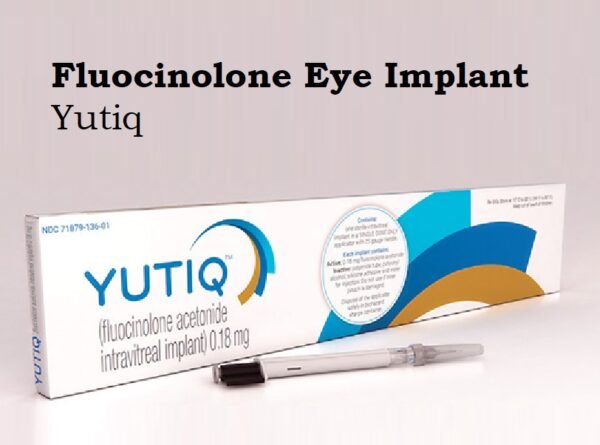
Yutiq (Fluocinolone acetonide) is a non-bio-erodible intravitreal implant that is indicated in the management of chronic non-infectious posterior uveitis.
Indications of Fluocinolone (Yutiq):
-
Diabetic macular edema (Iluvien):
- It is indicated for treating diabetic macular edema in patients who have been previously treated with a course of corticosteroids and without any clinically significant rise in intraocular pressure.
-
Uveitis (Retisert, Yutiq):
It is useful in the management of chronic, noninfectious uveitis affecting the posterior segment of the eye.
Fluocinolone dose in adults:
Yutiq (Fluocinolone) treatment dose in Diabetic macular edema:
- Ocular implant (Iluvien): Intravitreal injection: One implant (0.19 mg) injected in affected eye.
- Note: Implant is designed to release fluocinolone at an initial rate of 0.25 mcg daily lasting 36 months.
Yutiq (Fluocinolone) treatment dose in chronic Uveitis:
- Ocular implant (Retisert): Intravitreal injection: One silicone-encased tablet (0.59 mg) surgically implanted into the posterior segment of the affected eye.
- Note: Implant is designed to initially release 0.6 mcg/day, decreasing over 30 days to a steady-state release rate of 0.3 to 0.4 mcg daily for 30 months.
- Reimplantation is required in case of recurrence of uveitis as it indicates the depletion of tablets.
- Ocular implant (Yutiq): Intravitreal injection: One implant (0.18 mg) injected in the affected eye.
Note: Implant is designed to release fluocinolone at an initial rate of 0.25 mcg daily lasting 36 months. [/bg_collapse] [bg_collapse view="button-blue" color="#f7f2f2" icon="arrow" expand_text="Dose in Children" collapse_text="Dose in Children" ]
Fluocinolone (Yutiq) dose in children:
Yutiq treatment dose in chronic Uveitis:
-
Children ≥12 years and Adolescents:
- Ocular implant (Retisert): Intravitreal injection: One silicone-encased tablet (0.59 mg) surgically implanted into the posterior segment of the affected eye.
- Note: Implant is designed to release 0.6 mcg/day, decreasing over 30 days to a steady-state release rate of 0.3 to 0.4 mcg daily for 30 months.
- Reimplantation is required in case of recurrence of uveitis as it indicates the depletion of tablets.
Fluocinolone Pregnancy Risk Category: C
- Studies on animal reproduction showed adverse effects from the use of steroids. However, fluocinolone studies were not conducted.
- After ocular administration,systemic absorption is below the limit of quantification.
Fluocinolone use during breastfeeding:
- Breast milk contains systemic corticosteroids.
- The amount of fluocinolone that is absorbed by the eyes to make breast milk detectable is unknown. However, it is possible to determine the level of systemic absorption.
- Breastfeeding during therapy is a decision that depends on the risks to infants, the benefits to the mother, and the benefits to the infant.
Yutiq Dose adjustment in kidney disease:
There are no dosage adjustments provided in the manufacturer’s labeling.
Yutiq Dose adjustment in liver disease:
There are no dosage adjustments provided in the manufacturer’s labeling.
Common Side Effects of Fluocinolone (Yutiq):
-
Central Nervous System:
- Headache
- Dizziness
-
Dermatologic:
- Skin Rash
-
Gastrointestinal:
- Nausea
- Vomiting
-
Hematologic & Oncologic:
- Anemia
-
Infection:
- Influenza
-
Neuromuscular & Skeletal:
- Back Pain
- Limb Pain
- Arthralgia
-
Ophthalmic:
- Cataract
- Increased Intraocular Pressure
- Eye Pain
- Abnormal Sensation In Eyes
- Blepharoptosis
- Blurred Vision
- Decreased Visual Acuity
- Eyelid Edema
- Macular Edema
- Maculopathy
- Visual Disturbance
- Conjunctival Hemorrhage
- Decreased Intraocular Pressure
- Dry Eye Syndrome
- Eye Pruritus
- Vitreous Opacity
- Conjunctival Hyperemia
- Glaucoma
- Vitreous Hemorrhage
- Eye Irritation
- Lacrimation
-
Respiratory:
- Cough
- Nasopharyngitis
- Sinusitis
- Upper Respiratory Tract Infection
-
Miscellaneous:
- Procedural Complications
- Fever
Rare Side Effects of Fluocinolone (Yutiq):
-
Cardiovascular:
- Hypertension
-
Central Nervous System:
- Foreign Body Sensation Of Eye
-
Ophthalmic:
- Uveitis
- Anterior Chamber Eye Hemorrhage
- Blepharitis
- Choroidal Detachment
- Diplopia
- Retinal Detachment
- Retinal Hemorrhage
- Swelling Of Eye
- Synechiae Of Iris
- Corneal Edema
- Posterior Capsule Opacification
- Eye Discharge
- Photophobia
- Photopsia
- Anterior Chamber Inflammation
- Conjunctivitis
- Ocular Hyperemia
- Ophthalmic Inflammation
- Vitreous Disorder
- Eye Discomfort
- Hypopyon
- Optic Atrophy
- Retinal Exudates
- Retinopathy
- Chorioretinitis
- Iridocyclitis
- Visual Field Defect
-
Renal:
- Renal Failure
-
Respiratory:
- Pneumonia
Contraindications to Fluocinolone (Yutiq):
- Hypersensitivity to fluocinolone or other corticosteroids or any component of this formulation
- Iluvien onlyGlaucoma is a condition that occurs in patients with a cup-to-disc ratio of greater than 0.
- Viral diseases that are active in the cornea and conjunctiva include epithelial herpes complex keratitis (dendritic-keratitis), varicella, and vaccinia.
- Active bacterial, mycobacterial or fungal infections of your eye.
Warnings and precautions
-
Formation of cataracts:
- Corticosteroids can cause posterior subcapsular cataracts.
-
Glaucoma:
- Long-term steroids therapy can cause increased intraocular pressure and glaucoma. Glaucoma patients should be treated with caution
- All patients should have their intraocular pressure checked.
- Most patients will require intraocular pressure-lowering medication or filtering procedures within three years of implantation.
-
Immunosuppression:
- Fluocinolone may cause secondary bacterial, fungal or viral infections.
- Patients with a history or potential for reactivation of ocular herpes are not advised to use it.
- Patients who have had bacterial, fungal, fungal or viral infections should be cautious.
- Steroids can mask acute purulent infections.
- If you have persistent corneal ulceration, it is important to suspect fungal infection.
-
Ocular effects
- Intravitreal injections can cause increased intraocular pressure, inflammation, endophthalmitis and retinal detachment. Therefore, it is important to be vigilant.
- In a few cases, an optic nerve injury may be visible.
- There are some complications to the procedure, including cataract formation, hypotony and vitreous hemorhage.
- Visual defects such as blurred vision or blurred field of sight may develop (lasting between 1 and 4 weeks after surgery).
- Late-onset endophthalmitis may occur due to surgical site integrity.
-
Ocular effects
- Retisert: Perforation can result from topical steroids in the treatment of corneal or sclera diseases.
- Steroids can help reduce the likelihood of bleb formation after cataract surgery.
Fluocinolone (topical): Drug Interaction
|
Risk Factor C (Monitor therapy) |
|
|
Ritodrine |
Corticosteroids may enhance the adverse/toxic effect of Ritodrine. |
|
Corticorelin |
Corticosteroids may diminish the therapeutic effect of Corticorelin. Specifically, the plasma ACTH response to corticorelin may be blunted by recent or current corticosteroid therapy. |
|
Deferasirox |
Corticosteroids may enhance the adverse/toxic effect of Deferasirox. Specifically, the risk for GI ulceration/irritation or GI bleeding may be increased. |
|
Risk Factor D (Consider therapy modification) |
|
|
Hyaluronidase |
Corticosteroids may diminish the therapeutic effect of Hyaluronidase. Management: Patients receiving corticosteroids (particularly at larger doses) may not experience the desired clinical response to standard doses of hyaluronidase. Larger doses of hyaluronidase may be required. |
|
Risk Factor X (Avoid combination) |
|
|
Aldesleukin |
Corticosteroids may diminish the antineoplastic effect of Aldesleukin. |
Monitoring parameters:
Iluvien, Yutiq:
- Monitoring of increased intraocular pressure and endophthalmitis is necessary after injection Optic nerve head perfusion should be checked immediately after injection, tonometry within 30 minutes, and biomicroscopy between 2 to 7 days after injection.
Retisert:
- Monitoring the integrity of implant by visual inspection is required, recurrence of uveitis, intraocular pressure should be checked periodically.
How to administer Fluocinolone (Yutiq)?
Ophthalmic implant (intravitreal injection):
- It should be administered under controlled aseptic conditions (eg, sterile gloves, sterile drape, sterile eyelid speculum).
- Adequate anesthesia and a broad-spectrum bactericidal should be given to the periocular skin, eyelid, and ocular surfaces before injection.
- Refer to manufacturer’s prescribing information for administration technique.
Iluvien:
- Preloaded applicators should be inspected visually to ensure the presence of a drug implant. Optimal placement is inferior to the optic disc and posterior to the equator of the eye.
Retisert:
- In order to avoid damage to the tablet integrity and adversely affecting release characteristics, it should only be handled by a suture tab.
- Resterilization should be avoided.
Yutiq:
- Optimal placement is inferior to the optic disc and posterior to the equator of the eye.
Mechanism of action of Fluocinolone (Yutiq):
- Fluocinolone inhibits phospholipase A2 through lipocortin stimulation.
- Lipocortins cause inhibition of arachidonic acids, which in turn controls the biosynthesis prostaglandins (leukotrienes) and prostaglandins (leukotrienes).
- Arachidonic acid can be released by membrane phospholipids via phospholipase B2.
Duration:
- Iluvien, Yutiq:Fluocinolone Acetonide is released at an initial rate 0.25 mcg/day over 36 months.
- Retisert:Fluocinolone Acetonide is released at an initial rate 0.6 mcg/day. This rate decreases over 30 days to a steady rate of 0.3-0.4 mcg/day after 30 months.
Absorption:
- Systemic absorption is negligible.
Distribution:
- Retisert: Aqueous and vitreous humor.
International Brands of Fluocinolone:
- Iluvien
- Retisert
- Yutiq
Fluocinolone Brand Names in Pakistan:
No Brands Available in Pakistan.
.png)


