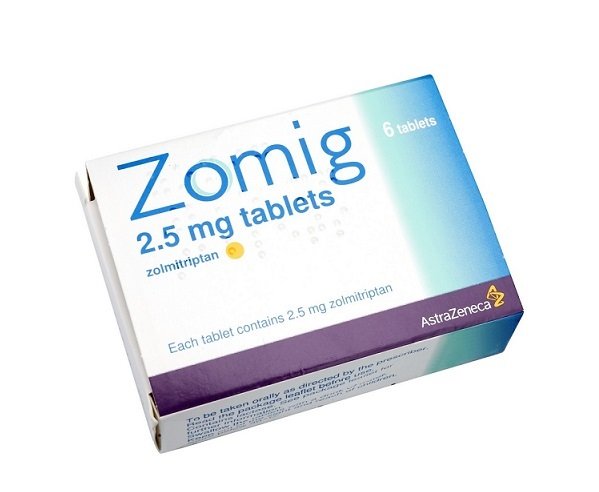
Zolmitriptan is a selective agonist for serotonin 5-HT-1B and 5-HT-1D receptors that are present in the cranial arteries and sensory nerves of the trigeminal system. [select-faq faq_id='7198'] It is indicated for the treatment of the following disorders:
-
For the acute treatment of migraine with or without aura in adults and children aged 12 years or more
-
Off Label Uses of Zolmitriptan in Adults include:
-
Treatment of Cluster headache
-
For the short-term prevention of menstrual migraines
-
Zolmitriptan Dose in Adults
Dose as off-label use in the treatment of Cluster headache:
- Nasal inhalation or oral tablets:
- The usual dose is 5 - 10 mg at the onset of cluster headache up to a maximum single dose of 10 mg.
Dose in the treatment of Migraine:
- Nasal inhalation:
- 2.5 mg to the maximum single dose of 5 mg
- Tablet:
- 1.25 - 2.5 mg orally to a maximum single dose of 5 mg
- Orally disintegrating tablet:
- 2.5 mg orally to a maximum single dose of 5 mg
- A second dose may be repeated in 2 hours up to a maximum dose of 10 mg/day if the patient does not respond to the first dose or the headache returns after transient improvement.
Dose as off-label use in the prophylaxis of Menstrual migraine:
- 5 mg orally 2 - 3 times a day.
- It should be started 2 days before the onset of menstrua cycles and continued for up to 5 days after the onset of menses for a total of seven days.
-
Dosing adjustment for concomitant therapy with cimetidine:
- A maximum single dose of 2.5 mg or 5 mg per day should not be exceeded.
Zolmitriptan Dose in Childrens
Dose in the treatment of Migraine in children:
- Children older than 12 years and Adolescents:
- Intranasal administration:
- 2.5 mg initially.
- The dose may be titrated based on the patient's response to a maximum single dose of 5 mg.
- It should be administered at the onset of symptoms.
- A second dose may be repeated in 2 hours up to a maximum dose of 10 mg/day if the patient does not respond to the first dose or the headache returns after transient improvement.
- Intranasal administration:
-
Dosing adjustment for concomitant therapy with cimetidine:
- A maximum single dose of 2.5 mg or 5 mg per day should not be exceeded.
Pregnancy Risk Factor: C
- It is not known if any data are available.
- This should be avoided, and other agents should be used.
- Particularly if adverse fetal outcomes are observed, inadvertent exposure should also be reported.
Zolmitriptan use during breastfeeding:
- Excretion of the drug into breastmilk is not known.
- The manufacturer advises weighing the benefits and risks of its use in both the infant and the nursing mother.
- Other safer agents should be preferably used.
Zolmitriptan dose in Kidney disease:
The manufacturer does not recommend any dose adjustment in patients with kidney disease, however, clearance is impaired with a CrCl of less than 25 ml/min.
Zolmitriptan dose in Liver disease:
Tablet formulation:
- Mild impairment:
- No adjustment in the dose is required.
- Moderate to severe impairment:
- Initiate therapy with 1.25 mg to a maximum daily dose of 5 mg in severe hepatic impairment.
- Initiate therapy with 1.25 mg to a maximum daily dose of 5 mg in severe hepatic impairment.
Orally disintegrating tablet:
- Mild impairment:
- No adjustment in the dose is required.
- Moderate to severe impairment:
- Avoid its use.
- Avoid its use.
Nasal inhalation:
- Mild impairment:
- No adjustment in the dose is necessary.
- Moderate to severe:
- Avoid its use.
Common Side Effects of Zolmitriptan Include:
- Gastrointestinal:
- Unpleasant taste
Less Common Side Effects of Zolmitriptan Include:
- Cardiovascular:
- Chest Pain
- Chest Pressure
- Facial Edema
- Palpitations
- Cardiac Arrhythmia
- Hypertension
- Syncope
- Tachycardia
- Central Nervous System:
- Dizziness
- Paresthesia
- Drowsiness
- Local Alterations In Temperature Sensations
- Sensation Of Pressure
- Hyperesthesia,
- Flushing Sensation
- Pain
- Vertigo
- Chills
- Depersonalization
- Headache
- Agitation
- Amnesia
- Anxiety
- Depression
- Emotional Lability
- Insomnia
- Nervousness
- Dermatologic:
- Diaphoresis
- Pruritus
- Skin Rash
- Urticaria
- Gastrointestinal:
- Nausea
- Xerostomia
- Dyspepsia
- Dysphagia
- Abdominal Pain
- Vomiting
- Genitourinary:
- Urinary Frequency
- Urinary Urgency
- Hypersensitivity:
- Hypersensitivity Reaction
- Local:
- Local Pain
- Application Site Irritation
- Neuromuscular & Skeletal:
- Weakness
- Arthralgia
- Myalgia
- Otic:
- Tinnitus
- Renal:
- Polyuria
- Respiratory:
- Nasal Discomfort
- Constriction Of The Pharynx
- Pressure On Pharynx
- Bronchitis
- Cough
- Dyspnea
- Epistaxis
- Laryngeal Edema
- Pharyngitis
- Rhinitis
- Sinusitis
Contraindication to Zolmitriptan Include:
- Allergy reactions to zolmitriptan and any component of the formulation
- Angina pectoris, myocardial injury, or history of myocardial injury, is an example of ischemia.
- Vasospasm of the Coronary Artery, including Prinzmetal-type angina
- Wolff-Parkinson-White syndrome or arrhythmias secondary to cardiac accessory conduction pathway
- Peripheral Vascular Disease
- Ischemic bowel disease
- Hypertension uncontrolled
- Concomitant with another 5-HT agonist, ergotamine-containing or ergot-type medication like dihydroergotamine or methysergide
- History of stroke, transient ischemic attacks, or basilar, hemiplegic, or ophthalmoplegic headaches.
- Use of monoamine-oxidase A (MAO) inhibitors in combination with zolmitriptan within 14-days of stopping MAO-A inhibitor therapy.
- Heart disease of the valvular kind
Warnings and Precautions
- Cardiac events:
- Zolmitriptan can cause vasoconstriction.
- It may lead to Coronary artery vasospasm and myocardial injury, ischemia, myocardial ischemia, ventricular arrhythmias such as fibrillation and ventricular tachycardia, cardiac arrest and even death.
- Patients suffering from vasospastic or coronary artery disease should not use it.
- Likewise, patients with Prinzmetal's variant angina, WPW (Wolff-Parkinson-White) Syndrome, and those with conduction defects should also avoid using it.
- Patients with chest pain or tightness symptoms should be evaluated by a physician. If the patient is not responding to treatment, he/she may be asked to stop taking medication.
- Cerebrovascular events
- Zolmitriptan has been linked to strokes and subarachnoid hemorhage in the brain.
- Patients who have suffered from stroke or TIA should not use it.
- High blood pressure
- Zolmitriptan should not be prescribed to patients with uncontrolled hypertension.
- Patients with hypertension controlled and sometimes those without a history of hypertension can experience a significant increase in blood pressure, including hypertensive crisis.
- Vasospasm-related events
- It has been associated with Vasospastic episodes, including gastrointestinal vascular and peripheral ischemia.
- Infarctions presenting with bloody diarrhea, abdominal pain, and splenic injury, as well as Raynaud syndrome, have been reported.
- Patients who have clinical signs that suggest a vasospastic disorder should receive the lowest dose possible.
- Visual effects
- It has been reported that temporary (rarely permanent!) visual impairments have been caused by its use.
- Coronary artery disease
- Patients at high risk for coronary artery disease should not be given the drug.
- These patients are at high risk for developing CAD:
- Hypertension
- Hypercholesterolemia
- Smoker
- Obesity
- Diabetes
- Strong family history of coronary heart disease
- Menopause
- Males over 40 years old are considered older.
- It is important to evaluate patients who have been diagnosed with coronary artery disease before administering the medication. The first dose should be administered in a hospital.
- Regular evaluations of patients should be done for CAD.
- Hepatic impairment
- Patients with hepatic impairment need to be cautious as drug clearance can be impaired in patients suffering from liver disease.
- Patients with liver disease should not use the nasal spray or the oral disintegrating tablets.
- Patients with severe or moderate hepatic impairment may need to adjust the dose of their oral tablets.
Zolmitriptan: Drug Interaction
|
Antiemetics (5HT3 Antagonists) |
May enhance the serotonergic effect of Serotonin Modulators. This could result in serotonin syndrome. |
|
Antipsychotic Agents |
Serotonin Modulators may enhance the adverse/toxic effect of Antipsychotic Agents. Specifically, serotonin modulators may enhance dopamine blockade, possibly increasing the risk for neuroleptic malignant syndrome. Antipsychotic Agents may enhance the serotonergic effect of Serotonin Modulators. This could result in serotonin syndrome. |
|
Droxidopa |
Serotonin 5-HT1D Receptor Agonists may enhance the hypertensive effect of Droxidopa. |
|
Metaxalone |
May enhance the serotonergic effect of Serotonin Modulators. This could result in serotonin syndrome. |
|
Methylphenidate |
May enhance the adverse/toxic effect of Serotonin Modulators. Specifically, the risk of serotonin syndrome or serotonin toxicity may be increased. |
|
Metoclopramide |
Serotonin Modulators may enhance the adverse/toxic effect of Metoclopramide. This may be manifest as symptoms consistent with serotonin syndrome or neuroleptic malignant syndrome. |
|
Opioid Agonists |
May enhance the serotonergic effect of Serotonin Modulators. This could result in serotonin syndrome. |
|
Propranolol |
May increase the serum concentration of ZOLMitriptan. |
|
Serotonin Modulators |
May enhance the adverse/toxic effect of other Serotonin Modulators. The development of serotonin syndrome may occur. Exceptions: Nicergoline; Tedizolid. |
|
TraMADol |
Serotonin Modulators may enhance the adverse/toxic effect of TraMADol. The risk of seizures may be increased. TraMADol may enhance the serotonergic effect of Serotonin Modulators. This could result in serotonin syndrome. |
|
Risk Factor D (Consider therapy modification) |
|
|
Cimetidine |
May increase the serum concentration of ZOLMitriptan. Management: Limit the maximum single dose of zolmitriptan to 2.5 mg, not to exceed 5 mg in 24 hours, when coadministered with cimetidine. |
|
Dapoxetine |
May enhance the adverse/toxic effect of Serotonin Modulators. |
|
Ergot Derivatives |
May enhance the vasoconstricting effect of Serotonin 5-HT1D Receptor Agonists. Serotonin 5-HT1D Receptor Agonists may enhance the vasoconstricting effect of Ergot Derivatives. Exceptions: Nicergoline. |
|
Methylene Blue |
May enhance the serotonergic effect of Serotonin Modulators. This could result in serotonin syndrome. |
|
Monoamine Oxidase Inhibitors |
May decrease the metabolism of Serotonin 5-HT1D Receptor Agonists. Management: If MAO inhibitor therapy is required, naratriptan, eletriptan or frovatriptan may be a suitable 5-HT1D agonist to employ. |
|
SUMAtriptan |
Serotonin 5-HT1D Receptor Agonists may enhance the adverse/toxic effect of SUMAtriptan. |
Monitor:
- The severity of the headache.
- Clinical features of angina especially in patients at risk.
- Blood pressure in hypertensive patients.
- ECG in patients at risk (with the first dose )
How to administer Zolmitriptan?
- It should be administered immediately the migraine symptoms are apparent.
- TheTabletIf a lower initial dose is needed, the dosage can be divided in half.
- TheOrally-disintegrating tabletIt must be consumed whole. It must not be broken or crushed.
- It should not be mixed with liquids. However, it can be placed on the tongue to dissolve.
- Before you use the nasal sprayGently blow your nose.
- Remove the protective cap, and instill the device directly into the nostril.
- Block the opposite nostril, and inhale gently while pushing the plunger of this device.
Mechanism of action of Zolmitriptan:
- It acts as a selective antagonist for serotonin 5-HT-1B or 5-HT-1D receptors, which are found in the cranial vessels and sensory nerves of trigeminal systems.
- It decreases inflammation due to antidromic neural transmission, and causes vasoconstriction. This can relieve the symptoms of migraine.
It is well absorbed.
25% of the drug is protein-bound.
It is metabolized to the more active compound N-N-desmethyl metabolite.
It has been abioavailabilityAfter oral intake, the average bioavailability of the nasal spray is 40% The nasal spray has a higher mean bioavailability than the oral tablet (102%).
It has been a half-life eliminationapproximately 3 hours, and the time topeak serum concentrationThe oral tablet takes approximately 1.5 hours to complete.
60-65% of the drug areexcretedIt is found in the urine, and 30% of it is excreted by the feces.
International Brands of Zolmitriptan:
- AG-Zolmitriptan
- APO-Zolmitriptan
- APO-Zolmitriptan Rapid
- CCP-Zolmitriptan
- DOM-Zolmitriptan
- JAMP-Zolmitriptan
- JAMP-Zolmitriptan ODT
- Mar-Zolmitriptan
- MINT-Zolmitriptan
- MINT-Zolmitriptan ODT [DSC]
- MYLAN-Zolmitriptan ODT [DSC]
- MYLAN-Zolmitriptan [DSC]
- NAT-Zolmitriptan
- PMSZolmitriptan
- PMS-Zolmitriptan ODT
- RIVA-Zolmitriptan [DSC]
- SANDOZ Zolmitriptan
- SANDOZ Zolmitriptan ODT
- Septa Zolmitriptan-ODT
- TEVA-Zolmitriptan
- TEVA-Zolmitriptan OD
- VANZolmitriptan ODT
- Zomig
- Zomig Rapimelt
- Ascotop
- Emicrania
- Heng Li An
- Miotrol
- Myslee
- Nomi
- Olatrip
- Rapimig
- Zolan
- Zolmigo
- Zolmigren
- Zolmiles
- Zolmist
- Zolmit
- Zoltrip
- Zomig
- Zomig Rapimelt
- Zomig ZMT
- Zomigon
- Zomigoro
- Zomiles
- Zomitan
Zolmitriptan in Pakistan:
|
Zolmitriptan 2.5 Mg In Pakistan |
|
|
Brand |
Pharmaceutical Company |
| Akpran | Akhai Pharmaceuticals. |
| Engzol | English Pharmaceuticals Industries |
| Limigzol | Genetics Pharmaceuticals |
| Mig-2.5 | Csh Pharmaceuticals-North (Pvt) Ltd |
| Migzor | Hilton Pharma (Pvt) Limited |
| Mitprix | Alliance Pharmaceuticals (Pvt) Ltd. |
| Olmig | Dyson Research Laboratories |
| Zintin | Elko Organization (Pvt) Ltd. |
| Ziptan | Medisure Laboratories Pakistan (Pvt.) Ltd. |
| Zolimit | Genome Pharmaceuticals (Pvt) Ltd |
| Zolmitra | Amarant Pharmaceuticals (Pvt) |
| Zolser | Panacea Pharmaceuticals |
| Zomig | ICI Pakistan Ltd. |
| Zominat | Bio Pharma |
| Zomip | Ferroza International Pharmaceuticals (Pvt) Ltd. |
| Zomoz | Wilshire Laboratories (Pvt) Ltd. |
|
Zolmitriptan 2.5 Mg In Pakistan |
|
|
Brand |
Pharmaceutical Company |
| Engzol | English Pharmaceuticals Industries |
| Mig-5 | Csh Pharmaceuticals-North (Pvt) Ltd |
| Migzor | Hilton Pharma (Pvt) Limited |
| Zolser | Panacea Pharmaceuticals |
| Zomip | Ferroza International Pharmaceuticals (Pvt) Ltd. |
| Zomoz | Wilshire Laboratories (Pvt) Ltd. |
.png)


