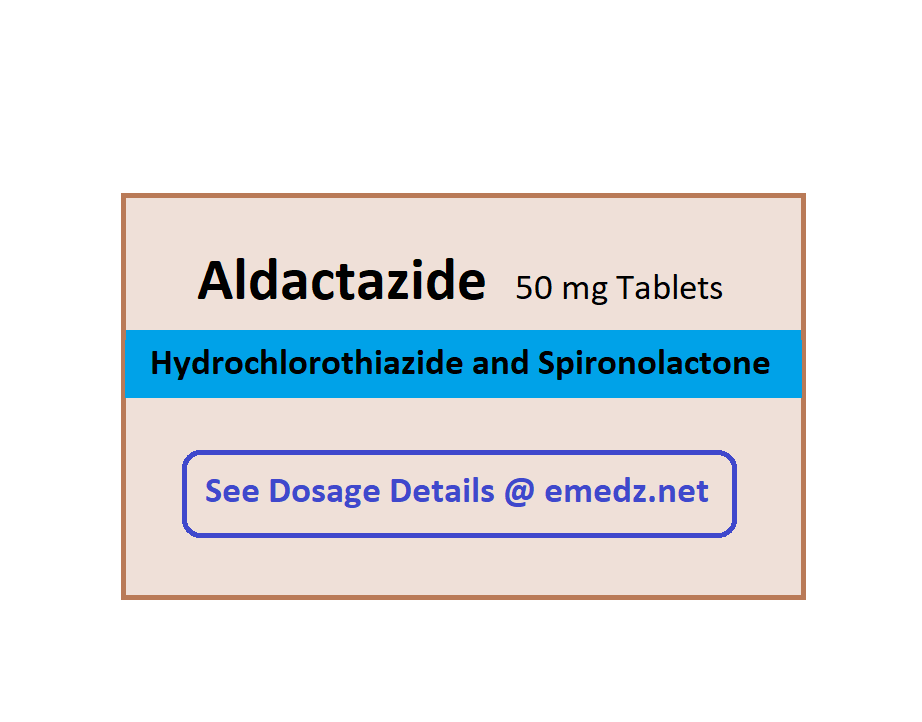
Aldactazide (Hydrochlorothiazide and spironolactone) is a combination pill of hydrochlorothiazide and spironolactone. Both are diuretics and helps in treating hypertensive patients with fluid retention or congestive cardiac failure.
Hydrochlorothiazide and spironolactone Uses:
-
Edema:
- It is used in the treatment of edema in congestive cardiac failure (CCF), nephrotic syndrome, and liver cirrhosis.
-
Hypertension:
- It is used to treat mild to moderate hypertension.
Hydrochlorothiazide and spironolactone (Aldactazide) Dose in Adults
Hydrochlorothiazide and spironolactone (Aldactazide) Dose in the treatment of Edema:
- Oral: Hydrochlorothiazide 25 - 200 mg per day and spironolactone 25 - 200 mg per day in single or divided doses
Hydrochlorothiazide and spironolactone (Aldactazide Dose in the treatment of Hypertension: Oral:
- Usual dosage range: Hydrochlorothiazide 50 - 100 mg per day and spironolactone 50 - 100 mg per day
-
Alternate recommendations:
- The target dose range of hydrochlorothiazide is 25 - 100 mg in 1 - 2 divided doses (JNC 8)
- Usual dosage range: Hydrochlorothiazide 12.5 - 50 mg daily and spironolactone 25 - 50 mg per day.
Hydrochlorothiazide and spironolactone (Aldactazide) Dose in Childrens
Note: Product is a fixed combination of equal milligram proportions of components e.g. (hydrochlorothiazide and spironolactone), not the total.
Hydrochlorothiazide and spironolactone (Aldactazide) Dose in the treatment of Bronchopulmonary dysplasia (BPD):
Limited data available; efficacy results variable There are various benefits of diuretic therapy in the management of BPD e.g. optimal duration of therapy, impact on pulmonary endpoints), diuretics are being used in clinical practice.
-
Infants:
- Oral: 1.5 mg/kg/dose every 12 hours
Hydrochlorothiazide and spironolactone (Aldactazide) Dose in the treatment of Edema and Hypertension:
-
Infants, Children, and Adolescents:
- Oral: Initial: 1 mg/kg/day in divided doses once or twice a day;
- It can be titrated up to maximum daily dose: 3 to 3.3 mg/kg/day or 100 mg per day
Pregnancy Risk Category: C
- This product has not been used in animal reproduction studies.
- Contraindications in pregnancy can be made by individual agents.
Use of spironolactone and hydrochlorothiazide during breastfeeding
- Breastmilk contains the active metabolite (canrenone), and the thiazide diuretics.
- Breastfeeding can lead to serious adverse reactions in infants.
- US labeling suggests that you consider the importance of the mother's treatment.
- A decision should be made to stop nursing or discontinue using the drug.
- Talk to individual agents.
Hydrochlorothiazide and spironolactone (Aldactazide) Dose in Kidney Disease:
- No dose adjustments listed in the manufacturer’s labeling
- There is limited efficacy of hydrochlorothiazide with CrCl <30 mL/minute; It is contraindicated in patients with significant renal derangements like anuria, acute renal insufficiency, or significant impairment of renal excretory function
- For additional considerations, see individual drugs.
Dose in Liver disease:
- No dose adjustments listed in manufacturer’s labelling.
- Contraindicated in acute or severe liver failure.
Side effects of Aldactazide (Hydrochlorothiazide and spironolactone):
See individuals agents: Spironolactone and hydrochlorothiazide.
Contraindications to Hydrochlorothiazide and spironolactone (Aldactazide):
- Hypersensitivity to thiazides and sulphonamide-derived medications
- Anuria, acute renal insufficiency; renal decompensation; significant impairments of renal excretory function
- Hypercalcemia
- Hyperkalemia
- Addison's Disease
- Hepatic impairment, acute or severe
Canadian labeling: Additional contraindications not in US labeling
- Hypersensitivity to spironolactone and any component of the formulation
- Use eplerenone, low molecular weight Heparin and heparin in conjunction
- Pregnancy;
- Breastfeeding
Notice:
- According to FDA approved Product labelling this medication is contraindicated with other sulphonamide-containing drug classes but the scientific basis of this statement has been challenged.
- See "Warnings/Precautions" for more detail.
Warnings and precautions
-
CNS effects
- There have been reports of dizziness and somnolence as a result of the use
- These side effects, especially somnolence or dizziness, should be discussed with patients.
- Patients should also be advised to exercise caution while operating machinery or driving until the initial treatment is completed.
-
Electrolyte disturbances:
- SpironolactoneHyperkalemia can occur; risk factors
-
- Renal dysfunction
- diabetes mellitus
- Concomitant use potassium-sparing diuretics or potassium supplements and/or potassium-containing sodium salts
-
- Take caution when using these agents. Also, closely monitor potassium levels.
- Hypokalemia, hypochloremic acidosis, hypomagnesemia and hyponatremia can be caused by Thiazide diuretics.
- SpironolactoneHyperkalemia can occur; risk factors
-
Gout
- Hydrochlorothiazide can cause gout in some patients who have gout history, chronic renal failure, or a family predisposition.
- Higher risk is associated with doses >=25mg
-
Gynecomastia
- spironolactone therapy (Related both to dose and duration).
- Most often, the condition is reversible after discontinuation of therapy, but it may not always persist.
-
Hyperkalemia:
- Hyperkalemia can occur. Be aware that there is a dose-related rise in serum potassium. Rates of hyperkalemia increase with decreasing renal function.
- Combining higher doses of ACE inhibitors (e.g. lisinopril >= 10 mg daily in adults also increases the risk of hyperkalemia
- Hyperkalemia may require dose reductions or discontinuation of therapy.
- Hyperkalemia patients should not be given this medicine.
- Hyperkalemia can be dangerous.
-
Hypersensitivity reactions
- Hydrochlorothiazide can cause hypersensitivity reactions.
- Patients with bronchial or allergy history are at greater risk.
-
Ocular effects
- Patients with acute transient myopia or acute angle-closure vision loss may experience hydrochlorothiazide.
- Stop using it immediately if you have severe visual impairments or pain.
- Additional treatments may be required if intraocular pressure is uncontrolled.
- A history of penicillin allergy or sulfonamide allergy could be a risk factor.
-
Photosensitivity
- Photosensitization may occur.
-
Allergy to sulfonamide ("sulfa")
- FDA-approved product labeling is available for medications that contain a chemical group of sulphonamides and have had an allergic reaction.
- Cross-reactivity is possible between members of one specific class (eg two antibiotic sulphonamides).
- A deeper understanding of allergy mechanisms has shown that cross-reactivity between non-antibiotic sulfonamides or antibiotic sulfonamides is very unlikely. It may not happen.
- T-cell-mediated reactions (type IV hypersensitivity) (eg, maculopapular skin rash) are less well understood. It is impossible to exclude this possibility based on current knowledge.
- Some clinicians avoid these classes because of severe reactions such as Stevens-Johnson syndrome/TEN.
-
Tumorigenic:
- When administered for a longer time, Spironolactone was found to be tumorigenic in animal experiments.
- Avoid unnecessary use
-
Diabetes:
- Hydrochlorothiazide should be used with caution in patients suffering from prediabetes and diabetes mellitus.
- This could lead to a change in glucose control.
-
Hepatic impairment
- Patients with mild to moderate hepatic impairment should be treated with caution
- Contraindicated for severe or acute hepatic impairment
- Hepatic encephalopathy/coma can occur in progressive/severe liver diseases.
-
Hypercalcemia:
- The excretion of calcium from the kidneys may be decreased by Thiazide diuretics
- Hypercalcemia patients should be advised not to take this medication.
-
Hypercholesterolemia:
- Patients with high or moderate cholesterol levels should be cautious.
- Thiazide can increase cholesterol and triglyceride levels.
-
Parathyroid disease
- Thiazide diuretics reduce calcium excretion
- Long-term use can cause parathyroid gland pathologic changes with hypophosphatemia and hypercalcemia.
- Do not discontinue testing for parathyroid function.
-
Renal impairment
- Patients with impaired renal function may experience cumulative effects, such as azotemia.
- Hydrochlorothiazide is not effective in severe renal disease.
- In patients with renal impairment, spironolactone may cause hyperkalemia; there is increased risk with declining renal function and with the combined use of larger doses of ACE inhibitors like lisinopril >= 10mg/day
- Patients with mild renal impairment should be cautious
- Contraindicated with: anuria, acute renal impairment, renal decompensation or significant impairments of renal excretory function.
-
Systemic lupus erythematosus (SLE):
- SLE activation or exacerbation may be caused by hydrochlorothiazide.
Monitoring parameters:
- Blood pressure
- Serum electrolytes
- Input & Output ratios
- Renal function
How to administer Aldactazide (Hydrochlorothiazide and spironolactone)?
Oral:
- It can be administered as single or divided doses with or without food.
Mechanism of action of Aldactazide (Hydrochlorothiazide and spironolactone):
See individual agents (Hydrochlorothiazide and Spironolactone)
International Brand Names of Hydrochlorothiazide and spironolactone:
- Aldactazide
- Aldactazide 25
- Aldactazide 50
- Teva-Spironolactone/HCTZ
- Adactazida
- Aldactazide
- Aldazida
- Ondolen
- Slosat
- Spironothiazid
- Spirozide
Hydrochlorothiazide and spironolactone Brand Names in Pakistan:
Hydrochlorothiazide + Spironolactone 25 mg Tablets |
|
| Aldactazide | Searle Pakistan (Pvt.) Ltd. |
Hydrochlorothiazide + Spironolactone 50 mg Tablets |
|
| ALDACTAZIDE | SEARLE PAKISTAN (PVT.) LTD. |
.png)