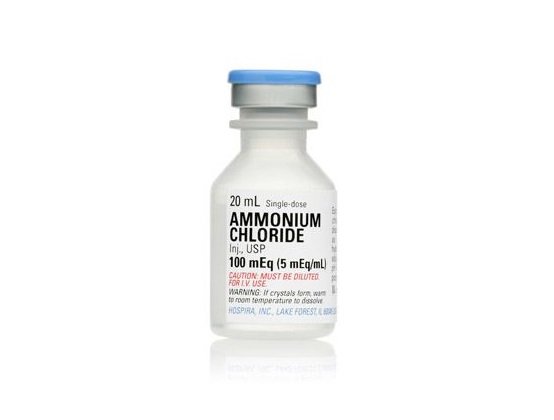
Ammonium chloride increases the blood acidity and decreases the PH. It is used in the treatment of hypochloremic states or metabolic alkalosis.
Ammonium chloride Dose in Adults
-
Dosing of mEq NH4Cl via the chloride-deficit method in patients with hypochloremia):
- Dose of mEq NH4Cl = [0.2 L/kg x body weight (kg)] x [103 - observed serum chloride]
- Administer 50% of the calculated dose over 12 - 24 hours or
- administer the entire calculated dose over 12 - 24 hours and then re-evaluate.
- Dosing of mEq NH4Cl via the bicarbonate-excess method in patients with refractory hypochloremic metabolic alkalosis:
- Dose of mEq NH4Cl = [0.5 L/kg x body weight (kg)] x (observed serum HCO3- 24).
- Administer 50% of dose over 12 - 24 hours and then re-evaluate
Ammonium chloride Dose in Childrens
For the treatment of Metabolic alkalosis:
- Infants, Children, and Adolescents:
- Dosing of mEq NH4Cl via the chloride-deficit method in hypochloremia:
- NH4Cl = 0.2 L/kg x wt in kg x [103 - serum Cl ] mEq/L
- Dosing of mEq NH4Cl via the bicarbonate-excess method in refractory hypochloremic metabolic alkalosis:
- mEq NH4Cl = 0.5 L/kg x wt in kg x [serum HCO - 24] mEq/L
- Dosing of mEq NH4Cl via the base excess method:
- mEq NH4Cl = 0.3 L/kg x wt in kg x base excess in mEq/L
- Dosing of mEq NH4Cl via the chloride-deficit method in hypochloremia:
Pregnancy Risk Factor C
- It has not been studied in pregnancy and lactation.
- It shoud be avoided.
Ammonium chloride Dose in Renal Disease:
- Mild-to-moderate impairment:
- Use with caution in mild to moderate renal disease.
- Adjustment in the dose has not been provided in the manufacturer labeling.
- Severe impairment:
- Use is contraindicated.
Ammonium chloride Dose in Liver Disease:
- Mild-to-moderate hepatic impairment:
- Use with caution.
- Adjustment in the dose has not been provided in the manufacturer labeling.
- Severe impairment:
- Use is contraindicated.
Side Effects of Ammonium Chloride Frequency not defined.
- Central nervous system:
- Coma
- Confusion
- Seizure
- Endocrine & metabolic:
- Hypervolemia
- Local:
- Extravasation
- Injection site infection
- Injection site phlebitis
- Pain at the injection site
- Venous thrombosis at the injection site
- Miscellaneous:
- Fever
Contraindication to Ammonium Chloride Include:
- Grave liver disease.
- Severe kidney dysfunction
- Patients with metabolic alkalosis should avoid vomiting.
Warnings and Precautions
- Ammonia toxicity:
- Ammonia toxicities can cause patients to experience pallor, sweating and altered breathing.
- Hepatic impairment
- Hepatic Encephalopathy may be caused by an increase in ammonia levels.
- It is contraindicated for severe hepatic impairment.
- Renal impairment
- This may cause an increase in the concentration of urea and should be avoided in mild to moderate renal impairment.
- It is not recommended for severe renal impairment.
- Respiratory disease
- Patients suffering from respiratory acidosis and insufficiency need to be cautious when using the drug.
Ammonium chloride: Drug Interaction
Note: Drug Interaction Categories:
- Risk Factor C: Monitor When Using Combination
- Risk Factor D: Consider Treatment Modification
- Risk Factor X: Avoid Concomitant Use
Risk Factor C (Monitor therapy). |
|
| Indirect-Acting Alpha-/Beta Agonists | The serum concentrations of Alpha-/Beta Agonists can be decreased by urinary acidifying agents (indirect-acting). |
| Amantadine | Amantadine may be reduced by urinary acidifying agents. |
| Amphetamines | Ammonium Chloride can decrease serum levels of Amphetamines. This is probably due to increased excretion of amphetamines from the urine. |
| ChlorproPAMIDE | The serum concentrations of ChlorproPAMIDE may be increased by urinary acidifying agents. |
| Mecamylamine | Mecamylamine may be reduced by urinary acidifying agents. |
| Salicylates | Ammonium Chloride can increase serum levels of Salicylates. |
Risk Factor D (Consider therapy modifications) |
|
| Potassium-Sparing Diuretics | Might increase the toxic/adverse effects of Ammonium Chloride. Particularly, the risk of systemic acidosis. |
Monitor
- Serum bicarbonate
- Clinical features of ammonia toxicity
How to administer Ammonium Chloride?
- Intravenous:
- It should be administered by slow intravenous infusion to avoid local irritation and adverse effects.
- In adults, the rate of infusion should not exceed 5 mL/minute.
Mechanism of action of Ammonium Chloride:
It decreases blood PH (increases acidity) by increasing free hydrogen ion concentration.
It isMetabolizedThe liver converts urea into hydrochloric acid, and isexcretedPrimarily in the urine.
International Brands:
- Ammonium Chloride Intravenous
Ammonium Chloride in Pakistan:
|
Ammonium Chloride [Syrup 100 Mg/5ml] |
|
| Ammonium Chloride | Ferozsons Laboratories Ltd. |
| Ammonium Chloride | Harmann Pharmaceutical Laboratories (Pvt) Ltd. |
| Ammonium Chloride | Medicaids Pakistan (Pvt) Ltd. |
| Ammonium Chloride | Amros Pharmaceuticals. |
| Broncofil | Medicaids Pakistan (Pvt) Ltd. |
| Euroconex | Euro Pharma International |
| Jonsyp | Unison Chemical Works |
| Kemodryl | Alkemy Pharmaceutical Laboratories (Private) Ltd. |
| Polyride | Polyfine Chempharma (Pvt) Ltd. |
| Unicough | Unison Chemical Works |
.png)


