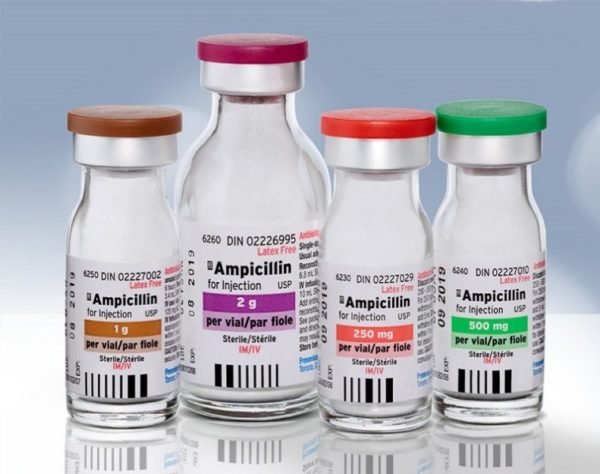
Ampicillin is a penicillinase-sensitive penicillin having the same mechanism of action as penicillin. It is a D-Ala-D-Ala structural analog binding penicillin-binding proteins (transpeptidases).
It blocks transpeptidase cross-linking of peptidoglycan in cell wall and activates autolytic enzymes. Having a wider spectrum and can also be combined with clavulanic acid to protect against destruction by beta-lactamase. It is used in the treatment of the following conditions:
-
Genitourinary tract infections:
-
Treatment of genitourinary tract infections caused by:
-
Escherichia coli,
-
Proteus mirabilis,
-
enterococci,
-
Shigella,
-
Salmonella typhosa and other Salmonella, and
-
nonpenicillinase-producing N. gonorrhoeae.
-
-
Not recommended as a first-line agent in the treatment of gonorrhea.
-
Treatment of GI tract infections caused by
-
Shigella,
-
S. typhosa and other Salmonella,
-
E. coli,
-
P. mirabilis, and
-
enterococci.
-
Not recommended as a first-line agent for Salmonellosis (nontyphoid), Shigellosis, or typhoid fever (Salmonella enterica) species due to development of resistance.
-
Respiratory tract infections:
-
RTIs caused by nonpenicillinase-producing H. influenzae, staphylococci, and streptococci, including Streptococcus pneumoniae.
-
Ampicillin Injections:
-
Gastrointestinal infections:
-
Treatment of GI infections caused by S. typhi (typhoid fever), other Salmonella species and Shigella species (dysentery).
-
Note: Ampicillin is not recommended as a first-line agent for Shigellosis, Salmonellosis (nontyphoid), or typhoid fever (S. enterica species) due to development of resistance.
-
Bacterial Meningitis:
-
Treatment of bacterial meningitis caused by group B streptococci, E. coli, and other gram-negative bacteria like N. meningitidis.
-
-
Respiratory tract infections:
-
Treatment of respiratory tract infections caused by S. pneumoniae, Staphylococcus aureus (penicillinase and nonpenicillinase producing), H. influenzae, and group A beta-hemolytic streptococci.
-
-
Septicemia and endocarditis:
-
Treatment of septicemia and endocarditis caused by susceptible gram-positive organisms, including Streptococcus species, penicillin Gsusceptible staphylococci, and enterococci; gram-negative sepsis caused by E. coli, P. mirabilis, and Salmonella species.
-
-
Urinary tract infections:
-
Treatment of urinary tract infections caused by E. coli and P. mirabilis.
-
-
Off Label Use of Ampicillin in Adults:
-
Endocarditis, prophylaxis;
-
Endocarditis, treatment (HACEK organisms) (adults);
-
Osteomyelitis, native vertebral;
-
Prophylaxis in patients with prosthetic joint implants undergoing dental procedures which produce bacteremia;
-
Prosthetic joint infection;
-
Surgical prophylaxis;
-
Group B streptococcus (maternal dose for neonatal prophylaxis);
-
Urinary tract infection due to ampicillin-susceptible Enterococcus spp.
-
Ampicillin Dose in Adults
Usual Dose:
- 250 - 500 mg orally every 6 hours
- Intramuscular and Intravenous:
- 1 to 2 g every 4 to 6 hours or 50 to 250 mg/kg/day in divided doses
- Maximum: 12 g/day
Dose in the treatment of Endocarditis (off-label):
- Enterococcus, native or prosthetic valve (penicillin/gentamicin-susceptible strains):
- 2 g Intravenous every 4 hours with concomitant ceftriaxone for 6 weeks or
- 2 g intravenous every 4 hours with concomitant gentamicin for 4 to 6 weeks (4 weeks for native valve and symptoms present <3 months; 6 weeks for native valve and symptoms present ≥3 months or for prosthetic valve)
- Enterococcus, native or prosthetic valve (penicillin-susceptible/aminoglycoside resistant strains):
- 2 g intravenous every 4 hours with concomitant ceftriaxone for 6 weeks.
- Enterococcus, native or prosthetic valve (penicillin-susceptible/gentamicinresistant/ streptomycin-susceptible strains):
- 2 g Intravenous every 4 hours with concomitant streptomycin for 4 to 6 weeks (4 weeks for native valve and symptoms present <3 months; ≥6 weeks for native valve and symptoms present ≥3 months or prosthetic valve).
- HACEK organisms, native or prosthetic valve (off-label use):
- 2 g Intravenous every 4 hours for 4 weeks (native valve) or 6 weeks (prosthetic valve).
- Listeria monocytogenes:
- 2 g intravenous every 4 hours, in combination with an aminoglycoside (eg, gentamicin)
- Viridans group streptococcus (VGS) and S. bovis:
- Native valve:
- Highly penicillin-susceptible (MIC ≤0.12 mcg/mL): 2 g Intravenous every 4 hours for 4 weeks (monotherapy) or for 2 weeks with concomitant gentamicin
- Native valve:
- Relatively penicillin-resistant (MIC >0.12 to <0.5 mcg/mL): 2 g Intravenous every 4 hours for 4 weeks with concomitant gentamicin for the first 2 weeks
- Prosthetic valve:
- Highly penicillin-susceptible (MIC ≤0.12 mcg/mL): 2 g Intravneous every 4 hours for 6 weeks (with or without concomitant gentamicin for the first 2 weeks)
- Prosthetic valve:
- Relatively or fully penicillin-resistant (MIC >0.12 mcg/mL): 2 g every 4 hours with concomitant gentamicin for 6 weeks
- Native valve:
Dose in the prophylaxis of Endocarditis (off-label):
- Dental, oral, or respiratory tract procedures:
- Intramuscular, Intravenous: 2 g within 30 to 60 minutes prior to procedure in patients not allergic to penicillin and unable to take oral amoxicillin.
- Intramuscular injections should be avoided in patients who are receiving anticoagulant therapy.
- In these circumstances, orally administered regimens should be given whenever possible.
- Intravenously administered antibiotics should be used for patients who are unable to tolerate or absorb oral medications.
Note: American Heart Association (AHA) guidelines now recommend prophylaxis only in patients undergoing invasive procedures and in whom underlying cardiac conditions may predispose to a higher risk of adverse outcomes should infection occur.
-
Genitourinary and gastrointestinal tract procedures:
Note:
- Routine prophylaxis not recommended.
- Consider only in high risk patients (eg, prosthetic heart valve, previous endocarditis, some categories of congenital heart disease, cardiac valvulopathy in cardiac transplant patients) who have an established GI or GU enterococcal infection or for those already receiving antibiotic therapy to prevent a wound infection or sepsis associated with a GI or GU procedure in which enterococcal coverage is desired.
-
High-risk patients:
- 2 g within 30 minutes prior to the procedure, followed by ampicillin 1 g (or amoxicillin 1 g orally) 6 hours later; must be used in combination with gentamicin.
-
Moderate-risk patients:
- 2 g within 30 minutes prior to procedure.
Dose in the treatment of Genitourinary or gastrointestinal infections:
- Oral, Intramuscular, Intravenous: 500 mg every 6 hours
Dose in the treatment of Group B streptococcus (maternal dose for neonatal prophylaxis) (off-label):
- 2 g Intravenous initial dose, then 1 g every 4 hours until delivery.
Dose in the treatment of bacterial Meningitis:
- Pathogen specific therapy eg,
- Enterococcus spp [ampicillin susceptible],
- Haemophilus influenzae [beta-lactamase negative],
- Listeria monocytogenes,
- Neisseria meningitidis [penicillin MIC <0.1 mcg/mL],
- Streptococcus agalactiae,
- Streptococcus pneumoniae [penicillin MIC ≤0.06 mcg/mL]):
- 2 g Intravenous every 4 hours.
- Use in combination with gentamicin for susceptible Enterococcus spp;
- addition of an aminoglycoside may be considered for L. monocytogenes or S. agalactiae.
- Mild to moderate infections:
- 250 - 500 mg orally 6 hourly.
Dose in the treatment of native vertebral Osteomyelitis as off-label use:
- Enterococcus spp (penicillin-susceptible):
- 12 g Intravenous continuous infusion every 24 hours or
- 2 g Intravenous every 4 hours for 6 weeks; the addition of an aminoglycoside for 4 to 6 weeks is recommended in patients with infective endocarditis.
Dose in the treatment of Prosthetic joint infection, Enterococcus spp (penicillin-susceptible) (off-label):
- 12 g Intravenous continuous infusion every 24 hours or
- 2 g Intravenous every 4 hours for 4 to 6 weeks; consider the addition of aminoglycoside.
Dose in the treatment of Prophylaxis in total joint replacement patients undergoing dental procedures which produce bacteremia (off-label):
Note: In general, patients with prosthetic joint implants do not require prophylactic antibiotics prior to dental procedures. In planning an invasive oral procedure, dental consultation with the patient's orthopedic surgeon may be advised to review the risks of infection.
- Intramuscular, Intravenous: 2 g 1 hour prior to the procedure.
Dose in the treatment of Respiratory tract infections:
- 250 mg orally 4 times daily
- Intramuscular, Intravenous: 250 to 500 mg every 6 hours
Dose in the treatment of Sepsis:
Note: administer doses Intravenous initially; Intramuscular may be used later in therapy course:
- Intramuscular, Intravenous: 150 - 200 mg/kg/day divided every 3 to 4 hours (range: 6 to 12 g/day)
Dose in the Surgical (perioperative) prophylaxis in liver transplantation (off-label):
- IV: 2 g within 60 minutes prior to surgical incision in combination with cefotaxime.
- The dose may be repeated in 2 hrs in lengthy procedures.
Dose in the treatment of Urinary tract infections (ampicillin-susceptible Enterococcus; off-label):
- 1 to 2 g Intravenous every 4 to 6 hours with or without an aminoglycoside.
Ampicillin Dose in Childrens
General dosing for susceptible infection :
- Infants, Children, and Adolescents:
-
Mild to moderate infection:
- 50 to 100 mg/kg/day orally 4 times day to a maximum daily dose of 2,000 mg/day.
- Intramuscular, Intravenous: 50 to 200 mg/kg/day divided every 6 hours; maximum daily dose: 8 g/day.
-
Severe infection (eg, meningitis, endocarditis):
- Intramuscular, Intravenous: 300 to 400 mg/kg/day divided every 4 to 6 hours; maximum daily dose: 12 g/day.
-
Dose in the treatment of Community-acquired pneumonia (CAP):
- Infants >3 months, Children, and Adolescents:
Note: Add vancomycin or clindamycin to empiric therapy if community-acquired MRSA suspected. In children ≥5 years, a macrolide antibiotic should be added if atypical pneumonia cannot be ruled out.
-
Empiric treatment or S. pneumoniae (MICs for penicillin ≤2 mcg/mL) or H. influenzae (betalactamase negative) in fully immunized patients:
- 150 to 200 mg/kg/day Intravenous divided every 6 hours.
-
Group A Streptococcus:
- 200 mg/kg/day Intravenous divided every 6 hours.
-
Pneumoniae (MICs for penicillin ≥4 mcg/mL):
- 300 to 400 mg/kg/day Intravenous divided every 6 hours.
Dose in the Endocarditis:
Treatment:
- Children and Adolescents:
- 200 - 300 mg/kg/day Intravenous divided every 4 - 6 hours
- The maximum dose is 12 gms/day.
- Use in combination with other antibiotics for at least 4 weeks.
- Some organisms may require longer duration.
-
Dental/oral procedures or respiratory tract procedures (eg, tonsillectomy, adenoidectomy):
- Infants, Children, and Adolescents:
- Intravenous, Intramuscular:
- 50 mg/kg within 30 to 60 minutes before the procedure.
- maximum dose: 2,000 mg/dose.
- Intramuscular (IM injections should be avoided in patients who are receiving anticoagulant therapy.
- In these circumstances, orally administered regimens should be used whenever possible.
- Intravenously (IV) administered antibiotics should be used for patients who are unable to tolerate or absorb oral medications.
- Intravenous, Intramuscular:
- Infants, Children, and Adolescents:
Dose in the treatment of complicated Intra-abdominal infection:
- Infants, Children, and Adolescents:
- 200 mg/kg/day Intravenous divided every 6 hours; maximum single dose: 2,000 mg; maximize doses if undrained abdominal abscesses.
Dose in the treatment of Meningitis (including health care-associated meningitis and ventriculitis):
- Infants, Children, and Adolescents:
- 300 to 400 mg/kg/day Intravenous divided every 4 to 6 hours; maximum daily dose: 12 g/day.
Dose in the treatment of Peritonitis (CAPD) Limited data available:
- Infants, Children, and Adolescents:
- Intraperitoneal: 125 mg/liter of dialysate for 2 weeks.
Dose in the Surgical prophylaxis:
- Infants, Children, and Adolescents:
- 50 mg/kg Intravenous within 60 minutes prior to surgical incision; may repeat in 2 hours if lengthy procedure or excessive blood loss.
- maximum dose: 2,000 mg/dose.
Pregnancy Risk Factor B
- Studies on animal reproduction have not revealed any adverse effects.
- Pregnant women should use ampicillin to manage preterm prelaborrupture of membranes (PROM), and prevent early-onset group B streptococcal disease (GBS).
- The volume of ampicillin distribution is greater during pregnancy than the half-life.
- The serum concentrations of pregnant patients are half those of non-pregnant women who received the same dose.
- During pregnancy, higher doses might be required
- Additionally, oral absorption during labor is not well absorbed.
Ampicillin Use during breastfeeding:
- Breast milk contains low levels of ampicillin.
- Therefore, it is safe to assume that infants breastfed will experience minimal toxicity.
Ampicillin Dose in Renal Disease:
- CrCl >50 mL/minute:
- Administer every 6 hours
- CrCl 10 to 50 mL/minute:
- Administer every 6 to 12 hours
- CrCl <10 mL/minute:
- Administer every 12 to 24 hours
-
End-stage renal disease (ESRD) on intermittent hemodialysis (IHD) (administer after hemodialysis on dialysis days):
- Dialyzable (20% to 50%): 1 to 2 g intravenous every 12 to 24 hours (administer after hemodialysis on dialysis days).
Note: Dosing dependent on the assumption of 3 times/week, complete IHD sessions.
-
Peritoneal dialysis (PD):
- Intravenous: 250 mg every 12 hours
-
Continuous renal replacement therapy (CRRT):
- Drug clearance is highly dependent on the method of renal replacement, filter type, and flow rate.
- Appropriate dosing requires close monitoring of pharmacologic response, signs of adverse reactions due to drug accumulation, as well as drug concentrations in relation to target trough (if appropriate).
-
The following are general recommendations only (based on dialysate flow/ultrafiltration rates of 1 to 2 L/hour and minimal residual renal function) and should not supersede clinical judgment: Intravneous:
- CVVH:
- Loading dose of 2 g followed by 1 to 2 g every 8 to 12 hours
- CVVHD:
- Loading dose of 2 g followed by 1 to 2 g every 8 hours
- CVVHDF:
- Loading dose of 2 g followed by 1 to 2 g every 6 to 8 hours
- CVVH:
Ampicillin Dose in Liver Disease:
No dose adjustment required.
Side Effects of Ampicillin Frequency not defined.
-
Central nervous system:
- Brain disease
- Glossalgia
- Seizure
- Sore mouth
-
Dermatologic:
- Erythema multiforme
- Exfoliative dermatitis
- Skin rash
- Urticaria
Note: Appearance of a rash should be carefully evaluated to differentiate (if possible) nonallergic ampicillin rash from hypersensitivity reaction. Incidence is higher in patients with a viral infection, Salmonella infection, lymphocytic leukemia, or patients that have hyperuricemia.
-
Gastrointestinal:
- Diarrhea
- Enterocolitis
- Glossitis
- Melanoglossia
- Nausea
- Oral candidiasis,
- Pseudomembranous colitis
- Stomatitis
- Vomiting
-
Hematologic & oncologic:
- Agranulocytosis
- Anemia
- Eosinophilia
- Hemolytic anemia
- Immune thrombocytopenia
- Leukopenia
-
Hepatic:
- Increased serum AST
-
Hypersensitivity:
- Anaphylaxis
-
Immunologic:
- Serum sickness-like reaction
-
Renal:
- Interstitial nephritis (rare)
-
Respiratory:
- Stridor
-
Miscellaneous:
- Fever
Contraindication to Ampicillin Include:
- Allergy reactions to ampicillin or any other penicillin, including any component of the formulation
- Infections caused by penicillinase-producing organisms
Warnings and precautions
- Hypersensitivity/anaphylactoid reactions
- Patients receiving penicillin therapy have reported severe or fatal allergic reactions (anaphylactoid).
- People who have a history or multiple allergies are more likely to experience allergic reactions.
- If severe allergic reactions occur, emergency treatment may be necessary.
- It is essential that appropriate treatments are readily available.
- Rash:
- To distinguish between a nonallergic and hypersensitive reaction to ampicillin, it is important to carefully evaluate the appearance of a rash.
- It affects 5% to 10% of children. The rash is generally a maculopapular, dull-red rash that appears between 3 and 14 days after therapy has begun.
- It usually begins at the trunk and extends to the majority of the body.
- It can be more severe in pressure areas such as elbows and knees.
- Superinfection
- Long-term use of ampicillin can lead to fungal and bacterial superinfections, such as pseudomembranous colitis or Clostridioides difficile -associated diarrhea.
- CDAD is often observed in patients who have been taking the medication for longer than two months.
- Infectious mononucleosis
- Patients with infectious mononucleosis should not be given ampicillin-class antibiotics due to the higher risk of drug-induced rash.
- It is generally maculopapular and pruritic. The rash usually appears 7-10 days after initiation. It disappears in a week.
Ampicillin: Drug Interaction
Note: Drug Interaction Categories:
- Risk Factor C: Monitor When Using Combination
- Risk Factor D: Consider Treatment Modification
- Risk Factor X: Avoid Concomitant Use
| Risk Factor C (Monitor therapy). | |
| Acemetacin | Penicillins may increase serum levels |
| Allopurinol | Ampicillin may increase the risk of allergic or hypersensitive reactions. |
| Atenolol | Ampicillin can decrease the bioavailability and bioactivity of Atenolol. |
| BCG Vaccine (Immunization) | Antibiotics can decrease the therapeutic effects of BCG Vaccine (Immunization). |
| Lactobacillus & Estriol | Antibiotics can reduce the therapeutic effects of Lactobacillus or Estriol. |
| Methotrexate | Methotrexate serum concentrations could be increased by penicillins |
| Mycophenolate | Penicillins can decrease serum levels of active metabolites of Mycophenolate. This may be due to impaired enterohepatic circulation. |
| Vitamin K antagonists (eg warfarin) | Vitamin K Antagonists can be enhanced by penicillins. |
| Risk Factor D (Regard therapy modification) | |
| Chloroquine | Can decrease serum Ampicillin concentration. Management: To minimize the potential adverse effects of chloroquine upon ampicillin bioavailability, it is recommended that you separate ampicillin and chloroquine for at least two hours. |
| Lanthanum | It may decrease serum Ampicillin concentrations. Treatment: Oral ampicillin should be administered at least 2 hours before or after lanthanum. |
| Probenecid | Increases the serum level of Penicillins. Management: Penicillins should not be combined with probenecid. However, this combination can be beneficial in certain cases and under careful supervision. If probenecid is given or if the dose is increased, monitor for potential toxic effects. |
| Sodium Picosulfate | Antibiotics can reduce the therapeutic effects of Sodium Picosulfate. Patients who are currently using or have just finished using antibiotics should consider using an alternative product to cleanse the bowels before undergoing a colonoscopy. |
| Tetracyclines | Penicillins may have a lower therapeutic efficacy. |
| Typhoid Vaccine | The therapeutic effects of Typhoid vaccine may be diminished by antibiotics. The only affected strain is the live attenuated Ty21a. Patients being treated with systemic antibiotics should avoid vaccination with live attenuated Typhoid vaccine (Ty21a). This vaccine should not be used until at least three days after the cessation or discontinuance of antibacterial agents. |
| Risk Factor X (Avoid Combination) | |
| BCG (Intravesical). | The therapeutic effects of BCG (Intravesical) may be diminished by antibiotics |
| Cholera Vaccine | Cholera Vaccine may be less effective if taken with antibiotics. Treatment: Cholera vaccine should be avoided in patients who have received systemic antibiotics. |
Monitoring Parameters:
- CBC
- LFTs
- RFTs
- Sign/symptoms of anaphylaxis during first dose.
How to take Ampicillin?
- Oral:
- With water, empty stomach (ie- 30 mins before or 2 hrs after meals).
- Intramuscular:
- Inject deep Intramuscular into a large muscle mass
- Intravenous:
- Direct Intravenous bolus: Administer over 3 to 5 minutes (125 to 500 mg) or over 10 to 15 minutes (1 to 2 g). More rapid infusion may cause seizures.
- Infusion:
- Rapid infusion may cause seizures.
Mechanism of action of Ampicillin:
- It is a D.Ala-D.Ala structural analog binding penicillin binding protein (transpeptidases).
- It prevents the transpeptidase from cross-linking peptidoglycans in cells wall and activates autolytic enzymes. This results in cell wall lysis.
Absorption, when administered via oral route, is 50% It is distribution into the bile. Penetration into CSF occurs only with inflamed meninges.
Protein binding: Neonates: 10%; Adults: 15% to 18%
Half-life elimination: Neonates: PNA 2 to 7 days: 4 hours PNA 8 to 14 days: 2.8 hours PNA 15 to 30 days: 1.7 hours Children and Adults: 1 to 1.8 h hours
Excretion: Urine (∼90%, unchanged within 24 hours); feces
International Brands of Ampicillin:
- Acipillin
- Alphacin
- Alphapen
- Ambiopi
- Amcillin
- APO-Ampi
- NOVO-Ampicillin
- Amcopen
- Amfipen
- Amicap
- Amillin
- Amipenix
- Ampecu
- Ampi-1
- Ampibex
- Ampiblan
- Ampicelo-500
- Ampicil
- Ampicilin
- Ampicilina
- Ampicillin
- Ampicin
- Ampiclin
- Ampiclox
- Ampicyn
- Ampiger
- Ampilag
- Ampilin
- Ampillin
- Ampimedin
- Ampina
- Ampipen
- Ampipharm
- Ampitenk
- Ampitrex
- Ampivral
- Ampliblan
- Ampolin
- Amsapen
- Ancillin
- Antallpen
- Austrapen
- Axum
- Binotal
- Biocil
- Bridopen
- Brupen
- Camicil
- Dancin
- Dhacillin
- Dibacilina
- Dinpen
- Doktacillin
- Duacillin
- Epicocillin
- Eurocin
- Excillin
- Extrapen
- Farcocillin
- Ficillin
- Flamicina
- Gobemicina
- Gobemicina Retard
- Gramcil
- Ibimycin
- Intramed
- Iwacillin
- Julphapen
- Magnapen
- Marovilina
- Maxipen
- Meprizna
- Nimpicillin
- Norcipen
- Novencil
- Omnipen
- Pamecil
- Panacta
- Pelitin
- Penbrex
- Penbritin
- Penibrin
- Penodil
- Pentrexyl
- Petercillin
- Polypen
- Primapen
- Promecilina
- Pulmosterin Retard
- Radiocillina
- Reichlin
- Rimacillin
- Roscillin
- Sanpicillin
- Semicillin
- Shacillin
- Silina
- Standacillin
- Standcillin
- Synthocilin
- Syntocil
- Totapen
- Tricil
- Trifalicina
- Trilaxin
- Viccillin
- Vidopen
- Virucil
- Winpicillin
- Z Cil
- Z cil
- Z-Cil
- Zampicillin
Ampicillin Brands in Pakistan:
|
Ampicillin [Inj 1 G] |
|
| Zampicillin | Zafa Pharmaceutical Laboratories (Pvt) Ltd. |
|
Ampicillin [Inj 100 Mg] |
|
| Ampicillin | Shifa Laboratories.(Pvt) Ltd. |
|
Ampicillin [Inj 200 Mg] |
|
| Ampicillin | Shifa Laboratories.(Pvt) Ltd. |
|
Ampicillin [Inj 250 Mg] |
|
| Ampicillin | Haji Medicine Co. |
| Ampin | Bosch Pharmaceuticals (Pvt) Ltd. |
| Amplipen | P.D.H. Pharmaceuticals (Pvt) Ltd. |
| Elkacillin | Elko Organization (Pvt) Ltd. |
| Omnipen-N | Pfizer Laboratories Ltd. |
| Penbritin | Glaxosmithkline |
| Procil | Cirin Pharmaceuticals (Pvt) Ltd. |
| Silpen | Lowitt Pharmaceuticals (Pvt) Ltd |
| Standacillin | Novartis Pharma (Pak) Ltd |
| Zampicillin | Zafa Pharmaceutical Laboratories (Pvt) Ltd. |
| Zyncillin | English Pharmaceuticals Industries |
|
Ampicillin [Inj 500 Mg] |
|
| Ampiceena | Mediceena Pharma (Pvt) Ltd. |
| Ampicillin | Haji Medicine Co. |
| Ampicillin | Shifa Laboratories.(Pvt) Ltd. |
| Ampin | Bosch Pharmaceuticals (Pvt) Ltd. |
| Amplipen | P.D.H. Pharmaceuticals (Pvt) Ltd. |
| Elkacillin | Elko Organization (Pvt) Ltd. |
| Omnipen-N | Pfizer Laboratories Ltd. |
| Penbritin | Glaxosmithkline |
| Procil | Cirin Pharmaceuticals (Pvt) Ltd. |
| Zampicillin | Zafa Pharmaceutical Laboratories (Pvt) Ltd. |
| Zyncillin | English Pharmaceuticals Industries |
|
Ampicillin [Drops 100 Mg/Ml] |
|
| Amicil | Ankaz Pharmex (Pvt) Ltd. |
| Ampimaz | Hamaz Pharmaceutical (Pvt) Ltd. |
| Amplipen | P.D.H. Pharmaceuticals (Pvt) Ltd. |
| Combicap | Don Valley Pharmaceuticals (Pvt) Ltd. |
| Fedrapen | Fedro Pharmaceutical |
| Imcocin | Imco Pharmaceuticals Laboratories |
| Pencipen | Lisko Pakistan (Pvt) Ltd |
| Penza | Ferroza International Pharmaceuticals (Pvt) Ltd. |
| Procil | Cirin Pharmaceuticals (Pvt) Ltd. |
|
Ampicillin [Drops 125 Mg/Ml] |
|
| Adacillin | Adamjee Pharmaceuticals (Pvt) Ltd. |
| Penbritin | Glaxosmithkline |
|
Ampicillin [Syrup 125 Mg/5ml] |
|
| Amicil | Ankaz Pharmex (Pvt) Ltd. |
| Ampcigen | Genera Pharmaceuticals |
| Ampiceena | Mediceena Pharma (Pvt) Ltd. |
| Ampicillin | Shifa Laboratories.(Pvt) Ltd. |
| Ampicillin | Swiss Pharmaceuticals (Pvt) Ltd. |
| Ampicillin | Amros Pharmaceuticals. |
| Ampicillin | Pliva Pakistan (Pvt) Limited |
| Ampicillin | Dosaco Laboratories |
| Ampilite | Elite Pharma |
| Ampillin | Semos Pharmaceuticals (Pvt) Ltd. |
| Ampimaz | Hamaz Pharmaceutical (Pvt) Ltd. |
| Ampipeed | Irza Pharma (Pvt) Ltd. |
| Amplipen | P.D.H. Pharmaceuticals (Pvt) Ltd. |
| Amplox | Munawar Pharma (Pvt) Ltd. |
| Arcilin | Ardin Pharmaceuticals |
| Elkacillin | Elko Organization (Pvt) Ltd. |
| Epocillin | Epoch Pharmaceutical |
| Fedrapen | Fedro Pharmaceutical |
| Hizopen | Hizat Pharmaceutical Industries (Pvt) Ltd. |
| Imcocin | Imco Pharmaceuticals Laboratories |
| Juvacillin | Progressive Laboratories |
| Kemycillin | Alkemy Pharmaceutical Laboratories (Private) Ltd. |
| M-Cil | Sharex Laboratories (Pvt.) Ltd. |
| Novocillin | Krka-Pak Pharmaceutical & Chemical Works |
| Ocelin | Safe Pharmaceutical (Pvt) Ltd. |
| Penbritin | Glaxosmithkline |
| Pencin | Marvi Laboratories |
| Pencipen | Lisko Pakistan (Pvt) Ltd |
| Penza | Ferroza International Pharmaceuticals (Pvt) Ltd. |
| Pexopen | Karachi Pharmaceutical Laboratory |
| Polycillin | Polyfine Chempharma (Pvt) Ltd. |
| Procil | Cirin Pharmaceuticals (Pvt) Ltd. |
| Roven | Geofman Pharmaceuticals |
| Standacillin | Novartis Pharma (Pak) Ltd |
| Ultra Pen | Hassan Pharmaceuticals (Pvt) Ltd. |
| Zampicillin | Zafa Pharmaceutical Laboratories (Pvt) Ltd. |
|
Ampicillin [Syrup 250 Mg/5ml] |
|
| Ampcigen | Genera Pharmaceuticals |
| Ampiceena | Mediceena Pharma (Pvt) Ltd. |
| Fedrapen | Fedro Pharmaceutical |
| Imcocin Forte | Imco Pharmaceuticals Laboratories |
| Penza | Ferroza International Pharmaceuticals (Pvt) Ltd. |
| Standacillin | Novartis Pharma (Pak) Ltd |
|
Ampicillin [Susp 125 Mg/5ml] |
|
| Ampicap | Don Valley Pharmaceuticals (Pvt) Ltd. |
| Eurocillin | Euro Pharma International |
| Mb-Cillin | Multinational Buisness Link |
| Silpen | Lowitt Pharmaceuticals (Pvt) Ltd |
|
Ampicillin [Susp 250 Mg/5ml] |
|
| Mb-Cillin | Multinational Buisness Link |
| Silpen | Lowitt Pharmaceuticals (Pvt) Ltd |
|
Ampicillin [Dry Susp 125 Mg/5ml] |
|
| Adacillin | Adamjee Pharmaceuticals (Pvt) Ltd. |
| Kemicillin | Alkemy Pharmaceutical Laboratories (Private) Ltd. |
|
Ampicillin [Caps 125 Mg] |
|
| Polycillin | Polyfine Chempharma (Pvt) Ltd. |
|
Ampicillin [Caps 250 Mg] |
|
| Adacillin | Adamjee Pharmaceuticals (Pvt) Ltd. |
| Ampcigen | Genera Pharmaceuticals |
| Ampicap | Don Valley Pharmaceuticals (Pvt) Ltd. |
| Ampicillin | Dosaco Laboratories |
| Ampicillin | Geofman Pharmaceuticals |
| Ampicillin | Irza Pharma (Pvt) Ltd. |
| Ampicillin | Pliva Pakistan (Pvt) Limited |
| Ampicin | Dosaco Laboratories |
| Ampilin | Pharmawise Labs. (Pvt) Ltd. |
| Ampilite | Elite Pharma |
| Ampilite | Elite Pharma |
| Ampimaz | Hamaz Pharmaceutical (Pvt) Ltd. |
| Ampiwil | Wilshire Laboratories (Pvt) Ltd. |
| Amplipen | P.D.H. Pharmaceuticals (Pvt) Ltd. |
| Anglocillin | Euro Pharma International |
| Empicil | Unexo Labs (Pvt) Ltd. |
| Empicil | Unexo Labs (Pvt) Ltd. |
| Epocillin | Epoch Pharmaceutical |
| Eurocillin | Euro Pharma International |
| Fedrapen | Fedro Pharmaceutical |
| Novocillin | Krka-Pak Pharmaceutical & Chemical Works |
| Ocelin | Safe Pharmaceutical (Pvt) Ltd. |
| Penbritin | Glaxosmithkline |
| Penbritin | Glaxosmithkline |
| Pencin | Marvi Laboratories |
| Pencipen | Lisko Pakistan (Pvt) Ltd |
| Pexopen | Karachi Pharmaceutical Laboratory |
| Polycillin | Polyfine Chempharma (Pvt) Ltd. |
| Procil | Cirin Pharmaceuticals (Pvt) Ltd. |
| Silpen | Lowitt Pharmaceuticals (Pvt) Ltd |
| Standacillin | Novartis Pharma (Pak) Ltd |
| Zampicillin | Zafa Pharmaceutical Laboratories (Pvt) Ltd. |
|
Ampicillin [Caps 500 Mg] |
|
| Adacillin | Adamjee Pharmaceuticals (Pvt) Ltd. |
| Ambilin | Multinational Buisness Link |
| Ampcigen | Genera Pharmaceuticals |
| Ampicap | Irza Pharma (Pvt) Ltd. |
| Ampicap | Don Valley Pharmaceuticals (Pvt) Ltd. |
| Ampiceena | Mediceena Pharma (Pvt) Ltd. |
| Ampicillin | Geofman Pharmaceuticals |
| Ampicillin | Pliva Pakistan (Pvt) Limited |
| Ampilite | Elite Pharma |
| Ampimaz | Hamaz Pharmaceutical (Pvt) Ltd. |
| Ampiwil | Wilshire Laboratories (Pvt) Ltd. |
| Anglocillin | Euro Pharma International |
| Empicil | Unexo Labs (Pvt) Ltd. |
| Epocillin | Epoch Pharmaceutical |
| Eurocillin | Euro Pharma International |
| Fedrapen | Fedro Pharmaceutical |
| Novocillin | Krka-Pak Pharmaceutical & Chemical Works |
| Ocelin | Safe Pharmaceutical (Pvt) Ltd. |
| Ocelin | Safe Pharmaceutical (Pvt) Ltd. |
| Penbritin | Glaxosmithkline |
| Pencin | Marvi Laboratories |
| Pencipen | Lisko Pakistan (Pvt) Ltd |
| Pexopen | Karachi Pharmaceutical Laboratory |
| Polycillin | Polyfine Chempharma (Pvt) Ltd. |
| Procil | Cirin Pharmaceuticals (Pvt) Ltd. |
| Silpen | Lowitt Pharmaceuticals (Pvt) Ltd |
| Standacillin | Novartis Pharma (Pak) Ltd |
| Zampicillin | Zafa Pharmaceutical Laboratories (Pvt) Ltd. |
.png)


