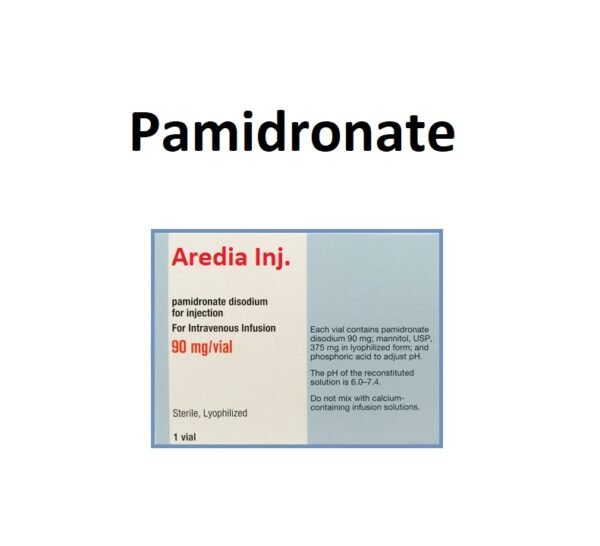
Pamidronate (Aredia) is an injectable second-generation bisphosphonate that is used to prevent and treat osteoporosis. It is also used to treat patients with Paget's disease and hypercalcemia of malignancy. It removes the calcium from the blood and deposits it in the bones making them less vulnerable to fractures. However, it can result in low serum calcium. Calcium and vitamin D supplementation is necessary for patients who are being treated for osteoporosis.
Pamidronate (Aredia) Uses:
-
Hypercalcemia of malignancy:
- Pamidronate is used in the treatment of moderate to severe hypercalcemia associated with malignancy, with or without bone metastases. But hydration is required concomitantly.
-
Osteolytic bone metastases of breast cancer and osteolytic lesions of multiple myeloma:
- It is also used in the management of osteolytic bone metastases of breast cancer and osteolytic lesions of multiple myeloma in adjunct to standard antineoplastic therapy.
-
Paget disease:
- Its use is also indicated in the treatment of patients with moderate to severe Paget disease of bone.
-
Off Label Use of Pamidronate in Adults:
- Prevention of bone loss associated with androgen deprivation treatment in prostate cancer.
- Hyperparathyroidism.
- Symptomatic bone metastases of thyroid cancer.
Pamidronate (Aredia) Dose in Adults
Note: Single dose should not exceed 90 mg.
Pamidronate (Aredia) Dose in the treatment of Hypercalcemia of malignancy:
- Moderate cancer-related hypercalcemia (corrected serum calcium: 12 to 13.5 mg/dL):
- 60 to 90 mg Intravenous, as a single dose over 2 to 24 hours
- Severe cancer-related hypercalcemia (corrected serum calcium: >13.5 mg/dL):
- 90 mg intravenous, as a single dose over 2 to 24 hours
- Re-treatment in patients who show an initial complete or partial response (allow at least 7 days to elapse prior to re-treatment):
- May re-treat at the same dose if serum calcium does not return to normal or does not remain normal after initial treatment.
Pamidronate (Aredia) Dose in the treatment of Multiple myeloma, osteolytic bone lesions:
- 90 mg intravenous over 4 hours once monthly
-
Lytic bone disease:
- American Society of Clinical Oncology (ASCO) guidelines:
- 90 mg intravenous over at least 2 hours once every 3 to 4 weeks for up to 2 years.
- Less frequent dosing (eg, once every 3 months) may be considered in patients with stable/responsive disease (patients with no active disease and are on maintenance therapy).
- Discontinue after 2 years in patients with responsive and/or stable disease.
- Therapy can be resumed upon relapse with new-onset skeletal-related events.
- American Society of Clinical Oncology (ASCO) guidelines:
-
Newly diagnosed, symptomatic (off-label dose):
- 30 mg intravenous over 2.5 hours once monthly for at least 3 years.
Pamidronate (Aredia) Dose in the treatment of osteolytic bone metastases Breast cancer:
- 90 mg intravenous over 2 hours once every 3 to 4 weeks
Pamidronate (Aredia) Dose in the treatment of Paget disease (moderate to severe):
- 30 mg intravenous over 4 hours once daily for 3 consecutive days (total dose = 90 mg).
- Pamidronate can be repeated at the initial dose if clinically required.
Pamidronate (Aredia) Dose in the treatment of Hyperparathyroidism (off-label):
- 15 to 90 mg intravenous as a single dose.
- The dose may be repeated every 1 to 2 months or when hypercalcemia recurs.
- The treatment period in clinical trials was up to 1 year.
Pamidronate (Aredia) Dose in the treatment of Prevention of androgen deprivation-induced osteoporosis (off-label): Males:
- 60 mg intravenous over 2 hours once every 3 months.
Pamidronate (Aredia) Dose in Childrens
Note: Due to increased risk of nephrotoxicity, single doses should not exceed 90 mg.
Pamidronate (Aredia) Dose in the treatment of Hypercalcemia:
- Children and Adolescents:
- Dosing based on several case reports and retrospective studies for treatment of hypercalcemia due to malignancy and/or immobility.
- Administer as a single infusion.
- Retreatment may be necessary if serum calcium does not return to normal or does not remain normal after initial treatment.
- The interval between the two doses should be at least 24 hours.
- Initial treatment:
- 0.5 to 1 mg/kg Intravenous to a maximum dose of 90 mg.
- Severe, life-threatening:
- 1.5 to 2 mg/kg Intravenous to a maximum dose of 90 mg.
Pamidronate (Aredia) Dose in the treatment of Osteogenesis imperfecta:
Note:
- The reported dosing regimes are variable. (ie, weight-directed vs BSA-directed).
- The duration of treatment has not yet been present in guidelines.
- However, most benefit has been shown to occur in the first 2 to 4 years of treatment.
-
Weight-directed dosing:
-
Infants and Children <2 years:
- Initial: 0.25 mg/kg Intravenous once on day 1, then 0.5 mg/kg/dose daily days 2 and 3 of the first cycle, then 0.5 mg/kg/dose once daily for 3 days for subsequent cycles;
- cycles are repeated every 2 months for a total yearly dose of 9 mg/kg.
-
Children 2 to 3 years:
- Initial: 0.38 mg/kg Intravenous once on day 1, then 0.75 mg/kg/dose daily days 2 and 3 of the first cycle, then 0.75 mg/kg/dose once daily for 3 days for subsequent cycles;
- cycles are repeated every 3 months for a total yearly dose of 9 mg/kg
-
Children >3 years and Adolescents:
- Initial: 0.5 mg/kg Intravenous once on day 1, then 1 mg/kg/dose daily days 2 and 3 of the first cycle, then 1 mg/kg/dose once daily for 3 days for subsequent cycles;
- cycles are repeated every 4 months for a total yearly dose of 9 mg/kg
-
-
BSA-directed dosing:
-
Infants, Children, and Adolescents:
- Initial: 10 mg/m²/dose intravenous once a month for 3 months, then increase to 20 mg/m²/dose once a month for 3 months, then increase to 30 mg/m²/dose once a month for subsequent doses to a maximum dose of 40 mg/m²/dose was used in six patients after 1-2 years due to skeletal pain and less bone mineral gain.
-
Dose in the treatment of Osteopenia associated with cerebral palsy in nonambulatory patients:
-
Children and Adolescents:
- Initial: 1 mg/kg/dose intravenously administered daily for 3 days then administer every 3 to 4 months.
- The minimum dose is 15 mg and the maximum dose is 35 mg.
Pregnancy Risk Factor D
- In animal reproduction studies, adverse events were noted.
- Although it is not clear if bisphosphonates cross into the placenta or not, it is possible that fetal exposure may occur.
- Bisphosphonates are integrated into bone matrix and slowly released over time.
- Doses and length of therapy affect the amount of systemic circulation.
- Theoretically, there could be a risk to fetal harm if a treatment is completed during pregnancy. However, data do not support this claim.
- Bisphosphonate therapy should be stopped in women of reproductive potential before a planned pregnancy.
- Premenopausal women should only be used in exceptional circumstances where rapid bone loss is happening.
- Hypocalcemia has been reported in infants exposed to in-uterobisphosphonate.
- Therefore, it is important to monitor for hypocalcemia once the baby is born.
Pamidronate use during breastfeeding:
- It is unknown if breast milk contains pamidronate.
- Pamidronate (30 mg IV monthly) was not detected in breast milk of a woman who received pamidronate (treatment began 6 months after birth).
- After the first infusion, milk is pumped and collected for 0-24 hours and 25-48 hours respectively. Each day is then pooled for analysis.
- The limit of quantification for Pamidronate was 0.4 micromole/L.
- Breast milk was removed from the infants' breasts for 48 hours after each infusion.
- Breastfeeding was done for >80% of the time. No adverse events were observed in this infant.
- It is important to monitor the serum calcium levels of breastfed infants.
- The manufacturer suggests that the mother decide whether to stop breastfeeding or discontinue using the drug.
- This is in consideration of the risk of serious adverse reactions in breastfed babies.
Pamidronate (Aredia) Dose in Kidney Disease:
Patients with serum creatinine >3 mg/dL were removed from clinical trials. There are only limited pharmacokinetic data in patients with CrCl <30 mL/minute.
Dosing adjustment in patients with renal impairment prior to initiating pamidronate treatment:
-
Treatment of bone metastases:
- In severe renal impairment, the use is not recommended.
-
Renal impairment in indications other than bone metastases:
- Clinical judgment is required if the benefits outweigh the risk.
-
Multiple myeloma:
- In severe renal impairment (serum creatinine >3 mg/dL or CrCl <30 mL/minute) and extensive bone disease:
- The recommended dose is 90 mg over 4 to 6 hours or consider a reduced initial dose.
- In severe renal impairment (serum creatinine >3 mg/dL or CrCl <30 mL/minute) and extensive bone disease:
Dosing adjustment in patients who develop renal toxicity during pamidronate therapy:
- In patients with bone metastases, treatment should be withheld for deterioration in renal function (increase of serum creatinine ≥0.5 mg/dL in patients with normal baseline [serum creatinine <1.4 mg/dL] or ≥1 mg/dL in patients with abnormal baseline [serum creatinine ≥1.4 mg/dL]).
- Resumption of therapy may be considered when serum creatinine returns to within 10% of baseline.
-
Multiple myeloma: American Society of Clinical Oncology (ASCO) guidelines:
- Renal deterioration without an apparent cause:
- Therapy should be stopped. it can be re-initiated at the prior dose when the renal function returns to within 10% of baseline.
- If albuminuria >500 mg/24 hours (unexplained) is present:
- Withhold dose until returns to baseline, then recheck every 3 to 4 weeks.
- Re-starting of the therapy can be done at a dose not greater than 90 mg every 4 weeks and with a longer infusion time of at least 4 hours
- Renal deterioration without an apparent cause:
Pamidronate (Aredia) Dose in Liver disease:
- Mild to moderate impairment:
- Dose adjustments are not required.
- Severe impairment:
- There is no modification of therapy required in severe liver disease.
Common Side Effects of Pamidronate (Aredia):
-
Central nervous system:
- Fatigue
- Headache
- Insomnia
- Anxiety
- Pain
-
Endocrine & metabolic:
- Hypophosphatemia
- Hypokalemia
- Hypocalcemia
- Hypomagnesemia
-
Gastrointestinal:
- Nausea
- Vomiting
- Anorexia
- Abdominal Pain
- Dyspepsia
-
Genitourinary:
- Urinary tract infection
-
Hematologic & oncologic:
- Anemia
- Metastases
- Granulocytopenia
-
Local:
- Infusion site reaction
-
Neuromuscular & skeletal:
- Myalgia
- Weakness
- Ostealgia
- Arthralgia
-
Renal:
- Increased serum creatinine
-
Respiratory:
- Dyspnea
- Upper Respiratory Tract Infection
- Cough
- Sinusitis
- Pleural Effusion
-
Miscellaneous:
- Fever
Less Common Side Effects of Pamidronate (Aredia):
-
Cardiovascular:
- Atrial fibrillation
- Hypertension
- Syncope
- Tachycardia
- Atrial Flutter
- Cardiac failure
- Edema
-
Central nervous system:
- Drowsiness
- Psychosis
-
Endocrine & metabolic:
- Hypothyroidism
-
Gastrointestinal:
- Constipation
- Gastrointestinal hemorrhage
- Diarrhea
- Stomatitis
-
Genitourinary:
- Uremia
-
Hematologic & oncologic:
- Leukopenia
- Neutropenia
- Thrombocytopenia
-
Infection:
- Candidiasis
-
Neuromuscular & skeletal:
- Arthropathy
- Back pain
-
Renal:
- Renal insufficiency
-
Respiratory:
- Rales
- Rhinitis
Side effects of Pamidronate (Aredia) Frequency not defined:
-
Endocrine & metabolic:
- Hypervolemia
Contraindications to Pamidronate (Aredia):
Hypersensitivity to pamidronate or its components can lead to hypersensitivity.
Canadian labeling: Additional contraindications not in the US labeling
- The Canadian labeling makes it clear that breastfeeding and pregnancy are not allowed.
Warnings and precautions
-
Bone fractures:
- Patients receiving bisphosphonate therapy may experience atypical femur fragments (AFF).
- These fractures are the diaphyseal (long segment of the thigh bone) as well as the subtrochanteric (the bone below the hip joint).
- Prodromal pain can occur weeks or even months before the fracture occurs.
- Bisphosphonate therapy may not be the cause of these fractures, although it is possible.
- Patients not receiving bisphosphonates and patients who receive glucocorticoids have also reported femur fractures.
- Patients who receive long-term bisphosphonate therapy (>3 to 5 year) may be at increased risk
- A femur fracture should be considered for patients who present with groin pain or thigh pain and have had bisphosphonates in the past.
- Patients who have a femoral shaft injury should be considered for discontinuing bisphosphonate therapy. Examine the contralateral limb for fractures.
-
Musculoskeletal pain
- Bisphosphonate treatment has been associated with severe and sometimes debilitating muscle, joint, or bone pain.
- The time it took to feel pain was anywhere from one day to several years.
- If patients are experiencing severe symptoms, it is worth suspending therapy. Most patients feel better after discontinuing treatment.
- Patients who were given the same drug as another bisphosphonate experienced recurrences.
- Patients with these symptoms should not be treated with bisphosphonate therapy.
-
An abnormality in the electrolyte:
- The therapy can cause symptomatic electrolyte abnormalities such as hypokalemia, hypocalcemia and low magnesium.
- Rare cases of hypocalcemia and tetany have also been reported.
-
Myelosuppression
- Patients with anemia or leukopenia should be closely monitored for the first two weeks.
-
Osteonecrosis in the jaw:
- Patients treated with bisphosphonates have been known to develop osteonecrosis (ONJ) or medication-related osteonecrosis (MRONJ).
- MRONJ is a condition that can be caused by invasive dental procedures, such as tooth extractions, dental implants, and boney surgery), cancer diagnosis, concurrent therapy (eg chemotherapy, corticosteroids or angiogenesis inhibitors), poor dental hygiene, poorly fitting dentures, and comorbid conditions (coagulopathy (anemia), sepsis), pre-existing oral disease.
- Risk increases with prolonged bisphosphonate treatment.
- This risk may be higher if the tumor type is advanced breast cancer or multiple myeloma.
- A position paper from the American Association of Maxillofacial Surgeons states that MRONJ has been linked to bisphosphonates, other antiresorptive drugs (denosumab), as well as antiangiogenic agents such (eg bevacizumab and sunitinib) for osteoporosis patients.
- The risk of developing cancer in patients receiving antiresorptive treatment is significantly greater than patients receiving treatment for osteoporosis (regardless of the medication or the dosing schedule).
- MRONJ risk increases with monthly IV antiresorptive therapy, compared to the low risk associated with oral bisphosphonate therapy.
- This means that IV therapy can be more associated with adverse events than oral bisphosphonate therapy.
- However, the risk seems to rise with oral bisphosphonates if the therapy lasts over 4 years.
- According to the AAOMS, IV bisphosphonates should not be initiated unless medically permitted.
- If extractions are necessary, antiresorptive treatment should be delayed until the extraction site is mucosalized, or after adequate osseous healing.
- After IV bisphosphonate therapy has been initiated for oncologic diseases, any procedures that result in direct osseous injury should be avoided.
- An oral surgeon should be consulted for patients who develop ONJ from therapy.
-
Renal deterioration:
- Doses of pamidronate should not exceed 90mg.
- Initial or single doses of dialysis have been linked to renal deterioration and progression to renal failure.
- Glomerulosclerosis (focal Segmental) has been reported with or without nephrotic Syndrome.
- Patients with pre-existing renal impairment may be at greater risk of developing renal toxicities if they receive longer infusions (>2 hours).
- Patients with signs of renal impairment should be advised to stop taking pamidronate (until their renal function returns back to baseline).
-
Breast cancer (metastatic).
- The American Society of Clinical Oncology/Cancer Care Ontario (CCO), updated guidelines regarding the role of bone-modifying agent (BMAs), in metastatic breast cancer patients.
- These guidelines recommend that patients with metastatic breast carcinoma to the bone should be initiated into a BMA (denosumab pamidronate and zoledronic Acid).
- A BMA is not better than another. There is no evidence to support one BMA over the other.
- BMA therapy's optimal duration is unknown. However, the guidelines recommend that BMA therapy be continued for a long time.
- BMAs have a modest analgesic effect. They should not be used as a pain management tool alone.
- Supportive care, analgesics and adjunctive therapies, radiation therapy and/or systemic cancer therapy should all be used.
- ASCO/CCO guidelines align with information regarding dosing, renal dose adjustments and infusion times.
- They also provide information about prevention and management for osteonecrosis.
-
Hypercalcemia in malignancy (HCM).
- Treatment requires adequate hydration (urine output greater that 2 L/day).
- Patients with heart failure should avoid fluid overload.
-
Hypoparathyroidism:
- Be cautious if you have had thyroid surgery in the past.
- Relative hypoparathyroidism can lead to patients being predisposed to pamidronate-related hypercalcemia.
-
Multiple myeloma
- Patients suffering from Bence-Jones proteinuria or dehydration need to be properly hydrated before starting therapy.
- American Society of Clinical Oncology has revised guidelines for bone-modifying agents (BMAs), in multiple myeloma.
- Patients with radiographic evidence or imaging of lytic bone disease should receive bisphosphonate (pamidronate, zoledronic Acid) therapy.
- Patients with osteolytic pain or patients who are in imminent danger of fractures may consider bisphosphonates.
- These guidelines recommend IV bisphosphonates for patients with multiple myeloma (osteoporosis), but not radiographic evidence of lytic bones disease.
- Patients with solitary plasmacytoma or smoldering (asymptomatic) should not be given bisphosphonates.
- Monoclonal Gammopathy of Undetermined Significance is not recommended if osteopenia (osteoporosis), is also present.
- Guidelines recommend that patients receive monthly treatment for up to two years. Patients with stable or responsive disease may need less frequent dosing.
- Consider quitting after 2 years in stable and responsive patients. Reinitiate if you experience a relapse.
- ASCO guidelines align with the prescribing information regarding dosing, renal dose adjustments and infusion times, prevention of and management of osteonecrosis in the jaw and monitoring laboratory parameter recommendations.
- The guidelines recommend that patients suffering from extensive bone disease and severe renal disease should receive pamidronate in a 90 mg dose over 4 to 6 hours. Preexisting renal disease should not be considered.
- Every 3 to 6 months, monitor for the presence of albumin in your urine.
- Patients with undiagnosed albuminuria greater than 500 mg/24 hours should be withheld from receiving any medication until the level is back to baseline.
- After that, recheck the patient every 3-4 weeks.
- Pamidronate can be reinitiated at a dosage not to exceed 90mg every 4 weeks, with an infusion time of at most 4 hours.
-
Renal impairment
- Patients with creatinine levels greater than 3mg/dl were not included in clinical trials. Patients with CrCl >30 mL/minute have limited data.
- Before each dose, test for serum creatinine.
- Patients with ESRD should not use this treatment for bone metastases.
- If you have other indications than bone metastases for which you are evaluating the benefits, it is important to use your clinical judgement to decide if there are any risks to patients with renal impairment.
Monitoring parameters:
- Serum creatinine (prior to each treatment).
- serum electrolytes, including calcium, potassium, Mg, and PO4.
- CBC with the differential count.
- monitor for low calcium for at least 2 weeks after therapy.
- Dental exam and preventive dentistry prior to therapy for patients at risk of osteonecrosis, including all cancer patients.
- Patients with pre-existing anemia, leukopenia, or thrombocytopenia should be closely monitored during the first 2 weeks of treatment.
- In addition to the above, monitor urine albumin every 3 to 6 months in multiple myeloma patients
In the case of Multiple myeloma:
- Monitor serum creatinine (prior to each dose), serum calcium (regularly).
- vitamin 25(OH)D3 levels (intermittently).
- spot urine sample for albuminuria (every 3 to 6 months).
- For unexplained albuminuria, obtain 24-hour urine collection to assess urinary albumin.
- Reassess every 3 to 4 weeks with 24-hour urine collection for total protein and urine protein electrophoresis until renal function returns to baseline.
Prostate cancer:
- Androgen deprivation therapy (ADT)-associated osteoporosis:
- Monitor BMD every 18 to 24 months.
How to administer Pamidronate (Aredia)?
It is administered as an intravenous infusion:
- Infusion rate varies by indication.
- Longer infusion times (>2 hours) may reduce the risk of renal toxicity, especially in patients with preexisting renal insufficiency.
- The manufacturer recommends infusing over 2 to 24 hours for hypercalcemia of malignancy; over 2 hours for osteolytic bone lesions with metastatic breast cancer; and over 4 hours for Paget disease and for osteolytic bone lesions with multiple myeloma.
- ASCO guidelines for bisphosphonate use in multiple myeloma recommend infusing pamidronate over at least 2 hours; if therapy is withheld due to renal toxicity, infuse over at least 4 hours upon reintroduction of treatment after renal recovery; infuse over 4 to 6 hours in patients with preexisting severe renal impairment and extensive bone disease.
Mechanism of action of Pamidronate (Aredia):
- Pamidronate, a nitrogen-containing bisphosphonate, is one.
- It reduces bone mineralization and inhibits osteoclast activity.
The beginning of action:
- For children, 48 hours
- Adults: 24-hours or less to decrease albumin-corrected se calcium; maximum effect is =7 Days
- Paget disease: About 1 Month for >= 50% reduction in serum alkalinephosphatase
- Maximum effect: Hypercalcemia in malignancy: =7 Days
Duration:
- Hypercalcemia of malignancy: 7 to 14 days;
- Paget disease: 1 to 372 days
Absorption:
- Poorly from the GI tract
Distribution:
- 38% to 70% over 120 hours
Metabolism:
- Not metabolized
Half-life elimination:
- 28 ± 7 hours
Excretion:
- Biphasic; urine (30% to 62% as unchanged drug; lower in patients with renal dysfunction) within 120 hours
International Brand Names of Pamidronate:
- Aredia
- Pamidronate Disodium Omega
- PMS-Pamidronate
- VAL-Pamidronate Disodium
- Aminomux
- Aredia
- Biodronate
- Pamidria
- Pamidrom
- Pamidron
- Pamired
- Pamisol
- Pamitor
- Panolin
- Panorin
Pamidronate Brand Names in Pakistan:
Pamidronate Injection 15 Mg in Pakistan |
|
| Aminomux | Seignior Pharma |
| Aredia | Novartis Pharma (Pak) Ltd |
Pamidronate 30 mg injection in Pakistan |
|
| Aminomux | Seignior Pharma |
| Osteopam | Consolidated Chemical Laboratories (Pvt) Ltd. |
| Pamidria | A. J. Mirza Pharma (Pvt) Ltd |
| Pamisole | Atco Laboratories Limited |
Pamidronate 60 mg injection in Pakistan |
|
| Pamidria | A. J. Mirza Pharma (Pvt) Ltd |
Pamidronate Injection 90 mg in Pakistan |
|
| Aminomux | Seignior Pharma |
| Osteopam | Consolidated Chemical Laboratories (Pvt) Ltd. |
| Pamidria | A. J. Mirza Pharma (Pvt) Ltd |
.png)