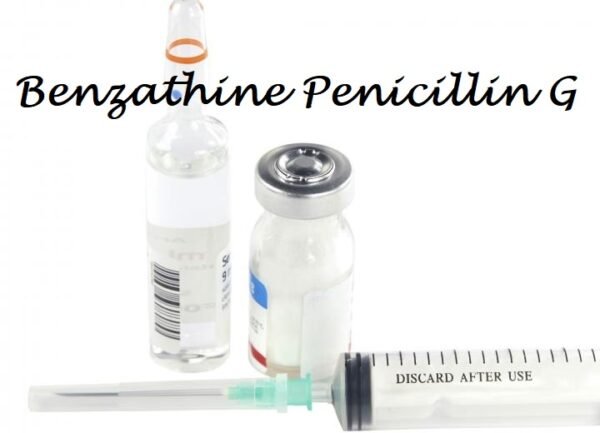
Benzathine Penicillin is a long-acting bactericidal antibiotic that causes cell lysis. It is used for the treatment of the following conditions:
-
For secondary prophylaxis in patients with a history of acute glomerulonephritis.
-
Treatment of mild to moderate upper respiratory tract infections caused by streptococci susceptible to low, prolonged serum concentrations of penicillin G.
-
For secondary prophylaxis of rheumatic fever and chorea
-
For secondary prophylaxis of rheumatic heart disease.
-
For the treatment of syphilis, yaws, bejel, and pinta
-
As Off-Label use of Group A Streptococcal chronic carriage
Benzathine Penicillin G Dose in Adults
The usual dosage range of Benzathine Penicillin G is 1.2 to 2.4 million Intramuscular as a single dose
Group A Streptococcus:
- Dose in the treatment of acute Pharyngitis:
- 2 million units intramuscular as a single dose.
- For the prevention of recurrent attacks (Secondary prophylaxis) of rheumatic fever:
- 1.2 million units intramuscular once every 21 - 28 days.
- For Secondary prophylaxis of glomerulonephritis:
- 2 million units intramuscular every 4 weeks or
- 600,000 units twice monthly
As Off-Label use in the treatment of Chronic carriage:
-
- 1.2 million units intramuscular as a single dose in combination with oral rifampin.
Use in the treatment of syphilis:
- Primary, Secondary, or Early Latent (duration of less than one year):
- 2.4 million units Intramuscular as a single dose
- Latent syphilis with unknown duration, late latent, or Tertiary Syphilis (with normal CSF examination):
- 2.4 million units intramuscular once a week for 3 doses
- Neurosyphilis and Ocular Syphilis):
- It is not indicated for initial treatment.
- Aqueous penicillin G intravenous is the preferred initial therapy.
- Benzathine penicillin G may be advised at a dose of 2.4 million units intramuscular once a week for 3 weeks following the initial intravenous penicillin G treatment.
Yaws, bejel, and pinta:
-
- 2.4 million units intramuscular as a single dose
Benzathine Penicillin G Dose in Childrens
Dose in the treatment of Group A streptococcal upper respiratory tract infection:
- For the primary prevention of Rheumatic fever:
- Less than 27 kgs:
- 600,000 units intramuscular as a single dose
- More than 27 kgs:
- 2 million units Intramuscular as a single dose
-
For secondary prevention of Rheumatic fever:
-
- Rheumatic fever with carditis and residual heart disease:
- 10 years or till the age of 40 years whichever is longer (lifelong prophylaxis is sometimes required)
- Rheumatic fever with carditis but no residual heart disease:
- 10 years or until the age of 21 years whichever is longer
- Rheumatic fever without carditis:
- 5 years or until 21 years of age whichever is longer
- Rheumatic fever with carditis and residual heart disease:
- Less than 27 kgs:
- 600,000 units intramuscular every 3 - 4 weeks
- More than 27 kgs:
- 2.4 million units intramuscular every 3 - 4 weeks
Syphilis:
- Primary, Secondary, or Early Latent (duration of less than one year):
- 50,000 units/kg intramuscular once to a maximum dose of 2.4 million units.
- Late Latent or Latent with unknown duration:
- 50,000 units/kg intramuscular once a week for 3 doses to a maximum dose of 2.4 million units
Pregnancy Risk Factor: B
- Although it crosses the placenta and causes adverse fetal outcomes, there have been no reported adverse effects.
- It is the preferred drug for treating syphilis in pregnancy.
Penicillin G use during breastfeeding:
- It is excreted from breastmilk.
- It is recommended that it be administered with caution to nursing mothers.
- Modifications in bowel flora or allergic sensitization can occur.
Benzathine Penicillin G Dose in Renal Disease:
- Adjustment in the dose has not been provided in the manufacturer's labeling in patients with renal disease.
Benzathine Penicillin G Dose in Liver Disease:
- Adjustment in the dose has not been provided in the manufacturer's labeling.
Frequency not defined:
- Cardiovascular:
- Cerebrovascular Accident
- Hypotension
- Palpitations
- Syncope
- Tachycardia
- Vasodilatation
- Vasospasm
- Vasodepressor Syncope
- Central Nervous System:
- Anxiety
- Coma
- Confusion
- Dizziness
- Drowsiness
- Euphoria
- Fatigue
- Headache
- Localized Warm Feeling
- Nervousness
- Neurologic Abnormality (Neurogenic Bladder)
- Numbness
- Pain
- Seizure
- Transverse Myelitis
- Dermatologic:
- Diaphoresis
- Gangrene Of Skin Or Other Tissue
- Pallor
- Skin Mottling
- Skin Ulceration at the injection site
- Gastrointestinal:
- Bloody Stools
- Intestinal Necrosis
- Nausea
- Vomiting
- Genitourinary:
- Hematuria
- Impotence
- Priapism
- Proteinuria
- Hematologic & Oncologic:
- Local Hemorrhage at the injection site
- Lymphadenopathy
- Hepatic:
- Increased Serum Ast
- Hypersensitivity:
- Hypersensitivity Reaction
- Immunologic:
- Jarisch-Herxheimer Reaction
- Local:
- Abscess
- Atrophy
- Bruising
- Cellulitis
- Localized Edema
- Inflammation at the injection site
- Injection Site Reaction & Neurovascular Damage
- Pain At Injection Site
- Residual Mass At Injection Site
- Tissue Necrosis At Injection Site
- Neuromuscular & Skeletal:
- Arthropathy
- Exacerbation Of Arthritis
- Periosteal Disease
- Rhabdomyolysis
- Tremor
- Weakness
- Ophthalmic:
- Blindness
- Blurred Vision
- Renal:
- Increased Blood Urea Nitrogen
- Increased Serum Creatinine
- Myoglobinuria
- Renal Failure
- Respiratory:
- Cyanosis
Contraindication to Benzathine Penicillin G Include:
- Allergy reactions to penicillins and any component of the formulation
Warnings and Precautions
- Hypersensitivity reactions
- It has been linked to severe and sometimes fatal anaphylactic reactions.
- Patients with a history of IgE-mediated reactions in the past (anaphylaxis, angioedema, and urticaria), history of beta-lactam allergy including allergy to cephalosporins, and history of sensitivity to multiple allergens are especially at risk.
- Immediate management facilities including epinephrine, steroids, and intubation facilities should be available.
- Superinfection
- Patients may need to be treated for a long time with bacterial or fungal infection.
- These include pseudomembranous colitis and clostridium difficile as-associated diarrhea (CDAD), especially if patients have been receiving treatment for longer than two months.
- Renal impairment
- Patients suffering from renal impairment should be aware that the drug is not recommended for them.
- Seizure disorders:
- Patients with seizures should not take it, especially if they are taking higher doses or have renal impairment.
- Use of Syphilis or Neurosyphilis:
- Because of its lack of efficacy, treatment failure and ineffectiveness, it is not recommended by the CDC or AAP for neurosyphilis and congenital disorders.
Monitoring Parameters:
Monitor for clinical features of anaphylaxis especially after the first dose.
How to administer Benzathine Penicillin G?
- Warm the injection to room temperature before administration (to reduce the pain associated with the injection).
- Administer in the upper outer quadrant of the buttock by a deep Intramuscular injection.
- Injection near an artery or a nerve should be avoided (permanent neurological deficit or gangrene may occur).
- The injection site should be rotated with repeated injections.
- Intravenous Administration, intraarterial, or subQ administration should be avoided.
Mechanism of action of Benzathine Penicillin G:
- It is responsible for the bacterial cell death of susceptible bacteria.
It has been aDurationEffects last for between 1 and 4 weeks. (Larger doses are more stable). Slowly, it isabsorbed after intramuscular administration. It is very populardistributedThe body that has the highest concentrations of CSF in the kidneys is the most healthy. There are less CSF concentrations in skin, liver, and intestines. 60% of the drug is protein-boundIt takes 12 - 24 hours to reach you. It takes between 12 and 24 hours to reach your destinationPeak plasma concentrations It isexcretedBy renal tubular excretion, and can be detected in urine for up 12 weeks after one intramuscular injection.
Benzathine Penicillin International Brands:
- Bencelin
- Benzapen
- Benzetacil
- Benzetacil L.A.
- Benzibiotic
- Bepeben
- Bicillin G
- Bicillin L-A
- Debecylina
- Deposilin
- Extencilline
- Indopen
- Lentocilin-S
- Leomypen
- Longacillin
- Mycin
- Noraben
- Pen Di Ben
- Penadur
- Penadur - LA
- Penadur LA
- Pencom
- Pendepon
- Pendiben L-A
- Pendysin
- Penidure
- Penilente LA
- Penzathine
- Retarpen
- Retarpen LA
- Tardocillin
- Terbocyl
- Ultracillin LA
- Unicil L-A
- Zalpen
Benzathine Penicillin in Pakistan:
|
Benzathine Penicillin [Inj 0.1 Miu] |
|
| Benzyl Penicillin | P.D.H. Pharmaceuticals (Pvt) Ltd. |
|
Benzathine Penicillin [Inj 0.6 Miu] |
|
| Benza L-A | Macter International (Pvt) Ltd. |
| Benzibiotic | Zafa Pharmaceutical Laboratories (Pvt) Ltd. |
| Biotic-P | English Pharmaceuticals Industries |
| La Pen | P.D.H. Pharmaceuticals (Pvt) Ltd. |
|
Benzathine Penicillin [Inj 1.2 Miu] |
|
| Benza L-A | Macter International (Pvt) Ltd. |
| Benzibiotic | Zafa Pharmaceutical Laboratories (Pvt) Ltd. |
| Biotic-P | English Pharmaceuticals Industries |
| La Pen | P.D.H. Pharmaceuticals (Pvt) Ltd. |
|
Benzathine Penicillin [Inj 0.05 Miu] |
|
| Benzyl Penicillin | P.D.H. Pharmaceuticals (Pvt) Ltd. |
.png)


