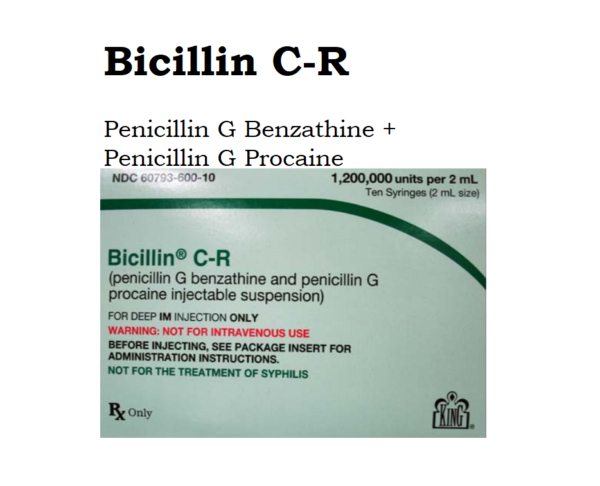
Bicillin C-R and Bicillin C-R 900/300 are a combination of two drugs (Penicillin G Procaine and Benzathine Penicillin). Procaine Penicillin is an intermediate-acting drug while benzathine penicillin is a long-acting formulation of penicillin.
Bicillin C-R (Penicillin G benzathine and penicillin G procaine) Uses:
-
Pneumococcal infections:
- Treatment of moderately severe pneumonia and otitis media due to susceptible Pneumococcus spp. (eg, Streptococcus pneumoniae)
-
Streptococcal infections, group A:
- Treatment of moderately severe to severe infections, without associated bacteremia, of the upper respiratory tract, scarlet fever, erysipelas, and skin and soft tissue infections due to group A streptococci
Note: Bicillin C-R 900/300 is indicated only in pediatric patients.
-
Limitations of use:
- Not considered to be appropriate for the treatment of sexually transmitted diseases, such as syphilis, gonorrhea, yaws, bejel, and pinta.
- When high, sustained serum levels are required, in such cases use alternative penicillin preparations.
Bicillin C-R Dose in Adults
Note: Bicillin C-R 900/300 is indicated only in pediatric patients.
Bicillin C-R Dose in the treatment of Pneumococcal infections (except meningitis):
- IM: 1.2 million units on day 1; may be repeated every 2 or 3 days until afebrile for 48 hours.
Bicillin C-R Dose in the treatment of Group A Streptococcal infections:
- IM: 2.4 million units in a single dose.
Note:
- Alternatively, 50% of the total dose can be administered on day 1 and other 50% on day 3.
- For the treatment of group A streptococcal pharyngitis in adults, penicillin G benzathine (Bicillin L-A) is preferred in such cases.
Bicillin C-R Dose in Childrens
Bicillin C-R Dose in the treatment of Pneumococcal infections (except meningitis):
-
Infants and Children: IM:
- Bicillin C-R:
- 600,000 units on day 1; may repeat after every 2 to 3 days until afebrile for 48 hours at least.
- Bicillin C-R 900/300:
- 1.2 million units on day 1;
- The dose may be repeated after every 2 or 3 days until afebrile for 48 hours
- Bicillin C-R:
Bicillin C-R Dose in the treatment of Group A Streptococcal infections:
-
Infants, Children: IM:
-
Bicillin C-R:
- <14 kg:
- 600,000 units in a single dose
- 14 to 27 kg:
- 900,000 units to 1.2 million units in a single dose
- <14 kg:
-
Bicillin C-R 900/300:
- 2 million units in a single dose
-
-
Children and Adolescents (>27 kg): IM:
- Bicillin C-R:
- Refer to adult dosing.
- Bicillin C-R 900/300:
- 1.2 million units in a stat single dose
- Bicillin C-R:
Note (Bicillin C-R only):
- Alternatively, 50% of the total dose can be administered on day 1 and the other 50% on day 3.
Bicillin C-R Dose in the primary prevention of Rheumatic fever (Bicillin C-R 900/300) (off-label):
-
Infants and Children 6 months to 12 years and Adolescents ≤14 years:
- IM: 1.2 million units as a stat single dose.
- Note:
- The efficacy of this regimen for heavier adolescents is unknown.
Pregnancy Risk Category: B
- Animal reproduction studies have not examined adverse events.
- Penicillins used by mothers have not been shown to increase the risk of adverse effects on fetal health.
- You can also see individual agents (Penicillin G-benzathine or Penicillin G procaine).
Breastfeeding: Penicillin G benzathine or penicillin G procaine
- Breast milk contains soluble penicillin G.
- This combination should not be administered to nursing mothers without caution, according to the manufacturer.
See individual agents.
Dose in Kidney Disease:
- There are no dosage adjustments provided in the drug manufacturer's labeling.
Dose in Liver Disease:
- There are no dosage adjustments provided in drug manufacturer's labeling.
Side effects of Bicillin C-R:
See individuals agents (Penicillin G benzathine and Penicillin G procaine)
Contraindications to Bicillin C-R (Penicillin G benzathine and penicillin G procaine):
- Hypersensitivity/allergy to penicillin(s), procaine, or any component of the formulation
Warnings and precautions
-
Anaphylactic and hypersensitivity reactions
- Patients on penicillin therapy have experienced severe and sometimes fatal anaphylactic reactions. This is especially true if they have a history of beta-lactam hypersensitivity (including cephalosporins) or sensitivity to multiple allergens.
- Asthmatic patients should be cautious.
- It is important to immediately treat any serious reactions with supportive care and airway protection.
-
Fibrosis, atrophy and other:
- After intramuscular penicillin injections into the anterolateral leg, quadriceps fimoris fibrosis (and atrophy) have been reported.
-
Methemoglobinemia:
- Local anesthetics have been used, including procaine. Clinically significant methemoglobinemia must be treated immediately.
- The onset of symptoms can be delayed or immediate (hours) following anesthesia exposure.
- Patients with glucose-6-phosphate metabolite deficiency, congenital and idiopathic mehemoglobinemia, cardiac and pulmonary compromise, or exposure to oxidizing substances or their metabolites are more vulnerable and should be closely monitored for signs of methemoglobinemia (eg cyanosis and headaches, rapid pulse, shortness or breath, lightheadedness and fatigue).
-
Sensitivity to Procaine:
- Test with 0.01 mL procaine 1% or 2.2% solution if you have a history of hypersensitivity.
- Penicillin G procaine should not be used in patients with erythema, wheal or flare.
- Supportive measures such as antihistamines can be used to treat sensitivity.
-
Superinfection
- Extended use can lead to fungal or bacterial overinfections, such as Clostridium difficile-associated diarrhea (CDAD), and pseudomembranous collitis. CDAD has been documented >2 months after antibiotic treatment.
-
Renal impairment
- Patients with impaired renal function should be cautious.
- Monitoring renal function is important, especially when you are taking high-dose therapy or for a longer time.
Penicillin G benzathine and penicillin G procaine (mixture of long and intermediate-acting intramuscular): Drug Interaction
|
Acemetacin |
May increase the serum concentration of Penicillins. |
|
BCG Vaccine (Immunization) |
Antibiotics may diminish the therapeutic effect of BCG Vaccine (Immunization). |
|
Lactobacillus and Estriol |
Antibiotics may diminish the therapeutic effect of Lactobacillus and Estriol. |
|
Methotrexate |
Penicillins may increase the serum concentration of Methotrexate. |
|
Mycophenolate |
Penicillins may decrease serum concentrations of the active metabolite(s) of Mycophenolate. This effect appears to be the result of impaired enterohepatic recirculation. |
|
Nitisinone |
May increase the serum concentration of OAT1/3 Substrates. |
|
Pretomanid |
May increase the serum concentration of OAT1/3 Substrates. |
|
Probenecid |
May increase the serum concentration of Penicillins. |
|
Teriflunomide |
May increase the serum concentration of OAT1/3 Substrates. |
|
Vitamin K Antagonists (eg, warfarin) |
Penicillins may enhance the anticoagulant effect of Vitamin K Antagonists. |
|
Sodium Picosulfate |
Antibiotics may diminish the therapeutic effect of Sodium Picosulfate. Management: Consider using an alternative product for bowel cleansing prior to a colonoscopy in patients who have recently used or are concurrently using an antibiotic. |
|
Tetracyclines |
May diminish the therapeutic effect of Penicillins. |
|
Tolvaptan |
May increase the serum concentration of OAT1/3 Substrates. Management: Patients being treated with the Jynarque brand of tolvaptan should avoid concomitant use of OAT1/3 substrates. Concentrations and effects of the OAT1/3 substrate would be expected to increase with any combined use. |
|
Typhoid Vaccine |
Antibiotics may diminish the therapeutic effect of Typhoid Vaccine. Only the live attenuated Ty21a strain is affected. Management: Vaccination with live attenuated typhoid vaccine (Ty21a) should be avoided in patients being treated with systemic antibacterial agents. Use of this vaccine should be postponed until at least 3 days after cessation of antibacterial agents. |
|
BCG (Intravesical) |
Antibiotics may diminish the therapeutic effect of BCG (Intravesical). |
|
Cholera Vaccine |
Antibiotics may diminish the therapeutic effect of Cholera Vaccine. Management: Avoid cholera vaccine in patients receiving systemic antibiotics, and within 14 days following the use of oral or parenteral antibiotics. |
Monitoring Parameters:
- Hypersensitivity reactions with first dose,
- injection-site reactions,
- periodic renal and hematologic function tests with prolonged therapy
How to administer Bicillin C-R (Penicillin G benzathine and penicillin G procaine)?
- IM:
- Inject by deep IM injection at a slow, steady rate in the dorso-gluteal region (upper outer quadrant of the buttock) or ventro-gluteal region.
- When repeated doses are indicated, change the injection site.
- Do not inject near an artery or a nerve; it may lead to permanent neurological damage or gangrene may result.
- Do not administer IV, intravascularly, or intra-arterially.
Mechanism of action of Penicillin G benzathine and penicillin G procaine:
- It inhibits bacterial cell wall synthesis through binding to one or several penicillin-binding protein (PBPs).
- This, in turn, stops the final transpeptidation step in peptidoglycan synthesis in bacterial cells walls and thus inhibits cell wall biosynthesis.
- Bacteria eventually lyse due to the continuing activity of cell wall hydrolases (autolysins, murein hydrolases), while cell wall assembly becomes stopped.
Absorption:
- IM: Released slowly
Distribution:
- Highest levels in the kidney; lesser amounts in liver, skin, intestines
Protein binding:
- ~60%
Time to peak, serum:
- IM: Within 3 hours
International Brands of Penicillin G benzathine and penicillin G procaine:
- Bicillin C-R
- Bicillin C-R 900/300
Penicillin G benzathine and penicillin G procaine Brand Names in Pakistan:
No Brands Available in Pakistan.
.png)


