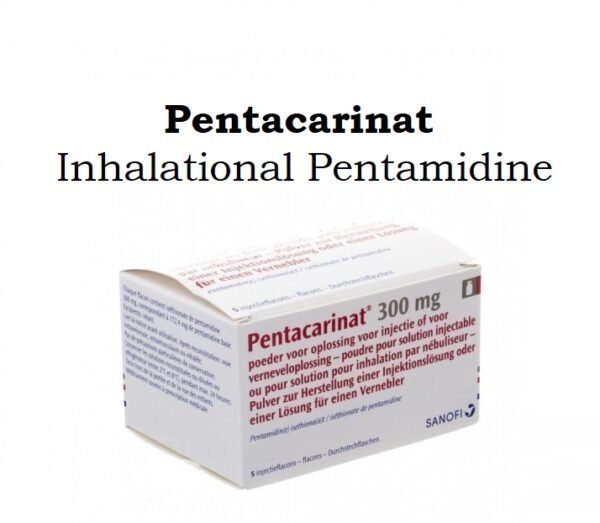
Pentacarinat (Inhalational Pentamidine) 300 mg powder is an antiprotozoal medicine for oral inhalational use.
Pentacarinat (Inhalational Pentamidine) Uses:
- Prevention of Pneumocystis jirovecii pneumonia (PCP) in high-risk, HIV-infected patients either with a history of PCP or with a CD4+ count ≤200/mm3
Pentacarinat (Inhalational Pentamidine) Dose in Adults
Pentacarinat (Inhalational Pentamidine) Dose in the prevention of Pneumocystis jirovecii pneumonia (PCP):
-
Primary or secondary prophylaxis (alternative to preferred therapy):
- Inhalation: 300 mg once every 4 weeks via Respirgard II nebulizer.
Pentacarinat (Inhalational Pentamidine) Dose in Childrens
Pentacarinat (Inhalational Pentamidine) Dose in the Primary and Secondary prophylaxis of Pneumocystis jirovecii (PCP):
- Note: For patients intolerant to sulfamethoxazole and trimethoprim.
-
Children <5 years who are HSCT recipients:
- Inhalation: 9 mg/kg (maximum dose: 300 mg/dose) once monthly (every 4 weeks) via Respirgard II nebulizer.
-
Children ≥5 years and Adolescents; independent of HIV status:
- Inhalation: 300 mg once a month (every 4 weeks) via Respirgard II nebulizer.
Pregnancy Risk Factor C
- Aerosolized routes may not be safe for pregnant women.
- Limited information is available on fetal outcomes after maternal pentamidine use.
- Aerosolized administration of maternal serum results in lower maternal serum concentrations, which minimizes the risk to the fetus.
- The literature has discussed concerns about occupational exposure and the theoretical risk to pregnant healthcare workers. If possible, pregnant health care workers should avoid exposure to aerosols.
- For pregnant women with HIV infection, aerosolized pentamidine can be used as an alternative therapy to prevent Pneumocystis Jirovecii pneumonia.
Pentamidine use during breastfeeding:
- It is unknown if pentamidine can be found in breast milk.
- The manufacturer suggests that the mother decide whether to stop breastfeeding or discontinue using the drug.
- This is in consideration of the possibility of serious adverse reactions in breastfeeding infants.
- To reduce the risk of HIV transmission, pregnant women with HIV should stop breastfeeding.
Pentacarinat (Inhalational Pentamidine) Dose in Kidney Disease:
- There are no dosage adjustments provided in the drug manufacturer’s labeling (has not been studied). Use with caution.
Pentacarinat (Inhalational Pentamidine) Dose in Liver Disease:
- There are no dosage adjustments provided in the drug manufacturer’s labeling (has not been studied). Use with caution.
Common Side Effects of Pentacarinat (Inhalational Pentamidine):
-
Central Nervous System:
- Fatigue
- Dizziness
-
Gastrointestinal:
- Decreased Appetite
-
Infection:
- Infection
-
Respiratory:
- Cough
- Dyspnea
- Wheezing
- Bronchospasm
-
Miscellaneous:
- Fever
Less Common Side Effects Of Pentacarinat (Inhalational Pentamidine):
-
Cardiovascular:
- Chest Pain
-
Central Nervous System:
- Headache
-
Dermatologic:
- Night Sweats
-
Gastrointestinal:
- Diarrhea
- Dysgeusia
- Nausea
- Oral Candidiasis
-
Hematologic & Oncologic:
- Anemia
-
Infection:
- Herpes Virus Infection
- Herpes Zoster
- Influenza
-
Respiratory:
- Pharyngitis
- Bronchitis
- Sinusitis
- Upper Respiratory Tract Infection
-
Miscellaneous:
- Night Sweats
Contraindications to Pentacarinat (Inhalational Pentamidine):
- Hypersensitivity to pentamidine Isethionate and any component of the formulation
Warnings and precautions
-
Asthma
- Patients with asthma should be cautious when using inhalation formulas.
- This condition can cause bronchospasm and cough in those with asthma or who smoke.
- An inhaled bronchodilator before pentamidine could help to alleviate symptoms.
-
Pancreatitis
- Patients with a history or elevated levels of amylase/lipase should be cautious.
- Reports of acute pancreatitis with fatalities have been made.
- If you experience signs or symptoms of acute pancreatitis, discontinue inhalational pentamidine.
-
PCP
- Acute PCP may develop despite aerosolized pentamidine prophylaxis.
- Extrapulmonary PCP may occur, although it is rare. It has been linked to aerosolized pentamidine.
- Take appropriate precautions to avoid exposure to healthcare personnel. Refer to the individual institution policy.
Pentamidine (oral inhalation): Drug Interaction
|
BCG Vaccine (Immunization) |
Antibiotics may diminish the therapeutic effect of BCG Vaccine (Immunization). |
|
Sodium Picosulfate |
Antibiotics may diminish the therapeutic effect of Sodium Picosulfate. Management: Consider using an alternative product for bowel cleansing prior to a colonoscopy in patients who have recently used or are concurrently using an antibiotic. |
|
Typhoid Vaccine |
Antibiotics may diminish the therapeutic effect of Typhoid Vaccine. Only the live attenuated Ty21a strain is affected. Management: Vaccination with live attenuated typhoid vaccine (Ty21a) should be avoided in patients being treated with systemic antibacterial agents. Use of this vaccine should be postponed until at least 3 days after cessation of antibacterial agents. |
|
BCG (Intravesical) |
Antibiotics may diminish the therapeutic effect of BCG (Intravesical). |
|
Cholera Vaccine: |
Antibiotics may diminish the therapeutic effect of Cholera Vaccine. Management: Avoid cholera vaccine in patients receiving systemic antibiotics, and within 14 days following the use of oral or parenteral antibiotics. |
Monitoring Parameters:
- Liver function tests,
- renal function tests,
- blood glucose,
- serum potassium and calcium,
- CBC and platelets
How to administer Pentacarinat (Inhalational Pentamidine)?
- Inhalation:
- Deliver via Respirgard II nebulizer until the nebulizer is emptied (30-45 minutes).
- Administer at a flow rate of 5 to 7 L/minute from a 40 to 50 pound-per-square inch (PSI) oxygen or air source.
- A 4050 PSI air compressor can be used alternatively, with a set flow rate at 5 to 7 L/minute or a set pressure of 22 to 25 PSI.
- Air compressors <20 PSI should not be used.
- Use appropriate precautions to minimize exposure to healthcare personnel; refer to individual institutional policy.
Mechanism of action of Pentacarinat (Inhalational Pentamidine):
- Interferes in microbial DNA/DNA, phospholipids, and protein synthesis through inhibition of oxidativephosphorylation, and/or interference at the incorporation nucleotides or nucleic acids into DNA and RNA
Absorption:
- Inhalation: There is limited systemic absorption in chronic therapy. Potential accumulation and systemic effects are unknown.
Distribution:
- It binds to plasma proteins and tissues; high levels are found in the liver and kidneys, adrenals and spleens, lungs and pancreas. CNS penetration is poor.
- High concentrations of bronchoalveolar liquid are produced after oral inhalation
Half-life elimination:
- IV: 5 to 8 hours;
- IM: 7 to 11 hours;
- may be prolonged with severe renal impairment
International Brands of Inhalational Pentamidine:
- Nebupent
- Pentacarinat
Pentamidine Brands Names in Pakistan:
No Brands Available in Pakistan.
.png)


