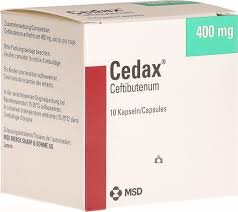
Cedax (Ceftibuten) is an orally administered third-generation cephalosporin that is used to treat the following conditions:
- Treatment of mild to moderate acute exacerbations of chronic bronchitis caused by:
- Haemophilus influenzae
- Moraxella catarrhalis (less efficacious)
- Streptococcus pneumoniae.
- Treatment of mild to moderate Acute bacterial otitis media caused by:
- H. influenzae
- M. catarrhalis
- Streptococcus pyogenes.
- It is less efficacious in strep. pneumoniae
- Treatment of mild to moderate Pharyngitis and tonsillitis caused by:
- S. pyogenes.
Ceftibuten Dose in Adults
Note: All ceftibuten formulations have been discontinued for more than 1 year in the United states.
- Use in treatment of Acute bacterial exacerbations of chronic bronchitis:
- 400 mg orally once a day for 10 days.
- Use in treatment of Acute bacterial otitis media:
- 400 mg orally once a day for 10 days.
- Use in treatment of Pharyngitis and tonsillitis:
- 400 mg orally once a day for 10 days.
Ceftibuten Dose in Childrens
Note: All ceftibuten formulations have been discontinued for more than 1 year in the United states.
General dosing of Cedax (ceftibuten) in mild to moderate infections:
- Infants, Children, and Adolescents:
- 9 mg/kg/dose orally once a day to a maximum dose of 400 mg/dose
Use of cedax in the treatmnet of acute bacterial exacerbations of Chronic Bronchitis:
- Children older than 12 years of age and Adolescents:
- 400 mg orally once a day for 10 days
Use of cedax in the treatment of acute Otitis media:
Note: the AAP guidelines do not recommend Ceftibuten for the treatment of acute otitis media.
- Infants older than 6 months and Children less than 12 years of age:
- 9 mg/kg/dose orally once a day for 10 days to a maximum dose of 400 mg/dose
- Children older than 12 years of age and Adolescents:
- 400 mg orally once a day for 10 days
Use of cedax in the treatment of Pharyngitis and tonsillitis:
Note: The IDSA guidelines 2012 do not recommend Ceftibuten as a treatment option for pharyngitis and tonsillitis
- Infants older than 6 months and Children less than 12 years of age:
- 9 mg/kg/dose orally once a day for 10 days to a maximum dose of 400 mg/dose
- Children older than 12 years and Adolescents:
- 400 mg orally once a day for 10 days
Pregnancy Risk Factor B
- Cedax is safe to use during pregnancy, as no adverse fetal outcomes were observed.
Ceftibuten use during breastfeeding:
- Ceftibuten can be excreted in small amounts in breastmilk. However, nursing mothers should still be cautious.
Ceftibuten Dose in Renal Disease:
- CrCl ≥50 mL//minute: Dosage adjustment is not required
- CrCl 30 to 49 mL//minute: 4.5 mg/kg or 200 mg once a day
- CrCl 5 to 29 mL/minute: 2.25 mg/kg or 100 mg once a day
- End-stage renal disease (ESRD) on intermittent hemodialysis (IHD) twice or thrice weekly:
- administer 400 mg or 9 mg/kg/dose to a maximum dose of 400 mg/dose after each hemodialysis session
Ceftibuten Dose in Liver Disease:
The manufacturer has not recommended any dose adjustment in patients with liver disease.
Common Side Effects Of Ceftibuten Include:
- Central nervous system:
- Headache
- Dizziness
- Gastrointestinal:
- Nausea
- Diarrhea
- Dyspepsia
- Loose stools
- Abdominal pain
- Vomiting
- Hematologic & oncologic:
- Eosinophilia
- Decreased hemoglobin
- Change in platelet count
- Hepatic:
- Increased serum ALT
- Increased serum bilirubin
- Renal:
- Increased blood urea nitrogen
Contraindication to Cedax (Ceftibuten) include:
Hypersensitivity to ceftibuten or other cephalosporins or any component of this formulation
Warnings and Precautions
- Penicillin allergy
- Ceftibuten should be used with caution for patients with IgE-mediated reactions such as anaphylactic reactions and angioedema.
- Superinfection
- Cefotaxime treatment for longer periods (over 2 months) can lead to superinfections, including fungal or bacterial superinfections. C. difficile-associated diarrhea, (CDAD), and pseudomembranous collitis can occur.
- Colitis
- Patients who have had colitis in the past should be cautious when taking this drug.
- Renal impairment
- Patients with kidney disease must be cautious when using the drug. The dose should also be adjusted.
Ceftibuten: Drug Interaction
Note: Drug Interaction Categories:
- Risk Factor C: Monitor When Using Combination
- Risk Factor D: Consider Treatment Modification
- Risk Factor X: Avoid Concomitant Use
Risk Factor C (Monitor therapy). |
|
| Aminoglycosides | Cephalosporins (3rd generation) can increase the nephrotoxic effects of Aminoglycosides. |
| BCG Vaccine (Immunization) | Antibiotics can decrease the therapeutic effects of BCG Vaccine (Immunization). |
| Lactobacillus & Estriol | Antibiotics can reduce the therapeutic effects of Lactobacillus or Estriol. |
| Probenecid | May increase serum Cephalosporins. |
| Vitamin K antagonists (eg warfarin) | Cephalosporins can increase the anticoagulant effects of Vitamin K Antagonists. |
Risk Factor D (Consider therapy modifications) |
|
| Multivitamins/Minerals (with ADEK, Folate, Iron) | Could lower the serum level of Ceftibuten. Zinc in multivitamins can decrease ceftibuten asorption. Management: Take oral zinc-containing multivitamins at the least three hours after ceftibuten. |
| Multivitamins/Minerals (with AE, No Iron) | Could lower the serum level of Ceftibuten. Zinc in multivitamins can decrease ceftibuten asorption. Management: Take oral zinc-containing multivitamins at the least three hours after ceftibuten. |
| Sodium Picosulfate | Antibiotics can reduce the therapeutic effects of Sodium Picosulfate. Patients who are currently using or have just finished using antibiotics should consider using an alternative product to cleanse the bowel before undergoing a colonoscopy. |
| Typhoid Vaccine | The therapeutic effects of Typhoid vaccine may be diminished by antibiotics. The only affected strain is the live attenuated Ty21a. Patients being treated with systemic antibiotics should avoid vaccination with live attenuated Typhoid vaccine (Ty21a). This vaccine should not be used until at least three days after the cessation or discontinuation of antibacterial agent treatment. |
| Zinc Salts | This may cause a decrease in serum Ceftibuten. Management: Oral zinc salts should be administered at least three hours after Ceftibuten. Exceptions: Zinc Chloride. |
Risk Factor X (Avoid Combination) |
|
| BCG (Intravesical). | The therapeutic effects of BCG (Intravesical) may be diminished by antibiotics |
| Cholera Vaccine | Cholera Vaccine may be less effective if taken with antibiotics. Treatment: Cholera vaccine should be avoided in patients who have received systemic antibiotics. |
Monitor:
- Renal functions,
- Hepatic functions, and
- Blood CBC periodically with prolonged therapy.
- Observe the patient for signs and symptoms of anaphylaxis after administering the first dose of cedax
How to take Cedax (Ceftibuten)?
- Administer the capsule without regard to meals.
- Administer the suspension at least 2 hours prior or one hour after meals. Shake the suspension before use.
Mechanism of action of Ceftibuten:
Cefotaxime blocks the formation of bacterial proteins, peptidoglycans and penicillin-binding proteins. This eventually leads to cell lysis through the use of autolytic enzymes. It is quickly absorbed and distributedIn the middle ear fluid, bronchial secretions and sputum. The drug accounts for 65%.Protein-boundWith abioavailabilitybetween 75% and 90%, and ahalf-life eliminationChildren: 2 hours, adults: 2.4 hours. Patients with blood pressures between 30 and 49 ml/min can be seen for a further 7.1 hours. Patients with CrCls of 5 to 29 ml//min will take 13.4 hours, while patients with CrCls of 5 to 29 ml//min take 22.3 hours. Patients with CrCls of 5 – 5 ml/min require 22.3 hours. Peak serum concentration can be reached in 2 to 2.6 hours. 56% of drug is excreted through the urine, while 39% are excreted via the feces.
International Brands of Ceftibuten:
- Butibac
- Caedax
- Cedax
- Ceditax
- Cefaten
- Ceftem
- Idispectra
- Keimax
- Oditen
- Procadex
- Seftem
- Sepex
- Shatbiotic
- Theradicate
Ceftibuten Brands in Pakistan:
|
Ceftibuten [Susp 90 mg/5ml] |
|
| XIGRIS | WILSHIRE LABORATORIES (PVT) LTD. |
|
Ceftibuten [Caps 400 mg] |
|
| XIGRIS | WILSHIRE LABORATORIES (PVT) LTD. |
[/bg_collapse]
.png)